
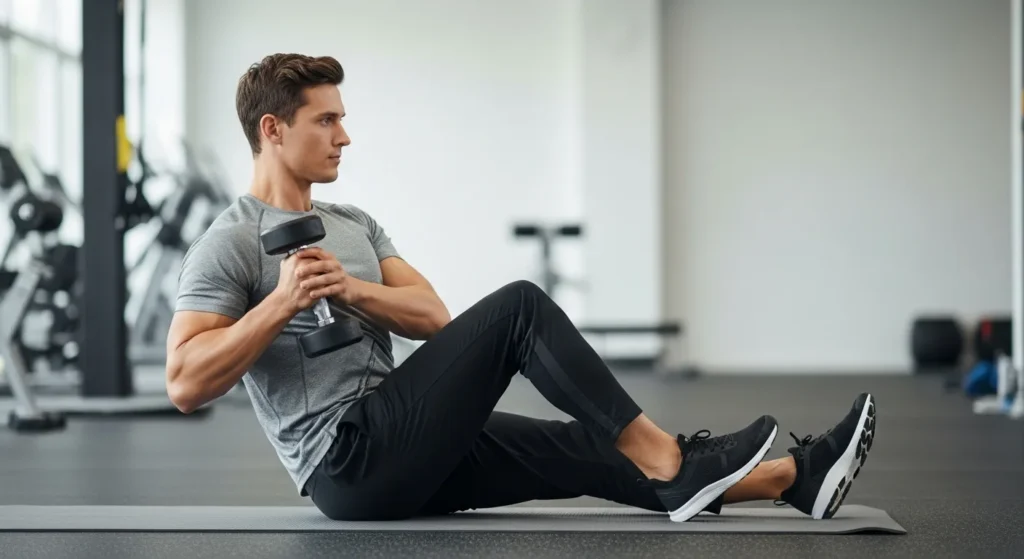
If you want a stronger, more functional core that doesn’t just look good but also performs in real-life movement, dumbbell Russian twists are one of the most effective rotational exercises you can add to your training routine.
What Are Dumbbell Russian Twists?
The Russian twist is a seated core exercise that involves rotating your torso side to side while maintaining a stable, slightly leaned-back position. When you add a dumbbell, the movement becomes a weighted rotational core exercise that significantly increases resistance and muscle activation.
In exercise science, this movement is often classified as a rotational core stability exercise, targeting both movement and anti-movement control of the trunk.
Russian Twist with a dumbbell increases intensity by forcing your obliques and deep core stabilizers to control the added load during rotation.
Muscles Worked in Dumbbell Russian Twists
One of the biggest advantages of this exercise is its multi-muscle engagement.
Primary muscles:
- Internal and external obliques
- Rectus abdominis (front abs)
Secondary muscles:
- Transverse abdominis (deep core stabilizer)
- Hip flexors
- Erector spinae (lower back stabilizers)
- Shoulders (for holding the weight)
According to exercise research, rotational movements like this engage multiple layers of the core rather than just surface ab muscles, making them highly functional for athletic performance and everyday movement patterns.
Benefits of Dumbbell Russian Twists
1. Stronger Obliques and Core Definition
The twisting motion directly targets the obliques, which are responsible for rotational strength and waist stability.
2. Improved Functional Strength
Unlike crunches, this exercise trains your core in a real-world movement pattern—rotation, similar to sports, lifting, or even daily activities.
3. Better Balance and Stability
Because you’re balancing while holding a weight, your deep stabilizers must constantly work to prevent tipping.
4. Enhanced Athletic Performance
Rotational strength is essential in sports like cricket, football, tennis, and martial arts.
5. Time-Efficient Core Workout
One exercise targets multiple muscle groups at once, making it ideal for quick workouts.
How to Do Dumbbell Russian Twists (Step-by-Step Guide)
Step 1: Starting Position
- Sit on a mat with knees bent
- Lean back slightly (about 45 degrees)
- Keep your spine straight and chest open
- Lift your feet slightly off the ground (optional for beginners keep feet down)
Step 2: Hold the Dumbbell
- Grip one dumbbell with both hands
- Hold it close to your chest or slightly extended forward
Step 3: Engage Your Core
- Tighten your abs before starting
- Avoid rounding your lower back
Step 4: Begin the Twist
- Rotate your torso to the right
- Bring the dumbbell toward your hip or side
- Return to center
- Rotate to the left
Step 5: Controlled Reps
- Move slowly and deliberately
- Avoid using momentum
- Focus on squeezing your obliques
Proper Form Tips (Very Important)
Good technique determines whether this exercise is effective or risky.
Keep in mind:
- Movement should come from the torso, not arms
- Keep your spine neutral (no rounding)
- Don’t lean too far back
- Rotate under control, not speed
Experts emphasize that over-rotation or using momentum can shift stress to the lower back instead of the core.
Common Mistakes to Avoid
1. Using Momentum
Swinging the dumbbell reduces muscle activation and increases injury risk.
2. Rounding the Lower Back
This removes core engagement and stresses the spine.
3. Twisting Too Far
Your thoracic spine (upper back) should rotate—not your lower spine.
4. Going Too Heavy Too Soon
Excess weight leads to poor form and reduces effectiveness.
5. Dropping Feet Without Control
If your feet are lifted, avoid losing balance or collapsing posture.
Dumbbell Russian Twist Variations
Beginner Variation
- Keep feet on the ground
- No weight or light dumbbell
- Slower tempo
Standard Variation
- Feet slightly lifted
- Moderate dumbbell
- Controlled rotation
Advanced Variation
- Heavier dumbbell or plate
- Full V-sit position
- Slower tempo with pause at each side
Decline Bench Twist
Performed on a decline bench for increased difficulty and range of motion.
Programming Guide (Sets, Reps & Frequency)
For beginners:
- 2–3 sets
- 10–12 reps per side
- 2–3 times per week
For intermediate:
- 3–4 sets
- 12–16 reps per side
For advanced:
- 4 sets
- 15–20 reps per side
- Add heavier resistance or slower tempo
Safety Tips for Dumbbell Russian Twists
While effective, this exercise must be performed carefully.
- Stop if you feel lower back pain
- Avoid excessive spinal rotation
- Keep core braced throughout movement
- Use lighter weight if form breaks
- Warm up your core before training
Many experts recommend focusing on controlled movement rather than range of motion to reduce spinal stress.
Dumbbell Russian Twists vs Other Core Exercises
| Exercise | Focus | Difficulty | Core Activation |
|---|---|---|---|
| Russian Twists | Obliques + rotation | Medium | High |
| Plank | Stability | Medium | High |
| Crunches | Upper abs | Easy | Medium |
| Leg Raises | Lower abs | Medium | High |
Who Should Do Dumbbell Russian Twists?
This exercise is ideal for:
- Athletes needing rotational strength
- People aiming for waist definition
- Beginners learning core control
- Anyone doing full-body workouts
However, it may not be ideal for:
- People with lower back injuries
- Beginners with weak core stability (start without weight first)
Expert Insight: Why Rotation Training Matters
Most daily movements—throwing, twisting, reaching—are rotational. That’s why training rotation improves not just aesthetics but also injury prevention and performance.
Dumbbell Russian twists train your body to resist and control rotational forces, making your core stronger in real-world conditions.
Frequently Asked Questions (FAQs)
Are dumbbell Russian twists effective?
Yes, they effectively target the obliques and deep core stabilizers while improving rotational strength.
Can beginners do Russian twists?
Yes, but beginners should start without weight and keep feet on the ground.
Do Russian twists reduce belly fat?
They strengthen muscles but fat loss depends on overall calorie deficit and training.
How heavy should my dumbbell be?
Start light (2–5 kg) and increase only when form is perfect.
Are Russian twists bad for your back?
Not if done correctly. Poor form, heavy weights, or fast movements can cause strain.
How many reps should I do?
10–20 reps per side depending on fitness level.
Should I keep my feet up?
Feet-up increases difficulty, but beginners can keep them on the floor.
What’s better: Russian twists or planks?
Both are useful—planks build stability, Russian twists build rotation strength.
Can I do them every day?
2–3 times per week is enough for recovery and growth.
Do I need equipment?
A dumbbell is optional; bodyweight version is also effective.
You can also follow “How to Do Dumbbell Thrusters” for dumbbell workouts, and fitness tips to help you get better results.