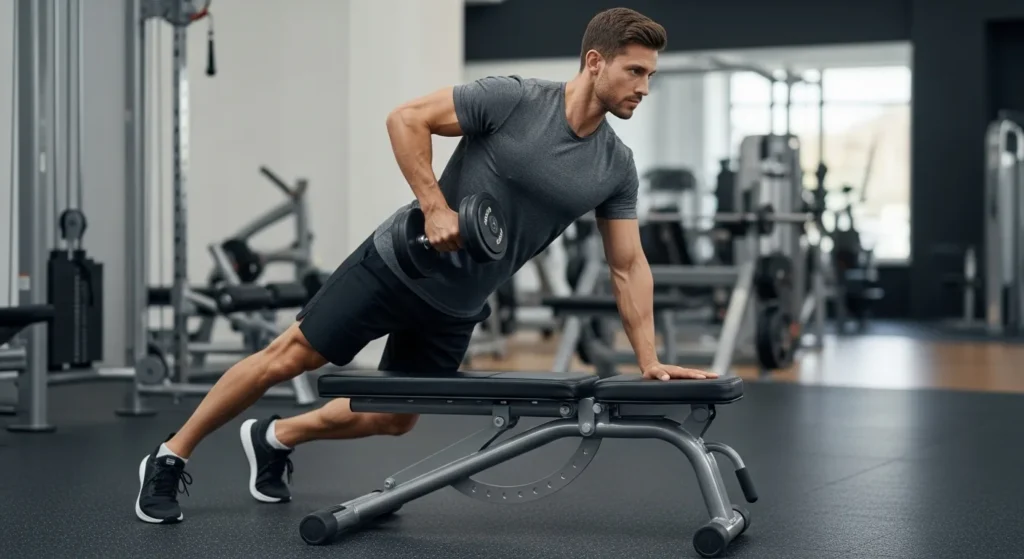
If you want to build a stronger, thicker back, improve posture, correct muscle imbalances, and boost total upper‑body strength without a ton of equipment, then mastering how to do dumbbell rows is essential.
The dumbbell row is a foundational compound back exercise. One that’s easy to learn, hard to master, and delivers serious results when performed with proper form.
What Is a Dumbbell Row?
A dumbbell row is a strength training exercise where you pull a dumbbell toward your torso while hinging forward at the hips. It emphasizes the muscles of the upper and middle back through a horizontal pulling motion.
Also called a single‑arm row, a bent‑over dumbbell row, or a one‑arm dumbbell row, this movement is essential because it strengthens back, shoulder, arm, and postural muscles with a single free weight.
Most lifters perform the row with one arm at a time while using the other arm to stabilize on a bench or support surface. Variations exist for beginners, intermediate lifters, and advanced athletes.
Why Dumbbell Rows Matter (Benefits)
When programmed correctly, dumbbell rows offer multiple advantages beyond just muscular development:
1. Strengthen Upper and Middle Back
Dumbbell rows target several back muscles that are often underdeveloped in people who focus too much on push movements (like bench press), helping balance strength and posture.
2. Improve Posture and Reduce Back Pain
Because the row emphasizes shoulder retraction and spinal stability, it can help counteract rounding of the shoulders and forward head posture—common issues for desk workers or frequent smartphone users.
3. Enhance Pulling Strength
Row strength translates into better performance in vertical pulling exercises like pull‑ups and lat pulldowns.
4. Unilateral Training Corrects Imbalances
Training one side at a time ensures that the weaker side doesn’t get overshadowed by a dominant one—a key benefit for symmetry and strength balance.
5. Low Equipment, High Reward
All you need is a pair of dumbbells and either a bench or stable surface, making this exercise ideal for gym and at‑home workouts.
Muscles Worked: What Dumbbell Rows Target
Understanding which muscles are engaged helps you optimize your technique and programming.
Primary Muscles
- Latissimus Dorsi (Lats) – Major back muscle extending down the sides of your mid‑back.
- Trapezius (Traps) – Upper back and neck muscles that stabilize the shoulder blades.
- Rhomboids – Connect shoulder blades to the spine and help with scapular retraction.
- Posterior Deltoids – Rear shoulder muscles assisting in pulling.
Secondary Muscles
- Biceps – Assisted pulling muscles in the arm.
- Forearm Flexors – Grip and forearm strength contribute to rowing.
- Rotator Cuff Muscles – Stabilize the shoulder joint during the movement.
How to Do Dumbbell Rows: Step‑by‑Step Form Guide
Follow these steps to master the proper technique for dumbbell rows and get the most out of every rep.
Setup
- Choose your dumbbell – Start lighter to dial in your form and increase weight gradually as you master technique.
- Find a bench or support surface – A flat bench, chair, or sturdy rack works.
- Position yourself – Place one hand and knee on the bench for support; the opposite foot stays planted firmly on the floor.
Execution
- Hinge at the hips – Bend forward so your upper body is almost parallel to the floor. Keep your back flat and core braced.
- Grip the dumbbell – Hold with a neutral grip (palm facing inward).
- Initiate the row – Pull the dumbbell toward your ribcage by driving your elbow up and back. Lead with the elbow rather than the hand or wrist.
- Squeeze at the top – Pause briefly when the dumbbell is close to your torso to maximize muscle contraction.
- Lower with control – Resist gravity as the weight returns to the starting position. Avoid letting it simply drop.
Breathing
- Inhale before the pull.
- Exhale as you pull and squeeze the back muscles. If holding breath creates pressure and helps core stability (with no contraindications), some trainers recommend exhaling at the top.
Common Dumbbell Row Mistakes (And Fixes)
Even small errors in form can limit results or increase injury risk. Here’s what to watch for and how to fix it.
1. Arching or Rounding the Lower Back
Mistake: Your lower back sagging or arching shifts load to the spine and away from the back muscles.
Fix: Brace your core like you’re about to get punched in the stomach. Keep a neutral spine throughout.
2. Not Aligning the Neck With the Spine
Mistake: Looking up or forward excessively creates neck strain and reduces efficiency.
Fix: Keep a neutral head position by looking a foot or so in front of your support hand.
3. Using Momentum Instead of Muscle
Mistake: Swinging the dumbbell with the torso or jerk motions turns the row into a cheat movement.
Fix: Slow down the tempo—think “pull and control.” Spend 2–3 seconds in the pulling phase and 1–2 seconds lowering.
4. Too Upright Upper Body
Mistake: Not bending enough reduces back activation.
Fix: Hinge more at the hips so the torso is closer to horizontal for a fuller range of motion.
5. Too Heavy Weights Too Soon
Mistake: Going heavy before mastering form leads to technique breakdown and risks injury.
Fix: Use a weight that allows control for the entire set; increase only when form stays perfect.
Dumbbell Row Variations You Should Know
To progress strength, target slightly different muscle emphases, or match your training goals, try these variations:
Standard Single‑Arm Dumbbell Row
Most common and excellent for beginners through advanced lifters. Performed with bench support or free‑standing with staggered stance.
Dumbbell Renegade Rows
Performed in a plank position holding dumbbells—this version also engages the core intensely and improves stability.
Chest‑Supported Dumbbell Row
Lying chest‑down on an incline bench reduces strain on the lower back and isolates the upper back more—a good progression or alternative.
Two‑Arm Bent‑Over Dumbbell Row
Hold a dumbbell in each hand with feet hip‑width apart and hinge forward to row both simultaneously. This variation increases the demand on the spinal stabilizers.
Tempo Variations
- Slow negative (eccentric) – Increases time under tension and hypertrophy stimulus.
- Pause at the top – Enhances muscle contraction awareness and recruitment.
How Many Reps and Sets for Dumbbell Rows?
Your programming depends on your goals:
| Goal | Sets | Reps | Notes |
|---|---|---|---|
| Strength | 3–5 | 3–6 | Heavier weights, longer rest |
| Muscle Hypertrophy | 3–4 | 8–12 | Moderate weight with controlled tempo |
| Endurance & Conditioning | 2–3 | 12–20 | Lighter load, shorter rest |
| Posture & Rehab | 2–3 | 10–15 | Focus on technique and shoulder retraction |
As a general recommendation, include dumbbell rows 1–3 times per week, depending on your split and recovery.
Sample Dumbbell Row Workout for Back Day
Here’s a balanced session incorporating dumbbell rows:
- Warm‑up: Shoulder circles, band pull‑aparts, light rows (5–8 min)
- Dumbbell Rows: 4 sets × 8–12 reps each side
- Lat Pulldowns or Pull‑ups: 3 sets × 6–10 reps
- Face Pulls: 3 sets × 12–15 reps
- Rear Delt Flyes: 3 sets × 10–15 reps
- Cool‑down: Stretch and mobility work (5–10 min)
Frequently Asked Questions (FAQs)
How do I know I’m doing dumbbell rows correctly?
Check:
- Neutral spine
- Rowing with elbow leading
- Controlled movement
- Feeling tension in the back, not just the arms
Use a mirror or record yourself for feedback.
Should I pull to my hip or chest?
Pulling to the hip emphasizes lats more, while pulling slightly higher engages traps and upper back. Vary between them based on your goals.
Can dumbbell rows help improve posture?
Yes. They strengthen the upper back muscles that counteract forward rounding caused by sitting and poor ergonomics.
What weight should I start with?
Choose a weight you can control through all reps without breaking form. Progress when you can complete your target reps with confidence.
Are dumbbell rows better than barbell rows?
Both have benefits. Dumbbell rows offer unilateral training and often less strain on the lower back, while barbell rows allow heavier loading.
Conclusion
How to do dumbbell rows isn’t just about pulling a dumbbell; it’s about engaging your back muscles with purpose, precision, and progressive overload. When executed with proper form and consistency, dumbbell rows will help you build a balanced, strong posterior chain, improve posture, and enhance performance in other lifts.
Remember:
- Prioritize technique over load
- Warm up and brace the core
- Minimize common mistakes
- Incorporate variations to stimulate growth
Whether you’re a beginner or a seasoned lifter, understanding and applying these principles transforms dumbbell rows into a cornerstone of your strength training routine.