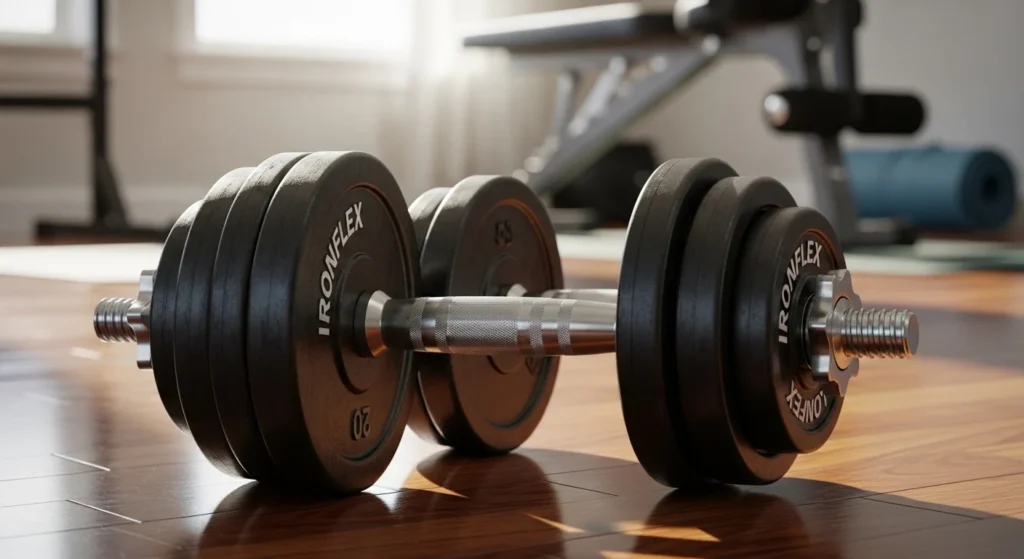
When someone asks “what are dumbbells?”, most people think of simple handheld weights. But dumbbells are so much more than just “weights you lift.” They are a cornerstone of effective strength training, used by fitness enthusiasts, athletes, rehab clients, and everyday people looking to improve health and function. Unlike machines or fixed pulleys, dumbbells allow natural movement patterns, improved muscle activation, and unmatched versatility.
Definition: What Are Dumbbells?
Dumbbells are a type of handheld free weight used for strength training and resistance exercise. Typically, a dumbbell consists of a short bar with weight on either end. They can be used individually (one in each hand) or in pairs and come in a wide range of weights suitable for all fitness levels.
Unlike fixed machines that constrain movement, dumbbells move naturally with your body, allowing you to train muscles through their full range of motion and engage stabilizer muscles more effectively. They are core tools for building strength, muscle mass, endurance, and functional fitness.
The History of Dumbbells
Dumbbells have a surprisingly rich history that spans centuries and continents:
- Ancient Greeks used early free weights called halteres—stone weights for long jump training and strength conditioning.
- In India, variations like the “Meel” weighted club were used by wrestlers and warriors as early strength tools.
- The modern term “dumbbell” emerged in 18th‑century England, originally referring to silent bell mechanisms used to practice bell‑ringing without sound—hence “dumb.”
- Over time, that name was adopted for handheld weights that mimicked the silent bell tools.
Today’s dumbbells are refined products suitable for home and commercial gyms, with variations built for convenience, space savings, and progressive training.
Anatomy of a Dumbbell
Understanding the parts of a dumbbell helps you select and use them wisely:
- Handles – The gripping area, often textured (knurled) for secure grip.
- Weight Ends – Discs or blocks at each end, which may be fixed or adjustable.
- Collars / Pins (on adjustable models) – Secure the plates in place.
Dumbbells can vary vastly in material—from cast iron and rubber‑coated metal to high‑tech selectorized mechanisms that adjust the weight with a dial.
Types of Dumbbells
Dumbbells aren’t one‑size‑fits‑all. Knowing the different types helps you choose what fits your goals and space:
Fixed‑Weight Dumbbells
These are classic hand weights with a preset weight. They are sturdy and low maintenance, commonly found in gyms and home racks.
Pros:
- Durable and simple
- No setup required
- Ideal for circuit and high‑rep workouts
Cons:
- Require more space if you need multiple weights
Adjustable Dumbbells
These allow you to add or remove weight plates on a bar using collars, offering a customizable setup that’s more cost‑effective for home users.
Pros:
- One pair replaces many fixed weights
- Saves space
Cons: - Takes time to adjust plates
Selectorized Dumbbells
Premium models (e.g., dial‑adjust or pin system) enable quick weight changes without manually adding plates.
Pros:
- Convenient and fast adjustment
- Great for superset workouts
Cons: - Generally more expensive
Benefits of Dumbbell Training
Why should you use dumbbells? The benefits go well beyond muscle building:
1. Build Muscle Strength & Size
Dumbbells provide progressive resistance that challenges muscles—leading to strength gains and muscle hypertrophy when used consistently. This process forces muscles to adapt and grow.
2. Improves Stability & Core Engagement
Free weights are naturally unstable, which means your body must recruit stabilizer muscles (especially core muscles) during lifts. This improves balance and body control.
3. Corrects Muscle Imbalances
Because each side of your body works independently with dumbbells, weaker muscles cannot hide behind stronger ones like they can with machines or barbells. This leads to balanced development and reduced injury risk.
4. Versatile & Functional Training
Dumbbells let you train every major muscle group—from chest and back to legs and shoulders. They support compound movements (like squats and lunges) and isolation exercises (like bicep curls), enhancing real‑world strength.
5. Accessible & Beginner‑Friendly
New lifters can start with light dumbbells and gradually increase weight as strength improves, making them excellent for all fitness levels. They are also safer to drop than barbells in failure situations.
Dumbbells vs Other Strength Tools
To fully understand what dumbbells are, it helps to compare them to other equipment.
Dumbbells vs Barbells
Both are free weights, but:
- Dumbbells allow independent limb movement and greater range of motion.
- Barbells let you lift heavier loads, but with less stabilization demand.
Dumbbells are often better for correcting imbalances, while barbells are more efficient for maximum strength phases.
Dumbbells vs Machines
- Machines guide the movement path, reducing stabilization demand.
- Dumbbells require your body to stabilize the weight, engaging more muscles overall.
This makes dumbbells superior for functional strength and natural movement patterns.
Dumbbells vs Kettlebells
Though both are handheld weights:
- Dumbbells have weight evenly placed on each side.
- Kettlebells have offset mass, promoting dynamic, momentum‑based movements.
Both have value, but dumbbells are often easier for beginners due to their stable design.
How to Use Dumbbells Effectively
Using dumbbells safely and effectively is critical for progress.
Warm‑Up & Safety Essentials
Before dumbbell workouts:
- Always warm up (5–10 minutes of light movement).
- Use a weight that lets you complete reps with proper form.
- Don’t rush progression—gradually increase weights.
Common Beginner Mistakes
Avoid:
- Using weights too heavy for your form
- Skipping rest days
- Ignoring muscle group balance
- Rushing through reps
Correct form ensures results and prevents injury.
Progression Strategies
To progress with dumbbells:
- Increase weight slowly
- Add sets or reps
- Try variations (e.g., tempo changes)
Consistent progression leads to continued gains.
Best Dumbbell Exercises by Muscle Group
Dumbbells can train every major muscle. Here are foundational exercises:
Chest
- Dumbbell Bench Press
- Dumbbell Fly
Back
- Bent‑Over Dumbbell Row
- Single‑Arm Row
Shoulders
- Dumbbell Shoulder Press
- Lateral Raises
Arms
- Bicep Curls
- Triceps Extensions
Legs & Glutes
- Goblet Squat
- Dumbbell Lunges
Each exercise targets different muscle groups while activating stabilizers and core muscles—making dumbbell training extremely efficient.
Dumbbell Training for Every Goal
Whether your goal is strength, muscle gain, fat loss, or everyday function, dumbbells can be tailored effectively:
- Strength Focus: Lower reps (4–6) with heavier weights
- Hypertrophy (Muscle Growth): Moderate reps (8–12)
- Endurance: Higher reps (12+) with lighter weights
- Fat Loss & Conditioning: Circuit training with dumbbells
How to Select the Right Dumbbells
When choosing dumbbells, consider:
- Your strength level
- Available space
- Budget
- Training goals
For home use, adjustable or selectorized dumbbells give the most flexibility in a small package. For gym setups, fixed or hex dumbbells offer durability and convenience.
FAQs
What are dumbbells used for?
Dumbbells are used for strength training, muscle building, endurance workouts, and functional fitness by providing resistance to challenge muscles.
How heavy should dumbbells be for beginners?
Beginners should start with weights that allow 10–15 quality reps without losing form, then gradually progress as strength improves.
Can dumbbells improve balance and coordination?
Yes. Dumbbell exercises engage stabilizer muscles and core control, improving balance and coordination.
Are dumbbells better than machines?
Dumbbells often offer greater range of motion and muscle activation compared to machines, which can be more restrictive.
Can dumbbells help with fat loss?
Yes. Dumbbell training increases muscle mass and metabolic rate, contributing to fat loss when combined with proper nutrition.
Are dumbbells suitable for all ages?
With proper guidance and appropriate weight selection, dumbbell training is safe and beneficial for most age groups.
How often should I train with dumbbells?
Training 2–4 times per week—targeting different muscle groups—is generally effective for most goals.
Can dumbbells help with rehabilitation?
Yes. Light dumbbells are often used in physical therapy to rebuild strength and improve joint mobility.
What’s better: fixed or adjustable dumbbells?
Fixed dumbbells are convenient and durable, while adjustable models save space and money. Choose based on your needs.
Do dumbbells build core strength?
Absolutely—most dumbbell exercises require core engagement for stability and control.