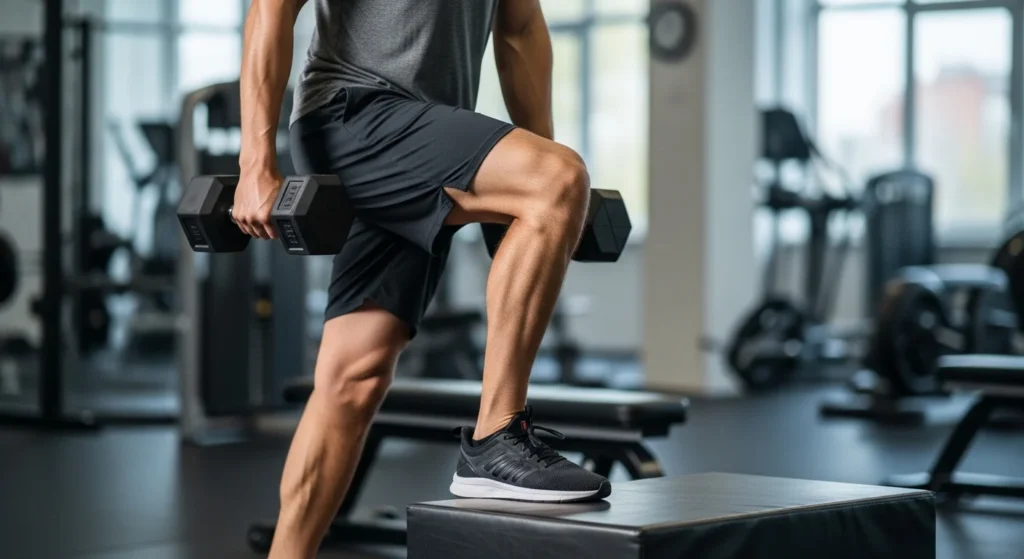
If you’re looking for a simple yet highly effective lower-body exercise, step ups with dumbbells deserve a permanent place in your routine. This underrated movement builds strength, improves balance, enhances athletic performance, and closely mimics real-life movements like climbing stairs or hiking uphill.
What Are Step Ups with Dumbbells?
Step ups with dumbbells are a unilateral (single-leg) exercise where you step onto an elevated surface—like a bench or box—while holding dumbbells in each hand.
The movement involves:
- Driving through your lead leg
- Lifting your body upward
- Controlling your descent back to the ground
Because each leg works independently, step ups help correct muscle imbalances and improve coordination.
Why Step Ups with Dumbbells Are So Effective
1. Functional Strength Development
Step ups replicate real-world movements such as:
- Climbing stairs
- Walking uphill
- Stepping onto elevated surfaces
This makes them highly practical for everyday strength and mobility.
2. Targets Major Lower Body Muscles
Dumbbell step ups primarily work:
- Quadriceps
- Glutes
- Hamstrings
- Calves
They also engage stabilizer muscles, including your core and hips.
3. Improves Balance and Stability
Since you’re working one leg at a time, your body must stabilize itself throughout the movement, improving:
- Coordination
- Joint stability
- Proprioception
4. Reduces Injury Risk
Unilateral exercises like step ups:
- Strengthen weaker sides
- Improve joint alignment
- Reduce strain on the lower back compared to bilateral lifts
5. Scalable for All Fitness Levels
Whether you’re a beginner or advanced lifter, you can adjust:
- Dumbbell weight
- Step height
- Tempo
Muscles Worked in Step Ups with Dumbbells
| Muscle Group | Role in the Exercise |
|---|---|
| Quadriceps | Primary driver during the step |
| Glutes | Power and hip extension |
| Hamstrings | Assist in lifting and control |
| Calves | Stabilization and push-off |
| Core | Balance and posture |
| Hip Stabilizers | Control and alignment |
How to Do Step Ups with Dumbbells (Proper Form)
Step-by-Step Instructions
- Set Up Your Platform
- Use a sturdy bench, box, or step
- Height should be around knee level or slightly lower
- Hold Dumbbells
- One in each hand
- Arms relaxed at your sides
- Position Yourself
- Stand tall with feet hip-width apart
- Engage your core
- Step Up
- Place one foot firmly on the platform
- Drive through your heel to lift your body upward
- Bring the Other Foot Up
- Either tap lightly or fully step onto the platform
- Step Down Slowly
- Lower yourself under control
- Return to starting position
- Repeat
- Complete reps on one leg or alternate
Key Form Tips for Maximum Results
- Keep your chest upright and shoulders back
- Drive through your heel, not your toes
- Avoid pushing off the trailing leg
- Control both the upward and downward phases
- Keep your knee aligned with your toes
Common Mistakes to Avoid
1. Using Momentum
Swinging your body reduces muscle engagement. Focus on controlled movement.
2. Pushing Off the Back Leg
This takes tension away from the working leg. Let your front leg do the work.
3. Choosing the Wrong Step Height
- Too high: increases injury risk
- Too low: reduces effectiveness
4. Leaning Forward Excessively
This shifts emphasis away from your legs and onto your lower back.
5. Letting the Knee Cave In
Keep your knee tracking over your toes to protect your joints.
Best Variations of Step Ups with Dumbbells
1. Alternating Step Ups
Switch legs with each rep to improve coordination and endurance.
2. High Knee Step Ups
Bring your trailing leg up into a knee drive at the top for added core engagement.
3. Lateral Step Ups
Step up from the side to target your glutes and hip stabilizers differently.
4. Deficit Step Ups
Stand on a lower platform before stepping up to increase range of motion.
5. Weighted Explosive Step Ups
Add speed and power for athletic training.
Step Ups vs Other Leg Exercises
| Exercise | Key Benefit | Limitation |
|---|---|---|
| Step Ups | Functional, unilateral strength | Requires balance |
| Squats | Builds overall mass | Less unilateral focus |
| Lunges | Great for coordination | Can stress knees |
| Leg Press | Controlled movement | Less functional |
How to Program Step Ups with Dumbbells
For Beginners
- 2–3 sets
- 8–10 reps per leg
- Light to moderate weight
For Muscle Growth (Hypertrophy)
- 3–4 sets
- 10–15 reps per leg
- Moderate weight
For Strength
- 4–5 sets
- 6–8 reps per leg
- Heavier dumbbells
For Endurance
- 2–3 sets
- 15–20 reps per leg
- Light weight
Where to Add Step Ups in Your Workout
You can include step ups with dumbbells in:
Leg Day
- After compound lifts like squats or deadlifts
Full-Body Workouts
- As a lower-body component
Conditioning Circuits
- Combine with cardio exercises for fat loss
Benefits for Different Fitness Goals
Fat Loss
Step ups elevate your heart rate and burn calories effectively.
Muscle Building
They provide enough resistance for hypertrophy, especially when loaded.
Athletic Performance
Improve explosiveness, coordination, and leg drive.
Rehabilitation
Often used in physical therapy to rebuild strength safely.
Step Ups for Home Workouts
One of the biggest advantages of dumbbell step ups is their simplicity.
All you need:
- A pair of dumbbells
- A sturdy surface (bench, chair, or step)
This makes them perfect for:
- Home gyms
- Small spaces
- Minimal equipment setups
Safety Tips
- Always use a stable surface
- Start with lighter weights
- Warm up properly
- Maintain proper form
- Stop if you feel pain (not to be confused with muscle fatigue)
Sample Dumbbell Leg Workout Including Step Ups
Workout Plan:
- Dumbbell Squats – 3 sets x 12 reps
- Step Ups with Dumbbells – 3 sets x 10 reps per leg
- Romanian Deadlifts – 3 sets x 10 reps
- Walking Lunges – 3 sets x 12 reps per leg
- Calf Raises – 3 sets x 15 reps
Advanced Tips to Maximize Gains
- Slow Tempo: Increase time under tension
- Pause at the Top: Improve balance and muscle activation
- Progressive Overload: Gradually increase weight or reps
- Mind-Muscle Connection: Focus on glute and quad engagement
FAQs
Are step ups with dumbbells good for beginners?
Yes. They are beginner-friendly and easy to modify based on fitness level.
What height should the step be?
Ideally, your knee should be at about a 90-degree angle when your foot is on the platform.
Can step ups replace squats?
They can complement squats but shouldn’t fully replace them for maximum strength development.
How heavy should my dumbbells be?
Start light and increase weight as your strength and form improve.
Do step ups build glutes?
Yes, especially when you focus on driving through your heel and controlling the movement.
How often should I do step ups?
2–3 times per week is effective for most people.
Are step ups bad for knees?
No, when done correctly, they can actually strengthen and protect your knees.
Should I alternate legs or do one side at a time?
Both are effective. Beginners may prefer alternating, while advanced users may train one side at a time.
You can also follow “Ab Workout with Dumbbells” for dumbbell workouts, and fitness tips to help you get better results.