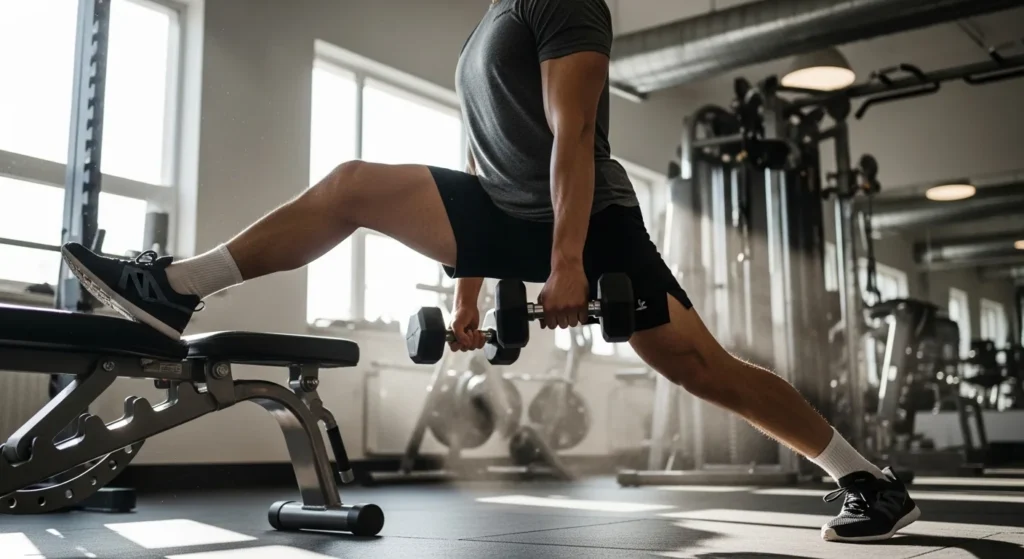
The bulgarian split squat is one of the most effective lower-body exercises you can add to your dumbbell workout routine. It builds strength, improves balance, corrects muscle imbalances, and targets your glutes and quads with unmatched intensity.
But here’s the truth: most people do it wrong.
Poor setup, bad balance, and incorrect posture can turn this powerhouse move into a knee-straining, ineffective exercise.
What Is a Bulgarian Split Squat?
The bulgarian split squat is a unilateral lower-body exercise where:
- One foot stays planted on the ground (working leg)
- The other foot is elevated behind you on a bench or platform
This creates a single-leg squat pattern that challenges your:
- Strength
- Balance
- Stability
- Mobility
Unlike traditional squats, it isolates each leg individually, making it ideal for fixing strength imbalances and improving athletic performance.
Muscles Worked in Bulgarian Split Squat
This compound movement targets multiple muscle groups simultaneously:
Primary Muscles
- Quadriceps (front thighs)
- Glutes (buttocks)
Secondary Muscles
- Hamstrings
- Calves
- Core (stabilization)
- Hip stabilizers
Because it’s a unilateral exercise, your core and stabilizing muscles work harder to keep you balanced throughout the movement.
Key Benefits of Bulgarian Split Squats
1. Builds Serious Lower Body Strength
Bulgarian split squats heavily target the quads and glutes, making them excellent for hypertrophy and strength.
2. Improves Balance and Stability
Since you’re working one leg at a time, your core and stabilizers are constantly engaged.
3. Reduces Lower Back Stress
Unlike barbell squats, this exercise places less load on the spine.
4. Fixes Muscle Imbalances
Each leg works independently, preventing one side from compensating for the other.
5. Enhances Athletic Performance
Unilateral exercises improve:
- Running
- Jumping
- Direction changes
How to Do a Bulgarian Split Squat (Step-by-Step)
Setup
- Stand about 2–3 feet in front of a bench or elevated surface.
- Place the top of your back foot on the bench.
- Keep your front foot flat on the ground.
- Maintain a shoulder-width stance for balance.
Execution
- Engage your core and keep your chest slightly forward.
- Lower your body by bending your front knee.
- Keep your knee aligned with your toes.
- Descend until your front thigh is parallel to the ground.
- Push through your front heel to return to the starting position.
Breathing
- Inhale as you go down
- Exhale as you push up
Recommended Sets & Reps
| Level | Sets | Reps per leg |
|---|---|---|
| Beginner | 2–3 | 6–10 |
| Intermediate | 3–4 | 8–12 |
| Advanced | 4–5 | 10–15 |
Once you can comfortably perform 3 sets of 12 reps, start adding dumbbells for progression.
Perfect Form Checklist (Critical Cues)
Use these cues to ensure proper execution:
- Keep 80–90% of weight on the front leg
- Maintain a slight forward lean (not upright)
- Keep your core tight
- Don’t let your front knee collapse inward
- Keep your heel planted
Common Mistakes to Avoid
1. Placing Your Front Foot Too Close
This causes your knee to go past your toes excessively and increases joint stress.
2. Staying Too Upright
A slight forward lean helps engage the glutes effectively.
3. Pushing Off the Back Leg
Your back leg should only provide balance—not force.
4. Poor Balance Setup
If you’re wobbling, your stance is likely incorrect.
5. Letting Your Knee Collapse Inward
This increases injury risk and reduces efficiency.
Dumbbell Bulgarian Split Squat (Best Variation)
Adding dumbbells is the most practical way to increase intensity.
How to Do It:
- Hold a dumbbell in each hand at your sides
- Follow the same movement pattern
- Keep your shoulders stable
Benefits:
- Builds strength faster
- Improves grip and coordination
- Ideal for home workouts
Bulgarian Split Squat Variations
1. Bodyweight Bulgarian Split Squat
Perfect for beginners to learn balance and form.
2. Glute-Focused Bulgarian Split Squat
To emphasize glutes:
- Take a longer step forward
- Lean slightly forward
- Push through your heel
3. Quad-Focused Bulgarian Split Squat
To target quads:
- Keep your torso upright
- Use a shorter stance
Foot positioning directly influences muscle activation.
4. Elevated Front Foot Split Squat
- Increases range of motion
- Improves flexibility and depth
5. Smith Machine Bulgarian Split Squat
- Great for beginners
- Reduces balance demands
Bulgarian Split Squat vs Lunges vs Squats
| Exercise | Stability | Muscle Focus | Load Potential |
|---|---|---|---|
| Bulgarian Split Squat | Low | Glutes/Quads | Medium |
| Lunges | Medium | Balanced | Medium |
| Barbell Squat | High | Full Lower | High |
Bulgarian split squats offer superior unilateral strength and muscle isolation compared to traditional squats.
How to Add Bulgarian Split Squats to Your Routine
Option 1: Leg Day
- Squats
- Romanian Deadlifts
- Bulgarian Split Squats
- Calf Raises
Option 2: Full Body Workout
- Superset with push-ups or rows
Option 3: Home Dumbbell Workout
- Combine with goblet squats and lunges
Pro Tips for Faster Progress
- Start with bodyweight before adding load
- Use a mirror to check form
- Progress slowly with weights
- Focus on mind-muscle connection
- Control the eccentric (lowering phase)
Who Should Avoid or Modify This Exercise?
You should be cautious if you have:
- Knee injuries
- Balance issues
- Hip mobility limitations
Consult a trainer or start with supported variations if needed.
FAQs
Are Bulgarian split squats better than regular squats?
They are not necessarily better, but they offer unique benefits like improved balance and unilateral strength.
Do Bulgarian split squats build glutes?
Yes, especially when performed with a longer stance and forward lean.
Why are Bulgarian split squats so hard?
Because they require:
- Balance
- Strength
- Stability
- Coordination
Can beginners do Bulgarian split squats?
Yes, start with bodyweight and focus on mastering form first.
How often should I do Bulgarian split squats?
2–3 times per week is ideal for most people.
Should my knee go past my toes?
A slight forward movement is okay, but avoid excessive forward travel.
Can I do Bulgarian split squats at home?
Absolutely. All you need is a chair or bench and optional dumbbells.
What weight should I use?
Start light and gradually increase once your form is solid.
You can also follow “Tricep Pushdown With Dumbbells” for dumbbell workouts, and fitness tips to help you get better results.