If you want bigger, stronger, and more defined arms, learning how to do dumbbell curls properly is one of the most important steps you can take. It’s a simple movement on the surface—lift the weight, lower it back down—but in reality, small details in your form can make a huge difference in your results.
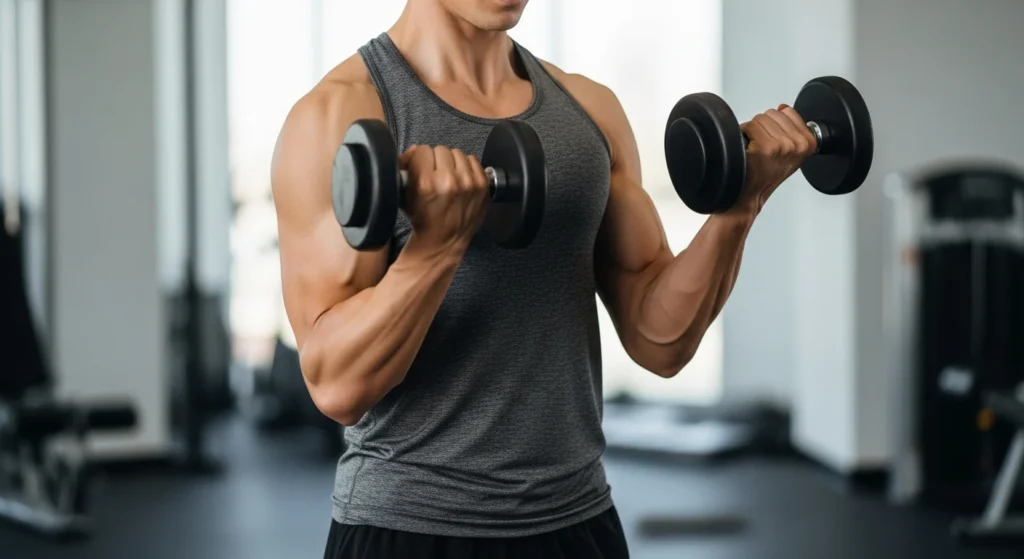
Many people perform dumbbell curls every week without ever seeing real progress. The reason? Poor technique, too much momentum, and a lack of understanding about how the exercise actually works. When done correctly, dumbbell curls don’t just build your biceps—they improve muscle balance, increase strength, and enhance overall upper body performance.
What Are Dumbbell Curls?
Dumbbell curls are a classic strength training exercise that primarily targets the biceps brachii, the muscle located at the front of your upper arm.
They involve bending your elbows (elbow flexion) to lift weights toward your shoulders, making them one of the most effective isolation exercises for arm development.
Muscles Worked
Primary muscle:
- Biceps brachii
Secondary muscles:
- Forearms (flexors)
- Brachialis
- Stabilizing muscles in shoulders and core
Dumbbell curls are widely used because they:
- Build arm size and definition
- Improve grip strength
- Enhance overall upper body strength
Why Dumbbell Curls Are So Effective
Before diving into how to do dumbbell curls, it’s important to understand why they’re a must-have in your routine.
Key Benefits
- Isolation of biceps: Focuses directly on arm growth
- Balanced strength: Each arm works independently
- Improved muscle symmetry: Helps correct imbalances
- Versatility: Can be done at home or in the gym
- Better range of motion: Dumbbells allow natural wrist rotation
When performed correctly, dumbbell curls can significantly increase muscle mass and definition in your arms.
How to Do Dumbbell Curls (Step-by-Step Guide)
Let’s break down exactly how to do dumbbell curls with proper form.
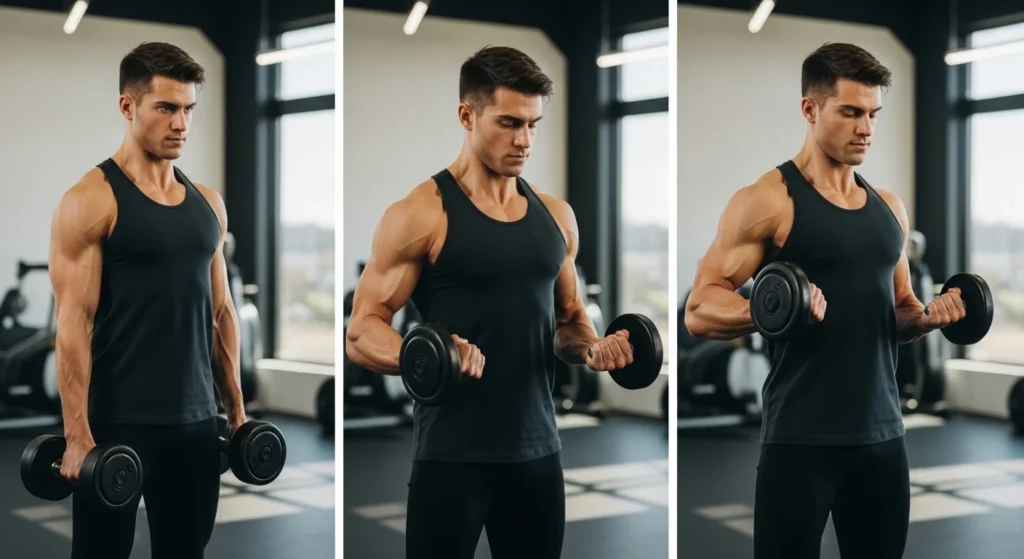
Step 1: Starting Position
- Stand upright with feet shoulder-width apart
- Hold a dumbbell in each hand
- Let your arms hang fully extended at your sides
- Keep palms facing forward (supinated grip)
- Engage your core and keep your chest up
Step 2: Curl the Weights Up
- Keep your elbows close to your torso
- Slowly bend your elbows to lift the dumbbells
- Rotate your wrists (if starting neutral) so palms face up
- Lift until the dumbbells reach shoulder level
Step 3: Squeeze at the Top
- Pause briefly at the top
- Contract your biceps fully
- Avoid letting your elbows move forward
Step 4: Lower the Weights
- Slowly lower the dumbbells back down
- Maintain control—don’t drop the weights
- Fully extend your arms at the bottom
Step 5: Repeat
- Perform controlled repetitions
- Focus on form over speed
Pro Tip: Keep the movement slow and controlled—this maximizes muscle activation and reduces injury risk.
Proper Form Checklist (Quick Reference)
Use this checklist every time you train:
- Back straight, chest up
- Elbows fixed at your sides
- No swinging or momentum
- Full range of motion
- Controlled lifting and lowering
- Wrists stable (not bending excessively)
Common Mistakes to Avoid
Even experienced lifters often get this wrong. Here are the biggest mistakes when learning how to do dumbbell curls:
1. Using Momentum
Swinging your body reduces tension on the biceps and increases injury risk.
Fix: Lower the weight and control the movement.
2. Moving Your Elbows
If your elbows drift forward or backward, you’re no longer isolating your biceps.
Fix: Keep elbows pinned to your sides.
3. Lifting Too Heavy
Using excessive weight leads to poor form and reduced effectiveness.
Fix: Choose a weight you can lift for 8–12 reps with proper technique.
4. Not Using Full Range of Motion
Half reps limit muscle growth.
Fix: Fully extend and fully contract your arms on every rep.
5. Poor Posture
Leaning forward or backward reduces effectiveness and strains your back.
Fix: Stand tall with a neutral spine.
Best Dumbbell Curl Variations
Once you’ve mastered the basic movement, try these variations to target your biceps from different angles.
1. Hammer Curls
- Palms face each other
- Targets brachialis and forearms
2. Alternating Dumbbell Curls
- Curl one arm at a time
- Improves focus and control
3. Incline Dumbbell Curls
- Performed on an incline bench
- Increases stretch and activation
4. Concentration Curls
- Performed seated with elbow on thigh
- Maximizes isolation
5. Reverse Curls
- Palms face downward
- Targets forearms more
Each variation slightly shifts muscle emphasis, helping you build well-rounded arms.
How Many Sets and Reps Should You Do?
Your goals determine your training approach.
For Muscle Growth (Hypertrophy)
- 3–4 sets
- 8–12 reps
- Moderate weight
For Strength
- 4–5 sets
- 4–8 reps
- Heavy weight
For Endurance
- 2–3 sets
- 12–15+ reps
- Light weight
Choosing the Right Weight
A common question when learning how to do dumbbell curls is: How heavy should I go?
Simple Rule:
Choose a weight that:
- Feels challenging
- Allows proper form
- Causes fatigue by the last rep
If you’re swinging or cheating, it’s too heavy.
Advanced Tips for Better Results
Want faster gains? Apply these expert-level strategies:
1. Focus on Mind-Muscle Connection
Actively think about squeezing your biceps during each rep.
2. Control the Negative (Eccentric Phase)
Lower the weight slowly (2–4 seconds) to increase muscle tension.
3. Use Supination
Rotate your wrists during the curl to maximize bicep activation.
4. Keep Constant Tension
Avoid resting at the bottom—keep slight tension in your arms.
5. Train Consistently
Train your biceps 1–2 times per week for optimal growth.
Sample Dumbbell Curl Workout
Here’s a simple but effective arm workout:
Beginner Routine:
- Standard dumbbell curls – 3×10
- Hammer curls – 3×10
- Concentration curls – 2×12
Intermediate Routine:
- Alternating curls – 4×10
- Incline curls – 3×10
- Hammer curls – 3×12
Dumbbell Curls vs Other Curl Types
| Exercise Type | Equipment Needed | Range of Motion | Muscle Focus |
|---|---|---|---|
| Dumbbell curls | Dumbbells | High | Balanced |
| Barbell curls | Barbell | Moderate | Heavier load |
| Cable curls | Machine | Constant tension | Controlled |
Dumbbell curls stand out because they allow natural movement and reduce muscle imbalances.
Who Should Do Dumbbell Curls?
Dumbbell curls are ideal for:
- Beginners starting strength training
- Home gym users
- Athletes building upper body strength
- Anyone aiming for bigger arms
They are simple, effective, and accessible for all fitness levels.
FAQs
How do beginners do dumbbell curls?
Start with light weights, focus on form, and perform 8–12 controlled reps per set.
Should I curl both arms at the same time?
You can do both. Alternating curls help with focus, while simultaneous curls save time.
How often should I do dumbbell curls?
Train biceps 1–2 times per week, allowing recovery between sessions.
Why don’t I feel dumbbell curls in my biceps?
You may be:
- Using too much weight
- Swinging your body
- Not controlling the movement
Fix your form and slow down.
Are dumbbell curls enough to build big arms?
They’re highly effective, but combining them with other exercises yields better results.
Can I do dumbbell curls every day?
Not recommended. Muscles need recovery to grow. Stick to 2–3 sessions per week.
What is the best grip for dumbbell curls?
A supinated grip (palms up) maximizes bicep activation.
Should I sit or stand during curls?
Both work. Standing engages more stabilizers, while seated reduces cheating.