
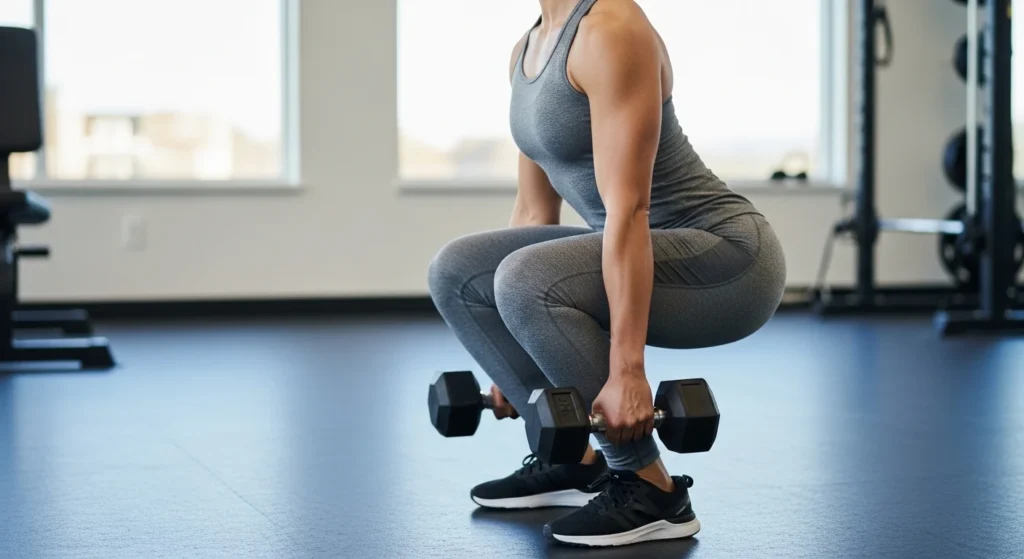
You’ve probably stood in your living room holding a pair of dumbbells, wondering if you’re actually doing squats correctly or just bending your knees and hoping for the best. Maybe your knees ache the next day, or your lower back feels tight instead of your legs feeling worked. That confusion is common, and it usually comes down to a handful of fixable habits rather than any lack of effort.
Squats with dumbbells are one of the most efficient lower-body exercises you can do at home, but only when the mechanics are right. This guide breaks down exactly how to do squats with dumbbells safely, what mistakes quietly sabotage your results, and how to build a routine that actually delivers.
Table of Contents
- Why Squats With Dumbbells Matter for Building Strength
- Signs You’re Squatting With Poor Form
- Common Causes of Bad Dumbbell Squat Technique
- Dumbbell Squats: Wrong Way vs. Right Way
- How to Assess Your Own Squat Form
- A Step-by-Step Dumbbell Squat Routine
- Risks of Ignoring Poor Squat Form
- Should You Keep Squatting Through Knee Discomfort?
- How Long Until You See Results From Dumbbell Squats
- Cost and Equipment Investment for Home Squats
- Best Practices to Keep Your Squats Safe and Effective
- Advice for Home Gym Users vs. Commercial Gym Users
- Frequently Asked Questions
- Final Takeaway
Why Squats With Dumbbells Matter for Building Strength
A squat is a compound movement, meaning it recruits multiple muscle groups at the same time. When you add dumbbells, you introduce external resistance that forces those muscles to work harder than bodyweight alone allows. This is the mechanism behind almost every strength gain: muscles adapt to a demand placed on them, and dumbbells let you control exactly how much demand that is.
At a light level, this just means slightly sore legs the next day and a gradual increase in how many reps feel easy. Left unaddressed with poor form, though, the same movement pattern that should build strength starts loading the wrong structures, instead of the muscles it’s meant to target.
Over time, repeating a flawed squat pattern doesn’t just slow your progress, it can create compensations that show up in other lifts and daily movements, like standing up from a chair or picking something off the floor. That’s why getting the form right early matters more than how heavy the dumbbells are.
Signs You’re Squatting With Poor Form
Watch for these indicators while you train or in the hours after a session:
- Your knees cave inward as you stand back up
- You feel the movement mostly in your lower back instead of your thighs and glutes
- Your heels lift off the floor at the bottom of the squat
- Sharp or pinching pain in the knees, rather than general muscle fatigue
- You can’t keep your chest upright without rounding forward
- Your depth is inconsistent rep to rep
- You feel dizzy or short of breath unusually early in a set
- Soreness lasts more than 72 hours or worsens instead of fading
Common Causes of Bad Dumbbell Squat Technique
Limited ankle mobility: Tight calves and ankles prevent the knees from tracking forward properly, which often causes the heels to rise and the torso to pitch forward to compensate.
Weak glute activation: Many beginners squat almost entirely with their quads because the glutes aren’t firing correctly, which shifts stress toward the knees and lower back.
Holding dumbbells incorrectly: Gripping dumbbells too far forward or letting them swing changes your center of gravity, pulling you off balance mid-rep.
Rushing the tempo: Dropping quickly into the bottom of a squat and bouncing back up uses momentum instead of muscle control, which is a common mistake in small home gym spaces where people want to finish sets quickly.
Insufficient core bracing: Without tightening the midsection before descending, the spine loses support and the lower back takes on load it isn’t meant to carry.
Wrong dumbbell weight for current strength level: Choosing dumbbells that are too heavy before mastering bodyweight squats is one of the most frequent errors among people setting up a home gym on a budget, since they want to skip straight to “real” weight.
Dumbbell Squats: Wrong Way vs. Right Way
| Factor | Doing It Wrong | Doing It Right |
|---|---|---|
| Knee position | Knees cave inward | Knees track over toes |
| Weight distribution | Weight shifts to toes | Weight stays through mid-foot and heel |
| Torso angle | Chest collapses forward | Chest stays upright, spine neutral |
| Depth | Inconsistent, often too shallow | Controlled depth, thighs near parallel |
| Breathing | Held randomly or ignored | Braced on descent, exhale on the way up |
| Tempo | Fast, bouncy reps | Controlled 2-3 second descent |
| Dumbbell hold | Loose grip, arms swinging | Stable grip at sides or at shoulders |
The takeaway is simple: proper dumbbell squats are slower, more controlled, and rely on stability before load, not the other way around.
How to Assess Your Own Squat Form
A useful way to check your own technique is to record yourself from the side and from the front during a light set with no weight at all. Watch the side view first to see whether your torso stays reasonably upright and whether your knees travel roughly in line with your feet rather than collapsing inward. Then check the front view for symmetry, since one side often compensates for the other without you noticing while you’re mid-rep. If you have access to a mirror, positioning it at a slight angle while you train can serve the same purpose in real time. Pay attention to where you feel fatigue after a few reps — if it’s concentrated in your lower back or knees rather than your thighs and glutes, that’s a clear signal something in the pattern needs adjusting before you add dumbbells at all.
A Step-by-Step Dumbbell Squat Routine
- Start bodyweight-only for two sessions to confirm depth, balance, and knee tracking are consistent.
- Choose a light dumbbell weight you can hold comfortably at your sides or at shoulder height for the full set.
- Stand with feet shoulder-width apart, brace your core, and lower slowly for a count of two to three seconds.
- Pause briefly at the bottom with thighs roughly parallel to the floor, keeping knees aligned with your toes.
- Drive through your heels and mid-foot to stand, exhaling as you rise.
- Repeat for 8-12 reps, increasing dumbbell weight only once all reps feel fully controlled with good form.
Risks of Ignoring Poor Squat Form
Continuing to squat with caved knees or a rounded lower back doesn’t usually cause an injury on day one. Instead, it creates cumulative strain that tends to surface as nagging knee pain, tight hip flexors, or lower back tightness that flares up during other activities like walking up stairs or bending to lift something.
Over months, this pattern can also stall your progress entirely, since your body starts recruiting whatever muscles compensate best for the flaw rather than the ones the squat is meant to target. That means more effort for less actual strength gained, and a higher chance of a more serious strain if the weight keeps increasing on top of the same faulty pattern.
Should You Keep Squatting Through Knee Discomfort?
General muscle fatigue or mild soreness in the thighs is a normal part of training and isn’t a reason to stop. Sharp, localized pain in the knee joint itself, however, is a different signal entirely — that’s your body indicating the joint is under stress it wasn’t built to absorb during that movement, and pushing through it usually makes the underlying issue worse rather than building resilience.
If you experience joint-specific pain, it’s reasonable to scale back to bodyweight squats or reduce your range of motion temporarily while you address the root cause, whether that’s mobility, weight selection, or technique. If discomfort persists even at lighter loads, that’s a signal to consult a physical therapist or sports medicine professional rather than trying to train around it indefinitely.
How Long It Takes to See Results From Dumbbell Squats
For a quick-fix scenario, noticeable improvement in form often comes within one to two weeks of focused practice. For a moderate case, such as rebuilding glute activation or working through tight ankles, expect four to six weeks of consistent training before the movement feels natural and stable under load.
For someone starting from a more deconditioned baseline, or recovering from a previous injury, it can take two to three months of gradual progression before both strength and form feel reliably solid. In all three cases, consistency two to three times per week matters more than the specific timeline.
Cost and Equipment Investment for Home Squats
The main cost consideration for dumbbell squats is the dumbbells themselves, and whether you choose fixed-weight pairs or an adjustable set. Adjustable dumbbells cost more upfront but save space and let you increase resistance gradually as your strength improves, which matters most for people planning to progress over months rather than weeks. Fixed sets are often cheaper per pair but require buying multiple sets over time as you get stronger.
Beyond the dumbbells, a stable, non-slip surface or a workout mat can make a meaningful difference in confidence and safety, especially on hard flooring. None of this requires a large investment, but it’s worth budgeting for equipment that will still be useful once your current weight starts to feel too light.
Best Practices to Keep Your Squats Safe and Effective
- Warm up ankles and hips with a few minutes of mobility work before loading weight
- Progress dumbbell weight in small increments rather than large jumps
- Prioritize full range of motion over lifting heavier
- Rest at least one day between lower-body sessions to allow recovery
- Keep footwear flat and stable rather than cushioned running shoes
- Reassess your form periodically, even after it feels comfortable
Advice for Home Gym Users vs. Commercial Gym Users
Training squats at home usually means less space and no spotter, which makes controlled, moderate-weight dumbbell squats a safer choice than trying to replicate heavy barbell work in a cramped area. Mirrors, recorded video checks, and a consistent flat surface become more important substitutes for the visual feedback a gym setting naturally provides.
In a commercial gym, access to a wider range of dumbbell weights and equipment like squat racks makes it easier to progress smoothly, but it can also tempt people to jump to heavier loads before their form is ready. Regardless of setting, the underlying principle stays the same: control and consistency should come before adding weight.
Frequently Asked Questions
How do you do squats with dumbbells correctly?
Hold the dumbbells at your sides or at shoulder height, keep your chest upright, and lower slowly until your thighs are near parallel to the floor while keeping your knees tracking over your toes.
Is squatting with dumbbells effective?
Yes, dumbbell squats effectively build lower-body strength and muscle when performed with proper form and progressive weight increases over time.
Will 20 squats a day make a difference?
Doing 20 squats daily can improve endurance and consistency, but without progressive resistance or variety, strength gains will plateau fairly quickly.
What is the most common injury from squats?
Knee strain is among the most common issues, typically resulting from poor tracking, insufficient mobility, or increasing weight before form is solid.
What are common mistakes when squatting?
Frequent mistakes include letting the knees cave inward, rushing the tempo, rounding the lower back, lifting the heels, and choosing dumbbells that are too heavy too soon.
Final Takeaway
Dumbbell squats are a reliable way to build lower-body strength at home, but the payoff depends entirely on getting the mechanics right before chasing heavier weight. Start light, check your form honestly, and let consistency do the work over the coming weeks.