
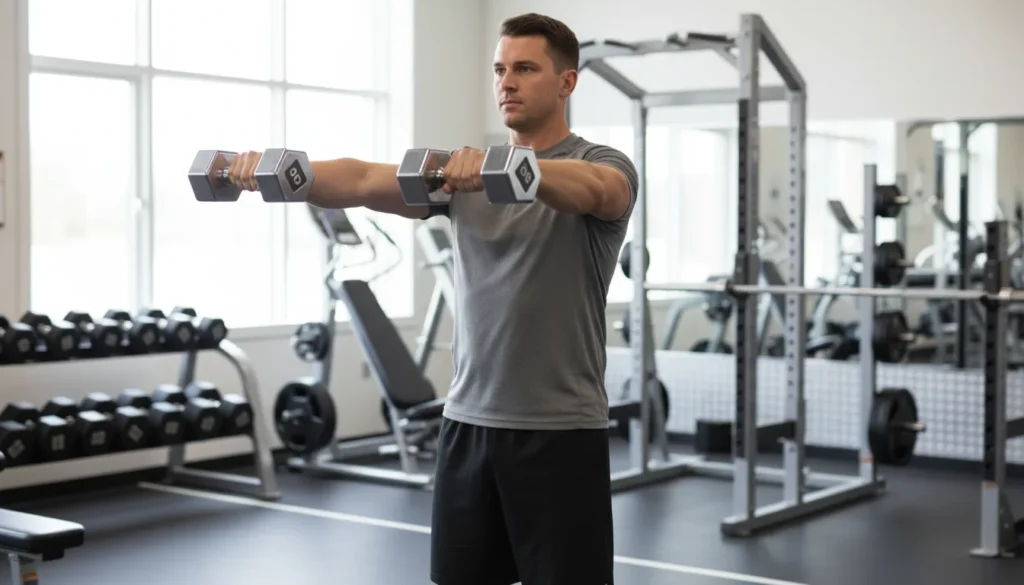
If you’re serious about building strong, well-defined shoulders, front raises with dumbbells deserve a place in your workout routine. While many lifters focus heavily on presses and lateral raises, the front raise isolates the anterior deltoid—a key muscle responsible for shoulder strength, aesthetics, and functional movement.
What Are Front Raises With Dumbbells?
Front raises with dumbbells are an isolation exercise that targets the front part of your shoulders (anterior deltoids). The movement involves lifting weights straight in front of your body to shoulder height.
This exercise is widely used in:
- Bodybuilding programs
- Strength training routines
- Rehabilitation protocols due to its controlled movement
Because of its simplicity and effectiveness, it’s ideal for beginners and advanced lifters alike.
Muscles Worked in Front Raises With Dumbbells
Understanding which muscles are involved helps you train smarter.
Primary Muscle
- Anterior deltoid (front shoulder) – the main muscle responsible for lifting the arms forward
Secondary Muscles
- Lateral deltoid (side shoulder)
- Upper chest (pectoralis major)
- Trapezius (upper back)
- Serratus anterior
- Biceps (assist movement)
These supporting muscles help stabilize the movement and maintain control throughout the exercise
How To Do Front Raises With Dumbbells (Step-by-Step Guide)
Proper form is everything. Poor technique reduces effectiveness and increases injury risk.
Step 1: Starting Position
- Stand upright with feet shoulder-width apart
- Hold dumbbells in front of your thighs
- Palms facing your body (neutral grip)
- Engage your core and keep your back straight
Step 2: Lift the Dumbbells
- Raise the dumbbells forward in a controlled motion
- Keep a slight bend in your elbows
- Lift until your arms are parallel to the floor (shoulder height)
Step 3: Pause
- Hold briefly at the top
- Focus on squeezing your front delts
Step 4: Lower Slowly
- Lower the weights back down with control
- Avoid dropping or swinging
Breathing Technique
- Exhale while lifting
- Inhale while lowering
Maintaining control and avoiding momentum is key for maximizing muscle engagement
Key Benefits of Front Raises With Dumbbells
1. Builds Stronger Shoulders
Front raises directly strengthen the anterior deltoids, which are crucial for pressing movements like bench press and overhead press.
2. Improves Shoulder Definition
This exercise enhances the front shoulder appearance, giving you a more rounded and aesthetic upper body.
3. Enhances Functional Strength
The movement mimics everyday activities like lifting objects in front of you.
4. Corrects Muscle Imbalances
Using dumbbells allows each arm to work independently, helping fix strength asymmetries.
5. Boosts Shoulder Stability
Stronger front delts improve joint stability and reduce injury risk when performed correctly.
Common Mistakes to Avoid
Even though front raises look simple, many people perform them incorrectly.
1. Using Too Much Weight
Heavy weights compromise form and shift tension away from the shoulders.
Fix: Start light and focus on control.
2. Swinging the Weights
Using momentum reduces muscle activation.
Fix: Keep your torso still and move slowly.
3. Lifting Above Shoulder Height
Going too high activates traps instead of front delts.
Fix: Stop at shoulder level.
4. Leaning Back
Leaning back puts stress on your lower back.
Fix: Engage your core and stay upright.
5. Locking the Elbows
Straight arms can strain joints.
Fix: Maintain a slight bend in the elbows.
Best Variations of Front Raises With Dumbbells
Adding variations keeps your workouts effective and prevents plateaus.
1. Alternating Front Raises
Raise one arm at a time.
- Improves focus and control
- Helps correct imbalances
2. Seated Dumbbell Front Raise
Perform the exercise while seated.
- Eliminates momentum
- Forces strict form
3. Hammer Grip Front Raise
Palms face each other throughout the movement.
- Reduces shoulder stress
- Targets muscles slightly differently
4. Plate Front Raise
Use a weight plate instead of dumbbells.
- Great for beginners
- Improves grip strength
5. Incline Front Raise
Performed on an incline bench.
- Increases range of motion
- Enhances muscle activation
Front Raises vs Lateral Raises: Which Is Better?
| Exercise | Primary Target | Purpose |
|---|---|---|
| Front Raises | Anterior deltoid | Front shoulder strength |
| Lateral Raises | Lateral deltoid | Shoulder width |
Key Insight:
Front delts are already heavily involved in pressing exercises, while lateral delts often need more isolation.
That’s why many experts recommend prioritizing lateral raises for aesthetics—but front raises still have value, especially for:
- Beginners
- Injury rehab
- Fixing imbalances
How Heavy Should You Go?
Choosing the right weight is critical.
Recommended Starting Weights:
- Beginners: 2–5 kg (5–10 lbs)
- Intermediate: 5–10 kg
- Advanced: Based on control and form
The goal is perfect form—not maximum weight.
If you’re swinging the dumbbells, the weight is too heavy.
Sets and Reps for Best Results
For Muscle Growth (Hypertrophy)
- 3–4 sets
- 10–15 reps
- Moderate weight
For Endurance
- 2–3 sets
- 15–20 reps
- Light weight
For Strength
- 3–5 sets
- 6–10 reps
- Heavier weight (strict form)
Sample Shoulder Workout With Front Raises
Here’s a simple routine you can use:
Beginner Workout
- Dumbbell Shoulder Press – 3×10
- Front Raises – 3×12
- Lateral Raises – 3×12
Intermediate Workout
- Overhead Press – 4×8
- Front Raises – 3×12–15
- Lateral Raises – 3×15
- Rear Delt Fly – 3×12
Advanced Workout
- Arnold Press – 4×8
- Superset:
- Front Raises – 12 reps
- Lateral Raises – 12 reps
- Cable Front Raise – 3×15
- Face Pulls – 3×12
Are Front Raises Necessary?
This is a common debate.
Some experts argue that:
- Front delts already get enough work from pressing exercises
However, front raises are useful if:
- Your front delts are underdeveloped
- You want better muscle isolation
- You’re rehabbing an injury
- You train at home with limited equipment
Safety Tips for Front Raises
- Always warm up your shoulders
- Use controlled movements
- Avoid excessive weight
- Stop if you feel shoulder pain
- Keep your core engaged
If you have shoulder issues, consult a professional before adding this exercise.
Pro Tips for Maximum Results
- Focus on mind-muscle connection
- Use a slow tempo (2–3 seconds lowering phase)
- Keep tension on the muscle at all times
- Avoid ego lifting
- Train shoulders 1–2 times per week
Frequently Asked Questions (FAQs)
Are front raises with dumbbells good for beginners?
Yes. They are simple, safe, and easy to learn, making them ideal for beginners.
How often should I do front raises?
1–2 times per week is enough for most people.
Can front raises build bigger shoulders?
Yes, but they mainly target the front delts. Combine with lateral and rear delt exercises for full shoulder development.
Should I lift both arms or alternate?
Both methods work. Alternating helps improve balance and control.
Why do I feel it in my traps instead of shoulders?
You’re likely lifting too high or using too much weight.
Can I do front raises every day?
Not recommended. Muscles need time to recover.
What’s better: dumbbells or cables?
- Dumbbells: More natural movement
- Cables: Constant tension
Both are effective.
Are front raises bad for shoulders?
Not if performed correctly. Poor form or heavy weights can cause strain.
You can also follow “Rear Delt Fly with Dumbbells” for dumbbell workouts, and fitness tips to help you get better results.