
Have you ever wondered whether leg workouts with dumbbells are actually enough to build strong, muscular legs, or if you need a fully equipped gym to see real results?
It’s a fair question. Most people assume heavy barbells, squat racks, and leg presses are essential for lower-body growth. While those tools can be useful, they’re not the only way to build stronger quads, glutes, hamstrings, and calves. In fact, a well-designed program built around leg workouts with dumbbells can deliver impressive results, especially for home gym users.
The key isn’t having access to more equipment; it’s choosing the right exercises, training through a full range of motion, and applying progressive overload consistently over time. When programmed correctly, dumbbells can challenge every major muscle in your lower body while also improving balance, coordination, and single-leg strength in ways that traditional machines often can’t.
What You Can Do with Dumbbell Leg Training
Dumbbells are excellent for single-leg work, accessory training, conditioning, and building a solid strength base. Where they fall short is pure max-strength development; you can only load a goblet squat so heavy before the grip becomes the limiting factor, not your legs.
In real training, most people with adjustable dumbbells top out somewhere around 40–60 lbs per hand for lower-body work before the movements become awkward or unsafe. That’s still a meaningful stimulus, especially for beginners and intermediate trainees. But if pure strength is your end goal and you have access to a barbell, eventually you’ll want to use it.
That said, for the majority of people training at home, dumbbells are more than enough to build noticeable lower-body muscle, improve athletic performance, and stay in shape year-round.
The Best Leg Exercises with Dumbbells
1. Goblet Squat
What it is: A front-loaded squat holding one dumbbell at chest height with both hands.
Why it works: The goblet squat is the most underrated beginner strength exercise that exists. The front load forces you to stay upright, which naturally teaches good squat mechanics.
How to do it:
- Hold one dumbbell vertically at chest height, gripping both ends
- Feet shoulder-width apart, toes turned out slightly (10–30 degrees, whatever feels natural for your hips)
- Push your knees out as you descend — they should track over your toes
- Squat until your elbows touch the inside of your knees, or as deep as your mobility allows
- Drive through your full foot on the way up — don’t let your heels rise
Common mistake: Using too light a weight “because it’s just a goblet squat.” This movement can be loaded heavily. A 60–80 lb dumbbell goblet squat is genuinely hard.
Coaching cue: “Elbows down, chest up, knees out.” Repeat that on every rep.
Progression: Once the grip becomes the limiting factor, switch to two dumbbells in a front rack position or consider a trap bar if you can access one.
2. Romanian Deadlift (RDL)
What it is: A hip hinge movement targeting the hamstrings and glutes, performed with dumbbells held at hip height.
Why it works: Most people’s hamstrings are significantly weaker than their quads. The RDL directly addresses this and transfers well to athletic performance and injury prevention. It’s also one of the easiest hip hinge patterns to learn.
How to do it:
- Stand holding two dumbbells in front of your thighs
- Soft bend in the knees — this isn’t a straight-leg deadlift
- Hinge at the hips, pushing them back as the dumbbells travel down your legs
- Keep the dumbbells close to your body throughout — they should almost graze your shins
- Lower until you feel a strong stretch in your hamstrings
- Drive your hips forward to return to standing
Common mistake: Bending the knees too much and turning it into a squat. If your torso isn’t nearly parallel to the floor at the bottom, you’re not hinging enough.
Coaching cue: “Push the hips back, not down.”
3. Bulgarian Split Squat
What it is: A single-leg squat variation with the rear foot elevated on a bench or chair.
Why it works: This is arguably the best single-leg exercise available with dumbbells. The unilateral nature means you’re effectively working one leg with nearly your full bodyweight (plus load), which closes the gap on what dumbbells can provide compared to barbells.
How to do it:
- Stand about two feet in front of a bench or chair
- Place the top of one foot on the bench behind you
- Hold a dumbbell in each hand at your sides
- Lower your back knee toward the floor — keep your front shin as vertical as possible
- Don’t let your front knee cave inward
- Drive through the front heel to return to the top position
Common mistake: Standing too close to the bench. This forces your knee too far forward and puts stress on the knee joint rather than loading the glutes and quads properly.
Coaching cue: “Front heel stays down. Lower the back knee straight down.”
Real training note: This exercise is harder than it looks and significantly harder on the legs than a standard squat at equal weight. Most people need to humble themselves on the load, especially at first.
4. Dumbbell Sumo Squat
What it is: A wide-stance squat holding one or two dumbbells between the legs.
Why it works: The wider stance and turned-out toes shift emphasis toward the inner thighs (adductors) and glutes — muscles that a standard squat doesn’t hit as directly. It also tends to be easier on the lower back than a narrow stance.
How to do it:
- Feet wider than shoulder-width, toes turned out 30–45 degrees
- Hold one heavy dumbbell vertically with both hands, or one in each hand between the legs
- Squat deep — the wider stance allows more depth for most people
- Keep your chest up and core braced throughout
Coaching cue: “Shove your knees out against your forearms at the bottom to activate the hips.”
5. Walking Lunges
What it is: A dynamic lunge variation where you walk forward, alternating legs with each step.
Why it works: Lunges develop single-leg stability, quad and glute strength, and hip flexor mobility simultaneously. Walking lunges add a conditioning component that static lunges don’t.
How to do it:
- Hold a dumbbell in each hand at your sides
- Step forward with one leg, lowering the back knee toward the floor
- The front knee should stay behind or directly above the front foot — not past it
- Push off the front foot, bring the back foot forward to take the next step
- Keep your torso upright throughout
Common mistake: Taking too short a step, which overloads the knee. A proper lunge step is longer than you think.
Space consideration: Walking lunges need open floor space. In a small home gym, reverse lunges (stepping back rather than forward) give you the same training effect in a quarter of the space.
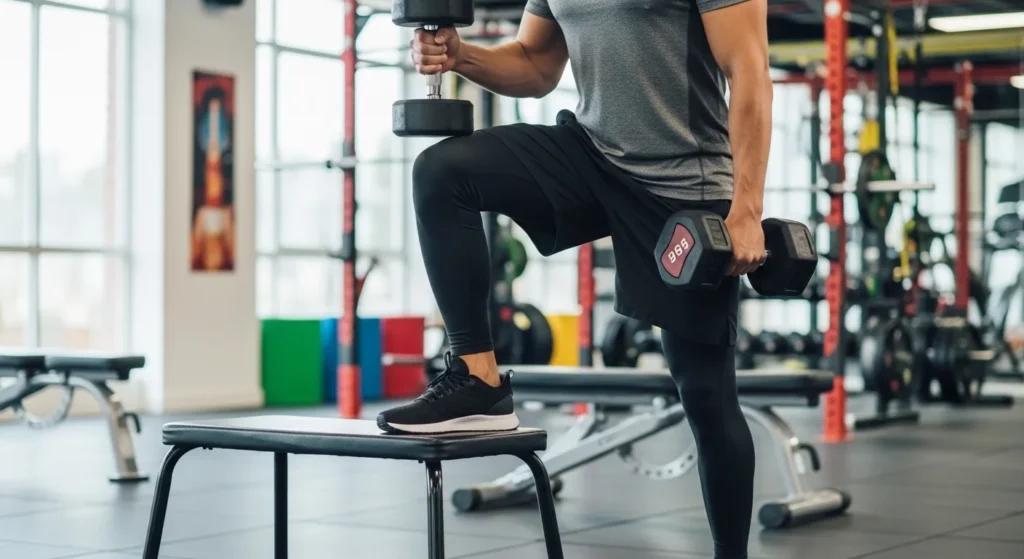
6. Dumbbell Step-Up
What it is: Stepping up onto a bench or box holding dumbbells, one leg at a time.
Why it works: Step-ups are one of the best quad-dominant exercises available at home. They also develop functional strength and balance that transfer to real-world movement patterns.
How to do it:
- Use a bench, box, or sturdy step that puts your thigh roughly parallel to the floor
- Hold dumbbells at your sides
- Step up with one foot, driving through the heel to stand on top of the bench
- Control the descent — don’t drop back down
- Either alternate legs or complete all reps on one side before switching
Coaching cue: “Drive the heel down into the bench, not the toe.” This keeps tension on the quad and glute rather than turning it into a calf raise.
7. Dumbbell Deadlift
What it is: A standard hip hinge pull from the floor using two dumbbells.
Why it works: It trains the posterior chain (hamstrings, glutes, lower back) in a full range of motion. Unlike the RDL, the dumbbell deadlift starts from a dead stop on the floor, which adds a different demand to the movement.
How to do it:
- Dumbbells on the floor just outside your feet
- Hinge down and grip them — keep your chest up, back flat
- Push the floor away rather than thinking about lifting the weight
- Stand tall at the top — don’t hyperextend your lower back
Home gym note: Most adjustable dumbbell sets change the height of the handles as you add weight, which can affect your starting position. Check that you can maintain a neutral spine before loading up.
8. Glute Bridge / Hip Thrust (Dumbbell Loaded)
What it is: A supine hip extension movement, loaded with a dumbbell placed on the hips.
Why it works: Bridges and hip thrusts target the glutes through their full range of motion — something squats and deadlifts don’t fully achieve. If glute development or lower back health is a priority, these belong in your program.
How to do it:
- Lie on your back, knees bent, feet flat on the floor
- Place a dumbbell horizontally across your hip crease (hold it in place with both hands)
- Drive through both heels, lifting your hips until your body forms a straight line from knees to shoulders
- Squeeze the glutes at the top — don’t rush the lockout
- Lower with control
Progression: Once floor bridges are easy, elevate your upper back on a bench for a full hip thrust range of motion.
9. Dumbbell Lateral Lunge
What it is: A lunge performed to the side rather than forward or backward.
Why it works: Most lower-body training happens in the sagittal plane (forward and back). Lateral lunges train the frontal plane, developing the adductors, abductors, and glutes in a way that squats and standard lunges don’t.
How to do it:
- Hold one or two dumbbells at chest height or at your sides
- Step out wide to one side, bending that knee while keeping the other leg straight
- Sit back into the hip of the working leg — don’t let the knee dive forward
- Drive back to standing through the heel
10. Single-Leg Romanian Deadlift
What it is: An RDL performed on one leg.
Why it works: The single-leg version adds a balance challenge and exposes asymmetries between legs that a bilateral RDL can hide. This is a great exercise for athletic development and injury prevention.
How to do it:
- Hold one or two dumbbells
- Shift weight to one foot, hinge forward from the hip
- The non-working leg extends behind you as a counterbalance
- Keep your hips level — don’t let one side rotate up
- Return to standing by driving the hip of the working leg forward
Common mistake: Rotating the hips to make the movement easier. Keep them square to the floor throughout.
11. Dumbbell Curtsy Lunge
What it is: A lunge variation where the rear foot crosses behind and outside the front foot.
Why it works: This unusual movement pattern places significant emphasis on the glutes, especially the glute medius, which gets very little attention from standard lower-body exercises.
How to do it:
- Holding dumbbells at your sides, step one foot back and across behind your body
- Lower the back knee toward the floor as in a standard lunge
- Keep the front knee tracking over the front foot
- Return to standing and repeat or alternate sides
12. Calf Raises (Dumbbell Loaded)
What it is: A standing calf raise holding dumbbells for load.
Why it works: The calves are often undertrained in home programs because they require high repetitions and significant load to respond. Adding dumbbell load while standing on a step edge gives you more range of motion and better stimulus.
How to do it:
- Stand on the edge of a step with your heels hanging off
- Hold dumbbells at your sides for balance and load
- Lower your heels below the step level, then rise as high as you can onto your toes
- Don’t bounce at the bottom — use a brief pause for the full range of motion
Home Gym Realities: What Most Guides Don’t Tell You
Progression: How to Keep Getting Stronger
- Use double progression: Increase the weight once you can complete all sets at the top of your target rep range with good form.
- Slow down the lowering phase: A controlled 3–4 second eccentric increases muscle tension and makes the exercise more challenging without adding weight.
- Add pause reps: Holding the bottom position of squats or lunges for 1–2 seconds increases difficulty and improves control.
- Increase your range of motion: Moving through a fuller range can make an exercise more effective even when the weight stays the same.
Mistakes That Stall Leg Day Progress
- Using the same weight for too long: If the weight and reps never increase, your body has little reason to keep building strength or muscle.
- Skipping single-leg exercises: Neglecting movements like lunges and split squats can leave strength imbalances and stability weaknesses unaddressed.
- Ignoring hamstring training: Focusing only on quad-dominant exercises can limit overall leg development and posterior chain strength.
- Rushing through reps: Lowering the weight too quickly reduces muscle tension and makes each rep less effective.
- Treating leg day as a low priority: Consistently training legs when you’re tired or unmotivated can slow progress and limit performance.
Frequently Asked Questions (FAQs)
Can you build real leg muscle with just dumbbells?
Yes, particularly for beginners and intermediate lifters. Dumbbells provide enough resistance to stimulate hypertrophy (muscle growth) in the quads, hamstrings, and glutes when exercises are programmed with progressive overload. Advanced lifters will eventually need heavier implements, but most home trainers are nowhere near that limit.
How heavy do dumbbells need to be for leg training?
For meaningful leg development, you’ll want access to at least 30–40 lbs per hand for most adults. Beginners can build strength with lighter loads, but plan for your strength to grow quickly; what feels heavy in month one becomes a warm-up by month three.
How often should I train legs with dumbbells?
Two times per week is the sweet spot for most people. This gives enough frequency to drive adaptation and enough recovery time between sessions. Training legs once a week is workable but slower. Three times a week is viable if the volume per session is low.
Are goblet squats as effective as barbell squats?
For beginners, yes. For intermediate and advanced lifters, the goblet squat becomes limited by how much weight you can hold, not how much your legs can lift. At that point, the barbell back squat or front squat provides a higher training stimulus.
What’s the best dumbbell exercise for glutes specifically?
The Romanian deadlift and hip thrust are the top two. Bulgarian split squats are also excellent. Squats train the glutes, but not as directly as hip hinge and hip thrust variations.
Do I need a bench for dumbbell leg workouts?
Not strictly, but having one significantly expands your options. Bulgarian split squats, step-ups, and hip thrusts with upper back elevation all require an elevated surface. A flat bench, a sturdy chair, or even a low coffee table can work.
Can dumbbell leg workouts help with fat loss?
Yes. Leg training builds the largest muscles in your body, which increases your resting metabolic rate over time. Dumbbell leg exercises can also be arranged as circuits to elevate heart rate and increase calorie burn during the session itself.
Conclusion
Building stronger legs doesn’t require a commercial gym or complicated equipment. What matters is consistently challenging your muscles with effective movements, proper technique, and a plan.
The best leg workouts at home with dumbbells combine squat patterns, hip hinges, lunges, and single-leg exercises to train every major muscle in the lower body. Movements like goblet squats, Romanian deadlifts, Bulgarian split squats, and step-ups can deliver impressive results.
It’s easy to get distracted by advanced routines and specialty equipment, but most people make their best progress by mastering the fundamentals. Focus on quality reps, increase the challenge when your current workload becomes easy, and give your body time to adapt. Those small improvements add up faster than most people realize.
Want to build stronger, more defined arms? Check out Arm Workouts with Dumbbells for effective exercises that target your biceps, triceps, and forearms with just a pair of weights.


