Most people spend their arm days hammering curls. They finish a session, pump their biceps in the mirror, and call it done. Meanwhile, the triceps barely get touched. That’s a problem if you actually want bigger, stronger arms.
The dumbbell tricep kickback fixes exactly that. It’s an isolation exercise that strips away all the noise and puts direct, controlled stress on the triceps brachii. No swinging. No momentum. Just the triceps working against gravity through a full range of motion.
What Is the Dumbbell Tricep Kickback?
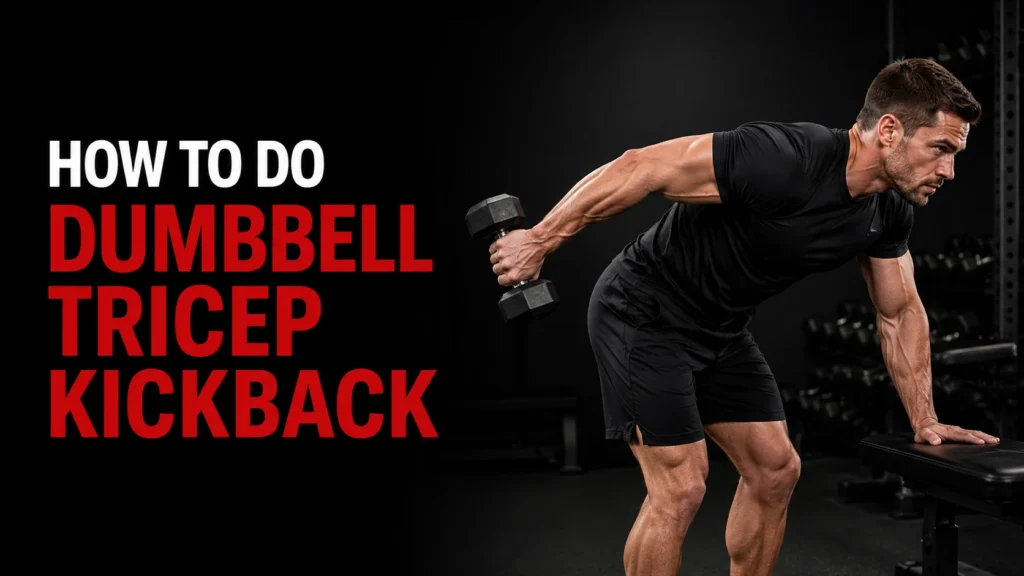
The dumbbell tricep kickback is a single-joint isolation movement. You hinge forward at the hips, pin your upper arm parallel to the floor, then extend the forearm back until the arm is straight. That’s it. The upper arm stays fixed; only the elbow hinge moves.
What makes this exercise valuable is the position it puts the triceps in. With the upper arm held back and the elbow elevated, the triceps — particularly the long head — reach a fully shortened position at peak contraction. Most pressing movements never get there. The bench press and overhead press both work the triceps hard, but neither fully shortens the long head at the top. The kickback does.
According to research by the American Council on Exercise (ACE), the tricep kickback ranks as the second most effective triceps exercise for muscle activation, producing over 87% of maximal voluntary contraction. Only diamond push-ups scored higher in their comprehensive study. That’s not a minor result for an exercise people tend to dismiss as “too light to matter.”
Muscles Worked During Dumbbell Tricep Kickbacks
Primary Muscle: Triceps Brachii
The triceps brachii has three heads, and understanding how each one contributes makes you train smarter.
Long Head: The largest of the three heads. It originates at the infraglenoid tubercle of the scapula, which means it crosses the shoulder joint — the only triceps head that does. Because of that shoulder attachment, it needs the arm to be positioned back (shoulder extension) to be fully shortened. The kickback provides exactly that position. This is why the long head gets more emphasis here than it does during pushdowns or close-grip bench.
Lateral Head: Attaches to the posterior surface of the humerus above the radial groove. It’s most visible as the “horseshoe” shape on the outer arm. During the kickback, especially at full extension, the lateral head takes on a significant portion of the work. Research consistently shows it receives heavy activation during the extension phase.
Medial Head: The deepest of the three, it’s active throughout elbow extension movements regardless of arm position. During kickbacks, it contributes to stabilization and the initial extension from the bent position.
Secondary Muscles
The rear deltoids and upper back work to hold the upper arm in position throughout the movement. The core braces to keep the torso stable while hinged forward. These muscles don’t move; they resist movement, which is still real work.
How to Do Dumbbell Tricep Kickbacks: Step-by-Step Form
The Bench-Supported Single-Arm Kickback (Best for Beginners)
This variation gives you a stable base so you can focus entirely on triceps activation without fighting to stay balanced.
Setup: Place your left knee and left hand on a flat bench. Your torso should be roughly parallel to the floor. Hold a dumbbell in your right hand with a neutral grip (palm facing inward). Pull the right upper arm back so it runs parallel to the floor alongside your torso. Bend the elbow to 90 degrees, so the forearm points straight down.
The Movement: Without moving your upper arm — this part matters more than most people realize — extend your elbow until the arm is fully straight. At the top, squeeze the triceps hard for one full second. The dumbbell should finish slightly above hip height, not awkwardly high. Then lower the forearm back under control to the 90-degree starting position. That’s one rep.
Breathing: Exhale as you extend the arm back. Inhale as you return to the start. Keep breathing steady; holding your breath through multiple reps creates unnecessary tension and messes with your stability.
The Standing Bilateral Kickback (Both Arms)
Stand with feet hip-width apart, a slight knee bend. Hinge forward at the hips — not the waist — until your torso sits at roughly 45 degrees. Hold a dumbbell in each hand. Pull both upper arms back so they run parallel to the floor, elbows bent at 90 degrees. Extend both arms back simultaneously, squeeze at the top, then return. The bilateral version increases the demand on your core to resist rotation.
The Single-Arm Standing Kickback
Same setup as above, but one arm at a time. Use the non-working hand on a weight rack or thigh for light support. Many coaches prefer this over the bilateral version because it lets each side work independently, preventing the stronger arm from compensating.
The Mechanics That Actually Matter
Here’s what separates a tricep kickback that builds muscle from one that just moves a dumbbell back and forth.
Upper Arm Position Is Everything. The upper arm must stay parallel to the floor throughout the rep. The second it drops, you lose the position that creates tension on the long head. You also make the movement easier for the wrong reasons — gravity is doing the work, not your triceps.
The Peak Contraction is Not Optional. Stopping short at the top is leaving the most productive part of the rep unfinished. Fully extend the elbow, squeeze the triceps as hard as you can for a beat, then lower. That squeeze is where the long head gets fully shortened and maximally stimulated.
Slow Eccentrics Build More Muscle. The return phase — lowering the forearm from full extension back to 90 degrees — is where you can generate more muscle damage and tension. Don’t let the weight drop. A 2-3 second lowering phase is worth far more than rushing back to start another rep.
The Elbow Is a Hinge, Not a Shoulder. Think of the elbow joint as a door hinge on a door that’s already wide open. The door doesn’t move; only the hinge operates. Your upper arm is the door. Your forearm is the hinge. If you start feeling this in your shoulder instead of your triceps, your upper arm is dropping and your shoulder is trying to assist.
Weight Selection: Why Most People Go Too Heavy
This is the most common problem with kickbacks, and it silently ruins the exercise for a lot of people. Because of the biomechanics of the movement — the angle of resistance, the position of the elbow — even experienced lifters often use 5–15 pounds to maintain strict form.
That number shocks people who throw 30 pounds around on cable pushdowns. But those are different exercises. The kickback demands that the triceps work in a highly lengthened position (elbow at 90 degrees) and finish in full shortening (arm fully extended), with zero assistance from the shoulder or momentum. A lighter weight done with strict control generates more real triceps stimulus than a heavier weight swung with body english.
A useful test: if your upper arm moves at any point during the rep, the weight is too heavy. Drop it and prioritize form.
Common Dumbbell Tricep Kickback Mistakes
Letting the Elbow Drop
When the upper arm falls below parallel, the movement shifts from elbow extension to shoulder extension. The triceps disengage and the rear delt takes over. Keep the upper arm locked in place; don’t let fatigue pull it down.
Swinging the Weight
Swinging uses momentum from the shoulder and torso to help the forearm travel back. It looks like effort. It isn’t. The triceps end up shortchanged because the force generating the movement is coming from somewhere else. Keep each rep deliberate, slow at the start, and controlled through full extension.
Rounding the Lower Back
Hinging forward with a rounded lumbar spine transfers unnecessary compressive load to the back and shifts your shoulder position, which in turn affects arm mechanics. Keep the core braced, the spine neutral, and the head aligned with the torso. Look at a point on the floor a few feet ahead of you to keep the neck in a good position.
Flaring the Elbow Out
Elbows that drift away from the torso allow the biceps and shoulder to assist the movement. The kickback is a triceps isolation exercise. Keep the elbow tucked close to your side throughout the entire rep.
Short Range of Motion
Starting from less than 90 degrees at the elbow, or not reaching full extension at the top, cuts the long head out of its most productive working range. Full range of motion on every rep — not just the first few when you’re fresh.
Breaking at the Wrist
The wrist should stay firm and neutral throughout. Letting it flex or extend shifts stress to the forearm and reduces the force transfer to the triceps. Grip the dumbbell firmly and keep the wrist locked.
Dumbbell Tricep Kickback Variations
Cable Tricep Kickback
Set a low pulley cable to roughly thigh height and attach a D-handle or use the bare carabiner. The cable provides constant tension through the entire range of motion — something a dumbbell doesn’t do because gravity pulls straight down, not backward. At the bottom of a dumbbell kickback, when the forearm is pointing down, the triceps are under almost no load. The cable changes that resistance curve, making the movement productive throughout. If you want more time under tension, cables are worth adding.
Resistance Band Kickback
A resistance band looped under one foot delivers similar constant tension benefits to the cable, and you can do it at home with no equipment beyond the band itself. The resistance increases as you extend, which actually overloads the triceps at the position of peak contraction. Good variation for home training or as a warm-up before heavier triceps work.
Incline Bench Kickback
Lie prone on an incline bench set to around 30–45 degrees, chest down, arms hanging. Perform the kickback from this position. The incline removes your lower back from the equation and strictly dictates your upper arm position. Useful for people who struggle to maintain a neutral spine while hinging forward, or who want a different stimulus.
Seated Kickback
Sit on the edge of a bench, hinge forward until your chest nearly touches your thighs, and perform the kickback with both arms. The limitation here is that you can’t get your torso as low, which limits how far back the arm can travel. Better suited for warm-up work than primary training.
Alternating Kickback
Perform the standing bilateral setup but alternate arms: extend one arm back and hold it at full extension while the other returns to 90 degrees, then switch. This increases the isometric hold time on the extended arm and creates a different training challenge compared to moving both arms together.
How to Program Dumbbell Tricep Kickbacks
The kickback is an accessory and isolation exercise. It doesn’t belong at the start of a session when you’re fresh and capable of heavy compound work. Use it after your primary pressing movements — bench press, overhead press, dips — to finish the triceps off.
For Muscle Mass (Hypertrophy): 3 sets of 12–15 reps with a 2–3 second eccentric. Rest 60–90 seconds between sets. Emphasize the squeeze at the top and don’t rush the lowering phase. This rep range keeps time under tension high, which is what you want from an isolation finisher.
For Strength Development: 3 sets of 8–12 reps with a slightly heavier load, though still within the range where form stays strict. Focus on maximum contraction at full extension and controlled tempo.
For Muscular Endurance: 3–4 sets of 15–25 reps with a lighter weight and emphasis on not swinging as fatigue sets in. This works well for active recovery days or high-rep arm circuits.
Frequency: 1–2 times per week is appropriate for most trainees. More than that, and you’re accumulating fatigue in the elbows and shoulders without enough additional benefit to justify it.
Where It Fits: Push day, arm day, full-body session — anywhere you’d include triceps work. Pair it after a heavier compound movement like close-grip bench or weighted dips, not before.
Why Your Triceps Are More Important Than You Think
People underestimate triceps in general. The triceps brachii make up roughly 60–67% of the upper arm’s total muscle mass. So if your goal is bigger arms, more of that growth potential lives in the back of the arm than in the biceps. Training the biceps while neglecting the triceps is like expecting a car to accelerate well with only one engine cylinder firing.
Beyond aesthetics, strong triceps matter functionally. Every pushing movement — pressing a door open, putting a box on a shelf, pushing yourself up from a chair — involves elbow extension. The triceps are the engine behind all of it. They also stabilize the shoulder joint and assist in maintaining proper shoulder mechanics during overhead pressing.
Weaker triceps are often the limiting factor in someone’s bench press, not a weak chest. If your triceps give out before your chest does on pressing days, targeted triceps isolation work, like kickbacks, will directly improve your compound performance.
Frequently Asked Questions (FAQs)
What muscles do dumbbell tricep kickbacks work?
Tricep kickbacks work all three heads of the triceps brachii: the long head, lateral head, and medial head. The long head gets particular emphasis because the arm position — held back with the shoulder extended — allows it to fully shorten at peak contraction. The rear deltoids and core muscles assist as stabilizers but are not the primary targets.
What muscle makes up 70% of your arm?
The triceps brachii makes up approximately 60–67% of the upper arm’s total muscle mass. People commonly cite the figure as “two-thirds,” and some sources round it to 70%. Either way, the takeaway is consistent: the back of the arm holds more volume and growth potential than the biceps. Neglecting triceps training while only doing curls is working against your own goals.
Are tricep kickbacks effective for building muscle?
Yes, and the evidence backs this up. ACE research found kickbacks produce over 87% of maximal voluntary contraction in the triceps, making them one of the highest-activation triceps exercises studied. They’re most effective as an isolation finisher paired with heavier compound movements. Performed with strict form, slow eccentrics, and a focused peak contraction, kickbacks stimulate real hypertrophy — not just the burn people associate with light-weight exercises.
Why don’t I feel tricep kickbacks in my triceps?
Almost always, this comes down to either the upper arm dropping below parallel or the weight being too heavy. When the upper arm isn’t held back parallel to the floor, the shoulder takes over, and the triceps disengage. Try this: drop the weight significantly, slow the movement down, and concentrate on keeping the upper arm completely still while only the forearm moves. If you still can’t feel the tricep working, place two fingers of the free hand on the back of the upper arm during the movement to get tactile feedback about where the contraction should be.
How many sets and reps should I do for tricep kickbacks?
For hypertrophy, 3 sets of 12–15 reps work well. For strength emphasis, 3 sets of 8–12 reps. For endurance or high-rep pump work, 3–4 sets of 15–25 reps. Train kickbacks 1–2 times per week, always after compound pressing movements. The exercise doesn’t need to appear multiple times in a single workout; one dedicated working set after your heavier triceps work is often enough.
What is the proper back position during dumbbell tricep kickbacks?
The spine should stay neutral throughout — neither rounded nor overextended. The hinge happens at the hips, not the waist. Think of your back as a tabletop: flat, stable, and unmoving. Engage the core before the first rep and hold that engagement through the entire set. The head should align with the spine; don’t crane the neck up or let the chin drop toward the chest.
Can I do tricep kickbacks if I have elbow pain?
Mild elbow discomfort during kickbacks often comes from using too much weight, letting the elbow flare out, or not controlling the eccentric phase. Address those issues first. If discomfort persists or is sharp rather than mild fatigue, stop the exercise and consult a healthcare professional. People with existing elbow issues sometimes find cable kickbacks more comfortable than dumbbell versions because the constant tension cable creates a smoother resistance profile.
Should I use a bench or a stand for tricep kickbacks?
Both work. The bench-supported version is better for beginners because it stabilizes the torso and makes it easier to keep the upper arm in place. The standing version increases core demand and is useful once you’ve groomed the movement pattern. Neither is inherently superior for triceps activation — form execution matters more than which stance you choose.
Are tricep kickbacks good for women?
The exercise works the same muscles regardless of sex. Many women specifically want to address the back of the arm, and kickbacks are one of the best isolation choices for that. The “toning vs. building” distinction doesn’t change the exercise — it changes the weight, rep range, and overall programming context. Kickbacks work well for anyone training to improve arm composition, upper body strength, or functional pressing ability.
What weight should I use for dumbbell tricep kickbacks?
Start lighter than you think you need to. Experienced lifters commonly use 5–15 pounds for kickbacks with strict form. Your first priority is keeping the upper arm parallel to the floor throughout the entire set. Once that’s consistent, add weight in small increments. If you need to swing or drop the elbow to complete a rep, the weight is too heavy.
In conclusion
The dumbbell tricep kickback doesn’t get the respect it deserves. It’s often skipped in favor of heavier-looking movements, or done sloppily as a throwaway finisher. But done well — controlled tempo, upper arm locked in place, genuine squeeze at the top — it’s one of the few exercises that actually shortens the long head of the triceps at peak contraction.
The triceps are too important for arm development and pressing performance to be treated as an afterthought. Add kickbacks after your compound work, use a weight you can control, and focus on what the muscle is actually doing. The results compound over time in ways that sloppy, heavy sets never will.
Want better bicep peak activation and stricter curl mechanics? Check out How to Do Dumbbell Drag Curl for proper form, key benefits, and tips to target the long head of the biceps more effectively.