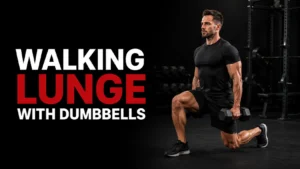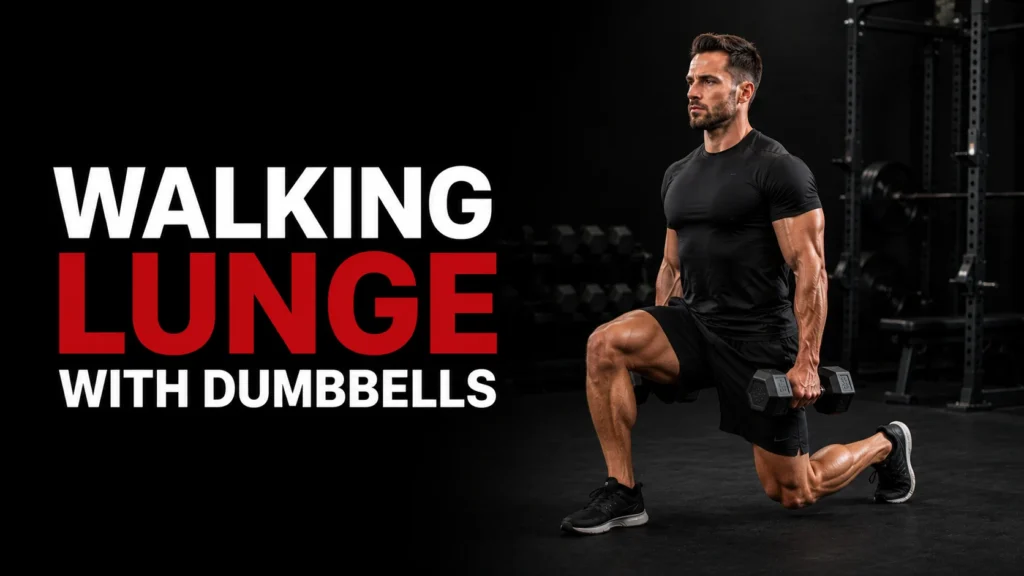
If you train legs with any seriousness, you already know that squats and leg press get most of the attention. But the walking lunge with dumbbells quietly does things neither of those exercises can. It builds quad size, hammers the glutes, forces unilateral stability, and elevates your heart rate, all in one continuous movement across the gym floor.
Why the Walking Lunge With Dumbbells Beats Stationary Alternatives
Before getting into technique, it helps to understand what makes the walking version distinct from a standard stationary lunge. They look similar, but they train differently.
In a stationary lunge, you drop down and return to the same starting position each rep. The movement is closed — you can reset, stabilize, and repeat. The walking lunge removes that safety net. You step forward, lower under control, stand up through the front leg, then bring the back leg through into the next step — and the forward momentum means you never fully return to a bilateral stance between reps. That continuous demand on balance and coordination is what makes it harder, and also what makes it more effective for people who want to build lower-body strength that carries over outside the gym.
Because you use a more explosive movement to propel your body forward, the walking lunge is slightly more effective at developing lower-body power than stationary lunge variations. That difference matters more for athletes and lifters who want functional strength — not just size.
Adding dumbbells at your sides scales the resistance without changing the movement pattern. Holding a pair of dumbbells at your sides increases the load and helps develop grip strength along with lower body muscle, making it one of the best hypertrophy variations for quads and glutes.
There’s also a spine-loading argument worth knowing. Dumbbells produce a lower axial load on your spine compared to a barbell, which means you can train with meaningful resistance while protecting your back — especially relevant if you’re working around previous injuries or simply prefer to keep heavy spinal compression out of your accessory work.
Muscles Worked During the Dumbbell Walking Lunge
Quadriceps (Primary Mover)
During the dumbbell walking lunge, the quads are the primary movers. On the way down (eccentric phase), the quadriceps lengthen to control the movement. On the way up (concentric phase), they shorten as tension drives you back to the starting position. EMG research confirms that the lunge movement pattern produces significant quadriceps activation, and step length directly influences just how hard they work.
Glutes and Hamstrings (Secondary Movers)
When you step back into reverse positions or reach the bottom of a lunge, the glutes and hamstrings kick in to control hip extension and keep your lower body powerful. The glutes work particularly hard during the drive phase — the moment you push through your front heel to stand. If you’re not feeling your glutes during lunges, your torso is probably leaning too far forward.
Adductors (Inner Thighs)
Most people don’t think about their adductors during forward lunges, but they play a stabilizing role on every rep. Training the inner thighs improves hip strength, agility, and balance, making the exercise valuable for athletes and general lifters alike.
Core and Spinal Stabilizers
Every lunge variation demands stability from the calves supporting the ankle, and from the core and spinal stabilizers keeping the torso upright. This demand increases when you’re holding dumbbells, because the weight at your sides creates a lateral pull your core must resist with each step. Research from Stastny et al. (2015) found that dumbbell-carrying position changes muscle activity patterns in both split squats and walking lunges — meaning the way you hold the weight genuinely affects which muscles work harder.
Grip and Upper Back
Holding heavy dumbbells for extended sets trains your grip and recruits the upper back to keep your shoulders down and back. Grip and upper back stabilizers activate as synergists — they’re not primary movers, but they work. After a tough set of heavy dumbbell walking lunges, your forearms will know about it.
How to Do the Walking Lunge With Dumbbells: Step-by-Step Form
Setup and Starting Position
Pick up a dumbbell in each hand and hold them at your sides with a relaxed grip. Stand with your feet hip-width apart. Check your body position: chest up, shoulders back, core engaged, hips forward, and arms straight by your sides. Take a breath before the first step — bracing your core before you move keeps your spine stable throughout the rep.
Step Forward
Take a step forward with your right foot. Your stride should be long enough that when you lower your body, both knees can bend to approximately a 90-degree angle. Too short a step and you lose depth; too long and you lose control. Think: front shin roughly vertical, knee tracking over your second toe.
The Descent
Lower your body toward the floor in a controlled manner. Stop the movement just before the back knee touches the floor — both knees should have roughly a 90-degree angle at the bottom position. Your front knee should sit directly above your ankle, not pushed past your toes. Keep your torso upright throughout. Letting your chest drop toward your front thigh shifts emphasis off the quads and onto the lower back.
The Drive and Step-Through
Push through your front foot and engage your quads, glutes, and hamstrings to extend the front leg and bring yourself to a standing position. Then switch legs and repeat. The moment you stand up from the lunge, your back leg swings forward into the next step. There’s no pause in neutral position between reps — the movement is continuous. That’s what makes it a walking lunge and not just alternating stationary lunges.
Tempo and Breathing
Breathe in as you lower, breathe out as you drive up. Keep the tempo controlled — a slow, deliberate descent (around 2 seconds) followed by a strong, decisive push through the front foot. Rushing the descent is one of the most common habits that kills knee stability and reduces glute activation.
How Much Weight to Use on Dumbbell Walking Lunges
This question trips up more people than it should.
The honest answer: start lighter than you think you need to. If your torso tips forward during a rep, the load is too heavy or your steps are too long. Reduce weight first. Technique falls apart in subtle ways before it falls apart visibly — a slightly forward-leaning torso, a knee that caves inward, a front heel that lifts — and all of these reduce glute and quad stimulus while loading the joints you’re trying to protect.
For most people starting out, 10–20 lb dumbbells are plenty to feel the exercise working without compromising movement quality. As you build familiarity with the pattern, add weight gradually. A proper single-leg progression might move from bodyweight to light dumbbells, then heavier dumbbells as your hip and core stability develops — and rushing that progression is a recipe for compensation and injury.
One practical rule: if you can’t keep your front heel down through the full rep, the weight is too heavy for where your strength is right now. Heel lift is a telltale sign that the load exceeds your current mobility and stability.
Common Mistakes and How to Avoid Them
Narrow Foot Placement
Walking on a “tightrope” puts your base of support too narrow and makes you prone to stumbling between reps. Your feet should land directly in front of your pelvis, or slightly out to the side — not crossing toward the midline. Think of two separate train tracks, not one.
Shallow Depth
Many trainees lunge forward but don’t go deep enough, robbing their quadriceps, hamstrings, and glutes of an adequate growth stimulus. Lower yourself until your back knee comes close to or lightly touches the floor — even if that initially means using less weight. Half reps on lunges produce half results. The full stretch through the hip flexors and quads at the bottom of the movement is where a significant portion of the training effect comes from.
Front Knee Caving Inward (Valgus Collapse)
Keep the knee aligned with your second toe to protect the joint. When the knee collapses inward, stress transfers to the medial structures of the knee rather than being handled by the surrounding musculature. Cue yourself to “push your knee out” as you descend and drive.
Leaning the Torso Forward
Maintain a neutral spine and upright posture throughout the movement. A forward lean isn’t always wrong — a slight forward inclination actually increases erector spinae activation — but uncontrolled chest-to-knee collapse removes the work from your legs and dumps it on your lower back.
Bouncing Off the Back Foot
Some lifters bounce off the back foot rather than driving through the front heel for proper muscle activation. The bounce is momentum, not strength. It reduces time under tension for the quads and glutes, and it usually indicates the front foot isn’t being loaded correctly.
Not Standing Fully Tall Before the Next Step
After the drive phase, stand up completely before stepping into the next rep. Hunching through the transition — half-standing, half-lurching into the next lunge — carries fatigue-driven compensation into each subsequent rep. Make sure to stand tall before going into the next rep.
Dumbbell Walking Lunge Variations Worth Training
Dumbbell Reverse Walking Lunge
Instead of stepping forward, you step backward. This reduces stress on the knees while emphasizing glute and hamstring engagement — a great option for individuals with anterior knee pain. The movement mechanics are similar but the forces at the knee joint are distributed differently, making it more forgiving for people who feel discomfort in the forward version.
Front-Rack Dumbbell Walking Lunge
Hold both dumbbells at shoulder height in the front rack position instead of at your sides. Front-loading increases trunk bracing demands and often helps people stay more upright during the lunge, improving torso position. It’s also harder — your core has to work considerably more to prevent the weights from pulling you forward. Use less weight than you would in the standard side-held version.
Single-Arm Dumbbell Walking Lunge (Offset Load)
Hold one dumbbell instead of two. The asymmetrical loading creates a rotational demand that your core must resist on every step. Perform one set holding the weight in one hand for the indicated reps, then switch sides. This variation challenges the lateral stabilizers of the core and improves unilateral strength asymmetries.
Dumbbell Walking Lunge With Rotation
Hold a dumbbell or medicine ball and rotate your torso toward the front leg as you lunge. This introduces a dynamic core challenge and improves rotational mobility and control. Athletes who play rotational sports — tennis, golf, baseball — will find particular carryover here.
Dumbbell Overhead Walking Lunge
Hold one or two dumbbells directly overhead with arms locked out. Proper form requires a strong, braced core, controlled steps, and active shoulder engagement to protect joints and prevent wobbling. This is an advanced variation that simultaneously trains shoulder stability, core integrity, and lower body strength. Don’t rush to this one — master the side-held version first.
How to Program the Dumbbell Walking Lunge
For Muscle Growth (Hypertrophy)
Program 3–4 sets of 10–12 reps with moderate to heavy dumbbells. Place the walking lunge after your primary bilateral compound movements — squats or Romanian deadlifts — so you’re not compromised on balance before the heavy work. Keep rest periods between 45 and 90 seconds to maintain elevated metabolic stress. Progressive overload applies just as it does for any other lift: add reps, then weight, then sets over time.
For Strength
Program 2–3 sets of 6–8 reps with heavier loads and a deliberately slow eccentric (lowering) phase. A 3-second descent increases time under tension and forces your muscles to resist, rather than fall, into the bottom position. Strength-focused walking lunges belong earlier in the workout while your neuromuscular system is fresh.
For Conditioning and Fat Loss
Walking lunges with dumbbells elevate heart rate significantly compared to stationary variations. The moving variation can raise your heart rate in ways that back-stepping and stationary lunges simply cannot. Used in circuits with short rest, they become a conditioning tool as much as a strength one. Program higher reps — 12–20 steps per leg — with lighter dumbbells and 30–45 second rest intervals.
For Beginners
Start with 2 sets of 12–15 reps per leg using just bodyweight. The pattern itself demands coordination and hip stability that take time to develop. There’s no shame in lunging without weight while you learn to keep your knee tracking correctly and your torso upright. Walking lunges are a more advanced progression that should only be utilized once you have the requisite hip and core stability.
Frequency
Lunges are taxing on the joints and require adequate recovery time, especially when weighted. Include them 2–3 times per week and rotate variations for better results. Doing identical walking lunge sets every single leg day will eventually produce a plateau — varying the loading position, step direction, or rep range keeps the stimulus fresh and reduces repetitive stress on specific joint structures.
Dumbbell Walking Lunge vs. Barbell Walking Lunge
Both tools work. But they work differently, and the better choice depends on your training context.
Both exercises use the same movement pattern, but the dumbbell version is generally easier to perform. With the barbell version, the loading position is more difficult to correct when form deviations appear. If your upper back rounds or your step length changes mid-set with a barbell on your shoulders, correcting it is awkward. With dumbbells at your sides, you can adjust naturally.
If you feel unsteady during a dumbbell lunge, you can easily drop the dumbbells. During a barbell lunge, dropping the weight isn’t straightforward if you stumble. That safety factor matters more than most people acknowledge.
The tradeoff: barbells typically allow heavier absolute loading, which can produce greater strength adaptations over time. But for most recreational lifters and athletes who aren’t primarily powerlifters, the dumbbell version provides more than enough load while allowing better movement quality monitoring.
The practical rule: use dumbbells when the goal is hypertrophy, balance, or you’re working in a context where safety and form quality take priority. Reserve barbell loading for when you’ve fully mastered the pattern and need to exceed what dumbbells allow.
How the Dumbbell Walking Lunge Fits Into a Complete Leg Program
A common mistake is treating the walking lunge as a throwaway finisher — something you do when there are 10 minutes left and the squat rack is occupied. It deserves better placement than that.
Think of it as your primary unilateral movement. Squats and deadlifts train both legs simultaneously; they’re efficient, but they can mask strength asymmetries. The walking lunge exposes and corrects those asymmetries one rep at a time. A leg program that includes bilateral compound work and unilateral loaded lunges covers most of the bases for building strong, balanced lower body development.
A sample structure:
- Barbell back squat or leg press (bilateral, primary strength movement)
- Romanian deadlift (posterior chain)
- Dumbbell walking lunge (unilateral, volume and hypertrophy)
- Leg curl or Nordic curl (hamstring isolation)
- Calf raises
The lunge sits in the third slot — after the heavy compound work, before isolation. That positioning lets you bring full coordination to the squat without pre-fatiguing the stabilizers, while still getting meaningful unilateral volume during the walking lunge.
Dumbbell Walking Lunges for Athletes
Any time you take a step forward during a walking lunge, you’re moving into instability. That single leg must support you through falling forward, which makes walking lunges an excellent movement for developing stability in real athletic contexts.
Whether you’re a runner, sprinter, or multi-sport athlete, unilateral and multi-directional lunging is key for improving joint mobility, coordination, and movement development. You’ll develop a more intuitive sense of where your body is and how it moves in space — proprioception — that translates into whatever sport you play.
Research shows that from a kinetic perspective, the anterior lunge is a hip-extensor dominant exercise, and with the addition of external weight, the greatest joint kinetic increases are seen at the hip and ankle with little change in knee contributions. That’s a key finding: properly loaded lunges don’t create disproportionate knee stress. The load distributes to the hip and ankle — which is exactly where athletic development should be happening.
Frequently Asked Questions (FAQs)
How many reps and sets should I do for dumbbell walking lunges?
It depends on your goal. For muscle growth, 3–4 sets of 10–12 reps per leg with moderate to heavy dumbbells is a strong starting point. For strength, 2–3 sets of 6–8 reps with heavier loads and a slow eccentric works well. Beginners do well starting with 2 sets of 12–15 reps using just bodyweight.
Should I count each step as a rep, or count total steps?
Each step counts as one rep for that leg. So 10 reps per leg means 20 total steps in one set. Most programming refers to reps per leg, not total steps — clarify this when reading workout plans.
Can I do walking lunges with one dumbbell instead of two?
Yes. Holding the weight in one hand for the indicated reps, then switching sides, creates an offset load that challenges your lateral core stabilizers in ways the standard two-dumbbell version doesn’t. It’s not a regression — it’s a different stimulus.
Do dumbbell walking lunges help with fat loss?
They contribute to it as part of a complete training and nutrition plan. The combination of muscular tension and continuous movement makes the walking lunge highly effective for calorie expenditure compared to isolated exercises. But no single exercise creates fat loss in isolation. Consistent programming and appropriate nutrition do.
What’s the difference between walking lunges and reverse lunges with dumbbells?
In a walking lunge, you step forward and continue in that direction. In a reverse lunge, you step backward and return to the starting position. The reverse lunge is more beginner-friendly and puts less pressure on the front knee, making it a good option for people with previous knee issues. Both train the same primary muscle groups, with slight emphasis differences.
How do I know if my step length is correct?
Your stride should be long enough that when you lower your body, both knees are bent at approximately 90 degrees. If your front knee shoots past your toes by a significant margin, step longer. If your back knee can’t come close to the floor at 90 degrees, shorten the step slightly and focus on depth.
When should I add weight to my dumbbell walking lunges?
When your current weight allows you to complete every rep with full depth, upright torso, flat front foot, and no knee caving — and it feels manageable — you’re ready to increase load. Progress one variable at a time: add reps, then weight, and stop sets before form breaks down. Chasing heavy dumbbells before technique is solid is a fast way to plateau and a slow way to injure yourself.
Can walking lunges replace squats in a program?
They can’t fully replace squats, but they don’t need to. Squats and walking lunges complement each other — squats build bilateral strength and allow heavier absolute loading; lunges develop unilateral stability, address asymmetries, and challenge balance and coordination that squats don’t demand. Use both.
How much space do I need for dumbbell walking lunges?
You need enough room to take at least 5–10 long steps without obstacles. A gym floor, an empty hallway, or outdoors all work. If you’re limited to a small space, stationary alternating lunges replicate most of the muscle stimulus.
Are walking lunges with dumbbells good for beginners?
Walking lunges are a more advanced progression and should only be used once you have the requisite hip and core stability. Beginners are better served starting with stationary bodyweight lunges or reverse lunges to build balance and movement familiarity before adding forward motion and external load.
In conclusion
The walking lunge with dumbbells is one of those exercises that rewards everyone who takes it seriously. It builds quad size, develops glute strength, corrects left-to-right imbalances, trains real-world balance and coordination, and does it all with nothing more than a pair of dumbbells and enough room to walk.
Start with your bodyweight, nail the knee tracking and foot placement, add weight only when the movement is clean, and program it consistently as your primary unilateral lower body movement. The people who treat it as an afterthought get afterthought results. The people who program it deliberately, load it progressively, and execute it with attention to form tend to build the legs they’re actually training for.
Want to build a stronger back and improve pulling strength? Check out How to Master the Inverted Row With Dumbbells for proper form, key benefits, and tips to perform this underrated bodyweight movement effectively.