Most people skip this exercise entirely. That is honestly their loss.
The seated good morning with dumbbells is one of those rare moves that looks almost embarrassingly simple from across the gym, and yet it does something that heavier, flashier exercises often fail to do: it isolates the spinal erectors and lower back with a precision that is genuinely hard to replicate.
If your lower back fatigues during deadlifts before your legs do, this exercise is probably missing from your programming. If you sit at a desk for eight hours a day and wonder why your lumbar region aches by Friday afternoon, the answer might partly live here, too. And if you are someone just returning from a lower back strain, looking for something that trains the hinge pattern without loading an axial barbell across your spine, this variation was practically designed for you.
What Are Seated Good Mornings With Dumbbells?
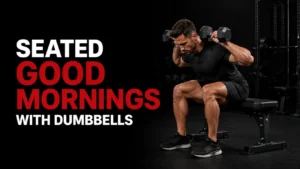
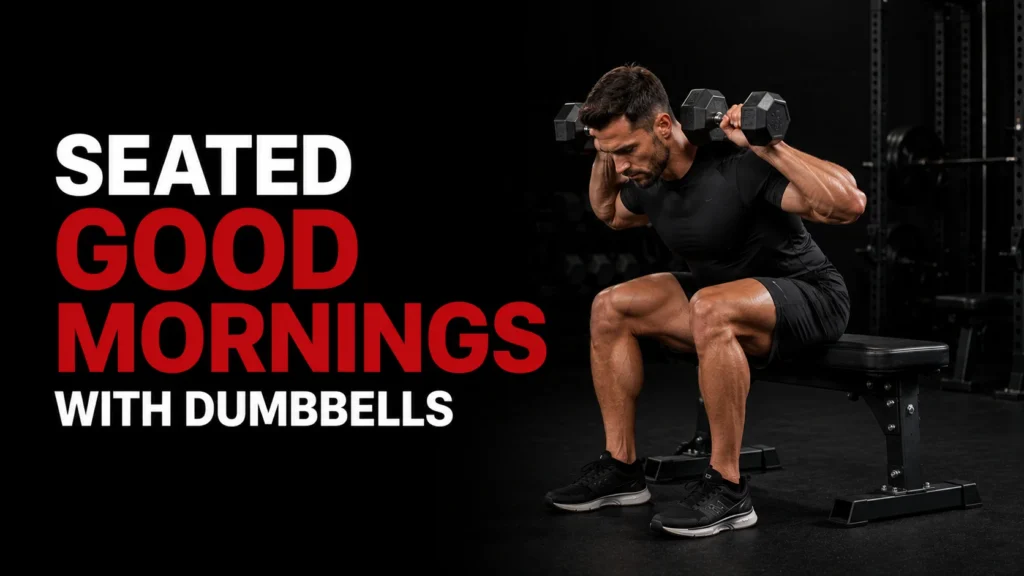
The seated good morning is a hip hinge exercise performed from a seated position on a flat bench. In the dumbbell version, you hold one dumbbell in each hand rather than loading a barbell across your upper back. The hinge itself — torso bowing forward, then returning upright — is the same fundamental movement pattern you use in deadlifts, Romanian deadlifts, and kettlebell swings.
What changes when you sit down is significant. The legs and glutes, which do a lot of stabilizing and driving work in the standing version, are largely removed from the equation. The bench locks your hips in place and shortens the hamstring contribution. What remains is primarily your lower back, your spinal erectors, your core, and your hip flexors working against the load. That is either a feature or a bug depending on what you are training for — and for most people reading this, it is a feature.
Dumbbells change the feel of the exercise in a few important ways compared to a barbell. There is no axial loading pressing down through your cervical spine. The weight hangs in front of your body or sits along your thighs, which slightly shifts where you feel the tension. You can also adjust the load unilaterally if needed, and the setup requires no squat rack.
How the Seated Version Differs From Standing Good Mornings
Standing good mornings are a more complete posterior chain exercise. With your feet on the floor and your hips free to move, the hamstrings and glutes get heavily involved as you hinge, especially in the eccentric phase where they are loaded under stretch. It is a bigger movement with greater systemic demand.
The seated version, as BarBend notes, essentially removes hamstring tension and makes the movement almost purely a spinal erector exercise. You cannot lift as much weight in the seated version — not even close — but that is the point. You are not trying to move weight. You are training a specific portion of the posterior chain that often gets undertrained, particularly in people whose programming leans heavily on hip-dominant movements where the hamstrings and glutes dominate.
Most lifters have done plenty of RDLs and hip thrusts. Their glutes are fine. Their lower backs and erectors? Often another story.
Muscles Worked in the Seated Good Morning With Dumbbells
Primary Muscles
Erector Spinae This muscle group runs the entire length of the spine in three columns — the iliocostalis, longissimus, and spinalis. During a seated good morning, these muscles do the most work. As your torso hinges forward, they contract eccentrically to control the descent, then concentrically to pull you back upright. Because the seated position limits other contributors, the erectors are forced to do proportionally more than they would in a standing version.
Lower Back Muscles (Lumbar Region) The multifidus and quadratus lumborum both contribute to spinal stability during this movement, working to maintain a neutral spine under load. These are deep stabilizer muscles that rarely get trained directly, and the seated good morning hits them in a way that most superficial back exercises miss entirely.
Secondary Muscles
Hamstrings Even seated, there is a degree of hamstring involvement, particularly if your feet are flat on the floor and you maintain some tension through the legs during the hinge. The contribution is less than in the standing version but not zero.
Glutes The gluteus maximus assists in hip extension during the concentric phase (returning upright), though again its role is reduced compared to the standing variation.
Core (Transverse Abdominis, Obliques) The core has to brace the spine throughout the movement. Any laxity here and you will feel it immediately in the lower back. Think of the core as the corset that keeps the spine in a safe position while the erectors do the dynamic work.
Shoulder Stabilizers In the dumbbell version, the rotator cuff and scapular stabilizers work to hold the dumbbells in position against your upper body. This is a secondary demand, but it is real — particularly when the weights drift away from the body.
Why This Exercise Deserves a Spot in Your Program
It Builds Posterior Chain Resilience That Carries Over Everywhere
Strong spinal erectors are not just useful in the gym. They are what keep you upright when carrying groceries, picking up a child, or sitting at a desk without slumping. The seated good morning with dumbbells trains these muscles through a controlled range of motion under load, which is exactly what you need to build functional, durable lower back strength.
It Improves Deadlifts and Squats
Westside Barbell has used seated good mornings as a primary accessory exercise for powerlifters for decades. The reason is straightforward: the squat and deadlift both demand strong spinal erectors and the ability to maintain a neutral spine under high loads. Weak erectors are often the reason a deadlift breaks down at the hip — the bar drifts, the lower back rounds, the lift fails or gets ugly. Seated good mornings address that weakness directly.
It Is Safer for Beginners and Those With Lower Back Sensitivity
A loaded barbell sitting across your upper back while you hinge forward is a situation that demands solid hip mobility, good shoulder mobility, and a trained feel for spinal position. Get any of those wrong and the risk goes up. The dumbbell seated version reduces that risk substantially. The load is lighter, the setup is simpler, and the seated position gives you feedback through the bench that helps keep the movement honest.
As ISSA notes in their training guidelines, the seated variation is particularly appropriate for people who cannot stand for long periods, who are recovering from lower body injuries, or who are new to hip hinge exercises and need a controlled environment to learn the pattern.
It Improves Hip Flexor Flexibility and Hip Mobility
Repeatedly hinging at the hip joint through a controlled range of motion trains the hip flexors to lengthen under tension rather than just contract. For people who sit for most of the day, hip flexor restriction is a real issue that affects posture and athletic performance. This exercise, done regularly, helps.
It Creates a Strong Mind-Muscle Connection in the Lower Back
Many lifters genuinely cannot feel their lower back working during compound movements. The seated good morning strips out enough of the other contributors that the erectors become impossible to ignore. After a few sets, most people report a clear sense of exactly where the work is happening, which translates into better muscle recruitment during heavier lifts.
How to Do Seated Good Mornings With Dumbbells: Step-by-Step
Equipment Setup
You need a flat bench and two dumbbells. For most beginners, starting with 10 to 15 pounds per hand is appropriate. The goal in early sessions is movement quality, not load.
Position the bench so you have clear space in front of you to hinge forward without the dumbbells hitting the floor.
Starting Position
Sit at the edge of the bench — not the middle. You want your hips at the edge so that your torso has room to hinge forward freely. Straddle the bench with one leg on each side if the bench is narrow enough to allow it, or sit with both feet flat on the floor wider than hip-width apart.
Hold one dumbbell in each hand. There are two common hand positions for the dumbbell version:
- Hanging at the sides or between the legs: This is the approach The Prehab Guys use in their exercise library. As you hinge forward, the dumbbells travel toward the floor between or outside your legs.
- Resting on the upper back or shoulders: This mimics the barbell position more closely and can be done with one dumbbell across the upper traps or with two dumbbells propped on the shoulders.
Both work. The hanging variation is more accessible and the natural choice for most people doing this without a barbell.
Sit tall. Roll your shoulder blades back and down. Brace your core. Set your feet slightly further forward than your knees.
The Movement
Take a breath and brace your core as if you are about to absorb a punch to the stomach. This intra-abdominal pressure is what protects the spine.
Hinge forward at the hips, not at the waist. There is a real difference. Hinging at the hips means your pelvis stays neutral as your torso descends — think of it as folding at the crease of your hip joint. Bending at the waist means the lumbar spine flexes first, which is not what you want here.
Lower your torso until it is close to parallel with the floor, or until you feel a noticeable but comfortable stretch in the lower back and posterior chain. Do not chase depth by rounding the lower back.
Pause briefly at the bottom. This is important. The pause eliminates momentum and forces the erectors to actually support the load in a lengthened position before contracting to bring you back up.
Drive through your hips and squeeze the glutes to return to the upright seated position. Do not yank yourself up. Keep the movement controlled through the entire concentric phase.
Exhale at the top. Reset your brace. Repeat.
Key Form Cues
- Neutral spine throughout — not arched, not rounded
- Chin tucked slightly, gaze forward and down
- Shoulder blades retracted before you begin the hinge
- Core braced, not just tight — there is a difference between sucking in and truly bracing
- Dumbbells controlled throughout the movement, not swinging free
Common Mistakes and How to Fix Them
Rounding the Lower Back
This is the most common and most consequential error. When the lower back rounds, the lumbar vertebrae flex under load, which is exactly the mechanism behind disc injuries. It usually happens because the weight is too heavy, the hip flexors are tight enough to pull the pelvis into a posterior tilt, or the lifter is not maintaining their brace.
Fix: Drop the weight. Practice with no weight at all first, just sitting on the bench and hinging with good spinal position. Feel where neutral is before adding load.
Bending at the Waist Instead of the Hip
Related to the above, but subtly different. Some lifters keep the lumbar spine neutral but flex at the thoracic spine, essentially folding over from the mid-back. This reduces the demand on the erectors and shifts stress to areas not designed for it.
Fix: Cue yourself to “push your chest toward the wall in front of you” rather than dropping your head down. Keeping the chest proud helps maintain thoracic extension.
Using Too Much Weight Too Soon
Seated good mornings are humbling. Because the movement is controlled and the range of motion is deliberate, it does not take much weight to create significant muscular demand. Many people grab the same dumbbell they use for bent-over rows and wonder why their form falls apart immediately.
Fix: Start light. The erectors are not typically trained this directly in most programs, so they fatigue faster than you expect. 10 to 20 pounds per hand is plenty for a first session.
Letting the Dumbbells Drift Away From the Body
When the weights drift forward and away from your center of mass, the leverage changes significantly and the lower back takes a much harder hit than intended.
Fix: Keep the dumbbells close to your legs throughout the movement. If using the hanging variation, let them travel between your thighs.
Sitting in the Middle of the Bench
This seems minor but it matters. Sitting in the middle of the bench restricts how far forward you can hinge before the bench itself blocks the movement. You end up doing a shortened, awkward version of the exercise.
Fix: Always set up at the edge of the bench.
Skipping the Pause at the Bottom
Rushing through the bottom position turns the exercise into a momentum-driven movement that trains nothing particularly well.
Fix: Count a one- to two-second pause at the bottom of every rep.
Seated Good Mornings With Dumbbells vs. Other Variations
Seated Dumbbell vs. Seated Barbell
The barbell seated good morning requires a squat rack and a spotter setup. It allows heavier loading and more closely mimics the powerlifting accessory version used at gyms like Westside Barbell. The dumbbell version is more accessible, allows for easier load adjustment, and removes the cervical spine compression that comes with a barbell across the traps. For most non-competitive lifters, the dumbbell version is the smarter choice.
Seated vs. Standing Good Mornings With Dumbbells
Standing dumbbell good mornings train more of the posterior chain — the hamstrings and glutes get a much larger share of the work. The seated version is more targeted to the spinal erectors specifically. Neither is better; they serve different purposes. If you want comprehensive posterior chain development, you might use both. If you specifically need to address lower back weakness or build erector endurance, the seated version is more direct.
Seated Good Mornings vs. Romanian Deadlifts
RDLs are a heavier, more systemic exercise. They build more total muscle, move more load, and are generally a better choice as a primary posterior chain exercise. Seated good mornings work better as an accessory — something you do after your main lift to target the erectors directly. Treat them as complementary rather than competing exercises.
Seated Good Mornings vs. Hyperextensions
Both target the erectors. Hyperextensions (done on a GHD machine or 45-degree back extension bench) work through a different plane and allow a slightly different range of motion. If you have access to a GHD, rotating between both exercises provides better overall erector development than doing just one.
Progressions: How to Make This Exercise Harder Over Time
The seated good morning with dumbbells has a natural progression curve that takes most people several months to work through.
Stage 1: Bodyweight Before picking up any dumbbell, master the seated hip hinge with bodyweight only. Sit at the bench edge, cross your arms over your chest, and hinge forward maintaining a neutral spine. Do three sets of 12 clean reps before adding load.
Stage 2: Light Dumbbells (5 to 15 lbs per hand) Add the lightest pair of dumbbells you have access to. Focus on the pause at the bottom and controlled tempo. A 3-second eccentric (going down), one-second pause, and 2-second concentric (coming up) is a good starting point.
Stage 3: Moderate Dumbbells (15 to 30 lbs per hand) Once you can consistently perform 3 sets of 12 with control and a clear pause, increase load. At this stage, you are building meaningful erector strength.
Stage 4: Heavier Load or Tempo Variation Rather than endlessly chasing heavier dumbbells — which gets awkward in the seated position — consider adding a longer pause (3 to 5 seconds) at the bottom, or using a 4 to 5-second eccentric. Both are more effective at this stage than simply adding weight.
Stage 5: Transition to Seated Barbell If you have access to a squat rack and want to load the movement more heavily, the barbell variation allows significantly more weight. By the time you are ready for this, you will have the positional awareness to do it safely.
How to Program Seated Good Mornings With Dumbbells
This exercise works best as an accessory movement, not a primary lift.
Frequency: Once or twice per week. The erectors need recovery time, especially if you are already doing heavy deadlifts or squats in the same training block. At least 48 hours between sessions that include this exercise.
Volume for Strength (building erector capacity): 3 to 4 sets of 8 to 12 reps. Choose a weight where the last two reps of each set require real effort but form does not break down.
Volume for Endurance/Rehabilitation: 2 to 3 sets of 12 to 15 reps with lighter weight. Useful in early rehabilitation phases or when using this as a warm-up tool before heavier pulls.
Where to Place It in a Session: After your main compound movements. If you are squatting or deadlifting, put seated good mornings toward the end of the session as an accessory. They complement pulling movements well. A sample placement might look like this:
- Conventional deadlift (main lift)
- Romanian deadlift (secondary compound)
- Seated good mornings with dumbbells (accessory, 3 sets of 10)
- Core work
Pairing Exercises: Seated good mornings work well alongside exercises that do not directly compete for lower back fatigue. Good pairings include glute bridges, planks, single-leg RDLs, face pulls, or bent-over rows. Avoid stacking them immediately after heavy back squats or sumo deadlifts where the erectors are already deeply fatigued.
Who Should Use This Exercise
Good Candidates
People who have identified lower back weakness as a limiting factor in their deadlift or squat are the primary audience. If your hips shoot up before your shoulders during a heavy pull, that is often an erector problem. Seated good mornings address it directly.
Desk workers with tight hip flexors and weak postural muscles also benefit significantly. The hip hinge pattern, trained regularly, counteracts the sustained hip flexion position that sitting creates.
Those in rehabilitation from mild lower back injuries (with physician or physio clearance) often find the seated dumbbell version accessible because it avoids the spinal loading of a barbell while still training the relevant muscles through their range.
Powerlifters and Olympic weightlifters who want to build upper posterior chain strength for their sport will recognize this as a staple accessory movement with a long history in serious strength training programs.
Who Should Be Careful or Skip It
Anyone with an acute disc herniation or active lumbar injury should not do this exercise without explicit clearance from a physical therapist or spine specialist. The spinal flexion-extension movement, even controlled, puts stress on the lumbar vertebrae and discs that can aggravate certain conditions.
People who cannot maintain a neutral spine under any load should regress to bodyweight hip hinge work before adding dumbbells. The exercise is not inherently dangerous, but poor form combined with even modest load can cause injury.
If you have significant shoulder mobility restrictions that prevent you from holding dumbbells in a controlled position across your upper body, the hanging dumbbell variation (weights between the legs) is a safer approach.
Alternatives When You Cannot Do Seated Good Mornings
Hyperextensions (Back Extensions): The closest substitute. A 45-degree back extension bench or GHD machine allows you to train the erectors through a similar range of motion with similar isolation. Widely available in commercial gyms.
Bird Dogs: A lighter-load alternative that trains lumbar stability and erector endurance without spinal flexion-extension under weight. Excellent for beginners or during rehabilitation.
Superman Hold: Lying prone and lifting the arms and legs off the ground. Trains the erectors isometrically. Works as a warm-up or very early rehabilitation exercise.
Cable Pull-Throughs: A hip hinge exercise with lighter load and no spinal loading. Not as specific to the erectors as seated good mornings, but it reinforces the same hip hinge mechanics with less lower back demand.
Banded Good Mornings: Using a resistance band across the upper back instead of dumbbells. The band accommodates resistance through the range of motion differently than free weights, with peak tension at the top rather than distributed evenly. Useful as a warm-up or when dumbbells are unavailable.
Practical Tips From Experienced Lifters
Film yourself from the side occasionally. It is almost impossible to know whether your lower back is rounding from internal sensation alone, especially as fatigue sets in. Even just checking a video on your phone from the side after a set tells you more than 20 minutes of thinking about it.
Use a slower tempo than you think you need. Seated good mornings feel easy with momentum. Remove the momentum completely — 3 to 4 seconds down, pause, 2 to 3 seconds up — and the exercise becomes genuinely demanding at weights that felt almost trivial before.
Squeeze the shoulder blades before the hinge begins. This one cue changes the exercise dramatically. A tight upper back gives the lower back something stable to work from. Without scapular retraction, the movement often breaks down at the thoracic spine before the lumbar spine even gets properly loaded.
Do not neglect the return phase. Most people pay attention on the way down and rush on the way up. The concentric phase — where the erectors contract concentrically to bring you upright — is where a lot of the strength-building stimulus lives. Control it.
Frequently Asked Questions (FAQs)
Are seated good mornings with dumbbells safe for people with lower back problems?
For many people, yes — but it depends heavily on the nature of the problem. For general lower back weakness or postural issues, this exercise can be genuinely therapeutic when performed with light weight and strict form. For acute disc injuries, herniations, or nerve compression, do not attempt this without clearing it with a spine specialist or physical therapist. The seated variation is generally lower-risk than the standing barbell version because the load is lighter and there is no axial spinal compression from a barbell, but lower risk is not no risk.
How much weight should I start with for seated dumbbell good mornings?
Lighter than you think. Most beginners are well served starting with 5 to 15 pounds per hand and focusing on form for the first two to three sessions. The erectors are not used to being trained this directly in most programs, which means they fatigue quickly at first. Adding weight prematurely is the most common reason people get nothing useful out of this exercise.
How many sets and reps should I do?
For strength development, 3 to 4 sets of 8 to 12 reps is a solid starting point, as recommended across multiple professional training resources. For rehabilitation or endurance, 2 to 3 sets of 12 to 15 reps with lighter weight works better. Adjust based on how your lower back feels in the 24 to 48 hours after training.
Can I do seated good mornings every day?
No. The erectors are a muscle group like any other — they need recovery time. Training them directly more than two times per week is likely to lead to cumulative fatigue rather than progressive strength. Once or twice weekly as an accessory is the appropriate frequency for most people.
What is the difference between seated good mornings and Romanian deadlifts?
The Romanian deadlift is a standing exercise that involves a much greater contribution from the hamstrings and glutes, heavier loads, and more total muscle recruitment. Seated good mornings isolate the spinal erectors more specifically and involve less weight. They are not interchangeable — they serve different purposes in a program. RDLs are better as a primary lower body movement; seated good mornings work better as targeted accessory work for the lower back.
Do seated good mornings help with posture?
Yes, in a real and practical sense. Weak spinal erectors are a primary contributor to the forward-rounded posture common in people who sit for long periods. Strengthening these muscles through exercises like seated good mornings — combined with upper back work like face pulls and rows — creates the muscular support system that holds the spine upright. It is not a quick fix, but consistent training makes a measurable difference over weeks and months.
Can I do this exercise at home without gym equipment?
You need a flat, sturdy bench or chair and a pair of dumbbells. If you have those, yes. A kitchen chair actually works reasonably well for the seated variation, though it needs to be stable enough to support your movement without sliding. Start with bodyweight if you have no dumbbells — the hip hinge pattern alone has value as a warm-up and mobility exercise.
Do seated good mornings build the glutes?
Less than the standing version. The seated position limits glute involvement considerably, which is the tradeoff for the increased erector isolation. If glute development is your primary goal, standing dumbbell good mornings, hip thrusts, or Romanian deadlifts will deliver better results. If lower back and erector strength is the goal, the seated version is more targeted.
In conclusion
The seated good morning with dumbbells is not a glamorous exercise. It will not show up on anyone’s social media feed as a PR attempt. But it fills a gap that most training programs leave wide open — direct, controlled, progressive training of the spinal erectors and lower back in a pattern that transfers directly to every posterior chain movement you do.
The dumbbell variation makes it accessible. You do not need a squat rack. You do not need a spotter. You do not need to load a barbell across your cervical spine and hope your shoulder mobility holds. A bench and a modest pair of dumbbells are enough to get meaningful work done.
Start light, learn what neutral spine actually feels like under load, use the pause at the bottom, and be consistent. Three sets twice a week, done properly, over eight to twelve weeks, builds a lower back that is noticeably more resilient. That resilience shows up in your deadlift lockout, your squat depth, your posture at the end of a long workday, and the way your back feels after a long flight.
Not every exercise needs to be impressive to be worth doing. Sometimes the quiet ones do the most important work.