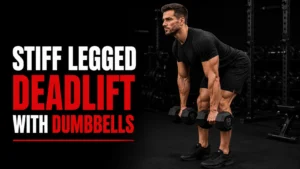
If your hamstrings feel like they just sit there doing nothing during your leg days, the stiff legged deadlift with dumbbells is probably the exercise you’ve been missing. It’s one of those movements that looks deceptively simple from across the gym but when you actually nail the technique, you’ll feel it working muscles you forgot you had.
What This Exercise Actually Does
The stiff legged deadlift is a hip hinge movement that hammers the posterior chain — primarily the hamstrings, but also the glutes and erector spinae. With the legs held nearly straight throughout, the hamstrings are forced to work hard through a long range of motion, from a stretched position at the bottom all the way through hip extension at the top.
The “stiff” part doesn’t mean your legs are locked out completely. It means there’s only a very slight bend in the knee and that bend stays constant. You’re not squatting. You’re hinging.
Because the dumbbells start from the floor each rep (unlike the Romanian deadlift, which stays in the hang), there’s a dead stop between reps. That resets the tension, which means slightly less constant time under tension on the hamstrings compared to an RDL, but also slightly less spinal loading on the way up because you can reset your bracing each time.
For home gym lifters and dumbbell-only trainees, this is one of the best posterior chain exercises available. You don’t need a barbell. You don’t need a lot of weight. You need good technique and a willingness to actually feel what your hamstrings are doing.
Stiff Legged vs. Romanian Deadlift: Clear It Up Now
These two get confused constantly, and the confusion matters because they’re not the same exercise and they don’t serve exactly the same purpose.
The Romanian deadlift starts from standing, with the weight in your hands. You push the hips back, lower the dumbbells to roughly mid-shin, feel the hamstring stretch, then drive back up — and the weights never touch the floor. Your knees stay noticeably bent throughout, maybe 15–25 degrees of flexion. Because of that knee bend, the hips can travel further back, keeping more tension on the hamstrings and glutes as a unit. It’s excellent for heavy loading and constant tension.
The stiff legged deadlift starts from the floor. Your knees are much straighter — maybe just 5–10 degrees of flexion — which means your hips sit higher at the start, your torso leans further forward, and there’s a significantly greater stretch placed on the hamstrings at the bottom. The lower back works harder here too, because that forward lean increases the moment arm on your spine.
Research comparing the two supports what experienced coaches already know: the RDL tends to produce slightly higher hamstring activation overall, while the stiff legged version places a deeper stretch on both the hamstrings and glutes. Both are useful. Neither replaces the other.
If you only do one, do the RDL — it’s more forgiving, allows heavier loads, and has a better risk-to-reward ratio for most people. But if you want complete posterior chain development, the stiff legged version earns its place.
How to Do the Stiff Legged Deadlift with Dumbbells
Setup
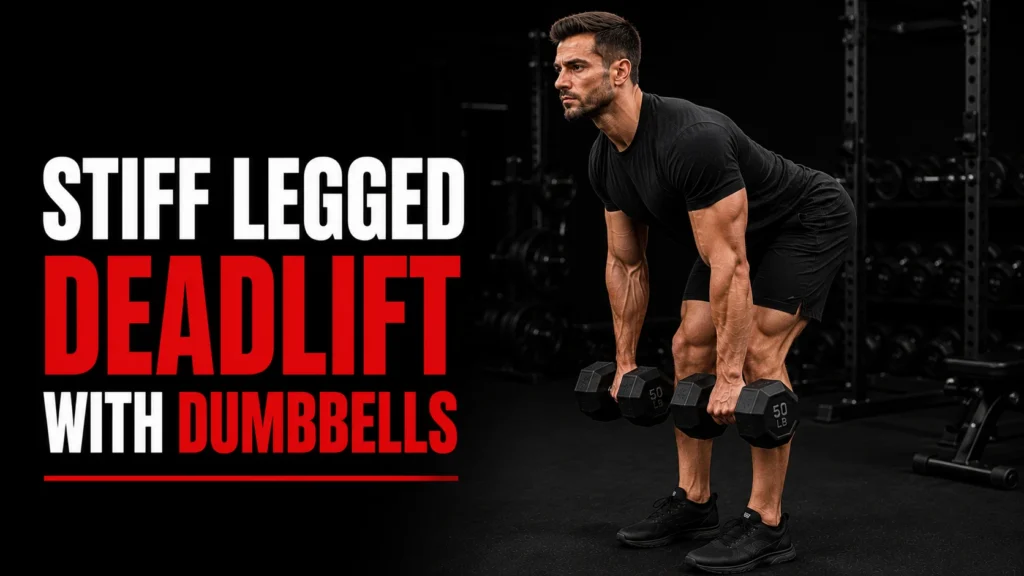
Stand with your feet about hip-width apart, dumbbells on the floor just in front of your shins. Most people do well with a neutral grip (palms facing your body), though a slight rotation inward is fine if it feels more natural.
Before you pull, set your position:
- Hips pushed back and raised, so they’re higher than a conventional deadlift — closer to shoulder height
- Very slight bend in the knees — think “soft knees,” not a squat
- Spine neutral — flat back, no rounding in the lumbar, no excessive arch either
- Chest up, shoulders pulled back and down
- Core braced hard, like you’re about to take a punch
This hip-high starting position is what distinguishes the stiff legged deadlift from a conventional pull. Your hamstrings should already feel some tension before you’ve lifted the weight an inch.
The Pull
Take a breath, brace your core, and drive through the floor — but think of it as “pushing the floor away” rather than pulling up. The dumbbells should travel in a straight line, staying close to your legs throughout. Drive the hips forward as you stand up, squeezing the glutes at lockout.
Don’t lean back at the top. Just stand tall.
The Descent
This is where most people lose the plot. Hinge at the hips — push them back, not down. Let the dumbbells travel down along your legs, keeping your back flat. Lower slowly and under control, maintaining that slight knee bend the whole way. Stop when you feel a significant stretch in the hamstrings, or when your lower back is about to round — whichever comes first.
Let the dumbbells touch the floor, reset your brace, and go again.
Breathing
Breathe in at the bottom or before you pull. Hold the breath through the pull (Valsalva maneuver), exhale at the top. On heavier sets, some people exhale and re-brace before lowering. Either way, don’t exhale mid-rep while your spine is loaded and in a compromised position.
The Range of Motion Question
This is where honesty matters. The bottom of this exercise is limited by your hamstring flexibility — not by how far the floor is. If your hamstrings are tight, you’ll start rounding your lower back before the weights reach the floor. That’s your cue to stop.
A common mistake is insisting on full range of motion even when your mobility doesn’t support it. You get the weight to mid-shin with a flat back, and then instead of stopping there, you try to coax those last few inches by cranking your lower back into flexion. That’s how people hurt themselves. The stretch you feel in your hamstrings at mid-shin is still training them effectively. You don’t need the weights on the floor to make progress.
Work with your current mobility. Over time — with consistent training and stretching — your range will improve naturally.
Common Mistakes to Avoid
Rounding the lower back. The biggest one. Usually happens because the weight is too heavy, the range of motion is too ambitious, or both. Drop the weight, reduce range, and focus on keeping the spine neutral throughout. If you can’t feel the difference between a flat back and a rounded one, film yourself from the side — it’s almost always worse than you think.
Going too heavy. This exercise is not a strength movement. You will never stiff leg deadlift your max deadlift weight, and you shouldn’t try. With nearly straight legs and a forward-leaning torso, you’re at a mechanical disadvantage. The loads need to be moderate. Moderate weight, controlled reps, real hamstring connection — that’s the goal. Most beginners feel humbled by how light they have to go to maintain good form.
Letting the dumbbells drift away from the body. The further the weights are from your center of mass, the more stress goes through your lower back. Keep them close. Trail them along your shins and thighs. They don’t need to touch your skin, but they should track close.
Bending the knees too much. You’ll notice that as the weight gets heavy or the set gets hard, there’s a temptation to bend the knees more and more until you’re basically doing an RDL. That’s fine as an RDL — but it’s not the stiff legged variation anymore. If you’re losing the straight-leg position, either the weight is too heavy or you’re fatiguing.
Looking up excessively. Keeping the neck neutral is important. Don’t crane your head up to look in the mirror — follow the natural line of your spine. This is a small thing that makes a noticeable difference in how the movement feels and how much stress goes through the cervical spine.
Hyperextending at the top. Don’t lean back at lockout. Stand up straight, squeeze the glutes, and resist the urge to exaggerate the finish. Excessive lumbar extension at the top of the rep can cause lower back discomfort over time.
What You’ll Actually Feel
This is worth covering because a lot of people think they’re doing this exercise wrong when actually they’re just experiencing it correctly.
At the bottom of the rep, you should feel a deep pull — almost an ache — in the hamstrings. It might also run into the glutes. That’s the stretch you’re looking for. Once the weights get heavy, some people also feel it in the erectors along the lower back, which is normal. If you feel it predominantly in the lower back and almost nothing in the hamstrings, your hips are probably too low and you’re more in a conventional deadlift position.
This usually feels awkward at first — especially the “standing up by driving the hips forward” cue. Most beginners instinctively try to stand up by pulling with the arms or arching the lower back. Focus on the hips. Imagine your hips are on a hinge and you’re closing the angle between your torso and thighs.
Programming: Where It Fits
The stiff legged deadlift is an accessory exercise, not a primary lift. It belongs on a lower body day, typically after your main compound movement.
A sensible structure might look like:
- Primary: Goblet squat or dumbbell lunge
- Accessory 1: Dumbbell stiff legged deadlift — 3–4 sets of 8–12 reps
- Accessory 2: Dumbbell split squat or Bulgarian split squat
- Isolation: Lying or seated leg curl if available
Sets of 8–12 work well for hypertrophy. If you’re using this as a mobility and flexibility development tool — which is a legitimate use — higher reps (12–15) with lighter weight can be effective too. Going below 6 reps on this exercise usually means the weight is too heavy to control safely.
Once the weights get heavy, grip can become a limiting factor before the hamstrings do. This is common and worth acknowledging. Lifting straps are a completely legitimate tool here — there’s no reason your grip should be the bottleneck when you’re trying to train your hamstrings.
Who Benefits Most
People with tight hamstrings. Counterintuitively, this exercise is both demanding of and beneficial for hamstring flexibility. Working the hamstrings in their lengthened position, consistently, over time, improves the flexibility you need to perform it properly. It’s a productive cycle.
Home gym and dumbbell-only lifters. This is one of the best posterior chain exercises you can do without a barbell. Dumbbells actually have a slight advantage here — they can travel slightly inside your thighs, which some people find allows a more natural range of motion than a barbell.
People building toward conventional or Romanian deadlifts. The stiff legged version is excellent for grooving the hip hinge pattern, building hamstring and erector strength, and developing the positional awareness you need for heavier pulling.
Anyone whose hamstrings are notably weaker than their quads. Quad dominance is extremely common, especially in people who do a lot of squats and running. The stiff legged deadlift forces the hamstrings to work hard and helps correct that imbalance.
Who Should Be Cautious
If you have a history of lower back issues, you need to be careful here. The forward lean combined with straight legs creates real torque on the lumbar spine, and going heavy with compromised form is a straightforward path to injury. If you’ve had back problems, start very light, work with a trainer or physio, and honestly evaluate whether the risk is worth it. Romanian deadlifts are significantly more lower-back-friendly and may be a better long-term choice.
People with very poor hamstring flexibility — where you physically can’t hinge without the lower back rounding immediately — should probably spend a few weeks doing RDLs to a comfortable range before introducing the stiff legged version.
A Few Programming Notes Worth Knowing
Don’t do this exercise cold. The lower back and hamstrings need to be warmed up before you put them under load at this kind of stretch. A few minutes of hip circles, light glute bridges, and some easy bodyweight hinges goes a long way.
This exercise goes well with hip flexor stretching as part of your cooldown. Tight hip flexors pull the pelvis anterior and can make maintaining a flat lower back harder. If your lower back always feels taxed after this movement, hip flexor tightness might be contributing.
Don’t neglect the eccentric. The lowering phase is where a lot of the hamstring-building work happens. Slow it down — 2–3 seconds down, brief pause at the bottom, controlled return. Rushing the descent is one of the most common ways to waste the exercise.
Frequently Asked Questions (FAQs)
Can I do this on a leg day or a pull day?
Either works. Since it trains the posterior chain, it fits naturally on both a lower body day and a back/pull day. If you’re training four or five days a week, spreading posterior chain work across multiple sessions — say, RDLs on pull day and stiff legged on leg day — is a legitimate approach.
Is it okay to feel this in my lower back?
Some erector involvement is normal and expected. If you feel a deep fatigue in the muscles alongside your spine, that’s usually fine. Sharp pain, or pain that shifts to one side or radiates down a leg, is a different story — stop, reassess your form, and if it persists, see a professional.
What weight should I start with?
Lighter than you think. For most people, starting with dumbbells that are 30–40% of what they’d use for a goblet squat is about right. The goal is to feel the hamstrings working, not to load as much as possible. Form degrades fast when the weight gets heavy on this one.
Can you do stiff leg deadlifts with dumbbells?
Yes — dumbbells actually work great for this movement, and some people find them more comfortable than a barbell since the weights can travel slightly inside your thighs for a more natural path.
Is deadlift good for back pain?
It depends entirely on the cause — for general lower back weakness, deadlifts (done correctly and progressively) can strengthen the supporting muscles and reduce pain over time, but if you have a disc injury or acute pain, get cleared by a professional before loading your spine.
Which is harder, RDL or SLDL?
The stiff legged deadlift is harder to execute with good form — the straighter legs demand more hamstring flexibility, your lower back works harder, and you can move significantly less weight before technique breaks down.
What are stiff-legged deadlifts good for?
Building hamstring and posterior chain strength, improving hip hinge mechanics, developing hamstring flexibility under load, and filling in the gaps left by quad-dominant training.
Is a stiff leg deadlift better than a deadlift?
Not better — different; the conventional deadlift is superior for overall strength and total load, while the stiff legged version is a more targeted accessory that isolates the hamstrings and erectors in a way a conventional pull doesn’t.