
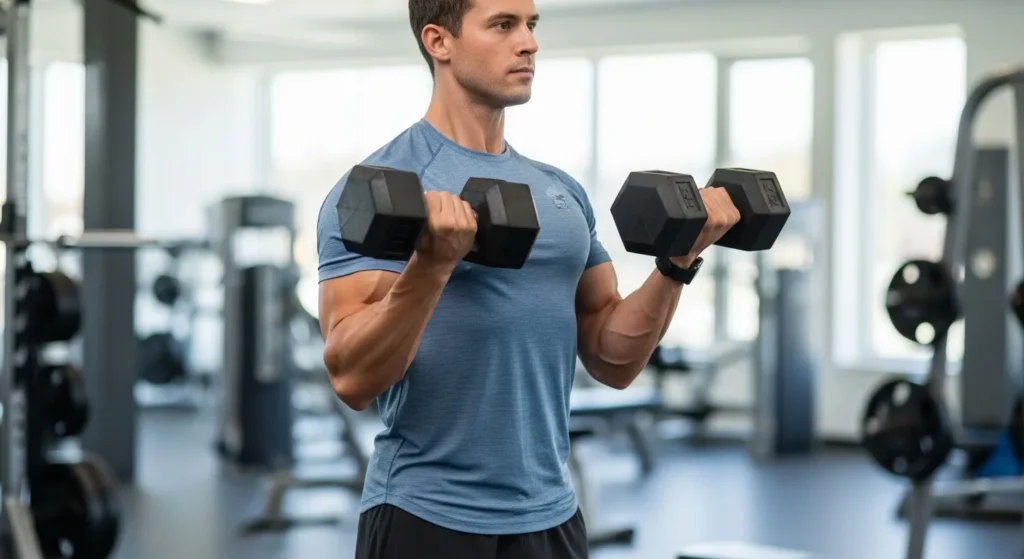
If your goal is to build thicker arms, improve grip strength, and develop balanced biceps and forearms, the dumbbell hammer curl deserves a permanent place in your workout routine. While traditional curls get most of the spotlight, this underrated variation is one of the most effective exercises for total arm development.
What Is a Dumbbell Hammer Curl?
The dumbbell hammer curl is a biceps curl variation performed with a neutral grip (palms facing each other). This small change significantly alters muscle activation, making it one of the best exercises for building arm thickness and forearm strength.
Unlike standard curls (palms up), hammer curls emphasize not just the biceps but also deeper and often neglected muscles in the arms.
Muscles Worked in the Dumbbell Hammer Curl
The hammer curl is a compound isolation movement targeting multiple elbow flexors:
Primary Muscles
- Biceps brachii – the main muscle responsible for arm flexion
- Brachialis – lies beneath the biceps and adds arm thickness
- Brachioradialis – a key forearm muscle that enhances grip strength
These muscles work together to flex the elbow and lift the dumbbell toward your shoulder .
Why This Matters
Most lifters focus only on the biceps peak. But if you want bigger-looking arms, the brachialis is crucial—it pushes the biceps upward, creating a fuller appearance.
Benefits of the Dumbbell Hammer Curl
1. Builds Thicker Arms (Not Just Bigger Biceps)
Because it targets the brachialis and brachioradialis, the hammer curl contributes more to arm width and density than traditional curls.
2. Improves Grip Strength
The neutral grip heavily engages forearms, improving performance in:
- Deadlifts
- Rows
- Pull-ups
3. Allows Heavier Lifting
Many people can lift more weight with hammer curls due to the stronger wrist position .
4. More Joint-Friendly
Hammer curls often reduce stress on:
- Wrists
- Elbows
- Shoulders
This makes them ideal for beginners and those with minor joint discomfort.
5. Enhances Functional Strength
The movement mimics real-life pulling actions like:
- Carrying bags
- Lifting objects
- Climbing or pulling
How to Do Dumbbell Hammer Curl (Step-by-Step)
Mastering form is critical. Here’s how to perform it correctly:
Step 1: Starting Position
- Stand upright with feet shoulder-width apart
- Hold a dumbbell in each hand
- Keep arms at your sides
- Palms facing each other (neutral grip)
Step 2: Brace and Curl
- Keep your core tight
- Curl the dumbbells upward by bending your elbows
- Keep elbows close to your torso
Step 3: Top Position
- Lift until dumbbells reach shoulder level
- Pause briefly (1 second squeeze)
Step 4: Controlled Lowering
- Slowly lower the weights back down
- Maintain control (2–4 seconds)
Step 5: Repeat
- Perform 8–15 reps
- Complete 2–4 sets
Proper technique includes keeping your elbows stable and avoiding momentum .
Proper Form Checklist
Use this quick checklist to ensure perfect execution:
- Keep elbows pinned to your sides
- Maintain a neutral spine
- Use a controlled tempo
- Avoid swinging or using momentum
- Keep wrists straight (no bending)
Common Mistakes to Avoid
Even experienced lifters mess this up. Here are the biggest errors:
1. Swinging the Weights
Using momentum reduces muscle activation and increases injury risk.
2. Moving Elbows Forward
This shifts tension away from the biceps.
3. Lifting Too Heavy
Heavy weights often lead to poor form and reduced effectiveness.
4. Partial Range of Motion
Not fully extending or contracting limits muscle growth.
5. Fast Reps
Rushing the movement reduces time under tension.
Best Variations of Dumbbell Hammer Curl
Adding variations helps target muscles from different angles and prevents plateaus.
1. Alternating Hammer Curl
- Lift one arm at a time
- Better focus and control
2. Cross-Body Hammer Curl
- Curl across your torso
- Greater brachialis activation
3. Seated Hammer Curl
- Reduces momentum
- Improves strict form
4. Incline Hammer Curl
- Performed on an incline bench
- Increases stretch and muscle activation
5. Rope Hammer Curl (Cable)
- Constant tension throughout movement
- Great finisher exercise
Dumbbell Hammer Curl vs Bicep Curl
| Feature | Hammer Curl | Bicep Curl |
|---|---|---|
| Grip | Neutral | Supinated |
| Focus | Brachialis & forearms | Biceps peak |
| Strength Potential | Higher | Moderate |
| Joint Stress | Lower | Slightly higher |
| Best For | Thickness & strength | Aesthetic peak |
How to Add Hammer Curls to Your Workout
For Beginners
- 2–3 sets
- 10–12 reps
- Light to moderate weight
For Muscle Growth (Hypertrophy)
- 3–4 sets
- 8–12 reps
- Moderate to heavy weight
For Strength
- 4–5 sets
- 6–8 reps
- Heavy weight
Sample Arm Workout
- Dumbbell curls – 3 sets
- Hammer curls – 3 sets
- Concentration curls – 3 sets
- Rope curls – 2 sets
Training Tips for Maximum Results
Focus on Time Under Tension
- 2 seconds up
- 3–4 seconds down
Progressive Overload
Gradually increase:
- Weight
- Reps
- Sets
Mind-Muscle Connection
Concentrate on squeezing your biceps and forearms.
Train 2–3 Times Per Week
Allow proper recovery for muscle growth.
Who Should Do Dumbbell Hammer Curls?
This exercise is ideal for:
- Beginners learning arm training
- Bodybuilders aiming for arm thickness
- Athletes needing grip strength
- People with wrist discomfort from supinated curls
Safety Tips and Precautions
- Warm up before lifting
- Start with lighter weights
- Stop if you feel pain
- Maintain strict form
- Avoid locking elbows aggressively
Frequently Asked Questions (FAQs)
Are dumbbell hammer curls better than regular curls?
They’re not better—just different. Hammer curls build thickness and forearm strength, while regular curls emphasize the biceps peak.
How heavy should I go on hammer curls?
Use a weight that allows proper form for 8–12 reps without swinging.
Can beginners do hammer curls?
Yes, they’re beginner-friendly and easier on the joints.
Do hammer curls build forearms?
Yes, they significantly activate the brachioradialis, improving forearm size and strength.
How often should I do hammer curls?
2–3 times per week is ideal for most people.
Should I do hammer curls seated or standing?
Both are effective. Standing allows heavier lifts, while seated improves strict form.
Why do I feel hammer curls more in my forearms?
That’s normal—the neutral grip emphasizes forearm muscles more than traditional curls.
Can hammer curls replace bicep curls?
No. For best results, include both in your routine.
You can also follow “Biceps Workouts With Dumbbells” for dumbbell workouts, and fitness tips to help you get better results.