Most people assume you need a barbell and a squat rack to build real strength. That assumption is wrong and it keeps a lot of people either stuck waiting for a gym membership they never use or doing bicep curls with 10-pound dumbbells wondering why nothing is changing.
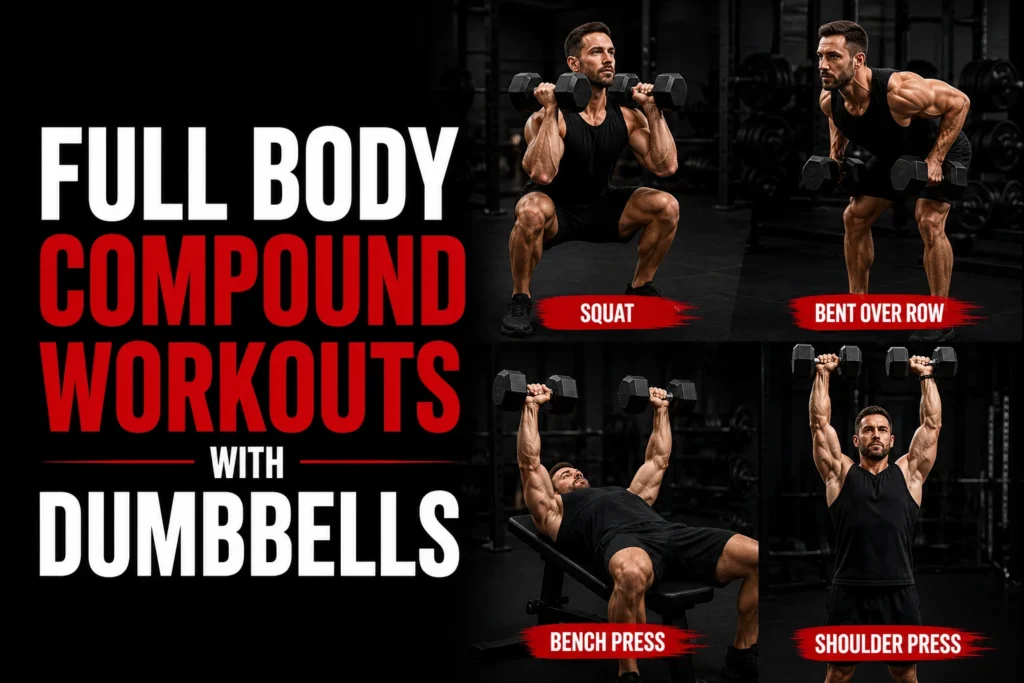
A pair of dumbbells, the right exercises, and a real understanding of how compound movements work is enough to train your entire body, build meaningful muscle, and get genuinely strong. Whether you’re training at home, traveling, or working with a bare-bones setup, this guide gives you everything you need.
What Are Full Body Compound Workouts?
Compound exercises are multi-joint movements that require two or more muscle groups to work together. A goblet squat, for example, loads the quadriceps, glutes, hamstrings, hip flexors, and core simultaneously. Compare that to a leg extension — one joint, one muscle group, a narrow training stimulus.
Full body compound workouts string several of these multi-joint movements into a single session, covering every major muscle group rather than dedicating separate days to chest, back, or legs.
This approach isn’t a beginner’s compromise. Research consistently shows that training each muscle group two to three times per week produces greater hypertrophy than hitting it once with higher volume, which is exactly what a properly structured full body program achieves.
The Science Behind Why Compound Movements Work
Motor Unit Recruitment
When you train an isolation exercise, you’re asking one muscle to produce force. Compound movements require your nervous system to coordinate multiple muscles firing in sequence and simultaneously — which recruits far more motor units per set. More motor units means more total muscle tissue stimulated, which is why a set of deadlifts leaves you more systemically fatigued than a set of leg curls at the same RPE.
Hormonal Response
Multi-joint exercises involving large muscle groups produce a stronger anabolic hormonal response than isolation work. Movements like dumbbell deadlifts and thrusters trigger greater post-workout release of testosterone and growth hormone, which accelerates recovery and muscle adaptation across all muscle groups — not just the ones you directly targeted.
EPOC and Caloric Burn
A study published in the European Journal of Applied Physiology found that a 30-minute compound exercise session elevated participants’ metabolisms for up to 48 hours after the workout — far beyond what steady-state cardio produces. This is excess post-exercise oxygen consumption, or EPOC. Research shows the EPOC effect produces a 6% to 15% increase in overall calorie consumption post-workout. Using compound movements, and supersetting exercises, results in a larger EPOC effect — particularly when heavy training loads and shorter recovery intervals are used.
Neural Efficiency
Repeating compound movement patterns across multiple sessions builds what exercise scientists call neural efficiency — the brain’s ability to recruit muscle fibers faster, more completely, and with less wasted effort. Most beginners see dramatic strength gains in their first couple months of compound training before muscle size visibly changes, because the nervous system is learning to use the muscle it already has.
The 10 Best Full Body Compound Workouts with Dumbbells
1. Goblet Squat
The goblet squat is the best entry point for loaded squatting. Holding a single dumbbell at chest height counterbalances the hips naturally, making an upright torso position easier to maintain than in a barbell back squat — which means cleaner mechanics and fewer technique breakdowns under fatigue.
The goblet squat trains multiple joints simultaneously, reinforcing proper squat mechanics while keeping the load centered. Holding the dumbbell in front encourages an upright torso and increases core engagement, making it ideal for full-body strength development. Muscles worked: quadriceps, glutes, hamstrings, core, upper back, and hip stabilizers.
How to do it: Hold one dumbbell vertically with both hands cupped around the top end, kept at chest height. Stand with feet slightly wider than hip-width, toes turned out 15–30 degrees. Sit your hips back and down between your knees — not straight down — until thighs are parallel to the floor or just below. Drive through your heels to stand.
Coaching cue: Think “sit between your hips” rather than straight down. This reduces knee strain and improves depth control.
Programming note: 3–4 sets of 8–15 reps. Adding a 2-second pause at the bottom dramatically increases the training stimulus without adding any weight.
2. Romanian Deadlift (RDL)
The Romanian deadlift trains the hamstrings under a loaded stretch — exactly the position where they’re weakest and most injury-prone. That makes this movement simultaneously one of the best strength builders and one of the most underused injury prevention exercises in dumbbell training.
The Romanian deadlift loads the hips through a controlled hinge pattern, strengthening the posterior chain while minimizing knee stress. It reinforces proper lifting mechanics used in many daily and athletic movements. Muscles worked: hamstrings, glutes, spinal erectors, and core stabilizers.
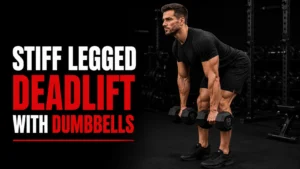
How to do it: Stand with feet hip-width, dumbbells held in front of your thighs with a neutral grip. Hinge at the hips — pushing them backward — while maintaining a flat back. Lower the dumbbells down the front of your legs until you feel a strong pull through your hamstrings. Drive your hips forward to return to standing. The motion comes from the hip joint, not the lower back.
Coaching cue: Stop the descent when your back position changes. Range of motion matters less than spinal control. For most people, that’s somewhere between mid-shin and the floor.
Programming note: 3 sets of 8–12 reps. Slowing the eccentric (lowering) phase to 3 seconds increases hamstring loading without requiring heavier dumbbells.
3. Dumbbell Thruster (Squat to Press)
The thruster — a front squat driven directly into an overhead press — is one of the most metabolically demanding movements you can do with dumbbells. It trains the entire lower body, core, shoulders, and triceps in one continuous flow and spikes heart rate significantly, which is why conditioning programs across disciplines have used it for decades.
The force generated from the lower body — glutes, hamstrings, and quadriceps — gets transferred to the upper body during the thruster. Muscles worked: quadriceps, glutes, hamstrings, core, anterior deltoids, triceps, and upper traps.
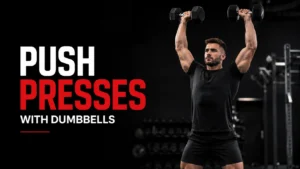
How to do it: Hold dumbbells at shoulder height in the rack position, elbows forward, palms facing inward. Squat until thighs are parallel to the floor. As you drive up from the bottom, use the momentum from your legs to press the dumbbells overhead until arms are fully extended. Return the dumbbells to the rack position as you descend into the next squat.
Programming note: 3 sets of 6–10 reps. Place this exercise early in the session — it’s taxing enough that performing it after five other movements produces significantly degraded output.
4. Bent-Over Dumbbell Row
Rows train the muscles most people chronically underwork. Sitting at desks and pressing things overhead are the dominant movement patterns in modern daily life — pulling movements get neglected, and the imbalance shows up as rounded shoulders, poor posture, and susceptibility to shoulder injuries.
Dumbbell bent-over rows offer a powerful back workout targeting muscles running from your neck to your back and shoulders, building back strength while improving core stability. Muscles worked: latissimus dorsi, middle and lower trapezius, rhomboids, and posterior deltoids.
How to do it: Stand feet hip-width, hinge forward until your torso is between 45 and 90 degrees from vertical, maintaining a neutral spine. Hold dumbbells hanging straight down from your shoulders. Drive your elbows back toward your hips — not upward toward your ears — squeezing the shoulder blades together at the top. Lower with control.
Coaching cue: Think about putting your elbows in your back pockets. This shifts emphasis from the biceps to the lats where it should be.
Programming note: 3–4 sets of 8–12 reps. Alternate between bilateral rows and single-arm supported rows across sessions for varied stimulus.
5. Dumbbell Overhead Press
The overhead press exposes shoulder mobility restrictions immediately. If pressing dumbbells overhead causes you to flare your ribs or excessively arch your lower back, you have a mobility deficit that’s worth addressing — because that same compensation pattern shows up during other upper body work and increases injury risk over time.
Muscles worked: Anterior and medial deltoids, triceps, upper trapezius, serratus anterior, core (anti-extension).
How to do it: Hold dumbbells at shoulder height, palms facing forward or at a neutral angle (palms facing each other). Press directly overhead until arms are fully extended. Lower with control. Keep your core braced throughout — pressing overhead with a loose core compresses the lumbar spine under load.
Programming note: 3 sets of 8–12 reps. Seated pressing allows heavier loads; standing pressing demands greater core bracing and is more functional.
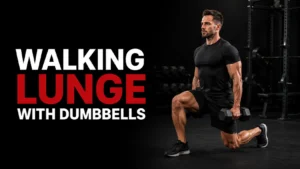
6. Dumbbell Lunge
Lunges surface strength asymmetries that bilateral squats easily hide. Most people have a dominant side that handles more load during squatting without them noticing — lunges eliminate that compensation.
Muscles worked: Quadriceps, glutes, hamstrings, hip flexors, calves, and core.
How to do it: Hold dumbbells at your sides. Step forward — or backward for a reverse lunge — and lower your rear knee toward the floor until both knees approach 90 degrees. The front shin should stay close to vertical; excessive forward knee travel increases patellofemoral stress. Drive through the front heel to return to standing.
Coaching cue: Pull yourself up from the lunge using the front leg rather than pushing off the back leg. This keeps the quad and glute of the working leg under load throughout.
Programming note: 3 sets of 10–12 reps per leg. Adding a bicep curl at the bottom of the lunge position turns it into a genuine combination movement that also trains the arms.
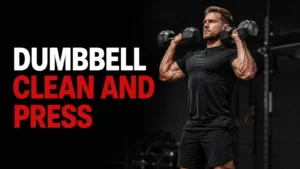
7. Dumbbell Clean and Press
The clean and press is one of the few dumbbell movements that trains explosive hip power alongside upper body pressing strength. Pulling the dumbbells from hip height to the rack position requires hip drive and lat engagement; the press finishes the movement. Done at a controlled tempo for moderate reps, it’s a legitimate full-body strength and conditioning exercise.
The clean and press is a full-body compound exercise that targets hamstrings, glutes, trapezius, triceps, shoulders, rhomboids, and core. It’s perfect for getting in a workout when pressed for time.
How to do it: Start with dumbbells at hip height, hips hinged slightly. Drive through your hips explosively, shrug, and use the momentum to pull the dumbbells to the rack position at shoulder height. From there, press overhead. Lower to shoulders, then hinge at the hip to bring dumbbells back to starting position.
Programming note: 3 sets of 5–8 reps. Prioritize the quality of each rep over quantity — form breakdown in the hip drive phase places unnecessary stress on the lower back.
8. Renegade Row
The renegade row combines a push-up and a dumbbell row in one movement, which means the chest, triceps, and anterior shoulders work during the push phase while the lats, rhomboids, and biceps work during the row. The plank position throughout creates constant anti-rotation demand — your obliques and transverse abdominis are working hard just to keep your hips from twisting with each pull.
Muscles worked: Chest, triceps, anterior deltoids (push phase); lats, rhomboids, biceps (row phase); obliques and transverse abdominis (stabilization throughout).
How to do it: Start in a push-up position with a hex dumbbell in each hand, wrists under shoulders. Set your feet wider than hip-width for a more stable base. Perform a push-up. At the top, row one dumbbell to your hip while resisting any tendency to rotate. Lower it, then repeat on the other side.
Coaching cue: Squeeze your glutes hard throughout every rep. This prevents hip sag and controls the rotational demand that would otherwise turn the row into a hip rotation exercise.
Programming note: 3 sets of 6–8 reps per side. Use hex dumbbells — round-bottomed ones roll, making the push-up position unstable in a way that’s counterproductive rather than useful.
9. Single-Leg Romanian Deadlift
The single-leg RDL earns its own entry because it trains the posterior chain under meaningfully different mechanical demands than the bilateral version. Balancing on one leg forces the hip abductors and rotational stabilizers to engage significantly, and the core demand is substantially greater. Since this is a unilateral exercise, it improves core stability, hip and ankle strength, and balance — in addition to strengthening the glutes, hamstrings, and lower back extensors.
Programming note: 3 sets of 8–10 reps per leg. Hold the dumbbell in the opposite hand to the standing leg — called contralateral loading — for a more demanding anti-rotation challenge. If balance is the main limiting factor initially, hold the dumbbell in the same hand as the standing leg (ipsilateral) until coordination improves.
10. Dumbbell Floor Press
For trainees without a bench, the floor press is a practical substitute for the dumbbell bench press that also functions as a useful exercise in its own right. The floor limits range of motion at the bottom, which makes this movement more shoulder-friendly for people with anterior shoulder pain, and it shifts more emphasis to the triceps because the short range of motion removes the stretch reflex advantage at the bottom.
Muscles worked: Pectorals, anterior deltoids, triceps.
How to do it: Lie on your back, knees bent, feet flat. Hold dumbbells above your chest with arms extended. Lower the dumbbells until your upper arms touch the floor. Pause briefly — this is the critical part — then press back up. The pause eliminates the elastic rebound from the stretch reflex, making each rep harder and more honest.
Programming note: 3–4 sets of 8–12 reps. Don’t rush the pause at the bottom.
The Mistakes That Actually Stall Progress
Using the Same Weight for Months
This is by far the most common issue. People find a comfortable pair of dumbbells, learn the exercises, get reasonably confident in the form — and then repeat the same session indefinitely. Without a progressively heavier load or some other form of increased demand, adaptation stops. If your current workout feels exactly like it did two months ago, that’s because physiologically, it is the same workout.
Skipping the Hip Hinge
Most self-designed programs include plenty of squatting and pressing. Very few include meaningful posterior chain training through a hip hinge pattern. This creates quad and hip flexor dominance that outpaces hamstring and glute development — one of the most common contributors to lower back pain and anterior knee problems. Romanian deadlifts aren’t optional additions to a compound program. They’re structural necessities.
Rushing Reps with Momentum
A bent-over row where you jerk the dumbbell up with a hip swing is mostly a back extension. A dumbbell press where the weight bounces off the chest is a spring-loaded chest exercise, not a controlled one. Momentum-driven reps reduce time under tension, shift load away from the target muscles, and accumulate joint stress without accumulating the training stimulus that actually drives adaptation.
Weights That Are Too Light
If you can comfortably talk through an entire set of Romanian deadlifts, the weight needs to go up. The last few reps of each working set should feel difficult, but not impossible. Selecting weights that never challenge you produces minimal adaptation — your body adapts to the demands you actually place on it, not the demands you could theoretically place on it.
Skipping the Warm-Up
Cold muscles performing heavy compound movements is a reliable path to avoidable injuries. Five to ten minutes of light movement — jumping jacks, bodyweight squats, leg swings, arm circles — followed by one to two warm-up sets at roughly 50% of working weight before each major exercise takes less time than the injury it prevents.
Nutrition and Recovery: What Happens Between Sessions
No training program overcomes poor recovery. Compound dumbbell workouts create a substantial physiological demand — and the body’s ability to respond to that demand depends entirely on what happens outside the gym.
Protein. Muscle protein synthesis requires adequate amino acid availability. Most research suggests 1.6–2.2 grams of protein per kilogram of body weight per day for those pursuing hypertrophy or strength development. Distributing this across several meals throughout the day maintains more consistent muscle protein synthesis than concentrating the same total intake into one large meal.
Sleep. Human growth hormone — one of the primary anabolic hormones driving muscle repair — is secreted primarily during deep sleep. Seven to nine hours per night isn’t optional for serious training. It’s a physiological requirement, not a lifestyle preference.
Hydration. Even mild dehydration measurably reduces strength output and coordination. Training performance deteriorates at 2% body weight dehydration, which is entirely reachable during a demanding compound session in warm conditions. Drink consistently throughout the day, not just during training.
Active recovery. Light walking, mobility work, or yoga on rest days promotes blood flow and tissue quality without adding training stress. These sessions support recovery rather than interfering with it.
Who Benefits Most from Full Body Compound Dumbbell Training
Beginners. Full body compound training builds a foundation of movement quality, neural efficiency, and general strength that isolation-focused programs can’t match in the early months. Three sessions per week hitting all major muscle groups is the fastest path from novice to competent lifter.
Intermediate trainees. Boredom, not biology, usually drives people toward complicated split programs before they’ve extracted everything full body training can offer. Three days of full body compound work at varying intensities continues to produce strength and size gains well into intermediate training.
Home gym trainees. Dumbbells are often the only equipment available. A well-programmed compound routine extracts enormous training value from that constraint — more than most people realize until they try it seriously.
Time-limited individuals. Hitting the full body in 45 minutes three times a week is far more efficient than a six-day split that leaves muscle groups waiting a week between stimuli.
Athletes. Compound movement patterns — hinge, squat, push, pull — are the building blocks of athletic performance. Dumbbell compound training builds the coordination, stability, and multi-directional strength that transfers to sport in ways machine-based training doesn’t.
Frequently Asked Questions (FAQs)
Can I build real muscle with just dumbbell compound exercises?
Yes. The mechanisms of muscle hypertrophy are fully achievable with dumbbells at appropriate loads. Research doesn’t show a meaningful difference in muscle growth between dumbbell and barbell training when volume and intensity are matched. The limiting factor is usually the maximum weight available, not the equipment itself.
How heavy should my dumbbells be?
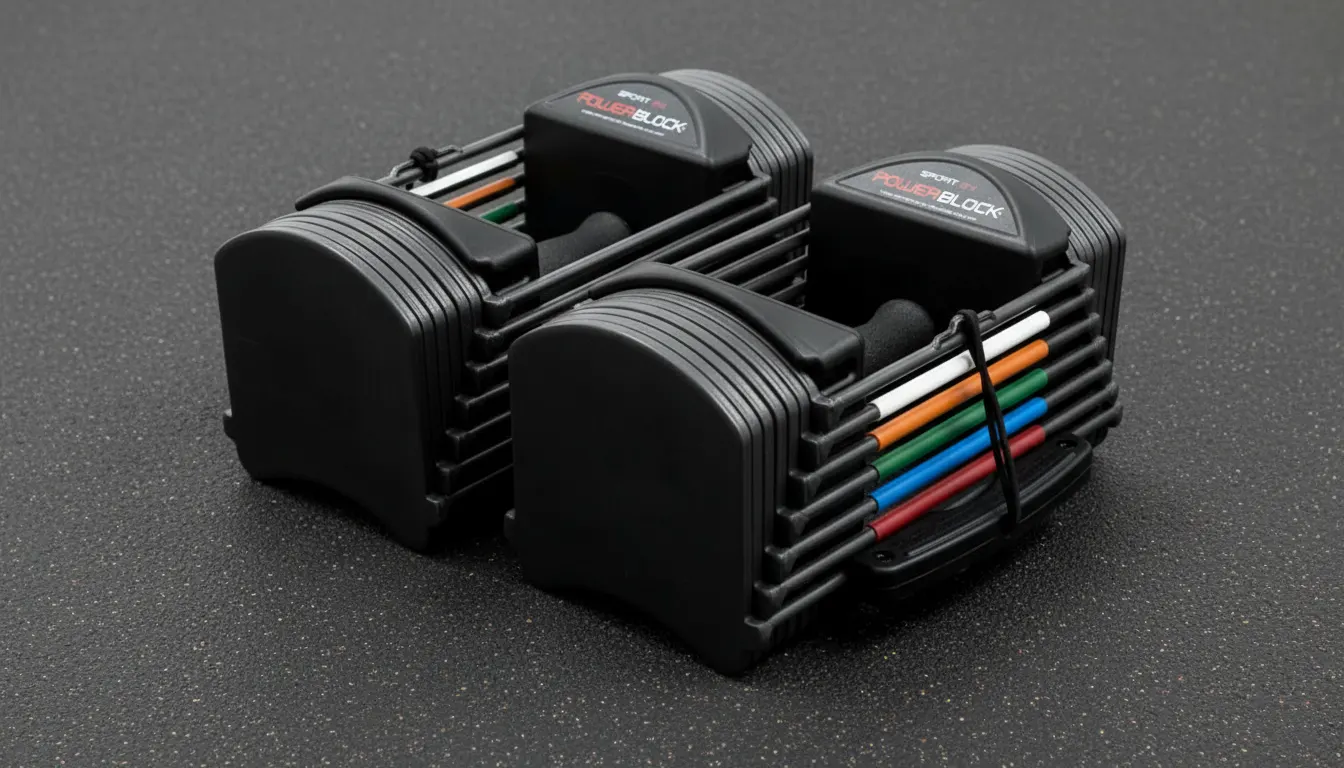
Choose weights where the last two or three reps of each working set feel genuinely hard while still allowing good form. This varies by exercise — you’ll need different dumbbells for Romanian deadlifts than for overhead pressing. Adjustable dumbbells that change weight in increments are the most practical solution for home training because they cover the full range in one compact piece of equipment.
How long does a full body compound dumbbell workout take?
A session covering five to six exercises at three to four sets each, with appropriate rest periods, typically runs 40 to 60 minutes. If sessions consistently exceed 75 minutes, rest periods are too long, volume is excessive, or both.
Is three days a week enough to build muscle?
For most people, yes — particularly at beginner and intermediate levels. Training three times per week provides a potent stimulus for muscles to adapt and grow while allowing adequate recovery between sessions — when the actual physiological changes, such as muscle repair and growth, occur. Studies comparing two, three, and four training days per week at equated volume show similar hypertrophy outcomes, suggesting recovery quality and progressive overload matter more than raw training frequency.
Should I train to failure on compound dumbbell exercises?
Not on compound movements. Technical breakdown at failure on a Romanian deadlift or thruster creates meaningful injury risk. Stopping one to two reps short of failure (leaving reps in reserve) maintains form quality, allows higher productive volume across sets, and reduces recovery cost. Failure training is better suited to isolation exercises where the consequence of technical breakdown is less severe.
Can I do full body compound workouts every day?
Intense compound training requires 48 to 72 hours of recovery between sessions targeting the same muscle groups. Daily high-intensity full body training accumulates fatigue faster than the body can manage. Light technical sessions or mobility work on off days are more productive than repeating the same compound session every 24 hours.
What’s the difference between compound and isolation exercises?
Compound exercises cross two or more joints and recruit multiple muscle groups simultaneously — a goblet squat crosses the hip, knee, and ankle joints while engaging quadriceps, glutes, hamstrings, and core. Isolation exercises target a single muscle group and are often used to correct muscle imbalances or rehabilitate after injuries. Both have a place in training; compound movements provide the primary stimulus and isolation work addresses specific weaknesses.
What if I don’t have heavy enough dumbbells for lower body work?
The lower body is strong relative to what most home dumbbell sets can challenge. Compensate by using higher rep ranges (15–20 reps), pausing at the most mechanically demanding point of each movement, slowing the eccentric phase to 3–5 seconds, or switching to unilateral variations — each leg carrying the full dumbbell weight rather than splitting it between both.
What’s the best warm-up before a full body session?
Five minutes of light movement — jumping jacks, bodyweight squats, leg swings, arm circles — to raise core temperature, followed by one to two warm-up sets at approximately 50% of working weight for the first exercise or two. Dynamic movements (active range of motion) are appropriate pre-workout; static stretching (holding positions) is better saved for after the session when muscles are already warm.
Do I need protein supplements to get results?
No. Whole food protein sources — meat, fish, eggs, dairy, legumes — are fully capable of meeting protein requirements for muscle growth without supplementation. Protein supplements are a convenient option when whole food sources aren’t practical, but they’re not superior to food. If your diet consistently meets your protein targets, supplements add nothing meaningful.
In conclusion
A pair of dumbbells and a structured compound program can take you further than most people expect — further than many gym machines, and certainly further than the random assortment of curls and crunches that most people default to when they train without a clear plan.
The exercises in this guide aren’t complicated. The programming principles aren’t exotic. What produces results is training consistently, working with appropriate intensity, recovering properly between sessions, and systematically demanding more from your body as it adapts.
Start with three sessions per week. Master the movement patterns before chasing heavier loads. Let progressive overload work over months, not days. That approach works whether you’re training in a commercial gym, a spare bedroom, or anywhere in between with a pair of dumbbells and enough floor space to hinge.
Looking to add resistance to your pool workouts? Check out Water Weights for Pool Exercises to learn how they work, their benefits, and the best ways to use them for strength and recovery.