You do not need a rack. You do not need cables, machines, or a wall of dumbbells sorted by five-pound increments. You need one dumbbell and a plan.
That sounds like a compromise. It is not. Single-dumbbell training forces you into unilateral movement, which corrects the strength imbalances that bilateral exercises quietly allow you to hide. Your stronger side cannot carry the weaker one. Your core has to stabilize constantly. And because you are not locked into a fixed machine path, your stabilizing muscles earn every rep.
People who train with one dumbbell consistently are not making do. They are training smarter than most gym-goers who spend forty-five minutes cycling between machines without ever challenging their body to balance, coordinate, or stabilize anything.
Why One Dumbbell Is More Than Enough
People underestimate single-dumbbell training because they associate effectiveness with complexity. The opposite is often true.
When you train with one dumbbell, you are forced into unilateral movement — working one side of the body at a time. This is actually a significant advantage. Unilateral exercises reveal and resolve strength imbalances that would stay hidden during bilateral movements. When you do single-arm rows or single-leg variations, your stronger side cannot compensate, so weaker muscles must carry their weight.
Beyond correcting imbalances, there is a neurological effect worth understanding. Studies show that training one limb can increase strength in the opposite, untrained limb — a phenomenon known as cross-education. This makes unilateral work valuable not just for balanced development, but also for maintaining strength during injury rehabilitation.
Dumbbells also require greater muscle activation compared to machines. The need to stabilize the weight engages more muscle fibers, improving muscle growth and overall strength. A machine guides you through a fixed path. A dumbbell demands that your stabilizers, core, and surrounding joints actively participate in every rep.
The practical arguments are equally strong. You do not need a gym membership, a bench, or even much floor space. Whether you are training in a spare bedroom, a hotel room, or a small apartment, one dumbbell fits the space and the budget.
The Science Behind Getting Results
Progressive Overload
The principle of progressive tension overload, coined by U.S. Army physician Thomas Delorme in the 1940s, states that in order for muscle to grow, it must adapt to a tension it has not previously experienced. In plain terms: your muscles need to work harder over time, or they stop adapting.
With a single dumbbell, progressive overload does not have to mean adding weight. Progressive overload is the process of gradually making exercises harder over time, and it can be achieved by increasing time, weight, or repetitions. Slowing down the lowering phase, adding pauses at the hardest point of a rep, reducing rest time between sets, or switching to a more demanding variation all count as progression.
Training Volume
Building muscle requires a specific amount of training volume — the total number of hard sets per week. For most people, this sits between 10 and 20 sets per muscle group per week. A well-structured one-dumbbell program can hit these targets. The key is choosing compound exercises that work multiple muscle groups simultaneously, so each set does more total work.
Muscle Damage and Recovery
Every time you strength train, you cause microscopic damage to muscle fibers known as microtears. During rest days, your body rebuilds those fibers with new tissue that is incrementally larger than before. This is why rest matters as much as the training itself. Training every day with one dumbbell, without adequate recovery, does not accelerate progress — it stalls it.
The Best Exercises to Do With One Dumbbell
Lower Body Exercises
Goblet Squat
Hold the dumbbell vertically at your chest, gripping both ends with both hands. Stand with feet shoulder-width apart or slightly wider. Sit your hips back and down until your thighs are parallel to the floor, keeping your chest upright and knees tracking over your outer toes. Drive through your heels to stand.
The goblet squat predominantly works your quadriceps, hamstrings, and glutes while also engaging your core to maintain the upright torso position. It is one of the cleanest ways to load a squat pattern with a single dumbbell, and the front-loaded position naturally encourages proper depth.
Sets and Reps: 3–4 sets of 10–15 reps
Single-Leg Romanian Deadlift
Hold the dumbbell in one hand. Stand on the opposite leg. Hinge at the hip, letting the dumbbell travel down toward the floor while your free leg extends behind you. Keep your back flat and your hips square throughout. Return to standing by driving through the heel of the working leg.
This exercise trains your posterior chain — glutes, hamstrings, and lower back — while demanding serious balance and hip stability. Step-up and single-leg movements reinforce unilateral leg strength and hip stability while helping address side-to-side strength imbalances. The single-leg Romanian deadlift achieves the same benefits with even greater range of motion demand.
Sets and Reps: 3 sets of 8–10 per leg
Reverse Lunge
Hold the dumbbell in a goblet position or at your side. Step one foot back and lower your rear knee toward the floor. Your front knee should stay stacked over your ankle. Push through your front heel to return to standing.
The reverse lunge is more knee-friendly than a forward lunge and easier to control for beginners. Reverse lunges, along with Bulgarian split squats and goblet squats, can make limited weights feel much heavier while effectively targeting quads, glutes, hamstrings, and calves. Slow the lowering phase to three or four seconds and the challenge increases dramatically.
Sets and Reps: 3 sets of 10–12 per leg
Lateral Lunge
Hold the dumbbell at your chest. Step one foot out to the side — well beyond shoulder width. Shift your weight onto that foot, push your hips back, and bend that knee while keeping the other leg straight. Push off to return to center.
Most workout programs ignore the frontal plane entirely, which is why hip abductors and adductors often stay underdeveloped. The lateral lunge directly addresses that gap. During a lateral lunge with a dumbbell, the load travels toward your ankle as you lower, then raises back to the side as you return to standing — training both strength and stabilization through the movement.
Sets and Reps: 3 sets of 10 per side
Upper Body Pushing Exercises
Single-Arm Overhead Press
Hold the dumbbell at shoulder height with one hand, palm facing forward. Stand or sit with your core braced. Press the dumbbell straight overhead until your arm is fully extended, then lower with control.
Pressing with one arm at a time forces your core to resist the lateral pull of the weight — an effect you simply do not get from a two-arm press. Your obliques and deep spinal stabilizers have to work hard just to keep you upright. Add a pause at the top and the shoulder stimulus intensifies considerably.
Sets and Reps: 3–4 sets of 8–12 per arm
Floor Press
Lie on your back with knees bent, feet flat. Hold the dumbbell in one hand, upper arm resting on the floor at roughly 45 degrees from your torso. Press the dumbbell straight up, then lower with control until your tricep touches the floor.
Without a bench, this is your chest press. The floor restricts the range of motion slightly, which actually reduces shoulder stress while keeping the pectoral and tricep demand high. Squeezing the dumbbell during the floor press brings more chest activation into what would otherwise be a triceps-dominant movement.
Sets and Reps: 3 sets of 10–12 per arm
Push-Up with Dumbbell Row (Renegade Row)
Place the dumbbell on the floor and grip it with one hand, the other hand flat on the ground. Get into a push-up position. Perform a push-up, then at the top, row the dumbbell up toward your hip. Lower and repeat.
This is a compound exercise that trains chest, triceps, shoulders, and back in one movement while the core works continuously to prevent rotation. Widening your legs during renegade rows helps keep your hips square to the floor, improving stability and maximizing the training effect.
Sets and Reps: 3 sets of 6–8 per side
Upper Body Pulling Exercises
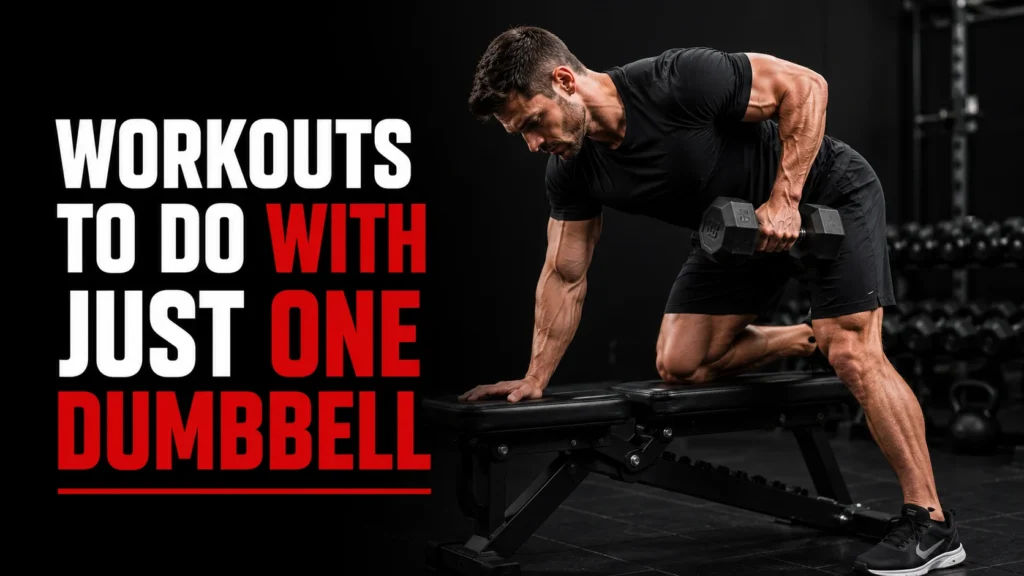
Single-Arm Bent-Over Row
Stand with feet hip-width apart. Hold the dumbbell in one hand. Hinge forward at the hips until your torso is nearly parallel to the floor, keeping your back flat. Let the dumbbell hang toward the floor, then drive your elbow back toward your hip, squeezing your shoulder blade at the top. Lower with control.
The single-arm row is the most accessible and effective back exercise you can do with one dumbbell. It targets the latissimus dorsi and rhomboids, contributing to a stronger and well-defined back while also enhancing posture and functional strength. Focus on pulling through the elbow rather than the hand to maximize lat activation.
Sets and Reps: 4 sets of 10–12 per arm
Dumbbell Pullover
Lie on your back with your knees bent. Hold the dumbbell with both hands above your chest, arms slightly bent. Lower the dumbbell back over your head in an arc until you feel a stretch through your lats and chest, then return to the starting position.
The pullover is an underrated movement that trains the lats and serratus anterior through a long range of motion — two muscles that most people never deliberately train. It also requires significant shoulder mobility, making it a useful diagnostic tool for flexibility deficits.
Sets and Reps: 3 sets of 12–15
Kang Squat (Posterior Chain Emphasis)
Place the dumbbell horizontally across your upper back, gripping both ends. With a slight knee bend, hinge forward at the hips until your torso is roughly parallel to the floor — this is the “good morning” portion. From there, bend your knees and sit into a squat. Reverse the movement to stand.
The Kang squat is a deadlift and squat combination that improves hip-hinge mechanics while challenging the entire posterior chain, targeting the glutes, hamstrings, erector spinae, and lower back. It sounds awkward at first, but it teaches the body to load the hips properly — a skill that carries over to almost every other lower body movement.
Sets and Reps: 3 sets of 8–10
Core Exercises
Suitcase Carry
Hold the dumbbell in one hand at your side. Walk 20–30 steps in a straight line, keeping your torso completely upright — no leaning toward the weighted side. Turn and return.
This is deceptively simple and surprisingly hard. Your obliques, quadratus lumborum, and hip stabilizers fight to prevent your torso from collapsing toward the load. Loaded carries challenge multiple muscles through a real-world movement pattern, improving strength, stability, and coordination simultaneously.
Sets and Reps: 3 sets per side, 20–30 meters each
Russian Twist
Sit on the floor with knees bent, heels either planted or slightly elevated. Hold the dumbbell with both hands. Lean back slightly and rotate your torso to bring the dumbbell from one hip to the other, turning your chest through the movement — not just your arms.
Sets and Reps: 3 sets of 15–20 total rotations
Half Get-Up
Lie on your back. Hold the dumbbell in one hand with your arm extended toward the ceiling. Bend the knee on the same side as the dumbbell. Use your free arm to prop yourself up to a seated position while keeping the dumbbell locked out overhead the entire time. Reverse slowly back down.
The half get-up is excellent for core stability and far less technically demanding than the full Turkish get-up. Keep your eyes on the dumbbell and your shoulder packed into the socket throughout. This exercise builds the kind of shoulder and core integration that carries over to almost every other lift.
Sets and Reps: 3 sets of 5–6 per side
How to Progress With a Fixed-Weight Dumbbell
When you cannot add load, these techniques sustain progress:
- Slower eccentrics: Extend the lowering phase to 3–5 seconds per rep. The muscle is under tension longer, which drives hypertrophy even at the same weight.
- Paused reps: Pausing mid-rep for 1–2 seconds eliminates momentum and forces genuine muscle contraction at the most mechanically demanding point of the movement.
- Reduced rest: Cutting rest from 90 seconds to 60 or 45 seconds increases metabolic demand and forces adaptation.
- Single-arm variations: Switching from a two-arm to one-arm version of any exercise roughly doubles the load on each side.
- More reps: Moving from 10 to 15 to 20 reps per set before adding weight is a legitimate and effective progression strategy.
Common Mistakes to Avoid
Choosing a weight that is too light. A weight that does not challenge you in the final few reps does not drive adaptation. The last 2–3 reps of each set should require real effort.
Skipping unilateral leg work. Many people default to goblet squats for every lower-body session, which is fine but incomplete. Bulgarian split squats, single-leg RDLs, and lateral lunges develop the hips and stabilizers in ways that bilateral squats cannot replicate alone.
Ignoring the eccentric phase. Lowering a weight fast wastes half the stimulus. Controlled, deliberate lowering builds more muscle and reduces injury risk.
Training without a plan. Random exercise selection produces random results. Even a simple structure — alternating push, pull, and lower body emphasis — produces far more consistent gains than choosing exercises based on what feels good that day.
Not resting enough between sessions. Since full-body workouts train every muscle group in a single session, it is best to have a rest day between training days. This gives the body enough time to recover before the next session.
Frequently Asked Questions (FAQs)
Can you really build muscle with just one dumbbell?
Yes. Hypertrophy comes from tension, effort, and progressive overload — not from specific equipment. Dumbbells can build serious muscle when used with proper progression. The constraint is that you need to structure your training thoughtfully and apply progressive overload consistently over time, just as you would in any other program.
What weight should I use for a one dumbbell workout?
There is no universal answer because different exercises demand different loads. A reasonable starting point for most beginners is 15–25 lbs for upper body exercises and 25–40 lbs for lower body work. The dumbbell should feel challenging by the final 2–3 reps without causing form to break down.
How many days per week should I train with one dumbbell?
Three full-body sessions per week — alternating training days with rest days — is a well-supported starting point. Most guidelines recommend at least two days per week of strength training, though three provides better stimulus for beginners and intermediate trainees. Advanced trainees can extend to four days by splitting upper and lower body emphasis across sessions.
Is a one dumbbell workout effective for weight loss?
It can be. Strength training increases lean muscle mass, which raises your resting metabolic rate — meaning you burn more calories throughout the day. Compound exercises burn more calories than isolation exercises and offer cardiovascular benefits by elevating heart rate. Combining a one-dumbbell resistance program with a calorie deficit is an effective and sustainable approach to fat loss.
Can beginners use a one dumbbell workout?
Absolutely. One dumbbell is arguably the best starting point for beginners because the exercises are straightforward to learn, the load is manageable, and the unilateral nature of most movements forces you to develop coordination and stability early on — before those deficits become ingrained habits.
What if my dumbbell feels too light after a few weeks?
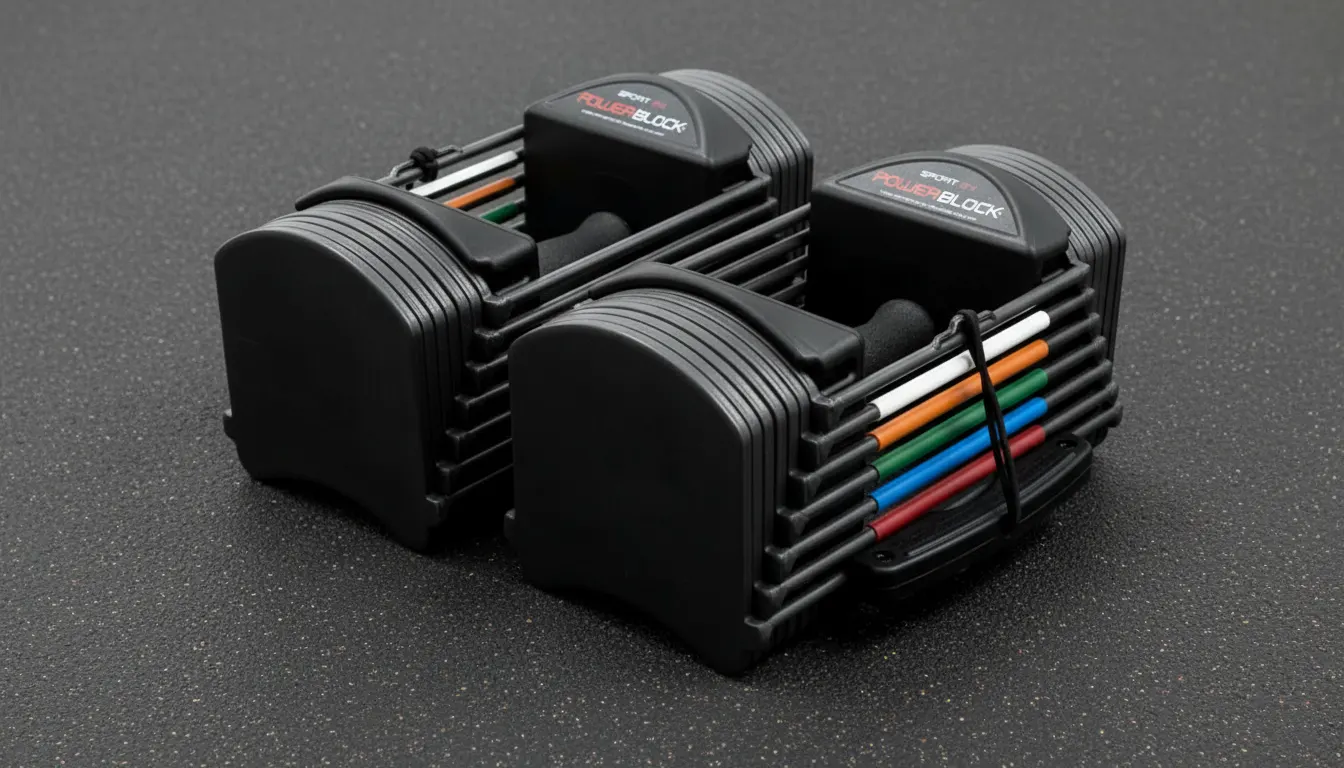
This is a good problem to have. First, exhaust your progression options: slower tempos, pauses, reduced rest, and single-limb variations. If those are all maxed out, an adjustable dumbbell or a second, heavier fixed dumbbell is a worthwhile investment. The popularity of home workouts continues to rise, and a range of 10–70 lbs in dumbbell options is generally sufficient to build muscle effectively.
Can I do a one dumbbell workout every day?
You can train daily, but full-body one-dumbbell sessions need 48 hours of recovery between them. If you want to train six or seven days a week, alternate full-body days with active recovery — walking, mobility work, or light stretching — rather than repeating the same strength sessions back to back.
Which is better — doing exercises bilaterally (both arms) or unilaterally (one arm at a time)?
Both have a place. Bilateral movements let you lift more total load. Unilateral movements correct imbalances and demand more core involvement. A program built around one dumbbell naturally emphasizes unilateral work, which is one of its genuine advantages over programs designed around two dumbbells or a barbell.
Do I need a bench for a one dumbbell full body workout?
No. Every exercise in this guide can be performed without a bench. The floor press substitutes for the bench press, and lower body and pulling movements work equally well standing or on the floor.
How long until I see results from a one dumbbell workout?
Strength improvements typically start within two to four weeks, as your nervous system becomes more efficient at recruiting muscle fibers. Visible muscle changes take longer — most people notice measurable differences in four to eight weeks with consistent training and adequate protein intake (0.7–1g per pound of bodyweight per day is a commonly cited target).
In conclusion
The gap between a well-equipped gym and a single dumbbell is smaller than most people think. What actually determines results is not the volume of equipment you have access to — it is whether you train consistently, apply progressive overload, recover between sessions, and execute each rep with intention.
One dumbbell is enough to hit every major muscle group in your body. It is enough to build real strength. And for a lot of people, the simplicity of it is exactly the environment where consistency finally clicks.
Start with the beginner program, master the movement patterns, and let progressive overload do the rest. The dumbbell in your hand is not a limitation. It is enough.
Not sure which equipment is better for muscle growth? Check out Dumbbells vs Resistance Bands to compare resistance, strength gains, versatility, and which option fits your training goals best.