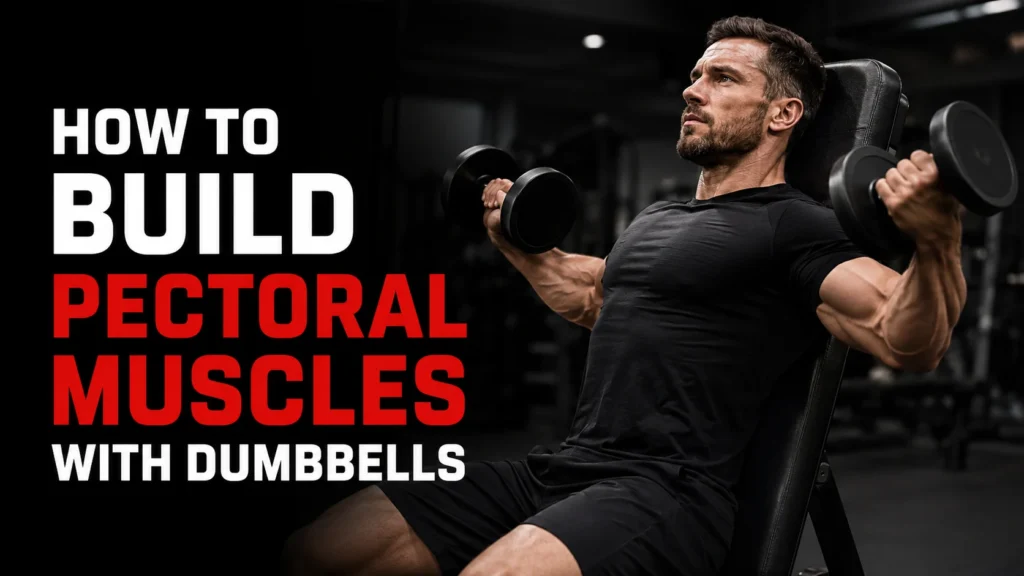
Most chest programs are built around a barbell. That’s fine if you have one. But dumbbells aren’t a consolation prize—there’s a real case they’re a better tool for building pecs, at least for most people training at home or without a spotter.
Research published in the Journal of Strength and Conditioning Research found that dumbbell pressing produces comparable pectoral activation to barbell pressing, even at lighter absolute loads. The reason comes down to two things: a greater range of motion, and the fact that each arm has to produce its own force. With a barbell, the bar physically stops at your chest. With dumbbells, your hands can travel past that point on the way down, creating a deeper stretch across the pecs on every rep.
That stretch matters more than most people realize. Training muscles at long lengths is one of the most consistent findings in hypertrophy research. Add the unilateral independence, the natural wrist path, and the joint-friendly movement arc, and you have equipment worth taking seriously.
Pectoral Muscle Anatomy: What You’re Actually Training
The Pectoralis Major
The pectoralis major is the large, fan-shaped muscle that makes up the visible chest. It has two heads. The clavicular head (upper chest) runs from your collarbone. The sternocostal head (mid-to-lower chest) originates from your sternum and ribs. These regions don’t contract in full isolation, but changing bench angle does shift emphasis—and that’s worth exploiting.
The main jobs of the pec major are shoulder horizontal adduction (pulling the arm across the body), shoulder flexion (raising the arm forward), and internal rotation. Pressing and fly movements both train it; they’re just different expressions of the same function.
The Pectoralis Minor
Underneath the pec major sits the pectoralis minor—a smaller muscle that attaches to the shoulder blade and controls how it moves. It produces no visible size, but a tight or weak pec minor causes rounded shoulders and wrecked pressing mechanics. Dumbbell pullovers and deep fly movements stretch it in ways most pressing exercises skip entirely.
The Serratus Anterior
The serratus anterior runs along the side of your rib cage. It stabilizes the shoulder blade against the ribcage and, when developed, creates the “serrated” look along the torso that frames a built chest. Heavy dumbbell pressing—especially through a full range of motion—keeps it engaged and working.
Why Bench Angle Actually Matters
Changing the angle genuinely shifts the training stimulus. Flat pressing loads the sternocostal fibers predominantly. Incline pressing at 15–30 degrees increases clavicular head activation. Research has specifically found 30 degrees produces the highest upper pec activation while keeping anterior deltoid involvement lower than steeper angles do. Decline angles stress the lower sternocostal fibers and tend to feel smoother on the shoulder joint for many lifters.
Why Dumbbells Build Pectoral Muscles So Effectively
The Range-of-Motion Advantage
Barbells stop at the chest. Dumbbells don’t. Your hands can travel below torso level on the way down, lengthening the pec at the bottom of each rep. That extra stretch is not just a feeling—it’s the reason dumbbell chest training drives hypertrophy so reliably. Current research consistently shows that training muscles in their lengthened position is one of the strongest mechanical drivers of growth.
Each Side Has to Work
A barbell connects both hands to the same rigid object. Your stronger side will compensate. Over months and years, this creates imbalances you don’t notice until they show up in the mirror. Dumbbells expose the weak side immediately and force it to catch up. That’s a feature.
Natural Joint Path
Fixed bars lock your wrists and elbows into one path. Dumbbells let your wrists rotate, your elbows track naturally, and your arm path adjust to your shoulder anatomy. This is why lifters with shoulder history often find dumbbell pressing far more tolerable than barbell pressing—the joint follows the movement rather than being forced through it.
Stabilizer Involvement
Dumbbells require more contribution from the rotator cuff, serratus anterior, and surrounding muscles to control the movement. This isn’t inefficiency. It’s broader upper-body function developed alongside pec mass—a reasonable trade.
The Best Dumbbell Exercises for Building Pectoral Muscles
Flat Dumbbell Press
No dumbbell chest exercise builds more overall pec mass. It’s a compound movement that loads the entire pectoralis major through a substantial range of motion, and it’s where you’ll move the most weight and generate the most mechanical tension over time. This is the exercise you keep in your program for months.
Setup and technique:
- Lie flat on a bench, dumbbells in each hand at chest level
- Retract and depress your shoulder blades—think “back and down”—before the first rep and hold that position throughout
- Elbows roughly 45–60 degrees from your torso, not flared straight out
- Press up and very slightly toward each other; stop just short of contact to keep tension on the chest
- Lower over 2–3 seconds until you feel a genuine stretch across the pecs
Sets and reps: 3–4 sets of 6–10 reps for strength; 3–4 sets of 8–12 for hypertrophy.
The scapular position is what makes or breaks this exercise. If the shoulder blades aren’t locked down, the deltoid takes over the moment the weight gets heavy. Pack them down before you lift and keep them there.
Incline Dumbbell Press
The incline press is the most reliable way to develop the clavicular head—the part that creates a full, defined look across the top of the chest. Many lifters press flat exclusively and end up with a chest that looks thick in the middle but underdeveloped at the collar. The fix is simple: put incline work first when the upper chest is the priority.
Setup and technique:
- Set the bench to 15–30 degrees, not steeper
- Press the dumbbells over your upper chest, not your face
- Lower in a controlled arc until you feel a stretch through the top of the chest
- Keep elbows at roughly 30–60 degrees from the body throughout
Sets and reps: 3–4 sets of 8–12 reps.
If you feel front delts taking most of the work, lower the bench angle before changing anything else. For many lifters, 15–20 degrees outperforms 45 degrees for upper chest feel and activation.
Decline Dumbbell Press
The decline press is skipped constantly because the bench adjustment is annoying. That’s a mistake. It develops thickness across the lower chest and gives the pecs a fuller, more rounded shape at the bottom—the kind of development that flat pressing alone never quite produces.
Setup and technique:
- Bench at 15–30 degree decline; steeper than 30 degrees rarely improves lower chest activation
- Secure your feet before lying back
- Hold dumbbells at the sides of your lower chest and press up and slightly inward
- Lower with control through the full range
Sets and reps: 3 sets of 8–12 reps.
Dumbbell Chest Fly
The fly doesn’t build the same raw mass as a press—there’s no elbow flexion to share the load, so the pec does almost all the work. That makes it genuinely valuable as a secondary movement. It trains the chest under tension in a deeply stretched position, which is where the strongest hypertrophic stimulus occurs. Think of it as the press’s complement, not its competitor.
Setup and technique:
- Lie flat, dumbbells directly above your chest, palms facing each other
- Maintain a soft but fixed elbow bend throughout the entire movement—it should not change as you lower
- Open in a wide arc until you feel a deep stretch, roughly when your upper arms are parallel to the floor
- Squeeze the pecs to bring the dumbbells back together above the chest
Sets and reps: 3 sets of 10–15 reps. If your elbows are bending significantly more on the descent, the weight is too heavy—reduce it and focus on the stretch.
Incline Dumbbell Fly
Set the bench to 30–45 degrees for this one. The steeper angle, combined with the deep fly arc, creates a strong stimulus for the clavicular head that pressing alone can’t fully replicate. It’s a finisher—used after incline pressing, not instead of it.
Setup and technique:
- Hold dumbbells above your upper chest at the incline angle
- Open in a wide arc, feeling the stretch through the top of the chest
- Bring the weights back with a brief squeeze at the top, but don’t smash them together
Sets and reps: 2–3 sets of 12–15 reps. Go lighter than you think you need to.
Dumbbell Floor Press
The floor limits range of motion below the midpoint of the movement, which removes shoulder impingement risk almost entirely. This is the go-to option for people training without a bench, working through shoulder irritation, or adding pressing volume without taxing the joint further.
Setup and technique:
- Lie flat on the floor, knees bent, feet planted
- Hold dumbbells at chest level and press to full extension
- Lower until your elbows lightly contact the floor, make contact without bouncing, then press again
Sets and reps: 3–4 sets of 8–12 reps.
Dumbbell Pullover
The pullover trains both chest and lats—which one works harder depends on technique and individual anatomy. For chest purposes, its value is the deep stretch across the ribcage and through the serratus anterior that almost no other exercise provides. Use it as a finisher or a warm-up movement, not a primary mass-builder.
Setup and technique:
- Lie across a flat bench so only the upper back is supported, hips low
- Hold a single dumbbell with both hands above your chest, slight elbow bend
- Lower behind your head until you feel a stretch through the chest and ribcage
- Pull back up by thinking about bringing your elbows toward the ceiling, not pulling with the arms
Sets and reps: 2–3 sets of 12–15 reps.
Crush Grip Dumbbell Press
Hold two dumbbells pressed firmly together and maintain active inward pressure throughout the entire set. This constant isometric contraction of the pecs adds a type of tension that standard pressing doesn’t produce. If you consistently struggle to feel your chest during pressing movements, this variation often solves it within one session.
Setup and technique:
- Press the dumbbells firmly against each other before you begin
- Perform a standard pressing motion while actively squeezing the dumbbells together the entire time
- The moment you stop squeezing, you lose the benefit
- Works flat, incline, or on the floor
Sets and reps: 3 sets of 10–15 reps.
How to Program Dumbbell Chest Workouts
Exercise Order
Every chest session starts with your heaviest compound movement. Flat press or incline press goes first, when you’re fresh enough to move a significant load. Follow with a second pressing angle to hit a different region. Finish with isolation work—flies, pullovers, or squeeze variations—where the goal is contraction quality, not load.
Doing flies before presses because you want to “pre-exhaust” the chest sounds logical but costs you on the movements that drive the most growth. Heavy presses first. Always.
Volume and Frequency
Ten to sixteen working sets per week across all pressing and fly movements covers most intermediate lifters well. Beginners typically see strong results in the 8–12 set range. Two sessions per week—one heavier, one higher-volume—generally outperforms one session per week for building size, provided recovery between sessions is adequate.
Give the chest at least 48 hours between sessions. Trying to train pecs every day on the assumption that more is faster will stall progress and beat up the shoulder joint.
Sample Hypertrophy-Focused Workout
- Warm-up: Arm circles, band pull-aparts, 2 light sets of push-ups
- Flat Dumbbell Press: 4 sets x 8–10 reps | 90–120 sec rest
- Incline Dumbbell Press (15–30 degrees): 3 sets x 10–12 reps | 90 sec rest
- Flat Dumbbell Fly: 3 sets x 12–15 reps | 60 sec rest
- Decline Dumbbell Press: 3 sets x 10–12 reps | 90 sec rest
- Dumbbell Pullover: 2 sets x 12–15 reps | 60 sec rest
That’s 15 working sets. Enough to drive growth without wrecking recovery for the rest of the week’s upper body training.
Sample Strength-Focused Workout
- Flat Dumbbell Press: 4 sets x 5–6 reps | 2–3 min rest
- Incline Dumbbell Press: 4 sets x 5–6 reps | 2 min rest
- Dumbbell Floor Press: 3 sets x 6–8 reps | 2 min rest
- Dumbbell Fly: 3 sets x 10–12 reps | 90 sec rest
Fewer movements, heavier loads, longer rest. The fly at the end is there to maintain tension work without adding joint stress.
Progressive Overload: The One Rule You Can’t Skip
Without progressive overload, the body has no reason to add muscle tissue. This is not a training philosophy—it’s physiology. The muscle grows in response to demands that exceed what it’s already adapted to. Remove that demand and growth stops.
For dumbbell chest training, the most practical approach: when you can complete all reps across all sets with clean form and feel like you have 1–2 reps left, increase the dumbbell weight at the next session. For most exercises, that means moving up 2.5–5 lbs per hand.
When you don’t have smaller weight increments, these work instead:
- Add one rep to each set until you reach the top of your target range, then increase load
- Slow the lowering phase to 3–4 seconds per rep
- Add pause reps at the bottom of the movement, where the pec is fully stretched
- Add one extra set before jumping to heavier dumbbells
The best dumbbell chest workout in the world doesn’t build pecs if the load never increases. Track your weights. Add to them when your form is solid. That’s the whole mechanism.
Training Each Region of the Chest
Upper Chest
The upper chest is underdeveloped in most recreational lifters. Flat pressing—even a lot of it—doesn’t load the clavicular head the way incline work does. If yours lags, make the incline press your first movement every chest session until the gap closes. The target angle is 15–30 degrees. A low incline often works better than a steep one.
Middle Chest
The mid-chest builds primarily through flat pressing. This is where most of the pec’s cross-sectional area lives, and it responds well to both heavy compound work and controlled fly movements. Flat dumbbell press plus flat fly covers this region thoroughly.
Lower Chest
Lower chest development is what gives the pecs a defined shape at the bottom—the line where the muscle ends and the torso begins. Decline presses at 15–30 degrees, forward-leaning dips, and decline flies address it directly. The lower sternocostal fibers activate when you press from a downward angle toward your midline. Flat pressing alone won’t fully develop this region.
Common Mistakes That Limit Pec Development
Letting the shoulders take over. This is the most common error and the most fixable. If the shoulder blades aren’t retracted and depressed before the set starts, the anterior deltoid activates first. The pec becomes secondary. Fix it by thinking “back and down” at the start of every set and holding that position even when the weight gets heavy.
Flaring the elbows to 90 degrees. Wide elbows strain the shoulder joint and reduce pec activation simultaneously. Keep elbows at roughly 45–60 degrees from the torso on pressing movements.
Chasing weight instead of tension. Dumbbells that are too heavy produce short, bouncy reps where the shoulder compensates at the bottom. The pec barely works. Drop the load, slow the eccentric, and feel the stretch. A properly executed rep with moderate weight outperforms a sloppy one with heavy dumbbells.
Cutting the range short. The bottom of the movement—where the pec is longest—is where the hypertrophy stimulus is strongest. Stopping reps short to handle heavier dumbbells eliminates the advantage that makes dumbbells worth using in the first place.
Flat pressing exclusively. Training only one angle produces a chest that looks unbalanced—thick in the middle, underdeveloped at the top and bottom. Incorporate at least two angles per session. Upper and lower chest both need direct work.
Nutrition and Recovery
Training provides the stimulus. Nutrition and sleep are where the growth actually happens.
Protein intake for muscle building should fall between 1.6 and 2.2 grams per kilogram of body weight per day. Spreading that across 3–5 meals improves utilization compared to loading everything into one sitting.
Carbohydrates fuel the training session. Heavy pressing requires glycogen. Attempting a full chest session on very low carbohydrates typically produces shorter, weaker workouts that accumulate less volume, which directly limits growth over time.
Sleep is where muscle protein synthesis peaks and where the body conducts most of its repair. Consistently sleeping less than 7 hours reduces training adaptation in measurable ways. This isn’t optional for people who want the muscle to actually grow.
How Long Does It Take to Build Pectoral Muscles with Dumbbells?
Honest answer: it depends on training history, genetics, nutrition consistency, and how close to failure each session actually gets.
That said, beginners typically see noticeable chest development in 8–12 weeks of consistent dumbbell training with progressive overload. Intermediate lifters addressing lagging regions—upper or lower chest specifically—generally see visible improvement in 6–10 weeks when that region is prioritized. Advanced lifters work on a longer timeline; months rather than weeks for meaningful change.
The variable that most determines the speed of progress is not a specific exercise or technique. It’s whether you’re consistently adding load, consistently eating enough protein, and consistently sleeping enough. All three need to be in place. Missing one limits the other two.
Frequently Asked Questions (FAQs)
Can you build a big chest with only dumbbells?
Yes. Dumbbells cover every region of the chest across presses, flies, and pullover variations at multiple angles. Research confirms the activation is comparable to barbell work—often greater, due to the deeper range of motion. The limiting factor is usually commitment to progressive overload, not the equipment itself.
How many times per week should I train my chest?
Most people do well with 1–2 sessions per week. Once works fine for beginners. Twice per week with at least 48 hours between sessions generally produces faster results for intermediate lifters, especially when one session is heavier, and the other is higher-volume.
What weight dumbbells should I start with?
Beginners typically start with 10–20 lbs per hand for pressing movements and 8–15 lbs for flies. Intermediate lifters often work in the 30–50 lb range per hand on pressing. The number matters less than whether you’re challenging yourself within 1–2 reps of failure on working sets.
Is the dumbbell fly or the dumbbell press better for building the chest?
Both serve distinct roles, and both belong in a complete routine. The press is your primary mass-builder—more load, multiple muscles working together. The fly is your secondary isolation movement, training the pec under deep stretch with less deltoid compensation. Relying on only one produces incomplete development.
How do I actually feel my chest during pressing instead of my shoulders?
Retract and depress your shoulder blades before lifting. Lower until you feel an actual stretch across the pecs. If using an incline, reduce the angle if the front delts dominate. Use lighter dumbbells and slow the lowering phase to 3 seconds. These adjustments usually solve the problem within one or two sessions.
What bench angle works best for the upper chest?
Research points to 15–30 degrees as the range that maximizes upper pec activation without loading the anterior deltoid excessively. Most people feel the upper chest best closer to 30 degrees. If the front shoulder consistently dominates, bring the angle toward 15 degrees.
Can I train my chest at home without a bench?
Yes. Floor presses, dumbbell flyes on the floor, crush grip presses, and feet-elevated push-ups all train the pecs effectively. The main limitation is a shortened range on pressing movements, but the floor press still provides a genuine pec stimulus and is entirely shoulder-safe.
How important is the mind-muscle connection for chest growth?
Focusing on the pec contracting during each rep does improve muscle activation versus going through the motions mechanically. It’s most useful during fly movements and any exercise where the shoulders tend to dominate. It doesn’t replace progressive overload, but it improves the quality of each set.
In conclusion
Dumbbells give you everything needed to build a complete, defined, strong chest—and the deeper range of motion they allow compared to barbells makes them genuinely effective rather than just convenient. Presses cover the mass-building work. Fly variations add the stretch stimulus. Different angles address the upper, middle, and lower chest. Progressive overload keeps the whole thing moving forward.
What doesn’t work is randomizing exercises every week, cutting reps short to use heavier dumbbells, or hoping that training alone compensates for poor nutrition and inadequate sleep. The fundamentals are straightforward. Applying them consistently over 12–16 weeks is where results actually come from.
Find a program with a flat or incline press as the anchor movement, add a secondary angle, include at least one fly variation, and track your weights from session to session. Run it for two to three months without changing everything. That’s it.
Want stricter bicep isolation and better peak contraction? Check out How to Do Dumbbell Spider Curls for proper form, key benefits, and tips to maximize bicep activation with controlled reps.