
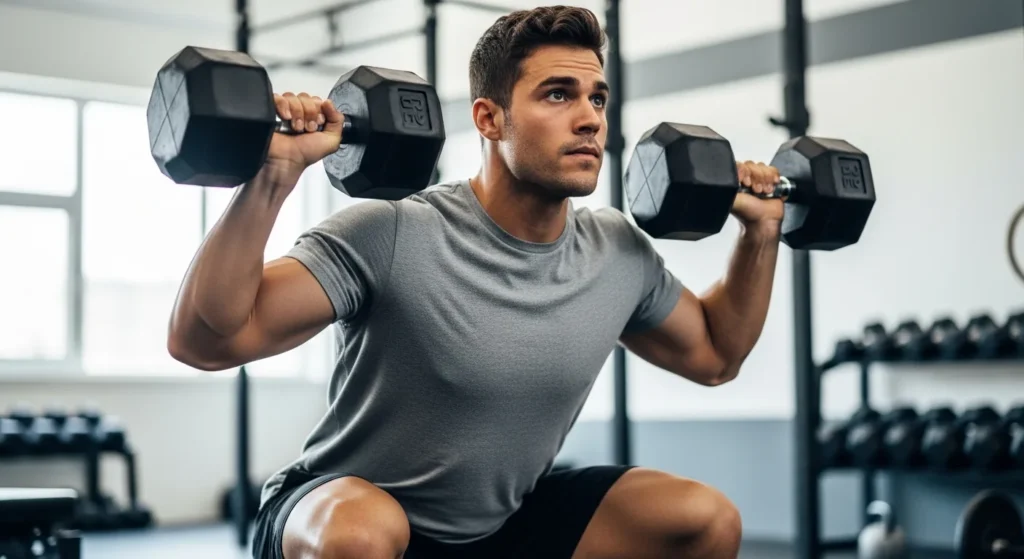
If you’re looking for one exercise that builds strength, burns fat, improves conditioning, and challenges your entire body at once, dumbbell thrusters should be at the top of your list.
The dumbbell thruster is not just a squat or a press, it is a powerful combination of both. It blends a front squat and an overhead press into one continuous explosive movement, making it one of the most efficient full-body exercises in strength training and functional fitness.
According to exercise breakdowns from fitness experts, thrusters recruit multiple muscle groups simultaneously, including the quads, glutes, hamstrings, shoulders, triceps, and core, while also elevating heart rate for cardiovascular conditioning.
What Are Dumbbell Thrusters?
A dumbbell thruster is a compound exercise that combines:
- A front squat (lower-body push)
- An overhead press (upper-body push)
These two movements are linked into one smooth, powerful rep.
Instead of stopping at standing after the squat, you use that upward momentum to press the dumbbells overhead in one fluid motion.
Why it matters
This movement trains:
- Strength
- Power output
- Muscular endurance
- Coordination
- Cardiovascular fitness
That’s why dumbbell thrusters are often used in high-intensity workouts and athletic training programs.
Muscles Worked in Dumbbell Thrusters
One of the biggest advantages of dumbbell thrusters is that they train nearly your entire body.
Primary Muscles Worked
Lower Body
- Quadriceps (front thighs)
- Gluteus maximus (hips and glutes)
- Hamstrings
Upper Body
- Deltoids (shoulders)
- Triceps (arm extension)
Secondary Muscles
- Core muscles (abdominals and obliques)
- Lower back (spinal stabilizers)
- Upper back (stability during press)
Research-based exercise breakdowns confirm that thrusters heavily engage both lower-body and upper-body muscle groups in one movement pattern .
Dumbbell Thrusters Proper Form (Step-by-Step Guide)
Proper form is critical. Poor technique reduces effectiveness and increases injury risk.
Step 1: Starting Position
- Stand with feet shoulder-width apart
- Hold dumbbells at shoulder level (front rack position)
- Palms facing inward or slightly toward each other
- Elbows slightly forward, not flared wide
- Chest up, core tight
Step 2: The Squat Phase
- Push hips back and bend knees
- Lower until thighs are at least parallel to the floor
- Keep heels grounded
- Maintain upright chest position
Step 3: Explosive Drive Up
- Push through heels
- Drive hips forward and upward
- Stand up explosively (this generates momentum)
Step 4: Overhead Press
- Use momentum from the squat
- Press dumbbells overhead in one motion
- Fully extend arms
- Biceps close to ears at the top
Step 5: Return
- Lower dumbbells back to shoulders
- Immediately move into next squat rep
Key Form Tips for Perfect Dumbbell Thrusters
To master dumbbell thrusters, focus on these coaching cues:
1. Keep It Fluid
Thrusters must be one continuous motion—not squat + pause + press.
2. Drive With Legs, Not Arms
Your legs generate most of the power. Arms only finish the press.
3. Maintain a Strong Core
A braced core prevents collapsing forward during the squat and press.
4. Keep Elbows High
Helps stabilize dumbbells and improves shoulder alignment.
5. Use Controlled Breathing
- Inhale on the squat down
- Exhale as you press up
Common Dumbbell Thruster Mistakes (And Fixes)
Even experienced lifters struggle with thrusters. Here are the most common issues:
1. Turning It Into a Shoulder Press
Problem: Not using leg drive
Fix: Focus on explosive squat-to-stand power
2. Poor Squat Depth
Problem: Half reps reduce effectiveness
Fix: Aim for parallel or slightly below parallel depth
3. Leaning Too Far Forward
Problem: Loss of balance and spinal stress
Fix: Keep chest upright and core tight
4. Pressing Too Early
Problem: Arms start pressing before full hip extension
Fix: Wait until standing before pressing
5. Dumbbells Moving Too Far Forward
Problem: Poor overhead alignment
Fix: Press straight up, not forward
Benefits of Dumbbell Thrusters
Dumbbell thrusters deliver multiple performance benefits.
1. Full-Body Strength Development
They build both lower and upper body strength in one movement.
2. Fat Burning and Conditioning
Because multiple muscle groups work together, heart rate stays elevated.
3. Improved Athletic Power
The explosive nature improves speed and coordination.
4. Better Core Stability
Core muscles stabilize the spine throughout the movement.
5. Time-Efficient Training
One exercise replaces multiple isolated movements.
Dumbbell Thrusters for Fat Loss
If your goal is fat loss, thrusters are extremely effective because:
- They recruit large muscle groups
- They increase calorie burn
- They elevate heart rate quickly
- They improve metabolic conditioning
This makes them ideal for HIIT circuits and fat-burning workouts.
Dumbbell Thruster Variations
Beginner Variation
- Light dumbbells
- Shallower squat
- Slower tempo
Standard Thruster
- Moderate weight
- Full squat
- Explosive press
Advanced Variation
- Heavier dumbbells
- Paused squat thrusters
- Unilateral (single-arm thrusters)
Conditioning Style
- High reps (12–20)
- Minimal rest
- Circuit training format
How to Program Dumbbell Thrusters
For Strength
- 4–5 sets
- 6–10 reps
- Heavy dumbbells
- Rest 60–90 seconds
For Fat Loss
- 3–4 sets
- 12–20 reps
- Light to moderate weight
- Short rest (30–45 seconds)
For HIIT
- 30 seconds work
- 15–20 seconds rest
- 8–12 rounds
Safety Tips for Dumbbell Thrusters
- Warm up shoulders and hips before starting
- Start with light weights to learn movement
- Avoid rounding your lower back
- Do not rush reps under fatigue
- Maintain control even at high speed
Who Should Do Dumbbell Thrusters?
This exercise is ideal for:
- Beginners learning compound movements
- Athletes improving power output
- Cross-training enthusiasts
- Fat loss trainees
- Functional fitness athletes
Avoid or modify if you have:
- Severe shoulder injuries
- Lower back issues
- Poor squat mobility (until corrected)
Frequently Asked Questions (FAQs)
1. What muscles do dumbbell thrusters work?
They target quads, glutes, hamstrings, shoulders, triceps, and core muscles.
Are dumbbell thrusters good for weight loss?
Yes, they are excellent for burning calories and improving metabolic conditioning.
Are dumbbell thrusters beginner-friendly?
Yes, but beginners should start with light weights and focus on form.
How heavy should dumbbell thrusters be?
Start light (5–10 kg per dumbbell) and progress gradually.
What is the difference between thrusters and squat presses?
Thrusters are continuous explosive movements, while squat presses may include pauses.
Why are my thrusters so hard?
Most difficulty comes from timing, coordination, and lack of leg-drive efficiency.
Can I do thrusters every day?
Not recommended. 2–4 times per week is optimal.
Do thrusters build muscle?
Yes, especially in legs, shoulders, and core when done with progressive overload.
Should I use heavy or light dumbbells?
Both work depending on your goal—heavy for strength, light for endurance.
Are dumbbell thrusters better than barbell thrusters?
Dumbbells improve stability and muscle balance; barbells allow heavier loads.