
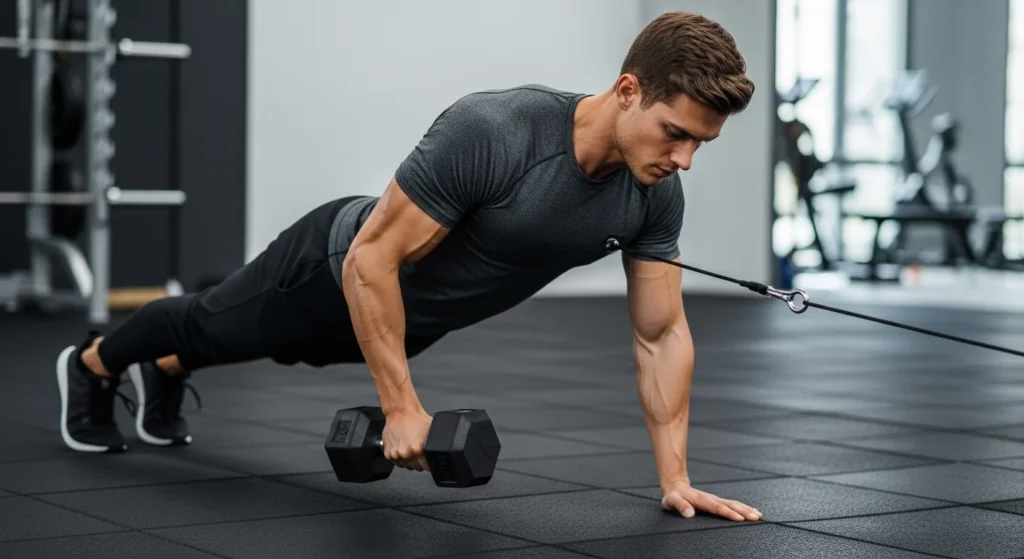
The renegade row with dumbbells is one of the most powerful full-body exercises you can add to your strength training routine. It combines a plank position with a dumbbell rowing movement, challenging your back, arms, shoulders, and especially your core stability at the same time.
Unlike traditional rowing exercises, this movement forces your body to resist rotation while lifting weight unilaterally, making it a top-tier exercise for building functional strength, athletic performance, and core control.
What Is a Renegade Row with Dumbbells?
The renegade row with dumbbells (also called a plank row) is a compound exercise that combines:
- A high plank (push-up position)
- A single-arm dumbbell row
- Anti-rotational core engagement
In simple terms, you hold a plank while rowing one dumbbell toward your body at a time, without letting your hips twist.
This exercise is widely used in functional training programs because it builds both upper-body pulling strength and deep core stability simultaneously.
Muscles Worked in Renegade Row with Dumbbells
One of the biggest advantages of this exercise is that it targets multiple muscle groups at once.
Primary muscles
- Latissimus dorsi (lats)
- Rhomboids
- Trapezius
Secondary muscles
- Biceps
- Forearms
- Rear deltoids
- Rotator cuff muscles
Core and stabilizers (major focus)
- Rectus abdominis (abs)
- Obliques
- Transverse abdominis
- Erector spinae
- Glutes and quads (isometric support)
Because of the plank position, your core works continuously to prevent rotation, making it more demanding than standard dumbbell rows.
Benefits of Renegade Row with Dumbbells
The renegade row is not just a back exercise. It is a full-body strength and stability builder.
1. Builds Core Stability and Anti-Rotation Strength
Your core must resist twisting every time you lift one arm. This improves:
- Athletic performance
- Postural control
- Lower back protection
2. Strengthens Upper Back and Lats
The rowing motion activates major pulling muscles, improving:
- Back thickness
- Shoulder stability
- Pulling strength for other lifts
3. Improves Functional Strength
Unlike machine exercises, renegade rows mimic real-life movement patterns that require:
- Balance
- Coordination
- Stability under load
4. Enhances Shoulder Stability
The exercise strengthens rotator cuff muscles, reducing injury risk during pressing or pulling movements.
5. Engages Full Body Muscles
Even your legs and glutes stay active to stabilize your body throughout the movement.
How to Do Renegade Row with Dumbbells (Step-by-Step Guide)
Proper form is everything in this exercise. Poor technique reduces effectiveness and increases injury risk.
Step 1: Set Your Equipment
- Place two dumbbells on the floor, shoulder-width apart
- Choose moderate weights (lighter than your normal rows)
Step 2: Get Into Plank Position
- Grip the dumbbells
- Hands directly under shoulders
- Feet slightly wider than hip-width for stability
- Body in a straight line from head to heels
Step 3: Engage Your Core
- Brace your abs tightly
- Squeeze your glutes
- Keep hips level and stable
Step 4: Perform the Row
- Shift weight slightly to one side
- Pull the opposite dumbbell toward your ribcage
- Keep elbow close to your body
- Avoid twisting your hips
Step 5: Lower Slowly
- Control the descent of the dumbbell
- Return to plank position
- Repeat on the other side
Step 6: Repeat
- Alternate arms
- Maintain strict form throughout
Pro Tips for Perfect Form
To get the most out of the renegade row:
- Keep feet wider for better balance
- Do not rush reps
- Pause briefly at the top of each row
- Think “anti-rotation,” not just pulling
- Keep neck neutral (don’t look forward)
If your hips are rotating, the weight is too heavy.
Common Mistakes to Avoid
1. Twisting the hips
This removes core activation and reduces effectiveness.
2. Using heavy weights
Renegade rows are about control, not maximum load.
3. Sagging lower back
Indicates weak core engagement.
4. Lifting hips too high
Turns the movement into an ineffective incline position.
5. Rushing the movement
Speed reduces stability and muscle activation.
Renegade Row Variations
Once you master the basic version, you can progress with these variations:
1. Knee-Assisted Renegade Row
Ideal for beginners to build strength safely.
2. Alternating Renegade Row
Switch arms after each rep for endurance training.
3. Push-Up + Renegade Row Combo
Add a push-up between rows for advanced full-body conditioning.
4. Feet-Elevated Renegade Row
Increases core and shoulder demand significantly.
5. Dumbbell to Kettlebell Switch
Using kettlebells increases instability and core activation.
Who Should Do Renegade Rows?
This exercise is ideal for:
- Intermediate to advanced lifters
- Athletes needing core stability
- People training for functional strength
- Individuals improving posture and back strength
Not recommended for:
- Complete beginners without plank strength
- People with wrist or shoulder injuries (unless modified)
Programming Tips (How to Use It in Your Workout)
Strength training
- 3–4 sets
- 6–10 reps per side
Conditioning
- 3 sets
- 10–12 reps per side
- Short rest periods
Full-body workouts
Pair with:
- Squats
- Dumbbell presses
- Lunges
Renegade Row vs Traditional Dumbbell Row
| Feature | Renegade Row | Dumbbell Row |
|---|---|---|
| Core activation | Very high | Moderate |
| Load capacity | Low-medium | High |
| Stability demand | Very high | Low |
| Muscle isolation | Moderate | High |
| Functional strength | Excellent | Good |
Safety Tips
- Warm up shoulders and core before starting
- Use a non-slippery surface
- Start light and progress slowly
- Stop if you feel lower back strain
Frequently Asked Questions (FAQs)
What muscles does the renegade row with dumbbells work?
It targets the back, shoulders, arms, and core muscles including abs and obliques.
Is the renegade row good for beginners?
It is better suited for intermediate users, but beginners can modify it using knees.
Can I use heavy dumbbells?
No, heavy weights reduce stability and increase injury risk.
Does renegade row build abs?
Yes, it strengthens deep core muscles through anti-rotation resistance.
How many reps should I do?
6–12 reps per side depending on your fitness level.
Why do my hips rotate during the exercise?
This usually means your core is weak or the weight is too heavy.
What equipment do I need?
Only a pair of dumbbells or kettlebells.
Is it better than a normal dumbbell row?
It depends. Renegade rows are better for core stability; rows are better for back muscle growth.
Can I do renegade rows at home?
Yes, it is one of the best home dumbbell exercises.
Should I include it in every workout?
No, 1–2 times per week is enough for most training programs.