Most chest programs have a blind spot. You do your bench press. You do your inclines. You may throw in some push-ups. And after a few months, the outer chest fills out, the upper chest starts showing — but that strip of muscle running down the middle, right along your sternum? Stays flat. Stays soft. Looks like you skipped half the muscle.
That’s not a volume problem. It’s a targeting problem.
The inner chest doesn’t respond to pressing the same way the rest of your pecs do. Pushing weight away from your body builds thickness, but it doesn’t force your arms across the midline. To train them properly, you need exercises that make your arms work toward each other, not just away from your torso.
Dumbbells are the best tool for this. A barbell locks your hands in place. Dumbbells let you bring them together, press them against each other, and squeeze through the full arc. That freedom of movement is the mechanical edge that makes dumbbell training so effective for inner chest definition, specifically.
Understanding the Inner Chest: What You’re Actually Training
The Anatomy Behind the “Inner Chest”
The pectoralis major has three distinct points of origin. The clavicular head runs along the medial half of the clavicle. The sternocostal head — the largest portion — originates along the manubrium, the body of the sternum, and the costal cartilages of ribs one through six. A smaller abdominal portion arises from the external oblique aponeurosis. All three sections converge into a single flat tendon that inserts onto the greater tubercle of the humerus.
When trainers and lifters refer to the “inner chest,” they’re talking about the medial fibers of the sternocostal head — the section of muscle closest to the breastbone. These fibers are most active during horizontal adduction: the motion of pulling the arms together across the body’s midline. That’s different from pressing (moving the arms perpendicular to the torso) or flaring (moving the arms outward). Understanding this distinction changes how you select and execute exercises.
Why the Inner Chest Gets Neglected
Standard chest programming defaults to compound pressing: bench press, incline press, push-ups. These movements build mass and general strength, but they don’t force the arms across the midline. Your elbows stop roughly in line with your shoulders. The outer and mid-pec fibers do most of the work, and the medial fibers contribute far less than they could.
Adding exercises that specifically require horizontal adduction — flies, crossovers, squeeze presses — shifts tension toward those medial fibers without abandoning the compound work that builds overall thickness.
The Mind-Muscle Connection Is Not a Myth
EMG research on chest activation consistently shows that how you focus during a set matters. A study published in the Journal of Strength and Conditioning Research by Saeterbakken et al. (2017) found that dumbbell variations of the chest press can produce higher pectoralis major activation compared to barbell equivalents, partly because the freedom of movement allows more deliberate squeezing at end range. Consciously thinking about squeezing your pecs together — rather than just pushing weight — genuinely changes which fibers do the most work.
Slow down. Squeeze at the top. Feel it working. That sounds basic, but it’s where most people leave gains behind.
The 7 Best Inner Chest Exercises With Dumbbells
1. Dumbbell Hex Press (Squeeze Press)
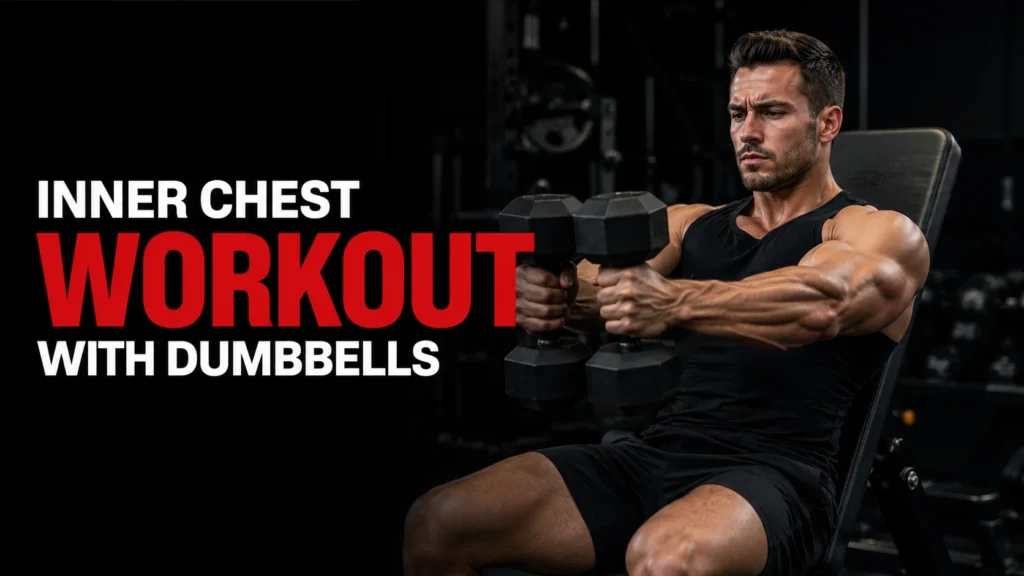
If you had to pick one exercise that directly targets inner chest fibers above all others, this is it. The hex press keeps both dumbbells in constant contact throughout the entire rep, creating continuous isometric tension across the inner pec. There’s no resting moment, no point where the load transfers away from the medial fibers.
How to do it:
- Lie flat on a bench with feet firmly planted on the floor.
- Hold two dumbbells horizontally, pressing them together at chest level. Your palms face inward and the ends of the dumbbells contact each other.
- Before pressing, actively squeeze the dumbbells together as hard as possible. Maintain that inward force throughout.
- Press them straight up to full arm extension, still squeezing.
- Lower under control, keeping the dumbbells touching from start to finish.
Sets and reps: 3–4 sets of 10–15 reps. Rest 60 seconds.
What trips people up: The moment they stop actively squeezing the dumbbells together, the exercise turns into a normal press and the inner chest activation drops significantly. The squeeze is the whole point.
2. Flat Dumbbell Fly
The dumbbell fly is a classic for a reason. It stretches the pectoral fibers under load at the bottom of the movement and then forces a strong contraction at the top as the arms come together. That combination of loaded stretch plus peak contraction is excellent for muscle growth.
EMG research comparing dumbbell flyes and barbell bench press (Solstad et al., Journal of Sports Science and Medicine, 2021) confirmed heavy reliance on the pectoralis major and anterior deltoid during the fly, with relatively little triceps involvement. This makes it a better isolation tool than most pressing movements.
How to do it:
- Lie on a flat bench holding a dumbbell in each hand. Start with arms extended directly above your chest, palms facing each other.
- Keep a slight, fixed bend in the elbows — never let them bend further or straighten during the movement.
- Lower the dumbbells in a wide arc until they’re roughly level with your chest and you feel a deep stretch across the pecs.
- Reverse the motion, thinking about pulling your fists toward each other in that same arc. The dumbbells should meet directly above your chest at the top.
- Pause and squeeze for one full second before starting the next rep.
Sets and reps: 3–4 sets of 10–15 reps. RPE 8–9 (leave one to two reps in the tank).
Load note: Go lighter than you think you need. Heavy dumbbells force the triceps to compensate and the arc turns into a pressing movement. The stretch and squeeze matter more than the weight.
3. Incline Dumbbell Fly
The incline angle shifts tension slightly toward the upper and inner chest, targeting the junction between the clavicular and upper sternocostal fibers. If your inner chest development lags at the top — right below the collarbone — this variation deserves a permanent slot in your routine.
How to do it:
- Set a bench to 30–45 degrees. Higher than 45 degrees turns this into a front raise and takes tension off the chest.
- Hold the dumbbells above your chest with palms facing each other, arms slightly bent.
- Lower in a controlled arc until you feel the stretch, keeping elbows at a consistent angle.
- Drive the dumbbells back together above your upper chest, squeezing hard at the top.
Sets and reps: 3 sets of 12–15 reps. Rest 60–75 seconds.
Trainer tip: The squeeze at the top is even more critical on incline flyes because the range of motion is slightly shorter than flat. Compensate with a longer pause at peak contraction.
4. Dumbbell Squeeze Press
This differs from the hex press in that the dumbbells are held vertically rather than horizontally, and the pressing motion is slightly more traditional. The constant inward force still creates strong medial fiber activation, but the vertical grip feels more natural for some lifters and allows a touch more load.
How to do it:
- Lie flat on a bench. Hold dumbbells vertically side by side at chest level, ends pointing up and down. The flat sides face each other and press together.
- Squeeze them inward before lifting.
- Press directly upward, maintaining the inward compression.
- Lower slowly, keeping contact between the dumbbells the whole way down.
Sets and reps: 3 sets of 10–12 reps.
5. Dumbbell Standing Cable-Style Crossover
No cables? No problem. A standing single-arm dumbbell crossover simulates the cable fly’s crossover motion using one dumbbell and a controlled shoulder rotation. This is among the few chest exercises that genuinely works without a bench, and it directly trains the horizontal adduction pattern.
How to do it:
- Stand with feet shoulder-width apart. Hold one dumbbell at your side with an overhand grip.
- Keep the elbow slightly bent and locked in that position — do not let it change throughout.
- Begin rotating your wrist and shoulder inward, driving the dumbbell across your body toward the opposite hip. Think of the motion as scooping across your chest.
- At the end range, the dumbbell should be at your centerline or slightly past it. Squeeze the chest hard.
- Return under control. Complete all reps on one side, then switch.
Sets and reps: 3 sets of 12–15 reps per side. Rest 45–60 seconds.
Common error: Letting the bicep take over. If you feel this primarily in your arm rather than your chest, reduce the load and slow down.
6. Decline Dumbbell Fly
The decline angle emphasizes the lower and inner chest — the portion of the sternocostal head that’s often the thickest and responds well to a deep stretch. If you’re training for an aesthetic chest with clear definition along the lower border, this variation earns its place.
How to do it:
- Set the bench to a 15–30 degree decline. Secure your feet under the pad.
- Start with dumbbells above your lower chest, palms facing each other.
- Lower in the same controlled arc as a flat fly, feeling a strong stretch through the lower pec.
- Bring the dumbbells together at the top and squeeze.
Sets and reps: 3 sets of 10–15 reps.
Note: The decline fly is also a good option if flat bench pressing causes shoulder discomfort, because the decline angle reduces anterior shoulder strain.
7. Dumbbell Pullover
The dumbbell pullover is unusual because it trains the chest in a completely different plane than every other exercise on this list. The arms move overhead and return — a stretch-focused movement that hits the inner chest and sternocostal fibers while simultaneously engaging the serratus anterior and lat. For full chest development, this underrated exercise fills gaps the other movements miss.
How to do it:
- Lie perpendicular across a flat bench, upper back supported, hips lowered slightly below bench height.
- Hold one dumbbell with both hands, cupped around one end.
- Start with the dumbbell above your chest. Lower it back behind your head in a slow arc, keeping elbows slightly bent.
- Stop when you feel a deep stretch through the ribcage and chest — usually when the upper arms are roughly parallel with the floor.
- Pull the dumbbell back over your chest, squeezing the pecs at the top.
Sets and reps: 2–3 sets of 12–15 reps. Use a moderate weight. Heavy pullovers drift toward a shoulder exercise and increase injury risk.
Programming Principles That Make the Difference
Progressive Overload Is Non-Negotiable
Your inner chest will not grow if the stimulus never changes. Progressive overload means you’re consistently making training harder over time — adding weight, adding reps, reducing rest periods, or improving the quality of each contraction. For inner chest exercises specifically, adding one rep per set each week before bumping the weight is a sustainable approach. When you can complete the top end of a rep range (say, 15 reps) with solid form and two reps still in the tank, increase the load by the smallest increment available.
Prioritize Quality Contractions Over Heavy Weight
Inner chest training responds better to controlled, intentional reps than to grinding through heavy weight with compromised form. A 20-pound dumbbell fly where you feel a deep stretch, a full arc, and a genuine squeeze at the top is worth far more than a 40-pound fly where the elbows bend dramatically and the movement looks more like a press. This isn’t about going easy — it’s about actually using the muscle you’re trying to develop.
Recovery and Frequency
The pectoralis major is a large muscle group that recovers in roughly 48–72 hours for most trained individuals. Two to three chest sessions per week is the sweet spot for most people. Training chest every day slows recovery and limits hypertrophy. Once per week is below the volume threshold most people need to see consistent growth.
Stretching After Inner Chest Training
A brief post-workout stretch improves flexibility and may accelerate recovery. Doorframe chest stretches (place hands on either side of a doorframe and lean forward) and arm-across-chest stretches work well. Hold each for 20–30 seconds. Nothing elaborate — just enough to maintain range of motion.
Common Mistakes That Kill Inner Chest Development
Going too heavy on flies. The moment the weight exceeds what your stabilizing muscles can control, the arc breaks down and the triceps take over. Flies are isolation movements. They work best at moderate loads with perfect form.
Skipping the squeeze at the top. The peak contraction is where inner chest fibers are most active. Rushing through it — or stopping just short of it — wastes the most productive moment of each rep.
Training only flat angles. The inner chest is active at multiple angles. Flat, incline, and decline work slightly different portions of the medial fibers. Using only flat-bench movements limits how much of the inner chest you’re actually developing.
Using pressing grip width on fly exercises. Shoulder-width grip on a fly changes the shoulder mechanics and reduces the stretching effect. Use a wider position on the way down, allowing the arms to open fully.
Neglecting compound pressing entirely. Some lifters overcorrect and fill their program with only isolation exercises. Compound pressing builds the thickness and base strength that makes isolation work more effective. Keep both in the rotation.
Frequently Asked Questions (FAQs)
Can you actually isolate the inner chest?
Not truly. The pectoralis major fires as a unit — you can’t contract only the medial fibers in complete isolation. What you can do is select exercises and movement patterns (specifically horizontal adduction) that create disproportionately higher tension on those medial fibers compared to other chest movements. The difference is real and measurable on EMG, but it’s a matter of emphasis, not pure isolation.
How long before I see results in my inner chest?
For most people who are consistent and eating adequately to support muscle growth, noticeable changes in chest definition begin appearing at 8–12 weeks of dedicated training. The inner chest develops more slowly than the outer pecs for most people because it receives less direct training stimulus in standard programs. Be patient and trust the process.
Do I need a bench to train my inner chest with dumbbells?
No. The standing single-arm crossover, hex press on the floor, floor fly, and dumbbell squeeze press can all be done without a bench. Floor-based pressing and fly variations do reduce the range of motion slightly at the bottom, but they’re entirely effective — especially if you’re training at home.
Should I train the inner chest before or after compound pressing?
Compound pressing first. Large multi-joint movements require the most energy and full motor unit recruitment. Performing isolation exercises like flies first pre-fatigues the chest before you get to your heaviest sets, which reduces the training stimulus for overall mass. Finish with isolation work as a “finisher” to flush the inner pec with blood and squeeze out the remaining fibers.
What’s the difference between the hex press and the squeeze press?
Both keep the dumbbells in contact throughout the movement. The hex press typically refers to using hexagonal dumbbells held horizontally (flat sides pressing against each other), while the squeeze press uses round or hex dumbbells held vertically with the ends pressing together. The hex press tends to feel more stable; the squeeze press allows a slightly larger load. Both are excellent — choose based on what you have available and what feels more natural in your hands.
Is there a specific rep range that works best for inner chest development?
Research on hypertrophy generally supports training across a range of loads — roughly 6–30 reps — as long as you’re working close to failure. For inner chest exercises specifically, moderate rep ranges of 10–15 per set tend to produce good results because they allow enough time under tension to feel and control the contraction without the form breakdown that often happens at very low reps with heavy weights.
How many sets per week does the inner chest need?
For most intermediate trainees, 12–20 direct chest sets per week is a productive range. Not all of those need to be inner-chest-specific — your heavy pressing work counts toward total volume. If you’re specifically trying to bring up lagging inner chest definition, add 4–6 isolation sets (flies, squeeze presses, crossovers) on top of your regular pressing work.
Why does my shoulder hurt during dumbbell flies?
Pain during fly movements usually comes from one of three causes: going too heavy and losing control of the arc, over-stretching at the bottom (taking the arms too low), or training through an existing shoulder issue. Check that your elbows maintain a fixed, slight bend throughout — never fully straighten them. Stop the descent when you feel a good stretch in the chest, not the shoulder. If pain persists regardless of form adjustments, see a sports medicine professional.
In conclusion
Training the inner chest with dumbbells is not complicated once you understand the underlying mechanics. Horizontal adduction — bringing the arms across the body’s midline — is the fundamental movement pattern. Exercises that force that motion under load, combined with genuine squeeze at peak contraction, put the most tension on the medial pec fibers.
The hex press and flat fly are the two most direct tools in your arsenal. Build your inner chest sessions around them, add variety with incline and decline angles, and use progressive overload to ensure you’re consistently asking more from the muscle over time. Two to three sessions per week with adequate recovery between them is enough frequency for most people to see real development within two to three months.
Lighter weights with better contractions beat heavy weights with sloppy form here every single time. Train deliberately, stretch after each session, and give the muscle the time it needs to grow.
Want to build bigger, stronger calves at home? Check out How to Do Seated Calf Raises with Dumbbells for proper form, key benefits, and tips to maximize calf muscle activation.