
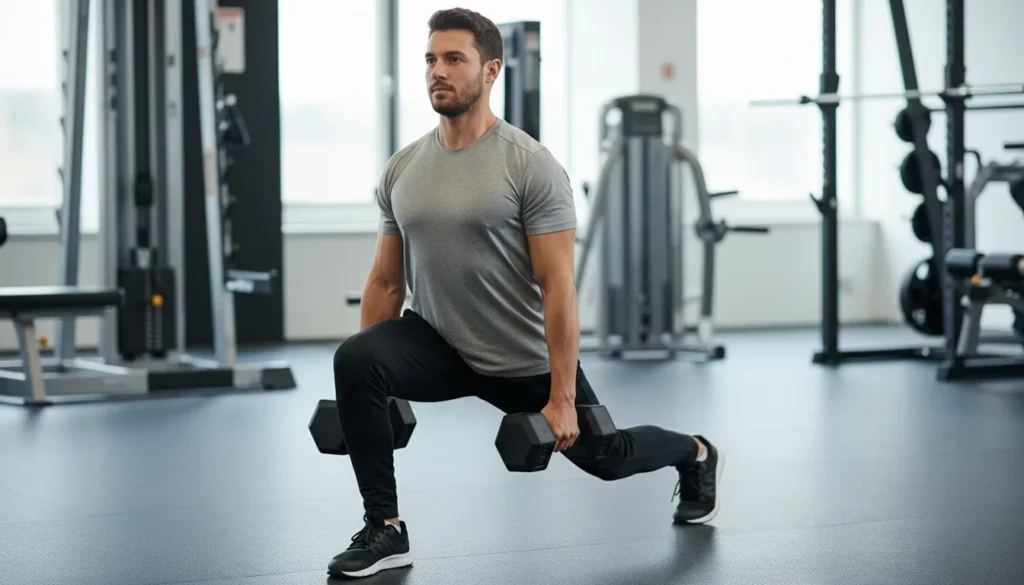
If you want stronger, leaner legs without complicated equipment, dumbbell lunges should be a cornerstone of your routine. This simple yet powerful exercise targets your thighs, glutes, and core while improving balance, coordination, and overall athletic performance.
What Are Dumbbell Lunges?
Dumbbell lunges are a weighted variation of the classic lunge exercise, where you hold a dumbbell in each hand while stepping forward, backward, or sideways into a lunge position.
They are considered a functional compound movement, meaning they train multiple joints and muscle groups simultaneously.
Muscles Worked by Dumbbell Lunges
One of the biggest advantages of dumbbell lunges is that they engage multiple lower-body and stabilizing muscles at once.
Primary Muscles Targeted
- Quadriceps (front thighs) – main driver of the movement
- Glutes (buttocks) – power and hip stability
- Hamstrings – assist in control and movement
Secondary Muscles
- Calves (gastrocnemius and soleus)
- Core muscles (abs, obliques)
- Lower back stabilizers
Lunges activate both the front and back leg simultaneously, making them highly effective for building balanced strength and coordination.
Benefits of Dumbbell Lunges
1. Builds Strong, Toned Thighs
Dumbbell lunges directly target your quadriceps and glutes, helping you develop defined, powerful legs.
2. Improves Balance and Stability
Because lunges are a unilateral exercise (one leg at a time), they challenge your balance and activate stabilizing muscles.
3. Enhances Functional Strength
The movement mimics everyday actions like walking, climbing stairs, and bending—making it highly practical for daily life.
4. Corrects Muscle Imbalances
Working each leg independently helps fix strength differences between your left and right sides.
5. Supports Fat Loss
Lunges engage large muscle groups, increasing calorie burn and boosting metabolism.
6. Protects Joints When Done Correctly
Proper technique strengthens the muscles around your knees and hips, reducing injury risk.
How to Do Dumbbell Lunges (Step-by-Step Guide)
Follow this expert-approved technique to perform dumbbell lunges safely and effectively.
Starting Position
- Stand upright with feet hip-width apart
- Hold a dumbbell in each hand at your sides
- Keep your chest up and core engaged
Execution Steps
- Step Forward
- Take a controlled step forward with one leg
- Keep your torso upright
- Lower Your Body
- Bend both knees until they reach about a 90-degree angle
- Your back knee should hover just above the floor
- Check Alignment
- Front knee should stay aligned with your toes
- Avoid letting it go too far forward
- Push Back Up
- Drive through your front heel
- Return to the starting position
- Repeat
- Alternate legs or complete reps on one side
Proper Form Checklist (Critical for Safety)
Use this quick checklist every time you perform dumbbell lunges:
- Keep your torso upright
- Engage your core throughout
- Maintain hip alignment (no tilting)
- Ensure knee tracks over toes
- Avoid slamming your back knee into the ground
- Move in a controlled, steady tempo
Poor form—like leaning forward or pushing the knee too far—can increase stress on joints and lead to injury.
Common Mistakes to Avoid
1. Letting the Knee Go Past the Toes
This increases stress on the knee joint.
2. Leaning Too Far Forward
Reduces glute activation and strains your lower back.
3. Using Too Much Weight
Start light and master form first.
4. Taking Steps That Are Too Short
This limits muscle engagement and balance.
5. Rushing the Movement
Lunges should be controlled for maximum effectiveness.
Dumbbell Lunges Variations (For All Levels)
1. Forward Dumbbell Lunges
- Most common variation
- Great for overall leg development
2. Reverse Dumbbell Lunges
- Easier on the knees
- Targets glutes and hamstrings more
3. Walking Dumbbell Lunges
- Adds a dynamic element
- Improves coordination and endurance
4. Lateral (Side) Lunges
- Targets inner thighs (adductors)
- Improves lateral mobility
5. Static Lunges (Split Squats)
- Beginner-friendly
- Focuses on stability and control
Each variation shifts emphasis slightly but still trains the entire lower body.
Dumbbell Lunges vs Other Leg Exercises
| Exercise | Focus Area | Balance Required | Best For |
|---|---|---|---|
| Dumbbell Lunges | Quads, glutes, core | High | Functional strength |
| Squats | Full lower body | Medium | Mass and power |
| Step-Ups | Glutes, quads | Medium | Stability + coordination |
| Leg Press | Quads | Low | Isolation and heavy loads |
How Many Reps and Sets Should You Do?
Beginners
- 2–3 sets
- 8–10 reps per leg
- Light weights or bodyweight
Intermediate
- 3–4 sets
- 10–12 reps per leg
- Moderate weights
Advanced
- 4–5 sets
- 12–15 reps per leg
- Heavy weights or variations
Safety Tips for Dumbbell Lunges
- Start with bodyweight first
- Use a mirror to check form
- Keep movements slow and controlled
- Avoid if you have severe knee or hip injuries
- Stop immediately if you feel joint pain
Experts recommend proper alignment and gradual progression to prevent strain and maximize benefits.
Best Dumbbell Lunges Workout Plan
Beginner Routine
- Static lunges – 3 sets
- Bodyweight walking lunges – 2 sets
Intermediate Routine
- Dumbbell forward lunges – 3 sets
- Reverse lunges – 3 sets
- Walking lunges – 2 sets
Advanced Routine
- Heavy dumbbell walking lunges – 4 sets
- Jump lunges – 3 sets
- Lateral lunges – 3 sets
Pro Tips for Faster Results
- Focus on mind-muscle connection
- Push through your front heel
- Keep tension on your legs (don’t lock out)
- Progressively increase weight
- Combine with a full lower-body workout
Frequently Asked Questions (FAQs)
Are dumbbell lunges good for beginners?
Yes, they are beginner-friendly when performed with proper form and light weights.
Do dumbbell lunges build muscle?
Yes. They target major lower-body muscles and promote muscle growth.
How often should I do dumbbell lunges?
2–3 times per week is ideal for most people.
Are lunges better than squats?
Both are effective. Lunges improve balance and correct imbalances, while squats build overall mass.
Why do my knees hurt during lunges?
Poor form, excessive forward knee movement, or weak stabilizers may be the cause.
Can dumbbell lunges help lose weight?
Yes, they burn calories and increase metabolism by engaging large muscle groups.
Should my knee touch the ground?
No, it should hover just above the floor to maintain tension and protect joints.
What weight should I use?
Start light and increase gradually as your form improves.
Are reverse lunges safer?
Yes, they generally place less stress on the knees.
Can I do lunges every day?
It’s better to allow recovery—2–4 sessions per week is optimal.