
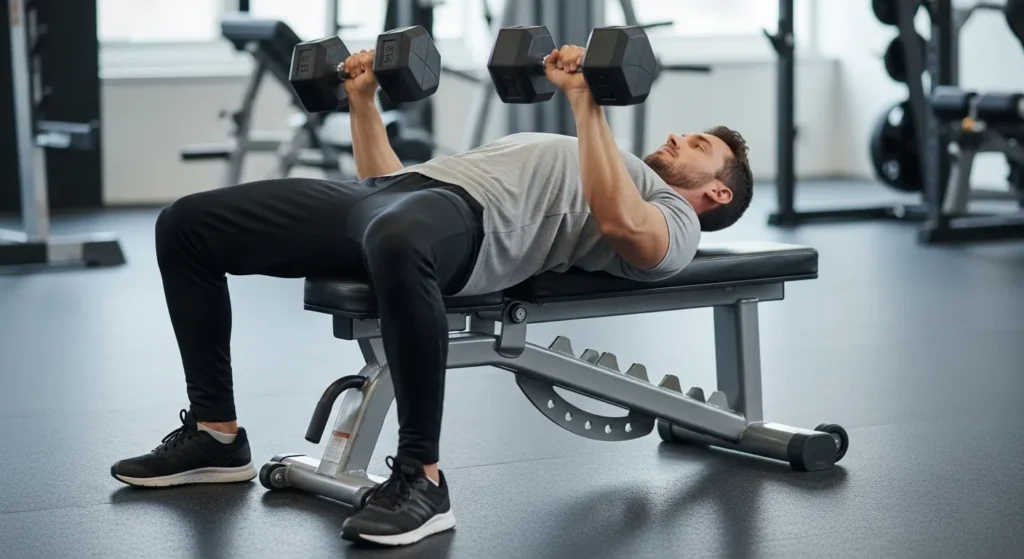
If your goal is to build a stronger, more muscular upper body, the dumbbell bench press deserves a permanent place in your workout routine. It’s one of the most effective compound exercises for developing chest strength, improving muscle symmetry, and enhancing overall pressing power.
Unlike the barbell version, this variation gives you greater freedom of movement, better muscle activation, and reduced joint strain.
What Is the Dumbbell Bench Press?
The dumbbell bench press is a compound upper-body exercise where you press a pair of dumbbells upward while lying on a flat bench.
It primarily targets your chest muscles while also engaging your shoulders and triceps. Because each arm works independently, it improves coordination, stability, and muscular balance.
According to fitness research, pressing movements like this activate multiple upper-body muscles, including the chest, shoulders, and arms, making it highly effective for strength and hypertrophy training .
Muscles Worked in the Dumbbell Bench Press
Understanding which muscles are involved helps you improve mind-muscle connection and training efficiency.
Primary Muscles
- Pectoralis Major (Chest) – Main driver of the pressing motion
- Anterior Deltoids (Front Shoulders) – Assist in lifting the weight
- Triceps Brachii – Extend your elbows during the press
Secondary & Stabilizing Muscles
- Core (abs and obliques)
- Serratus anterior
- Upper back muscles
- Forearms
Because dumbbells require more control, stabilizer muscles are more engaged compared to barbell pressing .
Benefits of the Dumbbell Bench Press
1. Builds Upper Body Strength
The dumbbell bench press is a foundational strength exercise that improves pressing power across your chest, shoulders, and triceps.
2. Enhances Muscle Growth (Hypertrophy)
Dumbbells allow a greater range of motion, stretching the chest muscles more effectively, which can lead to better muscle development .
3. Fixes Muscle Imbalances
Each arm works independently, preventing your stronger side from compensating for the weaker one.
4. More Joint-Friendly
Dumbbells allow a natural wrist and elbow path, reducing stress on shoulders compared to barbells.
5. Improves Stability and Coordination
You must control each dumbbell individually, which activates stabilizer muscles and improves overall control.
How to Do a Dumbbell Bench Press (Step-by-Step Guide)
Follow these steps for perfect form:
Step 1: Set Up
- Sit on the edge of a flat bench
- Place a dumbbell on each thigh
- Keep your feet flat on the ground
Step 2: Get Into Position
- Use your thighs to lift the dumbbells as you lie back
- Position the dumbbells at chest level
- Keep wrists stacked over elbows
Step 3: Starting Position
- Arms extended above your chest
- Palms facing forward or slightly inward
- Shoulder blades retracted (pulled back)
Step 4: Lower the Dumbbells
- Slowly lower weights to chest level
- Keep elbows at about a 45-degree angle
- Maintain control throughout the descent
Step 5: Press Up
- Push the dumbbells upward
- Extend your arms fully without locking elbows aggressively
- Bring dumbbells slightly together at the top
Step 6: Repeat
- Perform 8–12 reps for hypertrophy
- Maintain steady breathing (inhale down, exhale up)
Proper Form Checklist
Use this quick checklist to ensure optimal technique:
- Keep feet planted firmly on the ground
- Maintain a neutral spine (slight natural arch)
- Avoid flaring elbows too wide
- Control the weight—no bouncing
- Keep core engaged throughout
Common Dumbbell Bench Press Mistakes
1. Using Too Much Weight
Lifting too heavy compromises form and increases injury risk.
2. Flaring Elbows
This puts unnecessary stress on your shoulders.
3. Limited Range of Motion
Not lowering the dumbbells enough reduces chest activation.
4. Lack of Control
Dropping weights too fast reduces effectiveness and increases injury risk.
5. Not Engaging the Core
A loose core can lead to instability and poor force transfer.
Dumbbell Bench Press Variations
1. Incline Dumbbell Bench Press
Targets the upper chest and shoulders.
2. Decline Dumbbell Bench Press
Focuses on the lower chest.
3. Neutral Grip Dumbbell Press
Reduces shoulder strain and improves joint comfort.
4. Single-Arm Dumbbell Bench Press
Improves core stability and unilateral strength.
5. Floor Press
Limits range of motion and emphasizes triceps.
Dumbbell Bench Press vs Barbell Bench Press
| Feature | Dumbbell Bench Press | Barbell Bench Press |
|---|---|---|
| Range of Motion | Greater | Limited |
| Stability | Lower (harder) | Higher |
| Muscle Balance | Better | Can hide imbalances |
| Weight Load | Moderate | Heavier |
| Joint Stress | Lower | Higher |
Programming the Dumbbell Bench Press
For Muscle Growth (Hypertrophy)
- 3–4 sets
- 8–12 reps
- Moderate weight
For Strength
- 4–5 sets
- 4–6 reps
- Heavy weight
For Endurance
- 2–3 sets
- 12–15 reps
- Light weight
Expert Tips to Maximize Results
- Focus on time under tension (slow reps)
- Squeeze your chest at the top
- Use progressive overload (increase weight gradually)
- Train chest 1–2 times per week
- Combine with exercises like push-ups and chest flys
Dumbbell Bench Press for Beginners
If you’re new:
- Start with light weights
- Practice form before increasing load
- Use a spotter if possible
- Train 2–3 times per week
Safety Tips
- Always warm up before lifting
- Use proper grip and wrist alignment
- Don’t drop weights suddenly
- Stop if you feel shoulder pain
- Keep control throughout the movement
Sample Chest Workout with Dumbbell Bench Press
Beginner Routine:
- Dumbbell Bench Press – 3×10
- Incline Dumbbell Press – 3×10
- Dumbbell Fly – 3×12
- Push-Ups – 3 sets to failure
Frequently Asked Questions (FAQs)
Is the dumbbell bench press better than the barbell bench press?
Both are effective, but dumbbells offer better muscle activation and balance, while barbells allow heavier lifting.
How much weight should I use?
Start with a weight you can control for 8–12 reps with proper form.
How often should I do dumbbell bench press?
2–3 times per week is ideal for most people.
Why do I feel it more in my arms than chest?
This usually happens due to poor form or weak chest activation. Focus on slowing down and improving technique.
Can beginners do dumbbell bench press?
Yes, it’s beginner-friendly when performed with proper form and light weights.
Should dumbbells touch at the top?
They can come close but don’t need to touch. Focus on controlled movement.
What angle should my elbows be?
Around 30–45 degrees from your body for optimal safety and activation.
Is dumbbell bench press safe for shoulders?
Yes, when performed correctly, it’s generally more shoulder-friendly than barbell pressing.