
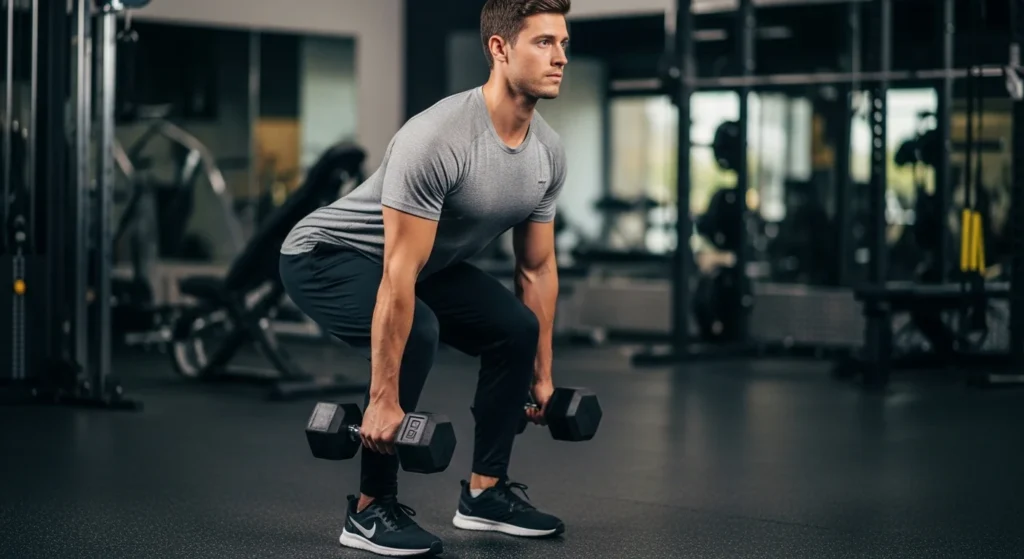
The dumbbell deadlift to row is one of the most efficient compound exercises for building total-body strength using minimal equipment.
This movement combines a powerful hip hinge with an upper-body pulling pattern, making it highly effective for muscle growth, athletic performance, and metabolic conditioning.
Unlike isolated exercises that target a single muscle group, this lift trains multiple systems at once, creating a strong carryover to real-world strength and sports performance.
What Is the Dumbbell Deadlift to Row?
The dumbbell deadlift to row is a hybrid resistance training movement that merges two foundational lifts into a single sequence.
It begins with a dumbbell deadlift, where the lifter hinges at the hips and lowers the weights toward the ground, followed by a bent-over row, where the dumbbells are pulled toward the torso.
This combination increases training efficiency while maximizing muscle activation across the posterior chain and upper back.
Fitness professionals often classify it as a full-body compound lift due to its multi-joint engagement and functional movement pattern.
Muscles Worked in Dumbbell Deadlift to Row
The exercise activates several major muscle groups simultaneously, making it highly effective for hypertrophy and strength development.
Posterior Chain Activation
The glutes and hamstrings are heavily engaged during the hip hinge phase, which improves lower-body power and stability.
Back Muscle Development
The latissimus dorsi, rhomboids, and trapezius muscles are activated during the rowing phase, contributing to a thicker and stronger upper back.
Core Engagement
The abdominals and obliques stabilize the spine throughout the movement, preventing excessive flexion and supporting posture control.
Grip Strength Enhancement
Holding dumbbells under tension improves forearm endurance and grip strength over time.
How to Do Dumbbell Deadlift to Row Properly
Proper technique is essential for maximizing results and preventing injury.
Step 1: Establish a Stable Stance
Position your feet hip-width apart with toes pointing forward or slightly outward.
Step 2: Grip the Dumbbells
Hold a dumbbell in each hand with a neutral grip while keeping shoulders relaxed.
Step 3: Perform a Controlled Hip Hinge
Push your hips backward while lowering your torso until it reaches a near-parallel position to the floor.
Step 4: Maintain Spinal Alignment
Keep your back straight and avoid rounding your shoulders or lower back.
Step 5: Execute the Row
Pull the dumbbells toward your lower rib cage by driving your elbows upward and backward.
Step 6: Return the Weights
Lower the dumbbells back to the hanging position with control.
Step 7: Stand Up to Complete the Rep
Drive through your heels and extend your hips to return to standing.
Dumbbell Deadlift to Row Form Tips
Proper form ensures both safety and muscle activation efficiency.
- Keep the core braced throughout the movement
- Maintain a neutral neck position aligned with the spine
- Avoid using momentum during the row phase
- Keep elbows close to the body during pulling
- Control both lifting and lowering phases
Benefits of Dumbbell Deadlift to Row
Full-Body Strength Development
This exercise engages both upper and lower body muscles in a single movement pattern.
Time-Efficient Training
Combining two compound exercises reduces workout duration without sacrificing effectiveness.
Improved Postural Strength
Strengthening the upper back helps counteract forward shoulder posture.
Enhanced Athletic Performance
The hip hinge and pulling combination improves explosive power and coordination.
Increased Calorie Burn
Multi-joint exercises elevate heart rate and energy expenditure more than isolation movements.
Functional Movement Transfer
The pattern closely resembles real-life lifting and pulling tasks.
Dumbbell Deadlift to Row vs Traditional Exercises
Compared to Standard Deadlifts
The dumbbell deadlift to row adds an upper-body pulling component, increasing total muscle engagement.
Compared to Bent-Over Rows
It includes a lower-body strength phase, making it more comprehensive than isolated back training.
Compared to Separate Movements
It reduces workout complexity while improving training density and efficiency.
Programming the Dumbbell Deadlift to Row
Beginner Level
- 2–3 sets
- 8–10 repetitions
- Light to moderate dumbbells
Intermediate Level
- 3–4 sets
- 8–12 repetitions
- Moderate resistance
Advanced Level
- 4–5 sets
- 6–10 heavy repetitions
- Progressive overload strategy
Variations of Dumbbell Deadlift to Row
Single-Arm Dumbbell Deadlift to Row
This variation challenges core stability and unilateral strength.
Alternating Dumbbell Row Deadlift
Each arm rows separately, increasing control and muscular endurance.
Staggered Stance Version
One foot slightly forward improves balance and reduces lower back stress.
Tempo Controlled Version
Slowing down the eccentric phase increases time under tension for hypertrophy.
Common Mistakes to Avoid
- Rounding the spine during the hinge phase
- Jerking the weights during the row
- Using excessively heavy dumbbells that compromise form
- Neglecting core engagement
- Standing too upright during the row phase
Safety Considerations
Maintaining proper spinal alignment is critical to preventing injury.
Individuals with existing lower back issues should begin with lighter weights and focus on form mastery before progressing.
A gradual increase in resistance ensures long-term joint safety and muscular adaptation.
Dumbbell Deadlift to Row for Muscle Building
This exercise is highly effective for hypertrophy due to its compound nature and sustained muscle tension.
When performed with moderate to heavy loads in the 8–12 rep range, it stimulates both fast-twitch and slow-twitch muscle fibers.
It is especially beneficial for developing back thickness and posterior chain strength.
Dumbbell Deadlift to Row for Fat Loss
Because multiple muscle groups are activated simultaneously, the exercise significantly increases metabolic demand.
It elevates heart rate and supports calorie expenditure during strength training sessions.
When incorporated into circuits or supersets, it becomes even more effective for fat reduction.
Equipment Needed
- Pair of dumbbells with adjustable or fixed weight
- Flat training surface
- Optional lifting straps for heavy loads
Training Integration Strategies
This exercise can be included in:
- Full-body workouts
- Upper/lower split routines
- Push-pull-leg programs
- Functional circuit training
- Home dumbbell workouts
Who Should Perform This Exercise?
- Beginners learning compound movement patterns
- Intermediate lifters building muscle mass
- Athletes improving strength and explosiveness
- Home gym users seeking efficiency
- Individuals aiming for fat loss and conditioning
Frequently Asked Questions (FAQs)
Is the dumbbell deadlift to row good for beginners?
Yes, it is suitable for beginners if performed with light weights and proper form.
What muscles does the dumbbell deadlift to row target most?
It primarily targets the glutes, hamstrings, back muscles, and core.
Can I build muscle with this exercise alone?
It can contribute significantly to muscle growth when included in a balanced program.
How heavy should dumbbells be for this exercise?
Start with a moderate weight that allows controlled movement without compromising form.
Is it better than doing deadlifts and rows separately?
It is more time-efficient but separate exercises may allow higher load specialization.
How often should I do dumbbell deadlift to row?
Two to three times per week is sufficient for most training programs.
Does it help with weight loss?
Yes, due to its high muscle engagement and calorie-burning potential.
Can I do it at home without a gym?
Yes, only dumbbells are required, making it ideal for home workouts.
What is the biggest mistake people make?
The most common mistake is using momentum instead of controlled movement.
Is it safe for lower back issues?
It can be safe if performed with correct form and appropriate load, but caution is recommended.
Want to build a stronger, wider, and more defined back? Check out these 9 Best Dumbbell Back Workouts to Build Your Back for effective exercises and complete training guidance.