
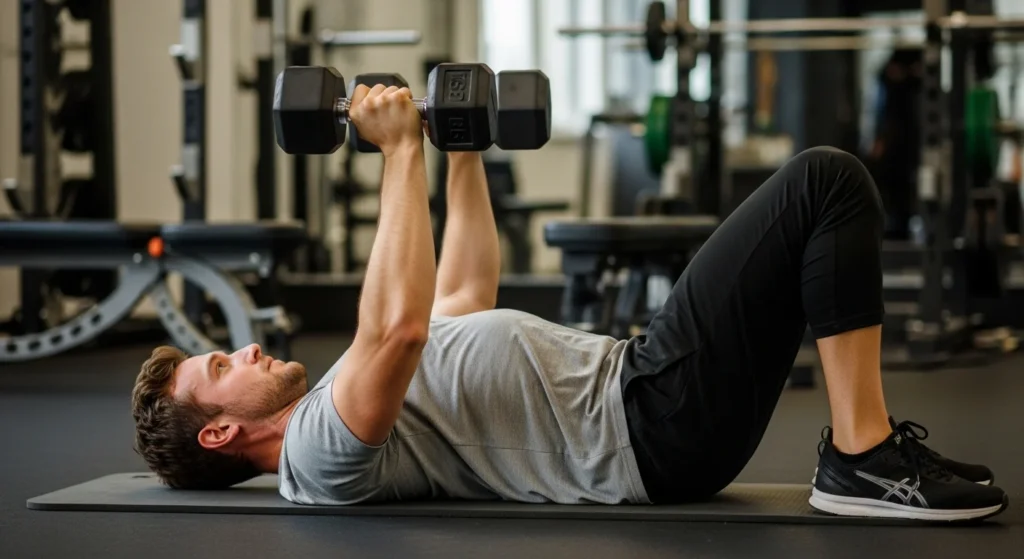
Most chest exercises get treated like they’re interchangeable. Bench press, cable flys, dumbbell press — people rotate through them without much thought about what each one actually does differently. The dumbbell floor press is different, and not in a subtle way. It cuts the range of motion, changes which muscles carry the most load, saves your shoulders from the deep stretch that causes most pressing injuries, and still delivers real strength and hypertrophy results. It also works perfectly in a home gym with nothing but floor space and a pair of dumbbells.
What Is the Dumbbell Floor Press?
The dumbbell floor press is a horizontal pressing exercise performed lying flat on the ground. Your upper arms contact the floor at the bottom of each rep, which stops the movement before your shoulders can travel into the deep external rotation that often causes discomfort during a full bench press. From that stopped position, you press the dumbbells back to lockout.
It is a variant of the dumbbell chest press where you lie on the floor rather than a bench, which limits the range of motion since your upper arms stop against the floor.
That shortened range is the whole point. It is not a compromise — it is a deliberate design feature that shifts muscular demand, reduces shoulder stress, and makes the exercise genuinely useful for a specific set of training goals that the full bench press cannot address as directly.
Some of the great old-school lifters actually popularized the floor press as a way to develop upper-body strength and power before benches were widely available. The modern version is not a workaround for missing equipment. It is an accessory movement with well-defined benefits, and coaches in powerlifting, strength and conditioning, and general fitness use it for different but equally valid reasons.
Muscles Worked During the Dumbbell Floor Press
Primary Movers
Triceps brachii carry the heaviest load in this exercise. The floor press targets the triceps to a greater extent than the bench press because the decreased range of motion minimizes chest engagement and places greater loading on the elbow extensors. This makes the movement unusually direct for a compound pressing exercise — you feel your triceps working in a way that most chest-focused movements do not produce.
Pectoralis major contributes throughout the press, particularly during the upper portion of the movement near lockout. The limited range of motion effectively takes the chest somewhat out of the equation, though the chest can still be indirectly targeted when squeezing the pecs at the top of the movement. Deliberately contracting the pecs at the top — not just extending the arms — makes a real difference in chest involvement.
Anterior deltoids assist the press and experience moderate load. The exercise is relatively shoulder-friendly and provides a good pump for the front deltoids when performed with proper setup and technique.
Secondary and Stabilizing Muscles
Because dumbbells move independently, each arm must stabilize its own load. This recruits the rotator cuff, serratus anterior, and various smaller shoulder stabilizers that barbell pressing doesn’t demand as much from. Your core activates to prevent your lower back from lifting off the floor as the weights travel overhead. The forearms and grip work continuously to hold the dumbbells in position throughout every rep.
The floor press enhances triceps activation and isolates upper body muscles since leg drive is not used. Dumbbells allow for unilateral movement, addressing muscle imbalances, and the need for stabilization boosts core engagement.
How to Do the Dumbbell Floor Press: Step-by-Step
Getting Into Position
Getting the dumbbells into the starting position is genuinely the trickiest part of this exercise, especially with heavier weights. There are two methods that work reliably.
Hip Bridge Method: Sit on the floor with a dumbbell balanced vertically on each thigh. Grip them firmly, then roll backward while using your thighs to push the dumbbells up toward your chest as you descend. Once your back is flat, the dumbbells should be resting at chest level with your elbows bent and your upper arms on the floor. This is the most common setup approach and works well for moderate to heavy loads.
Assisted Method: Have a training partner hand you the dumbbells once you are already lying down. This is the cleanest option for very heavy weights where the hip bridge creates too much awkward momentum.
Once in position, lie on the floor with knees bent and feet planted, holding dumbbells at chest level with a neutral or slight pronated grip, and position upper arms at roughly 45 degrees to the torso, keeping shoulder blades lightly retracted and ribs down.
The Press
Inhale, brace, and press the dumbbells upward until elbows are fully extended without shrugging the shoulders. Pause briefly at the top, keeping wrists stacked over elbows and forearms vertical from the front view.
Squeezing the pecs consciously at the top — as if you are trying to bring the dumbbells together — increases chest activation noticeably compared to just locking out the arms passively.
The Descent
Lower under control until triceps touch the floor lightly — do not bounce off the ground for momentum. Maintain a slight rib tuck and neutral neck, and keep feet planted to stabilize the torso during each rep.
That last point about bouncing matters more than it sounds. Bouncing the elbows off the floor at the bottom of the rep may result in injury due to the compressive forces generated between the weight and the floor. Touch the floor, pause for a half-second, then press again. That pause eliminates the stretch reflex and forces the muscles to restart from a dead stop — which is harder and more productive.
Elbow Angle
The angle for the floor press is wider at about 70 to 80 degrees, compared to the bench press at about 50 to 60 degrees. The bars of the dumbbells in the floor press line up with the upper chest at the bottom position. Keeping your elbows at this angle — not flared straight out to the sides, not tucked close to the body — protects the shoulder joint and keeps the press biomechanically efficient.
Common Mistakes and How to Fix Them
Bouncing Off the Floor
This one is worth repeating because it happens constantly. Using the floor as a rebound surface cuts the difficulty of the exercise and loads the elbow joint with compressive force at the exact moment it is most vulnerable. Lower slowly, touch lightly, and initiate the press from a controlled dead stop.
Elbow Flare
Flaring your elbows out to 90 degrees puts the shoulder in an impinged position and is the fastest way to develop anterior shoulder pain from this exercise. The 45-to-75-degree elbow angle is not a rough guideline — it is where the movement is actually safe.
Passive Lockout
Pressing to full extension and then dropping back down without pausing or squeezing at the top wastes the most valuable moment in the rep for chest activation. The pecs are maximally contracted near lockout in this exercise. Spending one extra second there with a deliberate squeeze changes what the exercise does to your chest.
Excessive Lower Back Arch
Some lower back arch is normal and fine. Lifting your lumbar completely off the floor during the press is a sign that your core is not braced properly, which reduces the stability your pressing muscles need to generate force efficiently. Brace your abs before each rep as if you are about to take a punch.
Moving Too Fast
Performing the floor press too quickly can reduce its effectiveness. Overextending the elbows at the top of the press can put undue stress on the joints. A controlled 2-to-3-second descent and a deliberate pause on the floor produce far better results than fast, momentum-driven reps.
Key Benefits of the Dumbbell Floor Press
Shoulder-Friendly Pressing
This is probably the most practical benefit for the largest number of people. Compared to the bench press, the limited range of motion helps prevent excessive shoulder strain. For anyone with anterior shoulder discomfort, a history of rotator cuff issues, or a pectoral strain that makes the deep stretch of the bench press painful, the floor press allows continued pressing work without irritating the injury.
Because of the reduced range of motion, the floor press generally puts less stress on the shoulder joint given the same amount of weight. It can be a great exercise for maintaining strength and muscle while rehabilitating shoulder injuries.
Lockout Strength Development
For many lifters, locking out the bench press is what holds their PRs back. Weak triceps are usually the culprit in a lackluster lockout, since the triceps are the muscle that fully extends the elbow. If you are specifically looking to target the triceps for a stronger bench press lockout, the floor press is your best option since it isolates that specific sticking point.
Powerlifters have known this for decades. The floor press is regularly used as an accessory lift to address the upper-range weakness that prevents heavier bench press totals.
Elimination of Leg Drive and Arch
The floor press removes both the leg drive and the excessive arching that can mask upper body weakness in a bench press. Your back stays flat. Your legs contribute nothing to the press. This forces the chest, triceps, and shoulders to do all the work, which means any strength you build here transfers directly to your pressing muscles — not to your technique.
Correcting Muscle Imbalances
Using dumbbells can reduce strength imbalances on each side, and since dumbbells are harder to stabilize than a barbell, the lift slows down and provides more time under tension. If your dominant arm compensates during barbell pressing, that imbalance never gets addressed. With dumbbells on the floor, each arm handles its own load independently.
Home Gym Accessibility
Floor presses can be done with minimal equipment — just dumbbells and a floor — making them accessible for home workouts or in gyms with limited equipment. For anyone training without a bench, this is a legitimate primary pressing movement rather than a compromise.
Dumbbell Floor Press vs. Bench Press: What Actually Differs
This comparison matters because understanding the difference helps you use each exercise for the right purpose rather than treating them as equivalent.
Range of Motion: The bench press allows the elbows to travel past the torso, producing a deep stretch through the pectorals. The floor press stops this stretch when the upper arms contact the floor. The bench press targets the pectorals to a greater extent simply because the longer range of motion increases the stretch and loading placed on the chest.
Triceps vs. Chest Emphasis: The bench press produces more chest activation overall. The floor press produces more direct triceps work because the shortened range emphasizes the portion of the lift where the triceps drive extension, rather than where the chest controls the descent and initiates the press.
Shoulder Stress: Floor presses provide a feedback mechanism to ensure the scapula is set in place and place less strain on the shoulder due to the shortened range of motion. This is a meaningful practical difference for lifters with shoulder issues.
Load Potential: When you have gotten used to floor pressing, you will likely be able to use slightly heavier weights than you use in the normal bench press. Getting the opportunity to feel this weight in your hand and work with it through a partial range of motion might help you break mental plateaus in the full bench press.
Dead Stop vs. Stretch Reflex: The floor press starts from a dead stop. The bench press benefits from the stretch reflex when the bar contacts the chest. This is a significant mechanical difference — the floor press is harder at the initiation of the press, which is exactly why it trains a different quality of strength.
| Factor | Dumbbell Floor Press | Dumbbell Bench Press |
|---|---|---|
| Range of Motion | Partial (limited by floor) | Full |
| Chest Activation | Moderate | High |
| Triceps Activation | High | Moderate |
| Shoulder Stress | Lower | Higher |
| Leg Drive | None possible | Optional |
| Equipment Needed | Dumbbells only | Dumbbells + bench |
| Best For | Lockout strength, triceps, injury rehab | Chest hypertrophy, overall pressing strength |
Dumbbell Floor Press Variations Worth Using
Single-Arm Dumbbell Floor Press
The single-arm dumbbell floor press focuses on unilateral strength, improving muscle imbalances, core stability, and shoulder control. Pressing with one arm while the other rests on the floor creates significant anti-rotational demand on the core — your torso wants to rotate toward the working side, and resisting that rotation activates the obliques and deep spinal stabilizers more than the bilateral version.
Dumbbell Floor Press with Glute Bridge
Adding a glute bridge to the dumbbell floor press increases core engagement and activates the lower body while you press. Bridging also slightly increases the effective range of motion by elevating the torso, which adds a small amount of chest stretch that the flat version does not include.
Neutral-Grip Dumbbell Floor Press
Rotating the dumbbells so your palms face each other throughout the movement further reduces stress on the anterior shoulder and is often the most comfortable option for people with existing shoulder problems. A neutral grip reduces external rotation demands and can feel smoother on the front of the shoulder.
Pause Floor Press
Extending the pause at the bottom — two to four seconds with the elbows on the floor — eliminates any possibility of momentum and maximizes time under tension in the stretched position. This variation is particularly useful for developing the discipline to control the descent and is harder than it looks.
Single-Arm Single-Leg Glute Bridge Floor Press
This variation amplifies the instability and neuromuscular demand of the traditional floor press, making it an excellent tool for athletes and advanced lifters. It promotes functional strength by integrating upper-body pressing with posterior chain activation and anti-rotational core engagement. It is not a beginner variation, but it is genuinely effective for athletes who need pressing strength alongside total-body coordination.
How to Program the Dumbbell Floor Press
Sets and Reps by Goal
For strength development, 3 to 5 sets of 4 to 6 reps with heavier loads and longer rest periods of 2 to 3 minutes works well. The floor press is particularly suited to lower rep ranges for strength since the dead-stop nature of each rep demands more from the nervous system.
For hypertrophy, 3 to 4 sets of 8 to 12 reps with moderate loads and 60-to-90-second rest periods targets the triceps and chest for muscle growth effectively.
When performed for three to five sets of six to fifteen reps, the floor press is a great move to add mass to the chest, shoulders, and triceps.
For muscular endurance or home workout finishers, higher rep sets of 15 to 20 reps with lighter loads produce a significant pump and keep training density high.
Where It Fits in Your Programming
The floor press works best as an accessory movement rather than a primary lift for most people — placed after your main compound pressing exercise in an upper body or push session. If you bench press on Mondays, add floor presses as a second or third exercise in that same session at moderate intensity.
For home gym lifters without a bench, it can serve as the primary horizontal press, in which case it belongs at the start of the session when you are freshest.
If you bench press several times per week, the floor press might fit the bill as a good assistance lift. Running it as a second pressing movement on a lighter training day — rather than competing directly with your heaviest bench session — tends to produce better results than stacking both heavy sessions together.
Progression
Progress by adding small weight jumps or pauses on the floor before increasing weight. Aim for consistent rep speed and control first. Adding load before you can control the current weight just reinforces bad habits. Once you can complete all prescribed reps with a controlled descent, a genuine pause at the bottom, and a deliberate squeeze at lockout, add 2.5 to 5 pounds per dumbbell and restart the process.
Who Should Use the Dumbbell Floor Press
Lifters with shoulder pain: The shortened range of motion is genuinely protective for anterior shoulder issues. If bench pressing hurts but you still want to train pressing, try the floor press with a neutral grip first.
People stuck on their bench press lockout: If you consistently fail bench press attempts near the top of the lift, your triceps are the limiting factor. The floor press addresses this directly by training the exact range where the triceps drive the movement to completion.
Home gym trainees without a bench: The floor press is not a lesser version of the bench press — it is a different exercise with distinct benefits. Training it consistently produces real upper body strength and size.
Intermediate and advanced lifters seeking variety: Partial reps, as provided by the floor press, allow you to change the training stimulus and improve in new ways. Over time, this can help break through training plateaus.
Beginners learning to press: The floor provides a natural depth limit and prevents the kind of excessive shoulder drop that causes beginners to develop poor pressing habits. It is a forgiving environment for learning the feel of a horizontal press.
Safety Considerations
The floor press is a low-risk exercise when form is sound. The most common problems are elbow bouncing (which creates compressive joint stress) and elbow flare (which strains the anterior shoulder). Both are avoidable with the 45-to-75-degree elbow angle and a controlled descent.
If discomfort appears in the front of the shoulder, switch to a neutral grip, reduce range by slowing the lower, or decrease load and volume temporarily. Stop if you experience sharp pain or numbness.
Getting heavy dumbbells into position is the other practical concern. Attempting to kick very heavy dumbbells into position with the hip bridge method creates injury risk if control is lost mid-transition. Start lighter than you think necessary while learning the setup, and increase load only when the setup itself feels completely controlled.
Frequently Asked Questions (FAQs)
Is the dumbbell floor press as effective as the bench press for building chest muscle?
For chest hypertrophy specifically, the bench press has an advantage because its greater range of motion creates more stretch and mechanical tension through the pectorals. The floor press builds chest muscle — particularly in the upper and mid-range of the press — but it is not an equivalent substitute for chest-focused training. For triceps development and lockout strength, the floor press is actually the more direct choice.
How heavy should I go on the dumbbell floor press?
Expect to use slightly less weight than your dumbbell bench press, particularly if you are new to the exercise. The dead-stop bottom position eliminates the stretch reflex, which makes initiating the press harder. Start conservatively, focus on technique, and build load incrementally over several sessions.
Can I build muscle at home with just dumbbell floor presses?
Yes. The floor press trains the chest, triceps, and anterior deltoids through a meaningful range and responds to progressive overload the same way any other pressing exercise does. Pair it with push-up variations, rows, and overhead pressing and you have a complete upper body program without a bench.
Should my legs be bent or straight during the floor press?
Bent knees with feet flat on the floor is the standard starting position and tends to be more comfortable for the lower back. Straight legs increases the difficulty slightly by reducing the base of support and adding a small amount of core demand. Try both and use whichever feels more stable.
Is the dumbbell floor press good for beginners?
It is one of the better pressing exercises for beginners precisely because the floor provides a natural depth limit. New lifters often lower the dumbbells too far or lose control of the descent on a bench press. The floor catches the movement at a safe depth and prevents the shoulder position errors that cause most beginner pressing injuries.
How does a neutral grip change the floor press?
A neutral grip — palms facing each other — reduces the external rotation demand on the shoulder during the descent. This makes the movement more comfortable for most people with anterior shoulder discomfort and is worth trying if the standard pronated grip produces any shoulder irritation.
Can I replace the bench press entirely with the floor press?
For general fitness and muscle building, the floor press can serve as the primary horizontal pressing movement, particularly in a home gym. For powerlifting, the bench press must remain the primary movement since it is the competition lift. For people with chronic shoulder issues, making the floor press the main pressing exercise is a reasonable and sustainable long-term approach.
How often should I do the dumbbell floor press?
Once or twice per week is appropriate for most programming contexts. If it is your primary horizontal pressing exercise, training it twice weekly with different intensities — one heavy session and one moderate session — aligns with the research on frequency for strength and hypertrophy. As an accessory movement following a bench press, once per week is typically sufficient.
Why does my floor press feel weaker than my bench press?
Two things are happening. First, the floor press starts from a dead stop with no stretch reflex, making the initiation of the press harder than in a bench press where you reverse out of the bottom stretch. Second, dumbbells require more stabilizer muscle involvement than a barbell, which reduces how much load the primary muscles can drive. Both effects are normal and expected, not signs that you are doing something wrong.
What muscles am I missing if I only floor press and never bench press?
The deep stretch of the bench press loads the chest through a longer range, which has a meaningful advantage for lower pec development and overall pectoral hypertrophy. If chest size is a primary goal, full-range pressing or dumbbell flyes should be in the program alongside the floor press. The floor press does not adequately train the stretch-position chest strength that the bench press develops through its lower range of motion.
In conclusion
The dumbbell floor press earns its place in a training program through specificity, not as a fallback option. It is the most direct tool available for building triceps lockout strength, it protects the shoulder during pressing work, and it forces honest effort from the pressing muscles without the leg drive or arch that can mask upper body weakness in a loaded bench press.
Whether you train in a commercial gym, a home setup, or somewhere in between, adding a floor press variation to your upper body programming is a straightforward decision. The setup takes seconds, the technique is manageable for most fitness levels, and the results — particularly for anyone whose bench press has stalled at the lockout — are genuinely hard to argue with.
Start with a weight you can control through every phase of the movement. Learn the setup. Pause at the bottom. Squeeze at the top. Then add load. It will work.
Want to build a stronger, more defined chest? Learn the correct technique in this guide on How to Do Dumbbell Chest Press Correctly to improve form, strength, and muscle activation.


