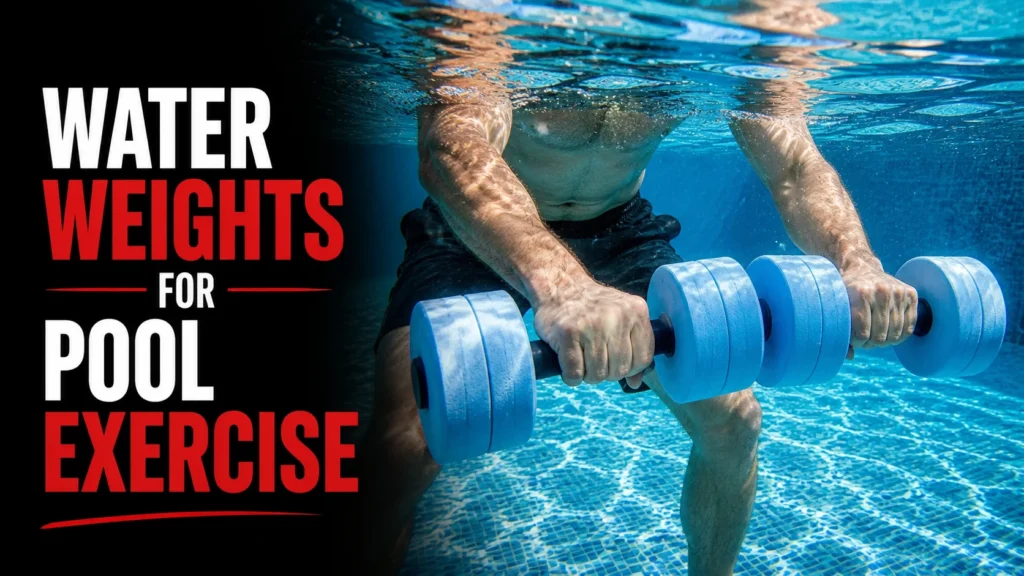
Water weights are not a gimmick. They are one of the most effective resistance tools you can use in a pool and most people are either using them wrong, using the wrong size, or skipping them entirely because they look too simple to matter. This guide fixes all three problems.
How the Resistance Mechanism Actually Works
Because water is denser than air, moving through it naturally creates resistance in all directions, meaning you engage multiple muscle groups at once. This is called omnidirectional resistance, and it is something land-based free weights simply cannot offer. A barbell curl on land only loads your bicep during the concentric phase unless you use a cable. A water dumbbell curl loads the bicep on the way up and the tricep on the way down.
The amount of resistance depends on three variables: the size of the foam buoy, the speed of your movement, and the depth of water. Move faster and you get more resistance. Work in chest-deep water rather than waist-deep water and your stabilizer muscles recruit harder to keep you upright. This is why the same pair of foam dumbbells can feel laughably easy one session and genuinely hard the next — it all depends on how you use them.
The Science Behind Aquatic Resistance Training
Before we get into exercises and programming, the research is worth a quick look — because it is more compelling than most people expect.
A 10-week progressive aquatic resistance training program produced significant improvements in knee extensor and flexor muscle torque, neural activation, and lean muscle mass — with changes in quadriceps lean cross-sectional area of 4% and hamstrings of 5.5%. That is meaningful muscle development from pool training alone, not just maintenance.
Water buoyancy reduces joint load by 50–90%, which is particularly valuable for people with decreased lower limb strength, obesity, or joint pain. In older adults specifically, aquatic resistance exercise increases muscle mass and strength and reduces fall risk.
High-intensity interval training performed in water, such as aquatic HIIT, enhances maximal aerobic capacity, maximal heart rate, and metabolic equivalents — benefits similar to those from swimming and traditional gym workouts, but with reduced joint stress.
According to research cited by Olympic athlete trainer Linda Huey, the benefits of water resistance training include the activation of opposing muscle groups, since the push and pull of water creates a natural safety barrier for joints while increasing muscle recruitment.
Pool dumbbell training is not a soft alternative to real training. It is a different modality with its own physiological demands, and the evidence supports it — especially for people over 50 who need to keep loading muscles without grinding joints down.
Who Benefits Most from Pool Dumbbell Workouts
People with Joint Pain or Arthritis
Aquatic exercise can improve joint use and lessen pain in people with osteoarthritis, and you do not need to know how to swim to participate. The pool creates a low-load environment where joints can move through a full range of motion without the compressive forces of bodyweight on land.
Older Adults
An 8-week aquatic resistance program using water resistance equipment produced significant improvements in plantar flexion strength, walking speed, and obstacle course performance in elderly participants — with the resistance group outperforming the non-resistance group on several measures. Falls are the leading cause of injury-related death in adults over 65. Training that improves balance, gait, and lower-limb strength without injury risk is not optional for this population — it is essential.
Injury Rehabilitation Patients
Physical therapists use aquatic environments for a reason. A board-certified sports clinical specialist notes that the buoyancy of water reduces the effects of gravity on joints, decreasing compressive forces and improving pain, which makes it a beneficial way to encourage joint movement with less impact. Pool dumbbells give rehab patients a way to load muscles progressively without risking re-injury from impact.
Athletes in Active Training
Light water dumbbells used as a warm-up tool can boost range of motion and strengthen muscles simultaneously, making them useful for swimmers of all levels before primary swim sets. For any land-based athlete dealing with overuse stress, an aquatic session is a way to stay active while giving tendons and bones a break from ground impact.
Overweight Beginners
Since you effectively weigh less in the water due to buoyancy, muscles do not have to work as hard to support body weight, which makes it easier to focus on individual muscle groups without the fatigue or joint discomfort that land exercise often causes for beginners carrying excess weight.
Types of Water Weights: What You Are Actually Buying
By Buoy Shape
Round buoys are the most common. They move smoothly through water, making them slightly more forgiving for beginners. The rounded edges reduce drag enough to allow controlled movement without jerking.
Triangular or angular buoys create more drag due to their flat faces. The flatter edges make pool dumbbells harder to use in the water, making them better for intermediate or advanced water aerobics trainees looking for added resistance.
Barbell-style aqua bars are longer, two-handed tools that function more like a barbell. They work well for chest presses, rows, and exercises that need a wider grip.
By Size and Resistance
Small buoys (approximately 6 inches in diameter) are best for beginners or those with shoulder issues. Medium buoys (approximately 8 inches) suit intermediate exercisers who have built baseline water fitness. Large buoys (approximately 10–12 inches) are for experienced exercisers who want maximum resistance — though oversized buoys can force improper form, elevated shoulders, and jerky movements that increase injury risk.
If you are just starting out, buy the smaller size even if your ego wants the large ones. Poor form in water is less visible than poor form on a gym floor, which means you can hurt your rotator cuff without realizing it until the damage is done.
By Material
EVA foam models are lightweight and easy to handle. They are durable enough to withstand exposure to sunlight and chlorine, and they typically dry quickly after use. Look for models with a padded inner pipe for a comfortable grip during longer sessions.
Hard plastic shells create resistance differently — through surface area and drag rather than buoyancy. They are less common in group fitness settings but used in some physical therapy clinics. Avoid standard metal weights entirely; metal weights are difficult to control underwater, can damage the pool surface, rust in chlorinated water, and do not provide the same resistance type as water-specific foam dumbbells.
How to Choose the Right Water Weights for Your Goals
For Rehabilitation or Joint Issues
Go small. A 6-inch buoy in waist-deep water gives you enough resistance to activate muscles without loading the shoulder joint heavily. Your goal at this stage is range of motion and blood flow, not strength overload.
For General Fitness and Toning
Medium buoys in shoulder-deep water hit the sweet spot for most adults. You can do bilateral and unilateral movements, add speed to increase resistance, and get a solid upper body and core session in 30–45 minutes.
For Cardiovascular Conditioning
Water depth matters more than dumbbell size here. Exercising in chest-deep or deeper water requires more effort to maintain buoyancy and perform movements, and incorporating high-intensity intervals — alternating short bursts of high-intensity exercise with brief recovery periods — can significantly boost calorie burn and improve cardiovascular fitness.
For Strength Development
Use large buoys and focus on slow, deliberate movement. The slower you move the dumbbell through the water, the more drag you create, and the harder your muscles have to work. Three sets of 8–10 slow reps with a large buoy taxes the muscles meaningfully.
For Deep Water Training
Deep water dumbbell work — where you are suspended without touching the pool bottom, typically with a buoyancy belt — adds a significant core stability challenge since your body must work to stay upright with no ground contact. This is best reserved for intermediate to advanced exercisers.
The Best Water Dumbbell Exercises for a Complete Pool Workout
Upper Body Exercises
Bicep Curls in Water
Stand in chest-deep water, arms at your sides with a dumbbell in each hand, palms facing up. Curl both arms simultaneously toward the surface. The resistance increases as the buoys approach the waterline because the upward force of buoyancy peaks near the surface. Lower slowly — this is where tricep activation happens. Do not let your elbows drift forward or your shoulders shrug. Three sets of 12–15 reps.
Lateral Arm Raises
Stand with feet shoulder-width apart, holding an aquatic dumbbell in each hand at your sides. Raise the weights out to the side until they reach shoulder height, then slowly lower them back down. At the top of the movement, you are working against maximum buoyancy — that is the hardest point. Pause for a count of two before lowering.
Tricep Pressdown
Stand with elbows bent at your sides, holding the dumbbells near your chest. Push the weights down toward your thighs, straightening your arms, then return to the starting position. Your triceps work during the downward push, and your biceps work on the way back up. This is a clean example of aquatic resistance providing bilateral muscle loading without any equipment swap.
Chest Press
Stand in shoulder-deep water, feet planted, holding a dumbbell in each hand at chest height. Push both dumbbells straight out in front of you until your arms are nearly straight, then pull them back. Your chest, shoulders, and triceps fire on the push; your upper back and biceps pull during the return. This movement effectively targets the chest, shoulders, and triceps in one compound motion.
Seated Row
Sit on a pool ledge or step. Hold a water dumbbell in each hand, extend your arms in front of you, and pull them back toward your torso, squeezing your shoulder blades together. This movement effectively targets the back muscles. If you do not have a ledge, stand and hinge slightly at the hips to simulate a bent-over row position.
Alternating Punches
Start with the weights at your chest. Extend one arm forward in a punching motion, then return it while alternating to the other side. Speed this exercise up to add cardiovascular demand. Slow it down with a pause at full extension to increase shoulder and core stabilization work.
Core and Lower Body Exercises with Pool Dumbbells
Single-Leg Balance with Dumbbell Hold
Stand in waist-deep water holding one dumbbell in both hands at chest level. Lift one foot off the pool floor and hold. The combination of a weighted, buoyant object at chest height with single-leg balance recruits your obliques, transverse abdominus, and hip stabilizers all at once. Hold 30 seconds each side.
Leg Lift with Dumbbell Anchor
Stand in waist-deep water, holding a water dumbbell in one hand for balance at the pool wall. Extend the opposite leg in front of you, lifting it to hip height, then lower it back down. Alternate sides. The dumbbell acts as an anchor and balance point while your hip flexors and core do the work.
Bird Dog in Water
Hold one aquatic dumbbell between both hands. Extend your arms in front of you, keeping the dumbbell below the surface. Slowly lean forward and extend one leg behind you. Return to standing. Alternate sides. This is a harder exercise than it looks. The water creates instability that forces constant micro-adjustments through the core.
Water Squats with Dumbbell Hold
Stand in chest-deep water, hold a dumbbell at chest height in both hands. Lower into a squat, keeping your chest up and knees tracking over your toes. Water reduces the knee load during the descent — which is exactly why this is a good option for people who find land squats painful. Three sets of 15 reps.
Programming: How to Structure Your Pool Dumbbell Sessions
Frequency
For general fitness, 2–3 water dumbbell sessions per week is a good starting point, with rest days in between to allow muscle recovery. Because water exercise is low-impact, many people can train more frequently than they could with land-based weights.
Maximizing Results: What Most Guides Do Not Tell You
Speed Is the Dial, Not Weight
On land, you increase difficulty by adding plates. In the pool, you increase difficulty by moving faster or using a larger buoy. If your current routine feels too easy, try doing each rep at twice the speed before reaching for bigger dumbbells. The drag increases exponentially with movement speed in water, so small increases in pace create significant increases in workload.
Core Tension Is Non-Negotiable
Core stability remains important during aquatic resistance training, and focusing on tightening core muscles throughout each exercise provides stability and maximizes the efficiency of movements. Without it, water’s instability works against you rather than for you. Every exercise in the pool should begin with a deliberate engagement of the abdominals and a neutral spine.
Water Depth Changes Everything
Waist-deep water provides the most stability and the least cardiovascular demand. Chest-deep water turns every exercise into more of a full-body event. Mix depths within a session or between sessions to train different adaptations.
Shoulder Health is the One Risk Worth Watching
The most common mistake in pool dumbbell training is using buoys that are too large. Oversized buoys force elevated shoulders and jerky movements, which increases injury risk — particularly to the rotator cuff. If you are using water dumbbells for the first time, start with the smallest size available and work your way up. This advice sounds obvious but gets ignored constantly.
Calorie Burn and Weight Loss with Aquatic Dumbbell Training
The calorie numbers for water aerobics vary widely based on intensity, water depth, and body weight. A 155-pound person burns roughly 400–500 calories per hour doing moderate-intensity water aerobics. Aquatic resistance training using specialized equipment can burn up to 800 calories per session at high intensity.
Building muscle mass through aquatic resistance training boosts metabolism, helping you burn more calories even at rest. The full-body engagement of water exercise — where resistance comes from all directions — leads to improved muscle tone and improved cardiovascular health simultaneously.
One practical note: the cooling effect of water can make you feel like you are not working as hard as you actually are. Focus on the intensity of your movements rather than perceived exertion — if the water feels comfortable, you are probably not pushing hard enough.
Caring for Your Water Weights
Foam dumbbells are low maintenance but not zero maintenance.
Rinse them with fresh water after every pool session. Chlorine and saltwater both degrade foam over time when allowed to dry on the surface. Store them in a shaded area — direct UV exposure breaks down EVA foam faster than water does. If you store them outdoors, bring them inside during winter. Freezing temperatures can cause microfractures in the foam core that you will not notice until the buoy starts to crumble.
Choose chlorine-resistant and quick-drying water weights to minimize wear and prevent mold or mildew accumulation. Check the handle attachment points every few months. The plastic tube inside the foam can loosen over time, and a dumbbell that spins in your grip is both ineffective and a shoulder injury waiting to happen.
Frequently Asked Questions (FAQs)
Can water weights replace gym dumbbells entirely?
For some goals, yes. For others, no. Water weights excel at building muscular endurance, cardiovascular fitness, joint mobility, and functional strength — particularly in the upper body and core. They are harder to use for heavy lower body loading (squats, deadlifts) or maximal strength work that requires progressive overload in small increments. If your goals are general health, toning, or rehabilitation, water weights can absolutely be your primary resistance tool. If you are training for hypertrophy or powerlifting, they work better as a supplement to land training.
How deep should the water be for water dumbbell exercises?
Most exercises are performed in waist- to chest-deep water. Waist- to chest-deep water is the most common setup and provides the most stability. Deep water work — where you are fully suspended — significantly increases core stability demands and is best for intermediate to advanced exercisers.
Do you need to know how to swim?
No. Aquatic exercise can be performed even if you do not know how to swim, and most water dumbbell exercises take place in shallow water where you stand on the pool floor. For deep water work, a buoyancy belt keeps you afloat without swimming ability.
How often should seniors use water weights?
The research supports 3 sessions per week for older adults, with each session lasting 45–60 minutes. An 8-week aquatic resistance program performed three times per week produced significant improvements in muscle strength, gait speed, and balance in elderly participants. That frequency is enough to produce real adaptation without recovery issues.
Are water dumbbells good for arthritis?
Yes, and they are specifically recommended for this population. Aquatic exercise can improve joint use and reduce pain in people with osteoarthritis. The key is using smaller buoys that allow full range of motion without forcing the shoulder joint into compromised positions. Warm water pools (around 83–88°F) are especially comfortable for arthritic joints.
What is the difference between foam water dumbbells and hard plastic ones?
Foam dumbbells create resistance primarily through buoyancy — the upward force of the water pushing against the compressed foam. Hard plastic dumbbells create resistance mainly through surface area and drag. Foam models are more beginner-friendly and widely available. Hard plastic models are found more often in clinical rehabilitation settings and create a different sensation of resistance that some advanced users prefer.
Can I use water weights for cardio, or are they only for strength?
Both. Used slowly with high reps, they build muscular endurance and strength. Used quickly with shorter rest periods, they drive the heart rate up and produce cardiovascular adaptations. Incorporating high-intensity intervals significantly boosts calorie burn and cardiovascular fitness. The same pair of dumbbells can serve both purposes depending on how you program them.
Will pool chemicals damage my water weights?
Not immediately, but over time chlorine degrades foam. EVA foam aquatic dumbbells are durable enough to withstand exposure to sunlight and chlorine, and they dry quickly after use. The practical lifespan of a well-maintained pair of foam dumbbells in a regularly chlorinated pool is typically 3–5 years with proper rinsing and storage.
Can I build real upper body muscle with water dumbbells?
Yes, though the nature of the adaptation differs from land training. Progressive aquatic resistance training produces significant improvement in muscle torque and neural activation, along with measurable increases in lean muscle cross-sectional area. You will not get the same hypertrophy response as heavy barbell training because you cannot easily apply progressive overload in fine increments. But for functional strength, endurance, and muscle tone, the results are real and backed by controlled research.
Who should avoid water dumbbell training?
Anyone with an open wound, active skin infection, or a condition that makes immersion medically inadvisable should stay out of the pool. People with severe rotator cuff tears should consult a physical therapist before using any resistance in the pool. Otherwise, water dumbbell training is appropriate for virtually every population from teenagers to adults in their 80s.
In conclusion
Most people who try water weights once and never go back were using the wrong size and had no structure to their session. That is it. The tool is not the problem. The ones who stick with aquatic dumbbell training tend to be the ones who actually needed it most — dealing with joint pain, recovering from surgery, or looking for a workout that does not wreck them the next day.
The foam dumbbells look simple. They are not. Used correctly, they provide omnidirectional resistance, activate opposing muscle groups simultaneously, protect joints while loading muscles, and scale from rehabilitation to high-intensity cardio depending on how fast you move and how deep you stand.
Want your equipment to last longer and stay hygienic? Check out How to Clean and Maintain Water Weights for simple steps to prevent mold, damage, and wear over time.