You’ve decided to get dumbbells. That part was easy. Now you’re staring at a weight range that starts at 2 lbs and ends somewhere around 100 lbs, and nobody gave you a roadmap.
Most people tell you “it depends” and leave it there. This one won’t. By the end, you’ll know exactly which weights make sense for where you are right now, how to plan for where you’re headed, and why buying the wrong size is a more expensive mistake than most people realize.
The Real Reason Most People Buy the Wrong Size Dumbbells
Two camps exist. The first buys too light — usually because someone told them “start small” — and ends up doing lateral raises with 3 lbs six months in, wondering why nothing changed. The second grabs something that looks respectable on the rack and immediately compromises their form to lift it.
Neither is training. Both are wasting time.
The weight that makes you stronger is the one that challenges the target muscle through a full range of motion while leaving you in complete control of the movement. That threshold is different for a bicep curl than it is for a goblet squat. It’s different at week one than it is at week twelve. And it varies by sex, training history, and how much sleep you got last night.
What doesn’t vary is the principle: pick a weight that makes the last two to three reps of a set difficult — not the first two, and not difficult enough that you’re compensating with momentum.
How to Test What Weight Is Right for You Before You Buy
If you have access to a gym before purchasing, spend one session working through the exercises you plan to do at home. Test a few different weights for each movement and note where you find that last-two-reps difficulty.
No gym access? Household objects work for a rough calibration. A standard bag of flour weighs about 2 kg (4.4 lbs). A filled 1-liter water bottle is roughly 1 kg (2.2 lbs). Pick them up, curl them, press them overhead, and see where things start to feel genuinely effortful. That sensation maps loosely to where your lighter starting weight should land.
The practical method: pick a weight you can lift 15 times, then pick one that gives out around 8 reps. The first is your light set for isolation work; the second is closer to your working weight for compound movements.
What Size Dumbbells Should I Buy? Recommendations by Experience Level
Beginners
Starting from scratch means your nervous system is still learning to recruit muscle fibers efficiently. Heavier weights don’t accelerate this, they disrupt it by forcing compensating patterns before the primary muscles are engaged.
Recommended starting weights for beginner women:
- Upper body isolation (bicep curls, lateral raises, tricep extensions): 2–5 kg / 4–10 lbs
- Upper body compound (chest press, bent-over row): 4–8 kg / 8–17 lbs
- Lower body compound (goblet squat, Romanian deadlift): 6–10 kg / 13–22 lbs
Recommended starting weights for beginner men:
- Upper body isolation: 5–8 kg / 10–17 lbs
- Upper body compound: 8–12 kg / 17–26 lbs
- Lower body compound: 10–16 kg / 22–35 lbs
These aren’t ego numbers. They’re numbers that produce results because they let you move correctly.
One important note: your leg and glute muscles have been working under load your entire life — every time you climbed stairs or stood up from a chair. They handle far more resistance than your shoulder’s lateral deltoid, which has never had a serious job. Treat different muscle groups as different starting points.
Intermediate Lifters (6–18 Months of Consistent Training)
Intermediate lifters have established movement patterns and can recruit muscle effectively. They need more weight to generate the same stimulus that lighter loads produced early on.
For intermediate women: A working set range of 8–16 kg / 17–35 lbs covers most upper body compound work, with 16–24 kg / 35–53 lbs for squats and deadlift variations.
For intermediate men: 14–24 kg / 30–53 lbs covers most pressing and rowing movements; 24–36 kg / 53–80 lbs becomes relevant for lower body work.
The defining characteristic of intermediate training is that a single weight no longer covers an entire workout. You need different loads for different exercises within the same session.
Advanced Lifters
If you’ve been training consistently for two or more years, you already know what your working weights look like for each movement. The question isn’t which size to start with — it’s how to structure a home gym that supports the full range of loads your programming requires.
Advanced lifters generally need pairs starting at a moderate weight and going heavy: women typically need up to 32–40 kg / 70–88 lbs for major compound movements; men commonly work up to 40–60 kg / 88–132 lbs or beyond.
At this stage, adjustable dumbbells capable of reaching those upper limits, or a comprehensive fixed set with rack storage, become the practical solutions.
The Best Dumbbell Sets by Goal
Goal: Weight Loss and Toning
This is the goal where people most often buy weights that are too light. “Toning” — a term fitness marketers love — is just muscle development combined with reduced body fat. You cannot tone a muscle that isn’t being challenged.
For fat loss, compound movements that recruit large muscle groups produce the highest caloric expenditure. Goblet squats, dumbbell lunges, Romanian deadlifts, bent-over rows, and chest presses all demand more from the body than isolation exercises.
A practical starting setup for this goal: one lighter pair for isolation movements (lateral raises, frontal raises, tricep kickbacks) and one heavier pair for compound lifts. Women might start with 5 lb and 12 lb pairs; men with 12 lb and 25 lb pairs.
Goal: Muscle Building (Hypertrophy)
Hypertrophy training sits in the 6–15 rep range, where the weight is heavy enough to produce mechanical tension and muscle damage — the two primary drivers of growth. Research published in exercise science literature consistently shows that training to or near muscular failure within this rep range produces meaningful hypertrophic adaptations.
For this goal, you need weights that allow 8–12 reps per set with significant effort on the final two. Multiple pairs are essentially mandatory — your chest can handle considerably more than your rear delts, and both need to be trained near failure to grow.
Practical minimum setup for hypertrophy at home: Three pairs covering light, moderate, and heavy relative to your current strength, plus a plan to add weight every four to six weeks as you progress.
Goal: General Fitness and Health
Not everyone is chasing aesthetic goals. Many people want to stay functional, maintain bone density (particularly important after 40), and support cardiovascular health through resistance training.
For general fitness, a versatile starting setup works well: a light pair for warm-ups and shoulder work, a moderate pair for upper body compound movements, and a heavier pair for lower body exercises. The American College of Sports Medicine recommends at least two resistance training sessions per week for general health benefits, targeting all major muscle groups.
Goal: Athletic Performance
Athletes training with dumbbells typically prioritize power, stability, and unilateral strength — movements that reveal and correct the imbalances that barbells can hide. Single-arm variations, farmer carries, dumbbell snatches, and step-up variations all feature prominently.
Athletic training often requires a wide weight range within a single session. A 25 lb dumbbell is too light for loaded split squats but exactly right for explosive single-arm presses. Adjustable dumbbells or a broader fixed set serve this population best.
Dumbbell Weight Guide by Exercise
This is where the “one size fits all” approach fully breaks down. Here’s a realistic weight guide for common exercises, shown as the approximate working weight for an average beginner to early-intermediate woman:
Upper body isolation:
- Lateral raises: 2–5 kg (these are genuinely hard; the muscle is small)
- Bicep curls: 5–8 kg
- Tricep kickbacks: 3–6 kg
- Front raises: 3–6 kg
Upper body compound:
- Dumbbell chest press: 8–14 kg per hand
- Bent-over row: 8–14 kg per hand
- Overhead shoulder press: 6–10 kg per hand
Lower body and full-body:
- Goblet squat: 10–18 kg (one dumbbell held vertically)
- Romanian deadlift: 10–18 kg per hand
- Reverse lunges: 8–14 kg per hand
- Dumbbell deadlift: 12–20 kg per hand
For men, roughly double these ranges as a starting reference point, though this varies significantly with training background and body size.
Fixed vs. Adjustable Dumbbells: Which Should You Buy?
This is a practical question with a real answer, not a philosophical debate. The right type depends on four things: space, budget, training style, and how many different weights you actually need at once.
Fixed Dumbbells
Fixed dumbbells are exactly what they sound like — a single weight, permanently set. They come in rubber hex, cast iron, neoprene-coated, and urethane varieties. Commercial gyms run on them because they’re nearly indestructible, require no setup, and allow instant transitions between exercises.
The case for fixed:
- Zero setup time between sets — you pick them up and go
- More natural feel and balance across all exercises
- Handle supersets and drop sets without interruption
- No mechanical parts to fail or break
The case against fixed:
- A full set from 5–50 lbs requires significant floor space and usually a rack
- Cost scales linearly — each additional pair adds cost
- You’ll probably outgrow lighter pairs and never use them again
Fixed dumbbells make the most sense if you have a dedicated gym space, know the specific weight ranges you need, and value workout speed over storage efficiency.
Adjustable Dumbbells
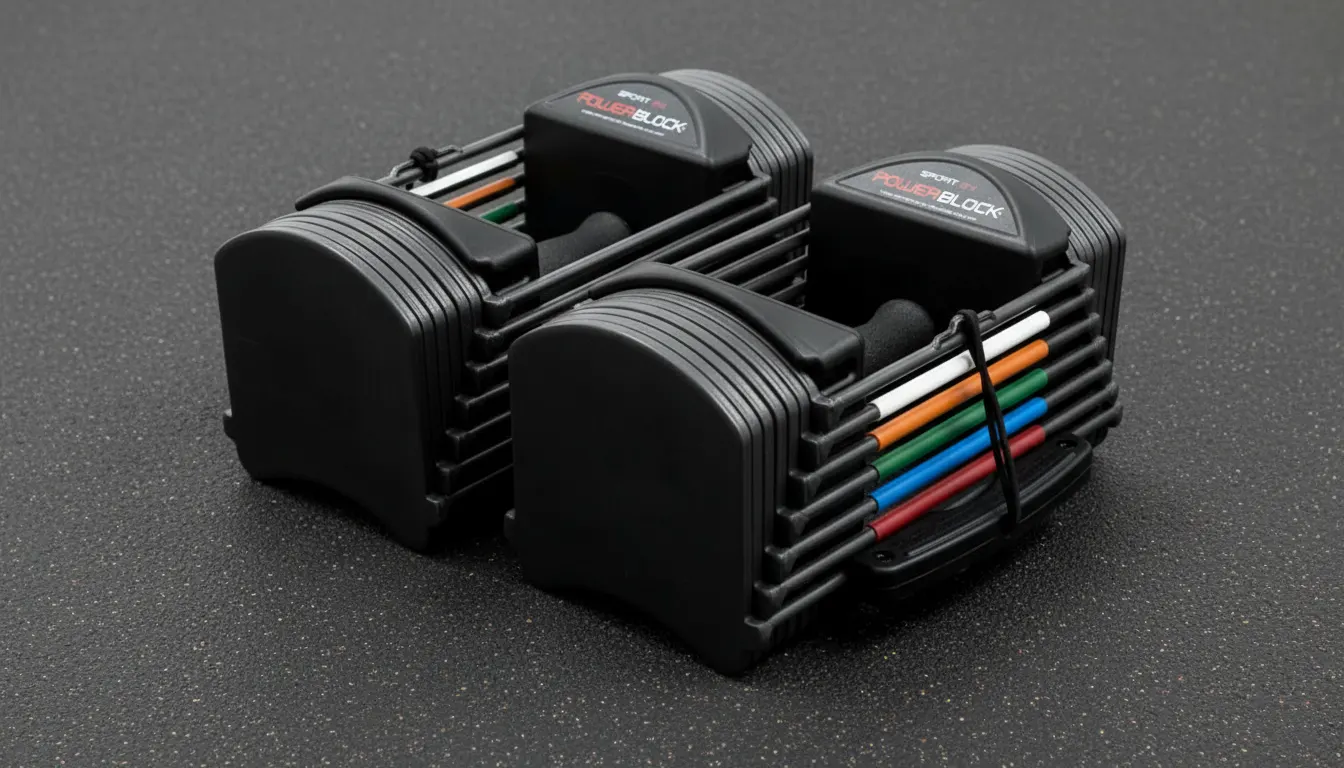
A quality adjustable pair can replace 10 to 30 fixed pairs in the footprint of a single cradle. For most home gym setups — apartments, garages, spare bedrooms — this matters enormously.
Modern selectorized models (dial-adjust systems like Bowflex SelectTech or PowerBlock) adjust in under five seconds. Older spinlock designs require unscrewing collars and swapping plates, which is slower but also cheaper and more durable.
The case for adjustable:
- Dramatically smaller footprint
- Lower total cost than buying equivalent fixed pairs
- One purchase covers you from beginner weights to advanced loads
- Easy to progress without buying new equipment
The case against adjustable:
- Slower to change than grabbing a different fixed pair
- Some designs feel bulky or unbalanced at certain weights
- Moving mechanical parts can fail; dropping them can damage the mechanism
- Not ideal for circuit training where you need multiple weights immediately accessible
The hybrid approach works well for many home gym setups: adjustable dumbbells as the primary tool, plus one or two fixed pairs at the weights you use most. This gives you the range of adjustable with the speed of fixed for your most frequent movements.
Should I Buy a Dumbbell Set or Individual Pairs?
The math here is relatively simple. If you’re a beginner who needs two or three weight options, buying individual pairs costs less upfront. If you anticipate needing five or more pairs within the next 12 months — which most consistent trainees do — a set is almost always the better value.
Sets typically come in ranges like 5–25 lbs (in 5 lb increments), 10–50 lbs, or 5–50 lbs. The broader sets include weights you won’t touch for months, but when you need them, they’re already paid for.
One important note: always buy pairs, not singles. Even for exercises you think you’ll do one-handed, having two dumbbells of each weight unlocks far more movement variety.
How to Know When Your Dumbbells Are Too Light or Too Heavy
Signs your dumbbells are too heavy:
- Your form breaks down before you reach the target rep range
- You’re swinging your torso, using momentum, or shrugging your shoulders to complete reps
- The muscle you’re targeting doesn’t feel the effort — other muscles or your lower back does
- You can’t control the lowering phase of the movement
Signs your dumbbells are too light:
- You complete 15 reps without your breathing changing
- The last rep feels identical to the first
- You’ve been using the same weight for more than four weeks without changing
- You’re adding more sets rather than more weight to feel anything
The right weight produces effort on reps 10–12 of a 12-rep set. If that isn’t happening, something needs to change.
Why the Weight You Buy Today Won’t Be Right in Three Months
Progressive overload is the mechanism behind all strength and muscle gains. It means consistently asking your muscles to do slightly more than they’re accustomed to. Without it, your body adapts to its current workload and stops changing.
In practical terms: once you can complete all reps of all sets with clean form, increase the weight. For compound movements, adding 2.5–5 lbs per session is realistic during the first few months of training. For isolation exercises, even 2 lb jumps produce meaningful stimulus for smaller muscles.
This progression means your initial dumbbell purchase has an expiration date. Plan for it. A beginner woman who starts with 5 lb and 10 lb pairs will likely need 15 and 20 lb pairs within four to six months of consistent training. Buying an adjustable dumbbell that covers this range from the start is almost always more economical than replacing fixed pairs.
What About Dumbbell Weight for Women Specifically
There’s an outdated idea that women should train with light weights. It persists partly because of marketing (pink 3 lb dumbbells), partly because of fear of “bulking up,” and partly because gyms historically didn’t make heavier options accessible to women.
The reality: women have the same muscle fiber types as men and respond to resistance training through the same mechanisms. The difference is that women have lower baseline testosterone levels, which limits the rate and ceiling of muscle hypertrophy — but doesn’t change the weight needed to stimulate it.
Women who train for strength, muscle, or functional fitness need weights that challenge them. A woman doing Romanian deadlifts with 5 lb dumbbells is not training her hamstrings. She may be going through motions, but the load is insufficient to produce adaptation.
Starting lighter than men makes sense due to average differences in muscle mass and strength. Staying lighter indefinitely does not.
Dumbbell Weight Recommendations for Seniors
Resistance training is among the most evidence-backed interventions for preserving bone density, reducing fall risk, and maintaining functional independence as we age. It’s not optional, it’s medicine.
Older adults often underestimate how much load they can and should handle. The general principles apply: start with a weight that allows controlled movement through full range of motion, and increase gradually.
For seniors new to resistance training, starting with 1–3 kg (2–6 lbs) for upper body isolation and 4–8 kg (8–17 lbs) for lower body movements is reasonable, with progression guided by how the body responds week to week. If you’re working with any pre-existing joint issues or chronic conditions, consulting a physiotherapist before starting a new resistance program is worthwhile.
The goal isn’t heavy weight. The goal is progressive load over time, applied consistently.
Types of Dumbbells: Material and Design Guide
Hex Dumbbells (Rubber or Cast Iron)
The most common type in commercial gyms. The hexagonal end prevents rolling and allows them to be rested flat on the floor. Rubber coating protects floors and reduces noise; cast iron without coating is cheaper but harder on surfaces.
Best for: general home gyms, functional training, anyone who might occasionally set them down mid-rep.
Neoprene Dumbbells
Lightweight, comfortable grip, color-coded by weight. Excellent for lighter work (2–12 kg range), barre classes, aerobics, and rehabilitation exercises. Not suitable for heavy lifting — the coating doesn’t hold up and the weight range is limited.
Best for: beginners focused on movement quality, rehabilitation, light conditioning work.
Chrome/Steel Dumbbells
Found in commercial gyms, often round-ended. The smooth surface isn’t ideal for home use (they roll), but the chrome handle provides excellent grip. More durable than neoprene but harder on floors.
Best for: commercial settings, lifters who prioritize grip feel.
Adjustable/Selectorized Dumbbells
Covered in detail above. Best for home gyms where space and progression flexibility are priorities.
Loadable Dumbbell Handles
A handle that accepts Olympic plates. The cheapest way to build heavy dumbbells, but requires owning plates and collars, and the loading process is slower than any other type. Good for strong lifters on a budget who already have plates.
Budget Guide: How Much Should You Spend?
You don’t need to spend a fortune, but you also shouldn’t buy the cheapest set on the market. Cheap dumbbells have coating that chips, handles that crack, and weight markings that are inaccurate — sometimes by several pounds.
Budget tier ($0.50–$1 per pound): Adequate for light to moderate weights. Rubber hex or neoprene from reputable mid-tier brands. Suitable for beginners and light home use.
Mid-range tier ($1–$2 per pound): Better construction, accurate weights, more durable coating. Worth the premium for heavier pairs you’ll use repeatedly.
Premium tier ($2–$4 per pound, or $400–$800 for a quality adjustable set): Commercial-grade materials, tighter tolerances, better grip texture. Adjustable sets in this range (PowerBlock, Bowflex SelectTech, NüBell) are built to last and cover 5–80+ lb ranges in a compact form.
As a general rule: spend more on the pairs you’ll use most, and don’t overpay for light weights you’ll stop using within six months.
Common Mistakes When Buying Dumbbells
Buying only one weight. Every muscle group has a different strength level. One pair doesn’t cover bicep curls and goblet squats.
Buying too light because it “feels responsible.” Starting light is smart; staying light isn’t training.
Buying in pairs you’ll outgrow quickly. A beginner who buys a 5–20 lb set will hit the ceiling of that range within 6 months. Think 18 months ahead.
Buying adjustable dumbbells that max out too low. Many entry-level adjustables cap at 25 lbs. That’s too light for lower body work within a few months of consistent training. Look for sets that go to at least 50 lbs.
Ignoring the handle. A bad grip ruins the workout. Knurled steel handles outperform smooth chrome for most lifting. Neoprene is comfortable but can slip when hands sweat.
Forgetting floor protection. Heavy rubber hex dumbbells on hardwood floors will eventually cause damage. A rubber mat under your training area costs far less than refinishing floors.
Frequently Asked Questions (FAQs)
What weight dumbbells should a beginner woman buy?
Most beginner women do well starting with a light pair (2–5 kg / 4–10 lbs) and a moderate pair (6–10 kg / 13–22 lbs). This covers most upper body and lower body work respectively. Adding a slightly heavier pair within 3–4 months is typical.
What weight dumbbells should a beginner man buy?
A beginner man typically benefits from a pair around 8–12 kg (17–26 lbs) for upper body compound movements and 12–18 kg (26–40 lbs) for lower body work, with a lighter 4–6 kg pair for isolation exercises.
Is it better to buy adjustable or fixed dumbbells for a home gym?
For most home gym setups, adjustable dumbbells offer the best balance of cost, space efficiency, and progression flexibility. Fixed dumbbells are better if you have dedicated gym space and prefer faster transitions between exercises.
Can I build muscle with just a pair of dumbbells?
Yes, provided the weight is sufficient to challenge you near muscular failure within the target rep range, and you apply progressive overload consistently. The limitation isn’t the equipment — it’s whether the weight is heavy enough.
How do I know if my dumbbells are too heavy?
If your form breaks down before reaching your target reps, or if you feel the effort in your lower back, joints, or momentum rather than the target muscle, the weight is too heavy for that exercise.
What size dumbbells should I buy for weight loss?
For weight loss, compound movements with moderately heavy dumbbells produce the highest energy expenditure. A starting pair at 8–12 lbs for isolation and 15–25 lbs for compound movements is reasonable for most women; men typically start higher. The key is that the weight must challenge you.
Should I buy dumbbells in 5 lb increments?
For most people, yes. Five pound jumps are manageable for compound movements. For isolation exercises targeting smaller muscles (lateral raises, tricep extensions), 2.5 lb increments may be more practical — which is one reason adjustable dumbbells with fine-increment adjustment have become popular.
What is the best dumbbell set for a complete beginner?
An adjustable dumbbell pair covering 5–50 lbs (or the kg equivalent) handles virtually everything a beginner needs and leaves room to progress for 1–2 years without additional purchases. Among fixed options, a 5–25 lb set in 5 lb increments works for early stages.
Can I use the same dumbbells for both strength training and cardio?
You can, though “cardio with dumbbells” typically means light weights with high reps and minimal rest — dumbbell complexes, circuits, or aerobic classes. The same pair works for both if the weight lands in a range that challenges you for strength work but allows sustained movement for cardio-style training.
Do dumbbells lose weight over time?
No, but cheap rubber coatings can chip and deteriorate, and some low-quality dumbbells are inaccurate in their stated weight from the beginning. Mid-range and premium brands maintain accuracy and integrity over years of regular use.
In conclusion
The right dumbbell weight is the one that makes the target muscle work hard by the final rep of each set — not the one that looks most impressive, and not the one that feels easiest to pick up.
Buy for where you are, with a plan for where you’ll be in six months. If you’re choosing between fixed and adjustable, space and workout style usually decide the question. If you’re choosing between cheaper and better quality, invest in the pairs you’ll use most.
Training consistently with the right weight beats training occasionally with an impressive one every time.
Want to build strength efficiently with minimal equipment? Check out Full Body Compound Workouts with Dumbbells for powerful exercises that train multiple muscle groups and maximize results.