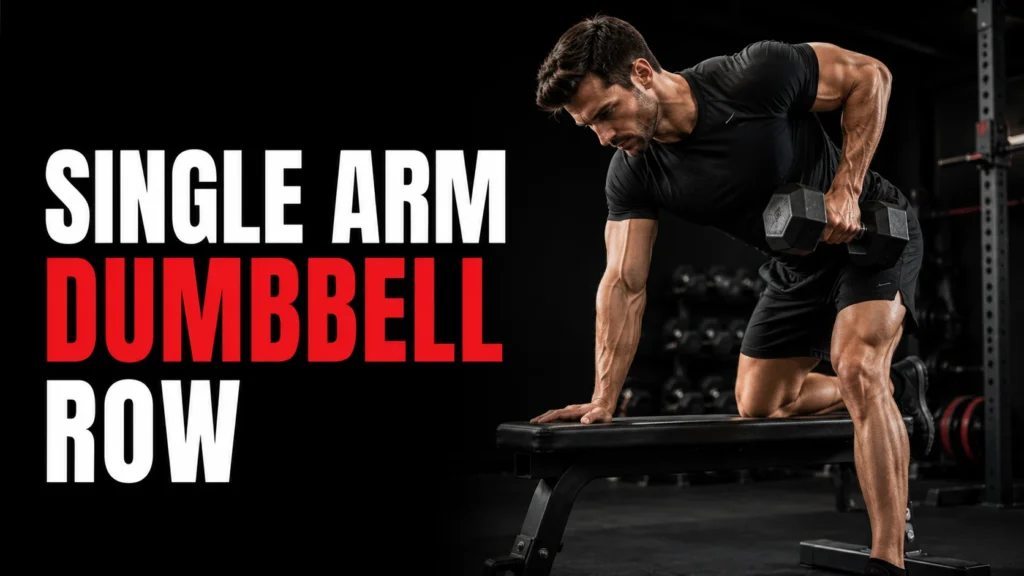
If you train with dumbbells, the single arm dumbbell row deserves a permanent spot in your program. Not because it is trendy but because it does things most exercises simply cannot. It trains one side of your back at a time, exposes strength imbalances you probably did not know you had, and lets you move through a fuller range of motion than most bilateral rowing variations allow.
What Is the Single Arm Dumbbell Row?
The single arm dumbbell row — sometimes called the one arm dumbbell row or unilateral dumbbell row — is a horizontal pulling exercise performed with one dumbbell at a time while the opposite hand and knee are braced on a flat bench. You hinge forward until your torso is roughly parallel to the floor, then drive the dumbbell from a dead hang up toward your hip by leading with your elbow.
It is a compound movement, meaning multiple joints move and multiple muscle groups contribute. The shoulder extends, the elbow flexes, and the scapula retracts and depresses throughout each rep. Horizontal pulling exercises like this one build back thickness, while vertical pulling movements like lat pulldowns primarily contribute to back width.
The bench support is what separates this from the standing bent-over row. Because the torso is partially supported, the single arm version does not require you to sustain a hip hinge through an entire set, which means the correct muscles can work without your hamstrings and glutes giving out first. Most lifters can handle heavier loads with this setup than they can in a bilateral standing row for exactly that reason.
Muscles Worked in the Single Arm Dumbbell Row
Primary Movers
Latissimus Dorsi
The latissimus dorsi — commonly called the lats — are the primary target. They are the largest muscles in the back, shaped like a wide V connecting the arms to the vertebral column. They govern shoulder extension and adduction, protect and stabilize the spine, and are responsible for the back width that creates a V-taper physique.
To train the lats optimally, you need a full range of motion — specifically, genuine scapular protraction at the bottom of the rep to stretch the lats, followed by strong retraction and elbow drive at the top. Without that full arc, you are short-changing the stimulus.
Rhomboids (Major and Minor)
The rhomboids are located between the shoulder blades and are responsible for scapular retraction and stability. They enable upper limb movement and contribute directly to maintaining healthy posture. When you consciously squeeze your shoulder blade toward your spine at the top of each rep, you are maximizing rhomboid involvement.
Middle and Lower Trapezius
The middle trapezius fibers originate from the spinous processes of C6 to T3 and bring the scapulae closer to the spine. The lower fibers, originating from T4 to T12, primarily function to depress the scapulae. At peak contraction during the row, when you consciously combine scapular retraction and depression, these two fiber groups co-contract significantly. Many lifters compensate with the upper trapezius instead, which reduces the training effect and can create neck tension over time.
Secondary Muscles
Rear Deltoids
The rear deltoids work alongside the middle trapezius to retract and depress the scapula, creating a stable base for the lift. This engagement also helps prevent shoulder impingement and maintains proper shoulder alignment throughout the movement.
Biceps Brachii
The biceps assist with elbow flexion during the pull. They are a helper muscle here, not the target. If you notice a strong biceps pump, it usually means you are using too much weight, relying on momentum, or pulling toward your shoulder rather than your hip. Pulling toward the hip keeps the lat in charge.
Core and Obliques
This is one area where the single arm row has a clear advantage over two-arm variations. The anti-rotation demand of single arm rowing forces the obliques and surrounding core muscles to work hard to prevent the torso from twisting under load. You are essentially training your core as a stabilizer every single rep.
Rotator Cuff
The unilateral pulling motion also engages the rotator cuff muscles as stabilizers, contributing to improved shoulder health and reduced injury risk over time.
How to Do Single Arm Dumbbell Rows: Step-by-Step
Equipment Setup
You need one dumbbell and access to a flat bench. If you do not have a bench, a sturdy chair, a low box, or a couch arm will work. The support surface should be roughly hip height or slightly below.
The Setup
Place your left knee and left hand on the bench when working the right side, or reverse for the left side. Your supporting hand should sit directly under your shoulder, and your supporting knee directly under your hip. This creates a stable, four-point base.
Your working-side foot stays flat on the floor beside the bench. Keep a slight bend in that knee rather than locking it out. Your spine should be flat and neutral, with your head aligned with your spine rather than craning upward or dropping toward the floor.
Research shows that a forward lean angle of approximately 45 degrees achieves optimal mechanical advantage for the latissimus dorsi fibers. Going too upright takes the lats out of their strongest position; going too parallel to the floor can place unnecessary load on the lower spine.
The Starting Position
Grip the dumbbell with a neutral grip (palm facing your body). Let your arm hang straight toward the floor. Gently brace your core to stiffen the torso, then depress and retract your scapula — pull your shoulder blade down and back — without arching your lower back. Maintain this shoulder position throughout the set.
Do not let the weight drag your working shoulder down toward the floor at the bottom. That passive hang removes muscle tension and does nothing for scapular control.
The Pull
Initiate the movement by retracting the shoulder blade first, then drive the dumbbell toward your hip — not toward your armpit or your ear. This distinction matters. Pulling toward the hip prioritizes the lat; pulling toward the shoulder recruits more biceps and rear delt.
Keep your elbow close to your torso. When the elbow stays closer to your body, lat involvement increases. Allowing the elbow to flare outward shifts the emphasis toward the rear deltoids and upper back instead. Neither is wrong — it depends what you are training — but for maximum lat development, elbow-to-hip is the cue.
The torso should not rotate during the pull. The only structures moving are the shoulder blade and, secondarily, the arm. If your body twists to complete the rep, the weight is too heavy.
Drive the elbow back until it passes the level of your torso. Pausing briefly at the top of the movement increases peak contraction and maximizes scapular retraction, which is when EMG activity reaches its highest point. A one- to two-second squeeze here is worth more than rushing through another rep.
The Descent
Lower the dumbbell slowly under control. Going slow on the way down adds time under tension and forces the muscles to work eccentrically to maintain control. Dropping the weight quickly wastes the eccentric phase, which is where significant muscle damage and subsequent growth stimulus occur. A two- to three-second lowering phase is a reasonable target.
At the bottom, allow the scapula to protract slightly before starting the next rep. This brief stretch improves the range of motion and ensures you are training through the full arc the lat is capable of.
Breathing
Exhale on the pull. Inhale on the descent. During heavier sets, some lifters prefer to brace and hold for the pull, then breathe at the top or bottom of the rep. Either approach works as long as you are not holding your breath for multiple consecutive reps.
Grip Options and What They Change
Neutral Grip (Palm Facing In)
This is the standard and most joint-friendly position for most people. It keeps the wrist in a natural alignment and allows the elbow to stay close to the body throughout the movement.
Overhand Grip (Palm Facing Back)
An overhand grip places greater challenge on the lats and increases demand on the upper back. Some lifters find this position uncomfortable at the wrist under heavier loads.
Underhand Grip (Palm Facing Forward)
An underhand grip engages the biceps more aggressively and can feel more comfortable for lifters with tight shoulder external rotation. It also tends to naturally pull the dumbbell slightly more toward the shoulder, which shifts the emphasis upward.
False Grip (Thumb Beside, Not Wrapped)
If you find your biceps dominating the movement rather than your back, try a false grip — meaning you do not wrap your thumb around the dumbbell. This reduces biceps involvement and forces the back to take over. It can feel uncomfortable at first but is worth experimenting with if your back consistently feels under-activated.
Common Mistakes That Kill Your Results
Using Too Much Weight
This is the most pervasive problem in the exercise. When the dumbbell is too heavy, you compensate by rotating the torso, shortening the range of motion, and swinging the weight up with momentum rather than pulling it with the lat. The torso does not move during a properly executed row — only the shoulder blade and arm do. If your hips are lifting and twisting with every rep, go lighter and build up.
Skipping Scapular Retraction
Many lifters treat this as a simple arm curl in a hinged position. The scapula needs to move. Failing to retract at the top leaves the rhomboids and middle trapezius almost entirely out of the movement, reducing back thickness development and the postural benefits the exercise can provide.
Pulling to the Wrong Target
Driving the elbow toward the ceiling or armpit — rather than toward the hip — changes which muscles take the lead. For lat-focused rowing, the cue is hip, not armpit. For more rear delt and upper back work, the armpit cue is appropriate. Know what you are training and set up accordingly.
Rounding the Lower Back
When lifting the weight, the temptation to round the back increases with fatigue. Rounding puts excessive stress on the spine and does not improve the lat stimulus. If you cannot maintain a neutral lumbar curve through a full set, reduce the weight or the rep count.
Letting the Supporting Shoulder Drop
The shoulder of your supporting arm should stay actively pressed into the bench. Letting it collapse inward or shrug upward destabilizes the torso and shifts unwanted load onto the shoulder joint. Think of the supporting arm as a structural column — rigid and engaged, not passive.
Training Only One Side
Because this is a unilateral exercise, complete both sides every session. Do the same number of sets and reps on each arm. Starting with your weaker side first — typically the non-dominant arm — ensures it gets equal volume and does not fall further behind.
Cutting the Range of Motion Short
Stopping the rep before the dumbbell reaches the floor on the way down, or before the elbow clears the torso on the way up, reduces the stimulus dramatically. The full range is what produces the full training effect. Use a weight that allows you to complete it.
Programming: Sets, Reps, and Frequency
The single arm dumbbell row works across a wide range of rep schemes.
For strength development: 4-6 sets of 4-8 reps with heavy loads and 2-3 minutes rest between sets per side.
For hypertrophy (muscle size): 3-5 sets of 8-15 reps with moderate loads and 60-90 seconds rest. Pairing this rep range with a controlled eccentric, full scapular protraction at the start, strong retraction and elbow drive, and a deliberate peak contraction of one to two seconds maximizes time under tension and the growth stimulus.
For muscular endurance or higher-volume phases: 3-4 sets of 15-20 reps with lighter loads and shorter rest periods.
Incorporating the single arm dumbbell row two to three times per week allows adequate training frequency while providing sufficient recovery between sessions. It fits naturally into back days, pull days, and upper body sessions. As a unilateral accessory movement, it pairs well after heavier compound pulling like the barbell bent-over row or weighted pull-ups.
Variations Worth Knowing
Chest-Supported Single Arm Row
Set an adjustable bench to a 45-degree incline and lie face-down on it with one dumbbell hanging from the working arm. Because your chest is braced against the pad, torso rotation becomes nearly impossible. This variation is excellent for lifters who struggle to prevent body rotation or who want to eliminate lower back fatigue from the equation entirely.
Single Arm Row Without a Bench (Staggered Stance)
If a bench is unavailable, you can perform the row by adopting a staggered stance, hinging forward at the hip while resting the non-working hand on your leg for light support. This variation demands greater core stability and may require a slightly lighter load.
Kroc Row
Named after powerlifter Matt Kroczaleski, this is a high-rep variation using a near-maximal weight with some deliberate torso rotation at the top to extend the range of motion. Sets of 20-50 reps with heavy dumbbells. It is not a beginner movement — it requires a solid foundation of form and conditioning — but it is highly effective for building raw back strength and work capacity.
Dead Stop Single Arm Row
Place the dumbbell on the floor between each rep and reset before pulling. This eliminates momentum entirely, forces a fresh muscle activation pattern at the start of every rep, and builds starting strength through the initial phase of the lift. It is humbling and effective.
Single Arm Cable Row (Seated)
A cable provides constant tension throughout the movement, unlike a dumbbell where tension varies with the angle. Strength gains may be slightly lower than with free weights, but the uninterrupted mechanical tension makes it a useful complement rather than a direct replacement.
Single Arm Dumbbell Row vs. Barbell Bent-Over Row
Both exercises train the same basic movement pattern, but they feel and perform differently.
Unlike bilateral barbell rows, the single arm variation allows a greater range of motion, improved scapular control, and better focus on the mind-muscle connection for each side independently. It also reduces spinal loading compared to the bent-over barbell row, making it a useful hypertrophy-focused alternative.
Two-arm rows permit more consistent heavy loading and greater absolute force output when heavier loads are used, which is advantageous for increasing mechanical tension and progressive overload over time. The barbell row wins on maximum load; the single arm row wins on range of motion, imbalance correction, and reduced spinal stress.
The intelligent approach is to use both. Heavy bilateral rows for three to six sets of four to eight reps provide the mechanical tension needed for strength and mass; single arm dumbbell rows for two to four sets of eight to fifteen reps address imbalances, extend range of motion, and improve the mind-muscle connection.
Frequently Asked Questions (FAQs)
What muscles does the single arm dumbbell row work?
The single arm dumbbell row targets the back muscles primarily — the lats, trapezius, rhomboids, and rear deltoids. The core and biceps are also actively engaged throughout the movement. Changing the grip can shift emphasis between these muscle groups.
Is the single arm dumbbell row effective?
Yes, and consistently so. Single arm rows enhance the mind-muscle connection by allowing full mental focus on the working side, engage core stabilizers that bilateral variations miss, and help correct the muscular imbalances that most people develop through years of dominant-side bias in daily activities. The research on unilateral training consistently shows that it produces greater activation of the ipsilateral (same-side) lat compared to bilateral rowing with equivalent loads.
What does the single arm dumbbell row specifically develop?
It builds back thickness through horizontal shoulder extension and scapular retraction. It addresses left-right strength asymmetries that bilateral exercises mask. It strengthens the core through anti-rotation demand. And it improves pulling mechanics in a way that transfers to nearly every compound pulling movement — deadlifts, pull-ups, and cable rows included.
Are single arm rows primarily a back exercise or a biceps exercise?
They are a back exercise. The biceps assist with elbow flexion during the pull, but a pronounced biceps pump is a clear sign of too much weight, too much momentum, or pulling toward the shoulder rather than the hip. If you feel this exercise mostly in your biceps, reduce the load, slow the eccentric, and focus on initiating from the shoulder blade rather than the elbow.
What muscle makes up roughly 70% of arm mass?
The triceps make up approximately 70% of total arm mass. The single arm dumbbell row does not train the triceps directly — that is relevant context for understanding arm development overall. Prioritizing biceps-only work while neglecting the triceps leaves the majority of the arm underdeveloped. Similarly, prioritizing mirror muscles while neglecting the back leaves both posture and pressing strength compromised.
What are the most common mistakes in single arm rows?
The six that show up most consistently are: using too much weight and compensating with torso rotation; failing to retract the scapula at the top of the rep; pulling toward the shoulder rather than the hip; rounding the lower back under fatigue; letting the supporting shoulder collapse rather than actively pressing it into the bench; and cutting the range of motion short at both the bottom and top of the rep. Fix these and the exercise becomes a fundamentally different stimulus.
In conclusion
The single arm dumbbell row is not complicated, but it is easy to perform badly. Most lifters go too heavy too soon, skip scapular retraction, and never actually feel their back working the way the exercise is designed to make them feel it. The result is a movement that looks like a back exercise but mostly trains the biceps and builds momentum.
Done correctly, it is one of the most productive exercises you can do for building a thick, strong, functional back.
The setup takes thirty seconds. Genuine lat activation takes a few sessions of focused, lighter practice to dial in. The long-term payoff in back thickness, posture, shoulder health, and pulling strength is worth both.
Start with a weight where you can actually feel the lat at the top of the rep. Own that. Then add load progressively.
Thinking about lifting daily? Check out The Real Benefits of Weightlifting to understand how consistent training impacts strength, recovery, energy levels, and long-term results.