Most people doing dips at the gym are working their chest more than their triceps and have no idea. The angle of your torso makes all the difference, and without understanding that, you can spend months grinding through sets without seeing much change in arm size. Tricep dips with dumbbells fix this problem by adding progressive resistance to a movement that most people plateau on quickly, and done correctly, they force the triceps to do the actual work.
Understanding the Triceps: Why Three Heads Matter
The triceps brachii is the muscle running down the back of your upper arm. It accounts for roughly two-thirds of your upper arm’s total size, which means if you want bigger arms, building the triceps will get you there faster than focusing on biceps alone.
The muscle has three distinct heads, each with its own attachment point and its own role in movement.
The Long Head
The long head originates from the infraglenoid tubercle of the scapula, which makes it the only tricep head that crosses the shoulder joint. That anatomical quirk is important: it means the long head is most active when your arm is elevated, and it contributes to both elbow extension and shoulder stability. It’s also the largest of the three heads and the most visible from behind. Overhead movements like the skull crusher and the single-arm dumbbell extension specifically load the long head through a stretched position, which research consistently ties to greater muscle hypertrophy.
The Lateral Head
The lateral head sits on the outer surface of the humerus and is primarily responsible for generating force during high-intensity elbow extension movements. Think of it as the head that shows up when heavy weight needs to move. It’s most active during pushdown-style exercises where the elbows stay fixed at the sides. The lateral head gives the tricep that horseshoe shape visible from the front when the arm is straightened.
The Medial Head
The medial head is deeper and less visually prominent, but it runs almost the entire length of the humerus and contributes to virtually every tricep contraction. It functions more like an endurance muscle, providing constant low-level support during isometric holds and precise movements. Training it often comes down to lighter, controlled work rather than maximal loads.
An effective dumbbell training program touches all three heads rather than defaulting to the same two or three exercises every session.
What Are Tricep Dips with Dumbbells?
The term covers two related but different movements that are worth keeping separate in your mind.
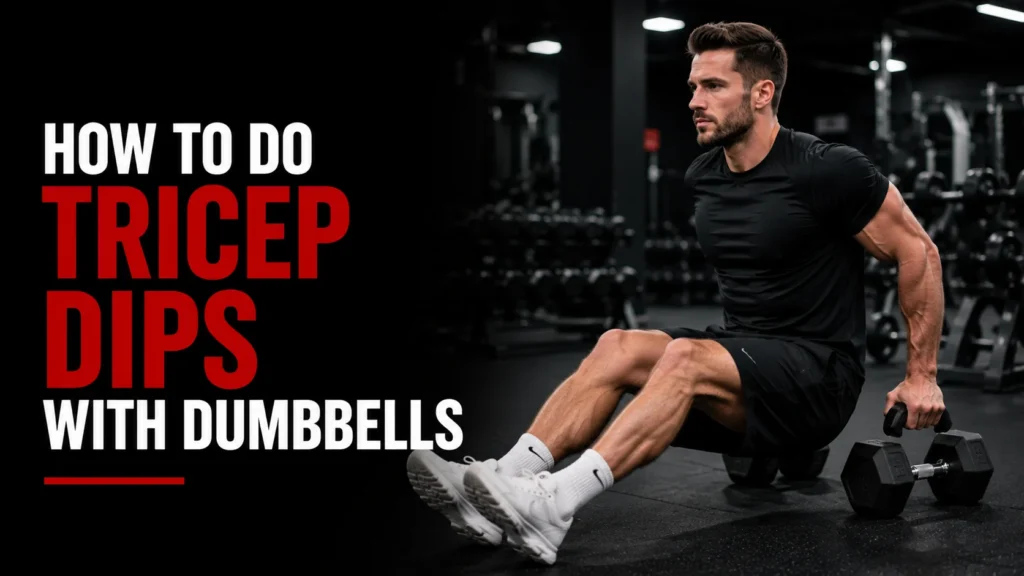
The first is the weighted bench dip, where you sit with your hands gripping the edge of a bench behind you, lower your body by bending the elbows, and use a dumbbell placed across your thighs to add resistance beyond bodyweight. It’s accessible, requires no special equipment, and lets you scale the load gradually.
The second is the parallel bar dip performed with a dumbbell held between your thighs or ankles, or secured with a dip belt. This version is more demanding and, when done with an upright torso, places the majority of the work on the triceps rather than the chest.
Both are legitimate. The bench dip is the better starting point for most people and lends itself naturally to dumbbell loading. The weighted parallel bar dip suits those who’ve already built a solid foundation of upper body pressing strength.
Muscles Worked During Tricep Dips with Dumbbells
The triceps are the primary movers, handling elbow extension during both the lowering and pressing phases. With an upright torso, the chest contributes relatively little compared to a forward-leaning dip variation. The anterior deltoid assists throughout the movement, and the core musculature, including the rectus abdominis, obliques, and erector spinae, contracts isometrically to stabilize the torso as load shifts up and down.
The more upright your body stays, the more the triceps dominate. Leaning forward shifts work toward the pectoralis major. This is not a mistake when training the chest, but it is a problem when the goal is tricep development.
How to Do Tricep Dips with Dumbbells: Step-by-Step
Weighted Bench Dip with Dumbbell
This is the most practical way to add dumbbell resistance to a dip movement without needing parallel bars or a dip station.
Setup
Use a flat bench, a sturdy box, or a solid chair. The surface should be stable enough to support your full body weight without sliding. If you’re adding a dumbbell to your lap, have it within reach before you take the starting position, or ask a training partner to place it once you’re set.
Starting Position
Sit on the edge of the bench with your hands placed directly beside your hips, fingers pointing forward and wrapping over the edge. Walk your feet out in front of you and lift your hips off the bench so your arms are supporting your weight. For beginners, keep a bend in the knees with feet flat on the floor. For a greater challenge, extend the legs further with only the heels touching the ground. Place the dumbbell across your upper thighs, holding it with your thighs pressed together to keep it secure.
The Descent
Lower your body by bending both elbows simultaneously. Keep your elbows pointing straight back rather than flaring out to the sides. Your back should stay close to the bench throughout, with hips tracking almost vertically downward. Lower yourself until your upper arms are roughly parallel with the floor. Going deeper does not produce more tricep activation, but it does put significantly more stress on the anterior shoulder capsule.
The Press
Drive through your palms to extend your elbows and return to the starting position. The movement should be slow and controlled on the way down, with a deliberate press on the way up. Do not lock out the elbows aggressively at the top, but do complete the full extension to ensure the triceps contract fully through the range of motion.
Breathing
Inhale as you lower yourself. Exhale on the push back to the start. If the breathing pattern is hard to remember at first, focus on exhaling during the exertion phase, which is the upward portion.
Weighted Parallel Bar Dip with Dumbbell
This version requires more strength to execute safely and shifts more absolute load onto the triceps. Hold a dumbbell between your thighs or ankles for lighter loads. For heavier work, a dip belt is far more practical and stable.
Grip the parallel bars with palms facing inward and elbows slightly bent. Squeeze the bar firmly and retract your shoulder blades before unracking your weight. Keep your torso as vertical as possible throughout the movement. Lower until the elbows reach approximately 90 degrees, then press back to the top. Adding the dumbbell here demands greater core stability, since the hanging weight shifts your center of gravity.
How Much Dumbbell Weight to Use
This is where most people either hold themselves back or create unnecessary injury risk. The dumbbell load should be treated as a secondary variable, not the primary goal.
For the weighted bench dip, even 10 to 15 pounds creates a noticeable difference when added to bodyweight. Start there. Once you can complete three sets of 12 clean reps with that weight, add 5 pounds. The triceps are smaller muscles than the chest or back, and the joint stress at the shoulder accumulates faster than you might expect.
For the weighted parallel bar dip, most people who have mastered 10 or more bodyweight reps can begin with 5 to 10 pounds and progress gradually. The StrongLifts approach of adding just 2 pounds per session is more sustainable than jumping to 45-pound plates, which is a mistake you’ll see at almost every gym.
Common Mistakes and How to Fix Them
Letting the Hips Drift Away from the Bench
This is the single most common error in bench dips and the primary cause of shoulder discomfort. When your hips move forward and away from the bench, the angle of force shifts and your shoulder ends up extended under load in a position it was not designed to hold for long. Keep your back as close to the bench edge as possible at every point in the rep. If you find yourself drifting, reduce the weight or shorten your range of motion temporarily until you can maintain position.
Going Too Deep
A deeper dip does not equal a better tricep workout. Below parallel, the benefit to the triceps does not increase, but the stress on the shoulder capsule does. Stop when your upper arms are roughly parallel to the floor, feel the contraction in the triceps, and press back up. If parallel feels shallow, it is not. The muscle is working hard at that point.
Using Momentum
Bouncing out of the bottom transfers kinetic energy to the movement and removes the load from the triceps at exactly the point where they should be working hardest. Slow the descent to a two-second count, pause briefly at the bottom, and press up under control. High-rep sloppy sets build less muscle and more bad habits.
Shrugging at the Shoulders
When the triceps fatigue, many people unconsciously let the shoulders ride up toward the ears. This recruits the upper trapezius and reduces tricep engagement. Before each set, actively pull your shoulder blades back and down and hold that position throughout. It feels like creating tension in your mid-back and keeping your chest lifted.
Partial Reps
Short, shallow reps look like work but miss the full range of motion the triceps need to develop through. Your upper arms must reach parallel to the floor on every rep for the exercise to count. If you cannot achieve that depth with control, reduce the weight or use the bent-knee variation until you build the strength to go deeper.
Dumbbell Variations to Target All Three Tricep Heads
Overhead Dumbbell Tricep Extension (Long Head Focus)
Sit or stand and grip a single dumbbell with both hands wrapped around one end. Press it overhead, then bend at the elbows to lower the dumbbell behind your head. Keep your elbows pointing upward and your upper arms close to your ears. Extend back to the top. This is the most effective movement for placing the long head under a deep stretch, which drives a significant portion of the hypertrophic response in the triceps.
Dumbbell Skull Crusher (Lateral and Long Head)
Lie on a bench and hold a dumbbell in each hand with arms extended over your chest. Bend at the elbows to lower the weights toward your forehead or temples, keeping your upper arms perpendicular to the floor. Press back to extension. The dumbbells allow each arm to move independently, which helps correct strength imbalances that a barbell version can mask.
Tricep Kickback (Long Head Contraction)
Hinge forward at the hips with a flat back, holding a dumbbell in one hand with the upper arm parallel to the floor. Extend the elbow to straighten your arm fully, hold for a beat at the top, and lower with control. EMG research indicates the incline kickback version produces some of the highest long head activation of any tricep exercise, largely because the arm position places the long head in maximum contraction.
Close-Grip Dumbbell Press (Strength and Compound Load)
Lie flat on a bench and hold dumbbells with palms facing each other directly above your chest. Lower them by bending the elbows while keeping the upper arms close to your torso. Press back to full extension. Because the triceps need to handle heavy compound load to develop the type II muscle fibers that make up the majority of the muscle, close-grip pressing belongs in most training programs alongside the isolation work.
Floor Dip (Bodyweight Contraction Focus)
Sit on the floor with knees bent, feet flat, and hands placed behind the hips with fingertips pointing forward. Push your hips off the floor and then lower the body toward the floor by bending the elbows. The floor stops you before you go too deep, making this a safer entry point for those working around shoulder sensitivity. Athlean-X’s Jeff Cavaliere recommends combining this with close-grip pushups in a descending ladder for a strong metabolic finishing set.
How to Program Tricep Dips into a Dumbbell Training Routine
Weighted tricep dips work best placed earlier in a push or arm session when the muscles are fresh and you can maintain form under load. Starting a workout with them allows you to handle more weight and stimulus than using them as a burnout finisher.
A practical weekly structure for someone training arms twice per week might look like this:
- Session 1: Weighted bench dip (3 sets of 8-10 reps), overhead dumbbell extension (3 sets of 10-12), close-grip dumbbell press (3 sets of 8-10)
- Session 2: Floor dips with bodyweight or light load (3 sets of 12-15), dumbbell skull crusher (3 sets of 10-12), tricep kickback (3 sets of 12 per arm)
Rest 60 to 90 seconds between sets for hypertrophy. If building raw strength is the goal, extend rest to 2 to 3 minutes to allow fuller recovery between heavy sets.
Progressive overload matters more than variation. Add weight, reduce rest, or add reps from session to session. Switching exercises every few weeks chases novelty without giving any movement long enough to produce adaptation.
Who Should and Should Not Do Tricep Dips with Dumbbells
Bench dips with dumbbell loading suit beginners building a tricep foundation, intermediate lifters who have outgrown pure bodyweight work, and home gym trainees without access to a cable machine or dip station. They scale well and require minimal equipment.
People with existing shoulder impingement, anterior shoulder pain, or a history of rotator cuff injury should approach dips with caution. The bench dip specifically places the shoulder in an extended position under load, which can aggravate these conditions. Diamond push-ups or cable pushdowns are lower-risk alternatives in those cases. The ACE study Cavaliere references found that diamond push-ups produced the highest tricep EMG activation of any bodyweight exercise, making them a legitimate substitute rather than a downgrade.
If you feel tension or discomfort in the shoulder joint rather than a muscular burn in the triceps during any dip variation, stop and reassess your form before continuing.
Frequently Asked Questions (FAQs)
What muscles do dumbbell tricep dips work?
The primary movers are the triceps brachii, specifically all three heads: the long head, lateral head, and medial head. Secondary muscles include the anterior deltoid, which assists with shoulder stabilization, the pectoralis major to a minor degree, and the core musculature, which contracts isometrically throughout the movement.
Is the single-arm dumbbell row effective compared to dips for triceps?
Single-arm dumbbell rows are a back exercise targeting the latissimus dorsi and rear deltoid, not the triceps. They train completely different movement patterns and muscle groups. For tricep development, dips, extensions, and pressing variations are the relevant exercises.
What does a single-arm dumbbell extension work?
A single-arm overhead dumbbell extension isolates the triceps with a particular emphasis on the long head, which is most active when the arm is raised and the elbow is bent behind the head. The unilateral nature also prevents the stronger arm from compensating for the weaker one, which can reveal and help correct strength asymmetries.
Are single-arm rows for back or biceps?
Single-arm dumbbell rows primarily target the latissimus dorsi, teres major, and the middle trapezius. The biceps and rear deltoid assist as secondary movers, but they are not the focus. This exercise is a back movement, not a direct bicep exercise.
What muscle makes up the majority of upper arm size?
The triceps brachii accounts for approximately two-thirds of the upper arm’s total muscle mass. This is the reason that people whose training consists mostly of curls often struggle to build overall arm size, because the larger muscle group behind the arm is being undertrained.
What are the most common mistakes in tricep dips?
The six errors that show up most consistently are: hips drifting away from the bench, lowering too far past parallel, using momentum to bounce out of the bottom, letting the shoulders shrug upward during fatigue, performing partial reps, and adding too much dumbbell weight before mastering the bodyweight version. Fixing the form first and adding load second produces better outcomes with less shoulder risk.
How many reps and sets should I do for dumbbell tricep dips?
For muscle growth, 3 to 4 sets of 8 to 12 reps with a load that becomes challenging around the 10th rep works well. Beginners should start with 3 sets of 8 to 10 using the bent-knee variation, rest 60 to 90 seconds, and add load only after the form is consistent. Strength-focused training can use lower rep ranges of 5 to 8 with heavier loading and longer rest periods.
Can I do tricep dips with dumbbells at home without a bench?
Yes. Any stable surface at roughly knee height works, including a sturdy chair, a low coffee table, or the edge of a couch. The dumbbell goes across your thighs exactly as it would on a bench. Ensure the surface will not slide before adding load, and keep the weight light when using furniture not designed for exercise.
How do I progress past bodyweight bench dips?
Once you can complete 3 sets of 15 clean reps with the straight-leg variation, add a light dumbbell. Start at 10 pounds and increase by 5 pounds when 12 reps feel manageable with solid form. Parallel bar dips with added weight via a dip belt represent a significant progression beyond that.
Should I lock out my elbows at the top of tricep dips?
Gentle full extension at the top is appropriate and ensures you’re completing the full range of motion. What to avoid is hyperextending or snapping the elbows aggressively into lockout, which places stress on the joint rather than keeping tension in the muscle. A controlled, deliberate straightening of the arm at the top of each rep is the right approach.
In conclusion
Tricep dips with dumbbells are worth including in a dumbbell-based training program because they solve a real problem: the triceps plateau quickly on bodyweight alone, and most gym machines or cables that allow progressive loading aren’t available to everyone. A dumbbell across your lap on a bench changes that entirely.
The movement requires more attention to detail than it gets credit for. Shoulder position, depth control, and back proximity to the bench matter every single rep. Get those right first, then add weight incrementally. Pair dips with overhead extensions to cover the long head through a full stretch, and close-grip pressing for heavy compound load, and you have a complete dumbbell tricep program built from three exercises.
Want to build a stronger upper back with better control? Check out How to Do Dumbbell Seated Bent Over Row for proper form, key benefits, and tips to improve muscle activation and reduce momentum.