Most people who train back seriously have their deadlift dialed in. They know the barbell row. But when it comes to building the thick, detailed upper back that makes a physique look complete from behind, the dumbbell seated bent over row gets either ignored or butchered.
That’s a problem. Not because it’s inherently superior in every metric, but because the seated position removes lower back fatigue from the equation and forces the upper back to actually do the work.
What Is the Dumbbell Seated Bent Over Row?
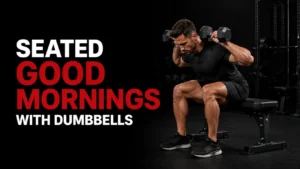
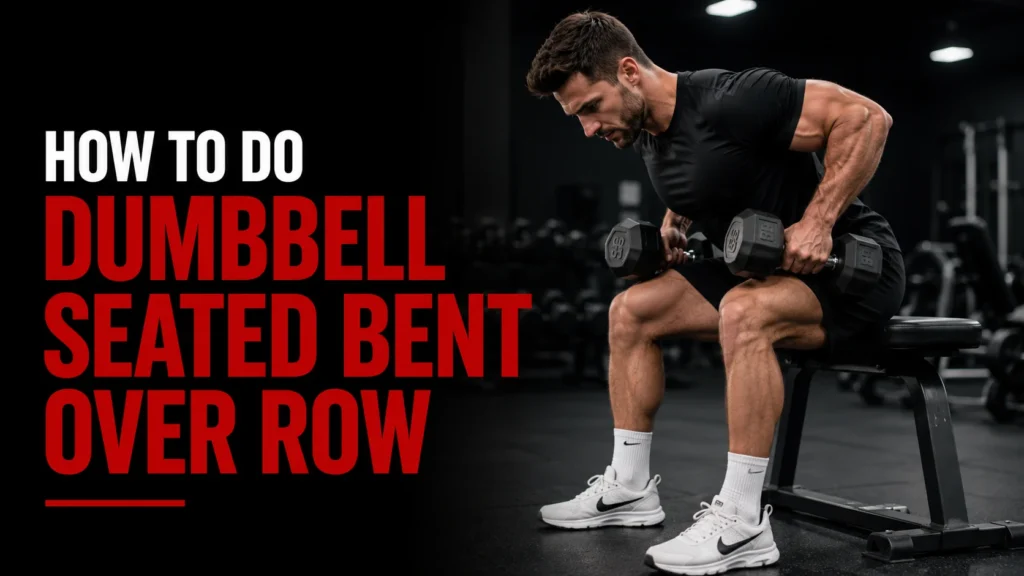
The dumbbell seated bent over row is a compound pulling exercise performed while seated on the end of a flat bench, torso hinged forward at the hips until the chest approaches the thighs. From that position, you row two dumbbells simultaneously toward the lower ribcage, driving the elbows back and squeezing the shoulder blades together at the top.
It sits at an interesting crossroads. It has the bilateral pulling mechanics of a barbell row, the independent arm freedom of a dumbbell variation, and the spinal support benefits of a supported row — without requiring a cable machine or specialty bench.
The seated position does something most lifters underestimate: it removes the hip hinge from the stability equation. You’re no longer fighting to keep your torso from collapsing under load. That stability demand transfers directly to the upper back muscles, which is exactly where you want it when training the posterior shoulder complex and mid-back.
Muscles Worked
Primary Muscles
Posterior Deltoids
The rear delts are the main target in the seated bent over variation, particularly when elbows flare outward at 45-90 degrees from the torso. They’re chronically underdeveloped in most lifters who prioritize pressing movements. Weak rear delts contribute directly to rounded shoulders, internal rotation problems, and shoulder impingement over time.
Rhomboids (Major and Minor)
The rhomboids sit between the shoulder blades and spine. Their job is scapular retraction — pulling the blades toward each other. They fire hardest at the top of the row when you squeeze the blades together. Training rhomboids is one of the most practical ways to address the forward-rounded posture that hours of desk work creates.
Middle Trapezius
The mid-traps assist the rhomboids in scapular retraction and add thickness to the upper back between the shoulder blades. Unlike the upper traps — worked in shrugs — the middle fibers need rowing movements at specific angles to develop fully.
Latissimus Dorsi
The large, fan-shaped muscles running from the armpit down to the lower back contribute to the pulling motion through shoulder extension. In the seated bent over row, they work in coordination with the rear delts rather than dominating the movement the way they do in a lat pulldown or close-grip cable row.
Secondary Muscles
The biceps brachii and brachialis act as elbow flexors throughout the pull. Grip orientation influences how much they contribute: supinated (underhand) grips recruit the biceps more, while pronated (overhand) grips reduce their involvement and shift more demand onto the back. The teres major, teres minor, and infraspinatus stabilize the glenohumeral joint during the rowing motion. The erector spinae and core brace isometrically throughout the set, and the forearm flexors maintain grip under load.
How to Do Dumbbell Seated Bent Over Row: Step-by-Step Guide
Step 1 — Bench Setup and Starting Position
Sit on the end of a flat bench with your feet flat on the floor, slightly wider than hip-width. Hold a dumbbell in each hand with a neutral grip (palms facing each other) to start — grip adjustments come later. The dumbbells should sit at your sides, behind your calves, so they have clearance to travel when you hinge forward.
Step 2 — The Forward Hinge
Bend at the waist — from the hip, not the lower back — until your torso reaches roughly 45 degrees from the floor, or closer to parallel depending on your goal. Your chest should approach your thighs. Keep the spine in its natural curve.
If the lower back strains to hold this position, you’re either rounding or using too much weight. The erectors should feel engaged, not maxed out.
Step 3 — Arm Position Before the Pull
Let the dumbbells hang with arms extended. They should clear the bench and hang in space. Shoulders should not collapse forward — maintain a slight “proud chest” even in the hinged position.
Step 4 — Initiate with the Elbows
The most important cue in any row: lead with the elbows. Drive them up and back toward the ceiling rather than curling the dumbbells up with the hands.
When you pull elbow-first, the biceps become a hook and the lats, rhomboids, and rear delts do the actual work. When you pull hand-first, the biceps take over and the back barely fires. The path should travel slightly outward from the body — not straight up — matching the angle of your upper arm relative to your torso.
Step 5 — Contract at the Top
At the top of the movement, squeeze the shoulder blades together and hold for one second. This brief pause trains the rhomboids and mid-traps — the muscles most people claim they can never feel during back training. The dumbbells should finish near the lower ribs or hips, elbows pointed toward the ceiling.
Step 6 — Slow the Descent
Lower the dumbbells over 2-3 seconds. Resist the drop. The muscle fibers lengthen under load on the way down, and that lengthening-under-tension drives hypertrophy. Allow the shoulder blades to protract (spread apart) slightly at the bottom before the next rep. Full scapular range — retraction at the top, controlled protraction at the bottom — produces better development than locking the blades in place for the entire set.
Breathing
Inhale as the dumbbells lower. Exhale on the pull. A controlled exhale on the concentric phase maintains core brace while supplying oxygen to the working muscles.
Grip Variations and What They Change
Neutral Grip (Palms Facing Each Other): The default starting point. Easiest on the wrists and shoulders, balances lat and rear delt recruitment, feels the most natural for most people. Start here.
Pronated Grip (Overhand, Palms Down): Increases lat emphasis, reduces bicep involvement. Creates a more horizontal upper arm path, shifting demand toward the lower trapezius and teres major. Good for lifters who find themselves bicep-curling every row.
Supinated Grip (Underhand, Palms Up): Recruits the biceps more and often allows slightly heavier loading. Because this position brings the elbows closer to the torso, it emphasizes the lats more than the rear delts. Use this when lat development is the priority.
Wide Elbow Path (Elbows Flared): Allowing the elbows to travel away from the body rather than hugging the sides dramatically increases rear deltoid activation. This is essentially the “row” version of a rear delt fly. If shoulder roundness and rear delt weakness are the specific targets, elbow path matters more than grip type.
Common Mistakes
Rounding the Lower Back
Rounding the lumbar spine under load risks disc compression and moves stress onto the wrong structures. Fix: lighten the load and focus on keeping the chest lifted even with the torso hinged forward.
Momentum and Weight Compensation
When the load is too heavy, the torso rocks back to heave the dumbbells up. The back muscles barely contract because momentum substitutes for muscular force. Fix: drop the weight, eliminate all rocking, and actually feel each rep in the target muscles before adding load.
Pulling with the Hands Instead of the Elbows
Hand-led rowing activates the biceps and underworks the back. The false grip technique — loosening the thumb around the handle — disconnects hand involvement and forces the back to lead. Some coaches recommend holding the dumbbell with only the fingers during light warm-up sets to groove the correct pulling pattern.
Locking the Shoulder Blades Throughout the Set
Some lifters retract their shoulder blades at the start and hold that position through every rep. This eliminates scapular motion entirely. The blades should retract hard at the top and protract slightly at the bottom. That full movement trains muscles through their actual function and prevents the rhomboid dominance imbalances that physical therapist Shirley Sahrmann documented in her work on movement impairment syndromes.
Letting the Head Drop Forward
When the chin drops and the neck flexes, the rest of the spine tends to follow. Keep the gaze directed slightly forward and downward — not at the floor, not straight ahead — so the cervical spine stays in line with the vertebral column.
Pulling the Elbow Too Far Past the Body
Excessive glenohumeral extension, where the elbow travels well behind the torso’s midline, can create anterior humeral glide and stress the shoulder capsule. The elbow should travel back to roughly hip level. Front-of-shoulder strain at the top of the row is usually a sign the elbow is going too far.
Why Choose the Seated Version Over Standing?
For lifters with lower back fatigue or sensitivity, the seated position removes the extended isometric demand on the erectors. When the lower back tires during a standing bent over row, form breaks down quickly — the torso rises, the load shifts, the back rounds. In the seated version, the bench provides structural support so the upper back can be worked hard without the lower back failing first.
The seated variation also limits hip drive and momentum. That constraint is a benefit for hypertrophy-focused training — less momentum means more time under tension for the target muscles.
For beginners who haven’t developed the hip hinge pattern or core stability for a standing row, the seated version provides a real training stimulus without demanding mastery of a more complex movement pattern.
The tradeoff is less total systemic demand. The standing version recruits more muscle overall — including the hamstrings, glutes, and core — making it more efficient for general strength work. Powerlifters and strength athletes likely want the standing row in the program. Bodybuilders targeting the rear delts and mid-traps with precision get a lot from the seated version.
How to Program It
Volume and Frequency
For hypertrophy, 10-20 weekly sets for the back distributed across 2-3 sessions gives most people solid results. The seated bent over row can account for 3-4 of those sets per session. A reasonable starting point: 3 sets of 10-15 reps with a weight that makes the final 2-3 reps genuinely hard without form breaking.
Placement in a Workout
This exercise works best mid-session — after heavier compound pulls like deadlifts or barbell rows that have already warmed the back, but before isolation movements like face pulls or rear delt flies where fatigue would limit the weight.
Progressive Overload
Add weight in small increments — 2.5 lb per dumbbell is appropriate. Alternatively, add reps within the target range before increasing load. Slower eccentrics (3-4 seconds down) also provide overload without touching the weight.
Pairing Options
Superset with face pulls to hit the rotator cuff and rear delts from different angles. Combine with lat pulldowns or pull-ups in the same session to train both vertical and horizontal pulling. Pair with chest-supported rows if lower back fatigue is still an issue even in the seated version.
Who Should Do This Exercise
Anyone who has neglected the rear delts and mid-traps — which is most people with a training history that includes a lot of pressing. Office workers and desk-bound individuals whose posture has shifted toward internal shoulder rotation benefit considerably from the scapular retraction emphasis. Beginners learning rowing mechanics without the complexity of the hip hinge. Older adults for whom controlled resistance training with reduced injury risk is a priority. Bodybuilders who want precise upper back development rather than just general back mass.
People with significant lumbar disc problems should get clearance from a physiotherapist before using this exercise even in the seated variation.
Frequently Asked Questions (FAQs)
What is the dumbbell seated bent over row best for?
Building the rear deltoids, rhomboids, and mid-trapezius — the muscles that pull the shoulder blades together and give the upper back its three-dimensional appearance. It also addresses rounded shoulders caused by overemphasis on pressing movements.
How heavy should I go?
Heavy enough that the last 2-3 reps of each set require real effort without form breaking. Most people should start with 20-30% less than they’d use on a standing dumbbell row. The isolated focus on the upper back means the loads feel lighter, but the stimulus is real.
Is this safe with lower back pain?
The seated version is generally safer than the standing version for mild lower back issues because it reduces the isometric demand on the lumbar erectors. Any existing back condition should be evaluated by a medical professional before adding resistance. If the forward hinge itself causes discomfort even when seated, a chest-supported row removes that variable completely.
Can this be done without a bench?
A sturdy chair works if it doesn’t slide. You can also perform the movement seated on the floor with legs extended if the dumbbells clear the ground, or simply default to the standing version on days when bench access isn’t available.
Is it okay to train rows every session?
Training the same muscles more than 3 times per week without adequate recovery risks overuse and impairs adaptation. Two well-structured back sessions per week — with the seated bent over row included in one or both — provides enough stimulus while allowing recovery.
Should I use lifting straps?
Straps help when grip fatigues before the back muscles are adequately challenged — typically with heavier loads in the 6-10 rep range. For higher-rep, lighter sets focused on technique, training without straps develops grip strength alongside back development. Neither approach is wrong; it depends on the training priority that day.
In conclusion
The dumbbell seated bent over row doesn’t get the attention it deserves. It sits in the shadow of barbell rows and cable machines, skipped by lifters who either don’t know it or underestimate anything that doesn’t involve maximal loading.
Build the habit of setting up precisely and the results show up in the mirror faster than expected. Rounded shoulders open up. The upper back fills in. Posture corrects without consciously trying to stand straighter.
Learn this exercise well, and it earns a permanent place in the program.
Want better back isolation and stricter form? Check out How to Do Chest Supported Dumbbell Row for a step-by-step guide, key benefits, and tips to build a stronger upper back with less momentum.