Most people skip the stationary lunge. They go straight to walking lunges because they look more impressive, or they load up a barbell and squat because that feels more “serious.” That’s a mistake.
The dumbbell stationary lunge is one of the most underused lower-body exercises you can do. It builds quad strength, fixes muscle imbalances between legs, and teaches your body to produce force from a single leg, which is literally how you walk, climb stairs, and run. And because you stay in one spot, you can load it heavier than most lunge variations before balance becomes an issue.
What Is the Dumbbell Stationary Lunge?
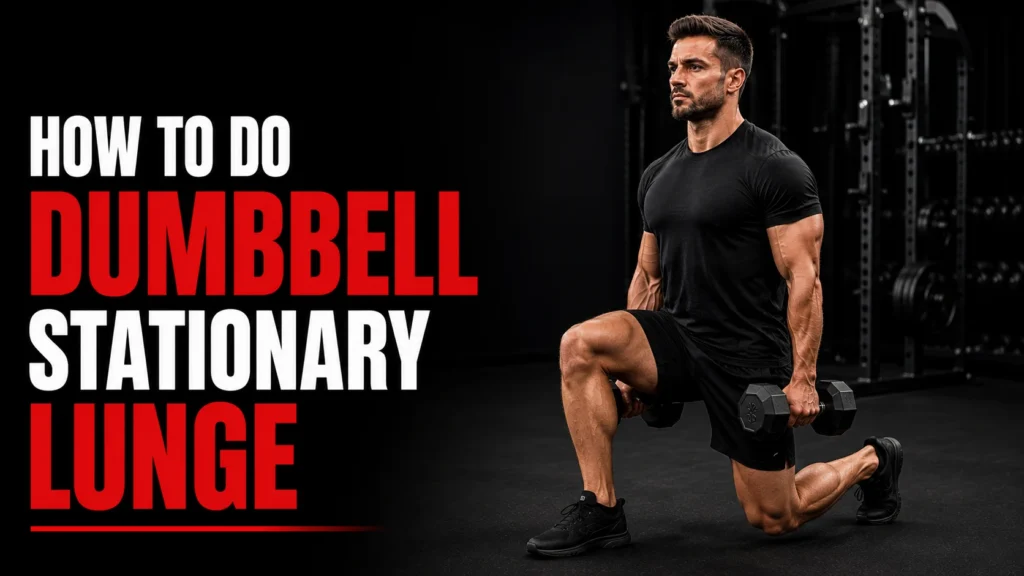
The dumbbell stationary lunge — sometimes called a split squat or fixed lunge — is a unilateral lower body exercise where you hold dumbbells at your sides, step one foot forward into a split stance, and lower your back knee toward the floor. Unlike walking lunges or forward-stepping lunges, you don’t move your feet between reps. You complete all your reps on one leg, then switch.
That fixed position is the whole point. It removes the balance demand of transitioning between steps, which means your muscles can focus on producing force rather than managing instability. That’s why coaches will often regress someone to stationary lunges when their walking lunge form falls apart — and why it’s also a better choice when you want to use heavier dumbbells.
Stationary lunges sit at an interesting spot in the lunge family. They’re more stable than walking lunges but less stable than a Bulgarian split squat. They load the front leg more than a reverse lunge does. Understanding these differences helps you choose the right variation at the right time — which is covered in detail later in this guide.
Muscles Worked
Quadriceps (Primary Mover)
The quadriceps — the four muscles on the front of your thigh — are the main driver of the stationary lunge. They extend the knee as you push back to the starting position. The vastus medialis, the teardrop-shaped quad on the inside of your knee, is particularly active because it has to stabilize the joint throughout the movement. If you feel a burn on the front of your thigh by rep 8 or 10, that’s the quads doing their job.
Glutes (Primary Mover)
The gluteus maximus works alongside the quads, driving hip extension as you rise from the bottom of the lunge. How much glute you get depends on step length. A shorter step keeps you more upright and shifts load to the quads. A longer step creates more hip flexion at the bottom, which stretches the glute and forces it to work harder on the way up. If glute development is your goal, step out a bit farther than feels natural and focus on pushing through your front heel rather than the ball of your foot.
Hamstrings
The hamstrings are active during the descent, working eccentrically (lengthening under load) to control how fast you lower yourself. They also contribute to hip extension alongside the glutes. You won’t feel them the way you feel your quads in a stationary lunge, but they’re working — and their eccentric role matters a lot for knee health and injury prevention.
Calves and Ankle Stabilizers
Your calf muscles — the gastrocnemius and soleus — work to stabilize the ankle throughout the movement. On the front leg, they keep the heel planted and prevent excessive forward knee travel. This is also why ankle mobility limits some people’s lunge depth: tight calves force the heel to lift, which shifts the knee too far forward and increases joint stress.
Core and Spinal Stabilizers
Every rep of a stationary lunge demands that your core keeps your torso upright. The deep stabilizers of the spine, along with the obliques and transverse abdominis, resist the tendency to lean forward under load. This is why stationary lunges quietly build core strength even though no one thinks of them as a core exercise. Hold heavier dumbbells and you’ll feel your grip, upper back, and core all working to manage the load.
How to Do the Dumbbell Stationary Lunge: Step-by-Step
Equipment You Need
A pair of dumbbells. That’s it. Pick a weight where you can complete your working sets with solid form — the back knee should come close to the floor on every rep, and your torso shouldn’t pitch forward.
Starting Position
Stand tall with a dumbbell in each hand, arms hanging straight at your sides, palms facing your thighs. Feet should be about hip-width apart. Take a breath in.
Step one foot forward — roughly two to three feet, depending on your height — and plant it firmly. This is your split stance. Your back heel will naturally be raised off the floor. Your front foot stays flat throughout the movement.
The Descent
From your split stance, bend both knees simultaneously and lower your body straight down. The movement is vertical, not forward. Your front shin should stay roughly vertical (or close to it), with your front knee tracking over your second or third toe. Your back knee descends toward the floor.
Lower until your back knee either lightly grazes the floor or hovers an inch above it. At the bottom, your front thigh should be roughly parallel to the floor, and both knees will be close to 90 degrees. Keep your chest up and your torso upright throughout — a slight forward lean is fine, but you shouldn’t be hunching over.
The Ascent
Drive through your front foot to push yourself back to the top of the split stance. Think about pressing the floor away rather than pulling your body up. Keep the core tight, the chest lifted, and the back knee pointed down (not flaring out to the side).
That’s one rep. Complete all reps on one leg before switching. Don’t step your feet together between reps — stay in your split stance for the entire set.
Breathing
Inhale on the way down. Exhale as you drive back up. On heavier sets, you may prefer to take a breath at the top between reps rather than breathing continuously.
Foot Position and Step Length: The Details That Actually Matter
The distance between your feet changes what the exercise does. This is one of the most important variables in lunge training, and most guides either ignore it or mention it in a single vague sentence.
A shorter step (feet closer together) keeps your torso more upright and increases the range of motion at the knee. This shifts the emphasis toward the quads and puts more demand on knee flexion. For quad development, a shorter step with deep knee bend works well — but it also increases stress on the patellar tendon. If you have a history of knee issues, be cautious here.
A longer step increases the range of motion at the hip. Your front hip flexes more deeply at the bottom, which stretches the glute and hamstring and forces them to generate more force on the way up. For glute and hamstring development, step out farther and drive through the heel. The trade-off is that a very long step can feel unstable and may pull on the hip flexors of the back leg.
For most people, a moderate step — where both knees reach roughly 90 degrees at the bottom — is the right starting point. From there, you can experiment based on what you want to target and what feels good in your body.
Common Form Mistakes
The Front Knee Caving Inward
Knee valgus — the front knee collapsing toward the midline during the descent — is the most common lunge mistake and the most worth correcting. It happens when the gluteus medius (the small stabilizing muscle on the side of the hip) isn’t strong enough to keep the femur in line. Under heavy load or fatigue, the knee caves because it’s the path of least resistance.
The fix isn’t just a cue to “push your knee out.” That helps in the moment, but if the underlying glute med weakness isn’t addressed, the problem will keep showing up. Add lateral band walks and clamshells to your warm-up. Over time, a stronger glute med keeps the knee tracking properly without you having to think about it.
Torso Pitching Forward
Leaning too far forward shifts weight onto the ball of the foot and takes stress off the glutes and onto the lower back. Some forward lean is natural, especially with longer step lengths, but you shouldn’t be hunching over your front thigh.
The most common cause is tight hip flexors on the back leg. When the hip flexor is short, it resists the extension required at the back hip, and the torso leans forward to compensate. Stretching the hip flexors between sets (a kneeling hip flexor stretch works well) often clears this up within a few sessions.
Not Going Deep Enough
Stopping too early robs the quads and glutes of the full range of motion they need to grow. If your back knee is nowhere near the floor, you’re getting a fraction of the benefit. Lower until the back knee either touches or nearly touches. If depth is limited by mobility rather than strength, work on ankle and hip flexibility as a separate priority.
Stepping Too Narrow
Some people step forward in a perfectly straight line, landing their front foot directly in front of their back foot — like they’re walking a tightrope. This makes the lunge dramatically less stable because your base of support becomes very narrow. Step forward and slightly to the outside, keeping both feet roughly hip-width apart side-to-side. This alone often eliminates wobbling that people blame on weak stabilizers.
Using Momentum
Dropping into the lunge quickly and bouncing at the bottom uses momentum to do work your muscles should be doing. Slow the descent down — two to three seconds on the way down. A controlled tempo builds more strength and protects the knee joint at the bottom position.
Dumbbell Stationary Lunge vs. Other Lunge Variations
Stationary vs. Walking Lunge
The walking lunge requires you to transition your weight forward with each rep, which adds a balance and coordination challenge that the stationary version doesn’t have. That extra demand is useful — it trains movement patterning and translates well to athletic performance. But it also limits how much weight you can use before instability becomes the limiting factor rather than leg strength.
For raw quad and glute development, stationary lunges often win because you can load them heavier without your balance giving out. For athleticism and conditioning, walking lunges are more functional. Most good programs include both at different points.
Stationary vs. Reverse Lunge
The reverse lunge — stepping backward rather than forward — reduces stress on the front knee because the shin stays more vertical. It also tends to feel more intuitive for people who have had knee issues. The stationary lunge loads the front knee slightly more than a reverse lunge, but it’s also a more direct quad builder. If your knees feel fine, stationary lunges are a solid choice. If forward-loaded knee flexion is painful, switch to reverse lunges and see if that resolves it.
Stationary Lunge vs. Bulgarian Split Squat
The Bulgarian split squat — where the back foot is elevated on a bench — increases the range of motion significantly and removes the back leg from the equation almost entirely. It’s harder, less stable, and places more load on the front leg. The stationary lunge is a logical stepping stone to the Bulgarian split squat. Build strength and confidence in the stationary version first, then progress to the elevated variation.
Programming the Dumbbell Stationary Lunge
For Hypertrophy (Muscle Building)
Program three to five sets of 10 to 15 reps per leg, using moderate to heavy dumbbells. Rest 60 to 90 seconds between sets. The goal is to get close to muscular failure on each set — if you can knock out 15 reps without much effort, the weight is too light. Tempo matters here: a two-second descent with a brief pause at the bottom creates more mechanical tension and drives better muscle growth than fast, bouncy reps.
For Strength
Use heavier weight and lower reps: three to five sets of five to eight reps per leg, resting two to three minutes between sets. At heavier loads, prioritize form over depth — better to stop an inch above the floor with perfect mechanics than to grind through sloppy reps with a heavy dumbbell. When you find that grip strength is your limiting factor rather than leg strength, consider lifting straps or transitioning to a barbell variation.
For Endurance or Conditioning
Two to four sets of 15 to 25 reps per leg with moderate weight and short rest (30 to 45 seconds) builds muscular endurance and adds a conditioning element. This works well in circuit training or as a finisher at the end of a leg session.
Where It Fits in a Workout
Stationary lunges work best as a secondary exercise after your main compound lift (squat or deadlift). Place them third or fourth in the session, after the movements that require the most neurological demand. If you lead with lunges, your squats will suffer. As a secondary movement, they add volume and training stimulus without wrecking your performance on the big lifts.
A simple placement:
- Barbell squat (primary)
- Romanian deadlift (primary accessory)
- Dumbbell stationary lunge (secondary)
- Leg curl or calf raise (tertiary)
Training Frequency
Two to three times per week is appropriate for most people. Lunges are taxing on the quads and the connective tissue around the knee, so back-to-back days without adequate recovery are a recipe for overuse. If legs are a priority, you can hit stationary lunges on both leg days but vary the rep range between sessions.
Progressions: How to Make It Harder Over Time
The most obvious progression is adding weight — go up by two to five pounds per hand once you can complete your target reps with full range of motion and controlled tempo. But there are other ways to progress that don’t require heavier dumbbells.
Slow the tempo. A three-second descent with a two-second pause at the bottom is significantly harder than the same exercise performed quickly. This doesn’t add joint load, so it’s a good option for people managing knee sensitivity.
Add a deficit. Standing on a small platform (a weight plate works) increases the range of motion your front hip moves through, giving the glute and hamstring more work to do. This is an intermediate progression that’s worth adding before jumping to the Bulgarian split squat.
Change foot position. Experimenting with step length (as discussed earlier) creates variety and shifts emphasis between muscle groups without requiring heavier weights.
Front rack or overhead hold. Holding the dumbbells at shoulder height or overhead dramatically increases the demand on your core and forces a more upright posture. It’s a legitimate progression that most people ignore.
Regressions: What to Do If the Standard Version Is Too Hard
If balance is an issue, hold onto something sturdy — a squat rack upright, a wall, or the back of a chair — while you build strength and proprioception in the position. The goal is to eventually not need the support, so use it as a training aid rather than a permanent crutch.
If depth is limited by mobility, start with a reduced range and work on ankle and hip mobility separately. Elevated heel lunges (standing on a small heel wedge or plate) can help if ankle dorsiflexion is the limiter.
If the weight feels heavy before your legs are tired, go lighter. There’s no shame in starting with five-pound dumbbells or even bodyweight-only until the mechanics feel solid. Every rep of a stationary lunge with correct form is worth more than ten messy reps loaded up.
Who Should Use the Dumbbell Stationary Lunge
Beginners benefit because the fixed stance is forgiving. You don’t need to coordinate a forward step, which means you can focus entirely on the up-and-down motion and learn the position before progressing to more complex variations.
Intermediate and advanced lifters can use stationary lunges to load the legs heavily, address asymmetries, and accumulate hypertrophy volume without the spinal compression of barbell squats.
Athletes building unilateral leg strength will find that stationary lunges transfer directly to sprinting, jumping, and change-of-direction performance. The single-leg strength you build here shows up in sport.
People with lower back issues often tolerate dumbbell lunges better than barbell squats because the weight hangs at the sides rather than sitting on the spine.
Anyone noticing one leg is stronger or more stable than the other should lean into unilateral work. Bilateral exercises like squats allow the stronger leg to compensate. Lunges expose and correct those imbalances over time.
Frequently Asked Questions (FAQs)
How is the dumbbell stationary lunge different from a split squat?
In practice, they’re nearly the same exercise. Some coaches use the terms interchangeably. If there’s a distinction, it’s usually that a split squat implies a more static stance where you actively lower and rise without any movement of the feet, while a stationary lunge might involve a brief return to a neutral stance between reps. Either way, the mechanics, muscles worked, and benefits are essentially identical.
Should the front knee go past the toes during a stationary lunge?
Somewhat, yes — and that’s fine for most people. The old rule that knees should never pass the toes has been largely disproved by biomechanics research. What matters is that the front heel stays flat on the floor and the knee tracks in line with the toes rather than caving inward. Some forward knee travel is both unavoidable and normal.
What weight should I start with for dumbbell stationary lunges?
Start lighter than you think you need to. A pair of 15 to 20-pound dumbbells is a reasonable starting point for most adults who are new to exercise. The goal in your first few sessions is to groove the movement pattern, not to test your max. Increase the weight once you can hit your target reps with controlled tempo and full depth.
How many reps and sets should I do?
For muscle building, three to five sets of 10 to 15 reps per leg is a standard and effective range. For strength, five to eight reps per leg with a heavier weight. For conditioning, 15 to 25 reps per leg with shorter rest. Start at the lower end of the set count and build up over several weeks.
Why do I feel the stationary lunge more in my front quad than my glute?
Almost certainly a step length issue. A shorter step keeps the front shin more vertical and emphasizes the quads. Step out farther — so your front shin angles slightly forward but the knee doesn’t travel excessively past the toes — and focus on driving through your heel rather than the ball of your foot. That heel drive recruits the glute and hamstring much more effectively.
Can I do stationary lunges if I have knee pain?
It depends on the source of the pain. For many people, the stationary lunge is more knee-friendly than forward-stepping lunges because the mechanics are more controlled, and you can manage the range of motion carefully. That said, if knee pain is significant or worsening, stop and get it assessed before continuing. Reverse lunges are often a better short-term substitute for people managing knee sensitivity.
How often should I do dumbbell stationary lunges?
Two to three times per week, with at least one rest day between sessions, is appropriate for most training programs. If you’re sore from a previous session, that’s useful information — it means the volume or intensity was right at your threshold. Reduce volume slightly if soreness is consistently severe or lasting more than three days.
Are stationary lunges better than squats?
Different, not better or worse. Squats allow you to move more total weight and train both legs simultaneously, which builds overall leg mass effectively. Stationary lunges train each leg independently, expose and correct strength imbalances, build single-leg stability, and reduce spinal load. A complete leg training program benefits from both.
In conclusion
The dumbbell stationary lunge earns its place in a well-designed leg program. It’s not flashy, it doesn’t require a rack, and it doesn’t photograph well — but few exercises do as good a job of building quad and glute strength while simultaneously correcting the left-to-right imbalances that most bilateral training misses.
Get the foot position right. Control the tempo. Go deep. Those three things will do more for your results than any other variable in this exercise.
If you’re new to lunges, start here before progressing to walking lunges or Bulgarian split squats. If you’ve been doing lunges for a while and your legs have plateaued, try going heavier on stationary lunges with a slower tempo — it’s a different stimulus than you’re probably used to, and your quads will feel it.
Want to build stronger forearms and improve arm definition? Check out How to Do Reverse Curls with Dumbbells for proper form, key benefits, and tips to target your brachioradialis and biceps more effectively.