Most people who train arms seriously still skip this one. They’ll do five variations of a bicep curl but never flip their grip over. That’s a problem, because the muscles you’re missing — the brachioradialis, the brachialis, the wrist extensors — are the ones that determine whether your arms look full or flat, and whether your grip holds up when you’re pulling serious weight.
What Are Reverse Curls with Dumbbells?
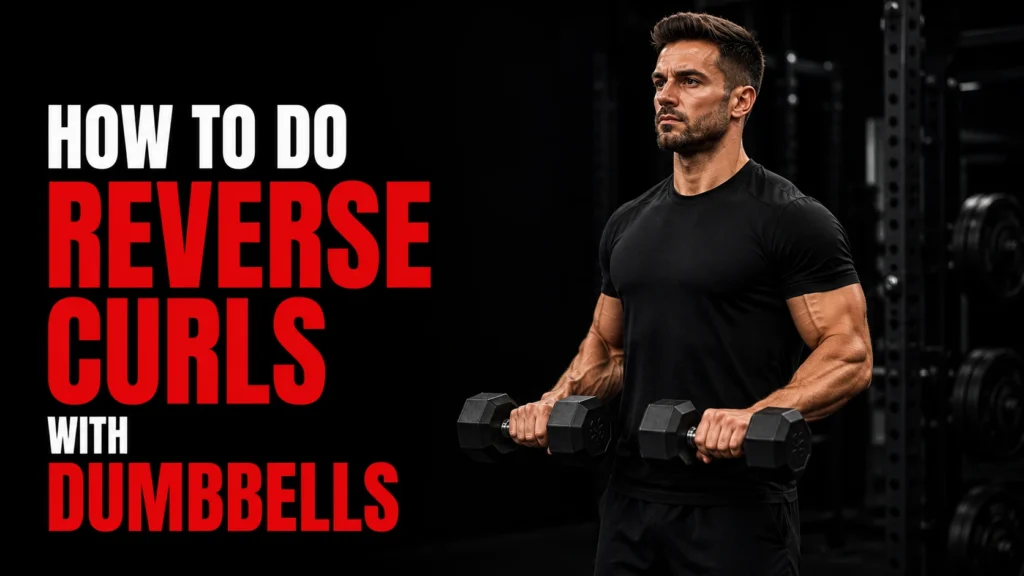
A dumbbell reverse curl is the same basic movement as a standard bicep curl, with one change: your palms face down instead of up. That’s it. The grip flips from supinated (underhand) to pronated (overhand), and that single shift completely reorganizes which muscles are doing most of the work.
Unlike traditional bicep curls, which primarily work the biceps brachii, reverse curls place more emphasis on the brachioradialis — the dominant muscle on the outer forearm. The biceps don’t disappear; they just stop being the lead mover.
What makes dumbbells a smart choice for this exercise is the independence they give each arm. Each wrist and forearm stabilizes the load on its own, which means you’ll catch and correct side-to-side strength imbalances that a barbell would mask. If your left forearm is noticeably weaker, a barbell lets your right arm compensate without you noticing. Dumbbells don’t allow that.
The Muscles Worked in Dumbbell Reverse Curls
Brachioradialis: The Primary Mover
The pronated grip puts the biceps brachii at a mechanical disadvantage, shifting the workload to the brachioradialis — the largest muscle in the forearm, running from the upper arm down to the thumb side, and a major contributor to elbow flexion when the forearm is pronated.
This muscle is visible. It runs along the outer edge of your forearm and creates the thick, muscular look between your elbow and wrist. Standard bicep curls barely touch it. The brachioradialis gets very little work from regular curls, so reverse curls fill that gap directly — and that’s precisely why the forearm growth shows up fast once you start doing them consistently.
Brachialis: The Hidden Thickness Maker
Underneath your bicep sits the brachialis, and most people have no idea it exists until they start training it. The brachialis is the primary flexor of the elbow — responsible for bending your arm regardless of what your hand is doing. It has a broad insertion on the humeral shaft and contracts constantly during pulling movements.
Here’s what matters aesthetically: a well-developed brachialis pushes the bicep up and outward, making the peak taller and the overall arm appear wider. You can’t isolate it directly, but during a reverse curl, demand shifts significantly toward the brachioradialis and forces the brachialis to pick up more elbow flexion duty than it would in a standard curl. That combination is what builds arm thickness that looks different — more complete — than bicep work alone provides.
Wrist Extensors: The Part Most People Don’t Know They’re Training
This is what most articles gloss over. The wrist extensor muscles — extensor carpi radialis longus, extensor carpi radialis brevis, and extensor carpi ulnaris — work statically throughout the reverse curl to prevent the wrist from flexing downward under the weight. This constant isometric tension maintains a straight wrist position, building strength and endurance in muscles that almost never get direct training.
They’re small, they fatigue fast, and after your first serious set of reverse curls you’ll feel them burning on top of your forearm. That sensation is the point.
Biceps Brachii: A Supporting Role
The biceps are still active; they contribute to elbow flexion and stabilize the shoulder. But their mechanical advantage is reduced when the forearm is pronated, so they’re doing less work than they would in a regular curl. Think of them as assistants rather than the driving force.
Why Reverse Curls with Dumbbells Deserve a Spot in Your Program
Forearm Development That Standard Curls Can’t Give You
The most visible reason. If your forearms look underdeveloped compared to your upper arms, reverse curls are almost certainly the missing piece. The brachioradialis gets almost no stimulus from supinated curls, and it’s the muscle most responsible for that thick, vascular forearm look.
Grip Strength That Carries Over to Everything Else
A 2018 study published in PeerJ found that a reverse grip bicep curl results in more activation of the brachioradialis muscle, the major muscle in the forearm. Grip is a limiting factor in more lifts than people acknowledge. Your back and legs might be strong enough to deadlift more, but if your hands give out first, you’re capped. Reverse curls address exactly that ceiling, through both the brachioradialis and the wrist extensors that work hard to keep the load controlled on the way down.
Elbow Joint Health
When one muscle group around a joint is significantly weaker than the others, the joint absorbs compensatory stress. Balancing the brachioradialis and brachialis against the biceps reduces that load. Many people who add reverse curls report fewer elbow aches over time — not because reverse curls are magic, but because they correct an imbalance that was causing the problem.
Correcting Side-to-Side Imbalances
With dumbbells, each arm works independently. A dominant side can’t carry the weaker one through the set. That unilateral demand brings both sides into balance over time — something a barbell will never force you to confront.
A Different Training Stimulus When Your Arms Have Stopped Growing
New mechanical stress leads to new adaptation. If you’ve been running the same three curl variations for a year and your arms have stopped responding, reverse curls introduce a stimulus they haven’t encountered. The brachioradialis in particular is almost certainly untrained if reverse curls aren’t in your rotation.
How to Do Reverse Curls with Dumbbells: Step-by-Step
Choosing Your Weight
Start lighter than you think you need to. Not slightly lighter — noticeably lighter. Your wrist extensors will fatigue before your biceps do, and the pronated grip reduces how much force your biceps can contribute. What feels easy as a regular curl will feel genuinely hard flipped over. Most people find they need to drop 30–40% of their usual curl weight to maintain clean form.
Starting Position
Stand with feet hip-width apart. Let the dumbbells hang at your sides with your palms facing behind you. Pull your shoulders back and down, brace your core lightly, and keep your chest up. Your elbows should have a slight bend at the bottom — don’t lock them out completely, which keeps tension in the working muscles from the start.
The Curl
Rotate your grip so your palms face the floor and keep them there throughout the entire movement. Your wrists stay straight — think of them as locked in line with your forearms. If your wrists bend backward as you curl, the weight is too heavy.
Bend at the elbows and curl the dumbbells toward your shoulders. Your upper arms stay fixed and pinned to your sides. Only the forearms move. Exhale as you lift. Stop when the dumbbells reach roughly shoulder height and hold for one count at the top.
The Lowering Phase
This is where most people get lazy — and where a lot of the growth stimulus lives. Aim for a deliberate 3–4 second lowering phase. Eccentric tempo is particularly effective for stimulating the brachioradialis and the underlying brachialis. Resist the weight the entire way down. Breathe in as you lower. Return to the starting position with a slight elbow bend and immediately start the next rep.
Sets and Reps for Growth
For hypertrophy: 3–4 sets of 10–15 reps, placed at the end of your arm or pull session. Starting out, 2–3 sets of 8–12 reps with a moderate weight is plenty. Your wrists and forearm extensors need time to adapt before you push volume or load higher.
Common Mistakes That Limit Your Results
Going Too Heavy
Unlike hammer curls or standard bicep curls, reverse curls require more control because of the pronated grip. Loading up too much weight puts unnecessary strain on the wrist joints and reduces the effectiveness of the movement. Accept the lighter weight and focus on the muscles you’re actually training.
Bending the Wrists
Wrists should stay neutral throughout. When the wrist collapses downward at the top, tension shifts away from the brachioradialis and into the joint. If you can’t keep your wrists neutral, the weight is too heavy.
Letting the Elbows Flare
Elbows drift outward and the traps and deltoids start picking up work that should be going to the forearm muscles. Keep elbows tucked to your sides from the first rep to the last.
Cutting the Range of Motion Short
The bottom portion of the rep — the stretch position — is where much of the growth stimulus lives. Full extension at the bottom and a complete curl at the top gives you access to the full range. Half reps produce noticeably less adaptation over time.
Rushing Through Reps
Reverse curls are not a power exercise. Momentum defeats the purpose. If you’re bouncing through the reps using body sway, you’re not training the brachioradialis — you’re just going through a motion with extra steps.
Placing Them Too Early in the Workout
Reverse curls belong at the end of a session. Your wrists and forearm extensors need to be fresh enough to control the load through a full range of motion. Running them first tires the stabilizing muscles before your main bicep work and limits performance on both.
Dumbbell Reverse Curl Variations
Alternating Dumbbell Reverse Curl
Instead of both arms simultaneously, alternate left and right. This increases time under tension per arm and requires more unilateral wrist stabilization. It’s useful for beginners still learning to maintain wrist neutrality, and for anyone whose bilateral form tends to break down late in a set.
Incline Dumbbell Reverse Curl
Lie on an incline bench at roughly 45–60 degrees with your arms hanging straight down. Curl from that stretched position. The incline eliminates momentum entirely — every rep is strict, and the extended bottom position puts the brachioradialis under a longer stretch than standing variations allow. It’s harder than it looks.
Seated Dumbbell Reverse Curl
Sit on the edge of a bench with your elbows braced against your thighs. This removes any possibility of body sway, so the work stays entirely in the forearms. Useful for people who unconsciously compensate with their torso during standing curls.
Preacher Bench Dumbbell Reverse Curl
The preacher bench locks your elbows in position and isolates the elbow flexion movement. It’s a genuinely brutal option for forcing adaptation because the joint angle places maximum tension at the mid-range of the rep — the range where most people can generate the most force — rather than allowing the easy bottom portion of a standing curl.
Wall Reverse Curl
Stand with your back flat against a wall and keep your elbows touching or very close to the wall throughout the movement. This simple constraint prevents elbow drift and forward lean. It’s a useful teaching tool for building the proprioceptive awareness needed to perform clean standing reps.
How to Program Dumbbell Reverse Curls
For Beginners
One set per session at the end of any upper body or arm workout. Use a weight where you can complete 12 clean reps without wrist collapse. Focus on form for two to three weeks before adding volume or load. Once a week is plenty to start — your wrists need time to adapt.
For Intermediate Lifters
Add them to your regular arm day after your main bicep work: 3 sets of 10–12 reps. If you’re already doing hammer curls, run both. Hammer curls first (they allow heavier load), reverse curls after.
For Advanced Lifters
Three to four sets of 10–15 reps with progressive overload applied consistently. Running reverse curls on both your arm day and at the end of a pull session accelerates forearm development without adding significant recovery cost.
Applying Progressive Overload
Add reps before adding weight. When you hit the top of your rep range with clean form, add 2.5 lbs per dumbbell and work back through the rep range again. The wrist extensors respond well to higher rep ranges — pushing to 20 reps per set before adding load is a valid strategy with this exercise.
Who Benefits Most
People whose grip fails before their back or legs in deadlifts and rows should treat this as a near-mandatory accessory. Grip is a forearm problem, and reverse curls address it more directly than most exercises.
Lifters with elbow pain during pulling exercises often have undertrained forearms relative to their biceps, creating joint stress from muscular imbalance. Reverse curls correct that ratio.
Anyone whose forearms look disproportionately thin compared to their upper arms. The brachioradialis is the primary mover here, and it’s a muscle that most common exercises skip entirely.
Athletes in racket sports, climbing, gymnastics, and combat sports where grip endurance and forearm strength directly limit performance.
Lifters who have been doing the same arm exercises for a long time without progression. The mechanical novelty alone is enough to restart adaptation in stalled arms.
Safety and When to Be Careful
Reverse curls are safe when performed correctly, but a few situations warrant attention.
If you have existing wrist pain, start with very light weight and stop if you feel joint pain rather than muscle fatigue. Those with diagnosed conditions like arthritis or carpal tunnel should consult a physiotherapist before adding this exercise — the wrist extension and flexion involved can aggravate symptoms.
Tennis elbow is context-dependent. Strengthening the wrist extensors is part of long-term rehab for lateral epicondylitis, but loading inflamed tissue makes acute cases worse. Get professional guidance before using reverse curls therapeutically.
Always use a weight that allows full wrist control through the entire set. The moment your wrists start buckling, the set ends.
Frequently Asked Questions (FAQs)
What is the primary muscle worked in a dumbbell reverse curl?
The brachioradialis is the largest muscle in the forearm, running from the upper arm down to the thumb side. The brachialis and wrist extensors also work hard throughout the movement, though the brachioradialis takes the lead role once your grip flips to pronated.
How much weight should I use for reverse curls with dumbbells?
Significantly less than your standard curl weight. The pronated grip reduces the biceps’ mechanical contribution, and the wrist extensors fatigue faster than expected. A weight that allows 10–12 controlled reps with straight wrists is the right starting point — typically 30–40% lighter than your usual curl weight.
Are reverse curls good for building bigger biceps?
They contribute to overall arm size but aren’t the most direct route to bicep hypertrophy. What they do is build the brachialis, which pushes the bicep peak upward, and the brachioradialis, which adds width to the outer arm. The combined result looks like bigger biceps even though the stimulus is targeting different structures.
How often should I do reverse curls?
Once a week to start. After two to three weeks, increasing to two sessions per week with 3–4 sets each is appropriate for most lifters. Consistent twice-weekly training is enough to see clear progress in forearm thickness and grip strength.
Can reverse curls help with grip strength?
Directly, yes. By training the brachioradialis and wrist extensors — muscles that are almost never challenged by other common exercises — reverse curls build the specific forearm endurance and stability that translates to better grip in deadlifts, rows, and pull-ups.
What’s the difference between reverse curls and hammer curls?
The grip position. Hammer curls use a neutral grip (thumbs up), reverse curls use a pronated grip (palms down). Reverse curls shift more activation to the brachioradialis compared to hammer curls, and they demand much more from the wrist extensors. The two exercises are complementary rather than interchangeable.
Should I do reverse curls with dumbbells or a barbell?
Dumbbells if one arm is weaker than the other or if wrist comfort is a concern. Barbell if your goal is maximum forearm mass and wrist health allows it. EZ bar if straight bar discomfort limits your sets before the target muscles are trained. Most beginners start with dumbbells and transition based on what their joints tolerate.
Are reverse curls good for tennis elbow?
Context-dependent. Strengthening the wrist extensors is part of lateral epicondylitis rehab, but loading inflamed tissue makes acute cases worse. Get guidance from a physiotherapist before using reverse curls as a rehab tool.
Where should reverse curls fit in my workout?
At the end, after your main bicep and back work. Placing them last means your primary lifts aren’t compromised by fatigued wrist extensors, and your forearms are already warmed up enough to train effectively.
How long until I see results?
Most lifters notice improved brachioradialis definition after four to six weeks of consistent twice-weekly training. Grip strength improvements often come faster — sometimes within two to three weeks of starting.
In conclusion
There’s no complicated secret behind reverse curls with dumbbells. Flip your grip, use less weight than your ego wants, and do every rep with control. The brachioradialis, brachialis, and wrist extensors — muscles that barely register in a standard curl — take over and get trained properly, possibly for the first time.
The results show up in multiple places: thicker forearms, a taller bicep peak, better grip under load, and fewer elbow complaints. It’s an exercise that adds a lot to a program relative to the cost of doing it.
If your arm development has stalled, your grip gives out before your back does, or your forearms look underdeveloped next to your upper arms — this is probably the exercise you’ve been skipping. Add it to the end of your next arm session, stay strict with the form, and give it six weeks. The forearms don’t lie.