Most shoulder exercises move in straight lines. Up and down. Forward and back. The dumbbell around the world is different — it traces a full arc around your body, hitting your deltoids, chest, and rotator cuff in one continuous sweep that most pressing and raising variations simply can’t replicate.
That makes it either an underrated gem or a wasted rep, depending entirely on how you execute it.
What Is the Dumbbell Around the World Exercise?
The dumbbell around the world is an isolation exercise in which you guide a pair of light dumbbells through a full circular arc — from your hips, out to your sides, up overhead, and back — in one fluid, controlled motion. It exists in two distinct variations: lying on a flat bench and standing upright. Both share the same circular path but target different muscle groups and demand different levels of stability.
The lying version emphasizes the pectoralis major and uses the bench for full-body support, making it closer in feel to a chest fly. The standing version removes that support entirely, turning it into a deltoid-dominant movement that also requires active core engagement throughout.
What separates this exercise from most upper-body work isn’t the resistance — you’ll use far lighter weight than you expect — but the range of motion. The circular path forces your shoulder joint through positions that lateral raises, front raises, and even overhead presses don’t reach. That’s its value, and also its main risk if you push the weight too heavily.
Muscles Worked by Dumbbells Around the World
Primary Muscles
Deltoids (anterior and lateral heads) The front and side heads of the deltoid drive the upward arc of the movement. As the dumbbells sweep from your sides up toward the overhead position, both heads fire to maintain control against gravity. The standing variation places considerably more demand on these structures because there’s no bench to offload stability.
Pectoralis major In the lying variation, the pecs engage from the moment the dumbbells move away from the hips toward the overhead position. The arc mimics the adduction and horizontal flexion pattern that makes chest flys effective, so the pectoralis major is under tension through much of the movement. This is the primary reason some coaches program dumbbell around the worlds as a chest accessory rather than a shoulder exercise — context determines emphasis.
Secondary and Stabilizing Muscles
Rotator cuff (supraspinatus, infraspinatus, subscapularis, teres minor) These four muscles surround the glenohumeral joint and keep the humeral head seated properly throughout circular movement. Because dumbbell around the world takes the shoulder through a sweeping arc, the rotator cuff is in near-constant stabilizing demand. This is different from exercises like overhead presses, where the rotator cuff works hard during a narrower range. For shoulder health and joint longevity, that extended stabilizing role matters.
Upper trapezius and serratus anterior Keep the shoulder blades moving in rhythm with the arm during the arc. If the shoulder blades don’t rotate upward as the arms rise, the subacromial space narrows — exactly the condition that leads to impingement. When the serratus anterior fires correctly and scapular upward rotation happens, the movement feels smooth throughout.
Core musculature In the standing variation, the obliques, transverse abdominis, and erector spinae work isometrically to keep the torso stable. Any lateral lean or spinal extension at the top of the arc is a sign the weight is too heavy or the core isn’t engaged.
Biceps and triceps Assist in controlling the arc rather than driving it. The elbow angle stays fixed — a slight bend maintained throughout — so these muscles function as secondary stabilizers, not movers.
How to Do the Dumbbell Around the World: Step-by-Step
Lying Dumbbell Around the World (Bench Version)
This is the classic version, best for targeting the chest with some shoulder involvement.
Setup Lie flat on a bench with your feet planted firmly on the floor. Hold a dumbbell in each hand with arms extended above your torso, palms facing each other — the same start position as a dumbbell fly.
The movement
- Pin your shoulder blades into the bench. This is not optional. Letting the shoulders round forward mid-rep shifts load onto structures that aren’t prepared for it.
- With elbows maintaining a slight, fixed bend, slowly lower both dumbbells out to your sides in a wide arc. Rotate your wrists as the dumbbells descend so your palms face the ceiling by the time your arms are level with your torso.
- Continue the arc downward until the dumbbells reach hip level. You should feel a stretch through the chest and the front of the shoulders at this endpoint.
- Pause briefly, then reverse the arc — sweeping the dumbbells back up and overhead to return to the starting position.
- You can complete full reps in one direction, or alternate — going from hips to overhead and back counts as one rep.
Tempo Slow is better here. A 3-second arc in each direction gives you time to feel the muscles working and prevents momentum from doing the job for you.
Standing Dumbbell Around the World
This version targets the deltoids far more than the chest and adds a balance and core demand that the bench version eliminates.
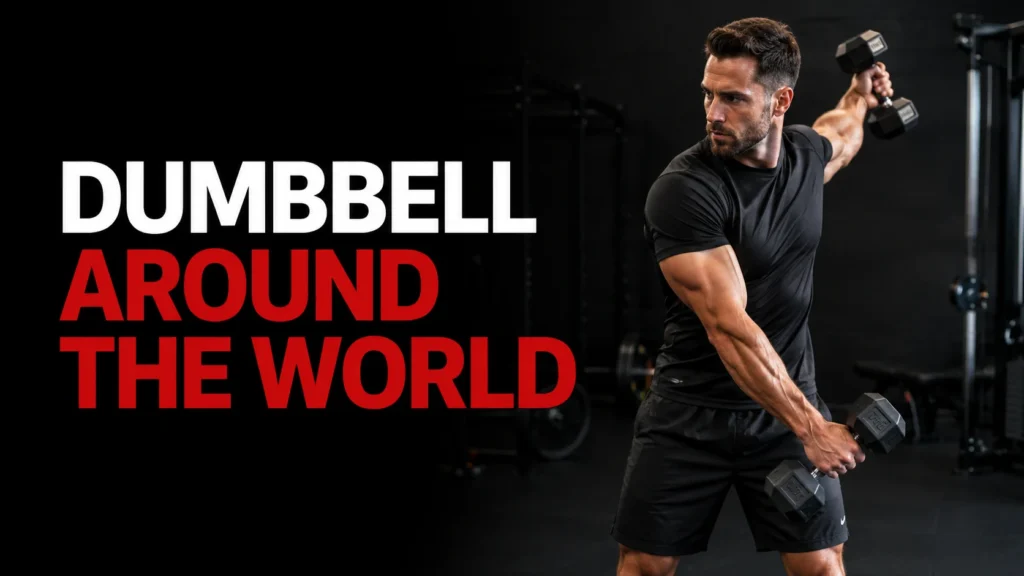
Setup Stand with feet shoulder-width apart, a dumbbell in each hand at your sides, palms facing inward. Knees slightly soft — not locked out.
The movement
- Brace your core before you lift. Think about stiffening the entire trunk, not just sucking in your stomach.
- Raise both arms simultaneously out to your sides, elbows slightly bent, in a wide arc. Keep your shoulders depressed — don’t let them creep up toward your ears as the dumbbells rise.
- Continue the upward arc until the dumbbells meet (or nearly meet) above your head.
- Reverse the motion with control, lowering back to the starting position along the same arc.
- After completing your set in one direction, repeat in the opposite direction.
Weight selection This is where most people make their first mistake. For the lying version, start with 5-10 lbs. For the standing version, 3-8 lbs is a reasonable starting point. These numbers feel insulting until you’ve done a full set with strict form — then they feel exactly right.
Common Form Mistakes and How to Fix Them
Using Too Much Weight
The most universal error. Heavy dumbbells shift the movement from a controlled arc into a compensated grind where momentum, spinal extension, and shrugged shoulders do the work. The muscles you’re trying to train get bypassed. Use a weight you can control through the full arc without your torso moving.
Letting the Elbows Bend and Extend
The elbow angle must stay constant — a soft, fixed bend throughout. Bending and straightening the elbows mid-rep recruits the triceps on the way up and turns the movement into something closer to a pullover. Set the elbow angle before you begin and don’t change it.
Shrugging the Shoulders at the Top
Shoulder elevation at the top of the arc engages the upper trapezius and reduces the work done by the deltoids. It also compresses the subacromial space. Think about pulling your shoulder blades slightly down and together before you start, and maintain that throughout.
Arching the Lower Back
Common in the standing variation when the weight is too heavy or the core isn’t braced. The lower back extends to compensate for the effort of lifting the dumbbells overhead. Brace first, lift second.
Rushing the Arc
Speed eliminates the benefit of this exercise. Moving quickly lets momentum carry the dumbbells through the arc without meaningful muscle activation. Slow each rep down deliberately — you’ll immediately feel the difference in effort.
Locking Out the Elbows
Full extension places stress on the elbow joint itself and reduces tension on the target muscles. The slight bend should be visible but not exaggerated — think 10-15 degrees of flexion, not a significant curl.
Benefits of the Dumbbell Around the World Exercise
Full Deltoid Stimulation Through a Unique Arc
Standard shoulder exercises like lateral raises and front raises are excellent but linear. They move through one plane, working a defined portion of the deltoid’s range. Dumbbell around the world moves through a sweeping circular arc that stimulates the anterior and lateral deltoid through positions those exercises miss. If shoulder development has stalled despite consistent pressing and raising, this is worth adding.
Rotator Cuff Conditioning Without Isolation Tedium
Most rotator cuff work involves small, repetitive movements that are necessary but tedious — side-lying external rotations, band pull-aparts. Dumbbell around the world doesn’t replace those, but it does integrate rotator cuff stabilization into a more dynamic movement pattern. The shoulder joint has to actively resist the pull of gravity through an extended arc, which builds functional stability alongside strength.
Chest Development in the Lying Variation
The pectoralis major engages during the arc from hip level up toward the overhead position — the same adduction pattern used in chest flys. For lifters who are “bench press non-responders” (those who get limited chest activation from pressing movements due to limb length or shoulder structure), around the worlds can be a useful way to create chest fatigue with a different loading pattern.
Genuine Shoulder Mobility Improvement
Moving through a full arc repeatedly improves the shoulder’s active range of motion over time. The exercise also lubricates the glenohumeral joint through synovial fluid distribution, which is why it works well as a warm-up before heavier pressing or pulling sessions. Regular practice reduces the stiffness many lifters experience after years of training in linear patterns.
Scapular Health and Posture
The standing version, done correctly, forces the serratus anterior to fire throughout the arc to control scapular upward rotation. This muscle is chronically undertrained in most gym programs and plays an important role in maintaining shoulder health and preventing the rounded-forward posture common in heavy pressers.
Accessibility
Both versions require only a flat bench (for the lying variation) or just floor space (for standing). A pair of light dumbbells is all the equipment needed. This makes it practical around the world for home gym setups, travel workouts, or any training environment where equipment is limited.
Dumbbell Around the World Variations
Weight Plate Around the World (Standing)
Instead of two dumbbells, hold a single weight plate at chest height with both hands. Raise the plate overhead and circle it around your head — rotating it vertically around your skull in a halo pattern. This variation is excellent for shoulder mobility and is commonly used in athletic warm-up protocols. The shared load between both hands allows for a more flowing, continuous motion.
Single-Arm Around the World
Perform the standing version with one arm at a time. This forces unilateral stabilization — the opposite shoulder and hip must work to keep the torso from tilting. Useful for identifying strength imbalances between sides, which are common in lifters who favor their dominant arm.
Stability Ball Lying Around the World
Perform the lying version with your upper back on a stability ball instead of a flat bench. The unstable surface increases the demand on core and lower back stabilization throughout. Only recommended once the flat bench version is fully mastered, as the instability adds meaningful risk if form breaks down.
Partial Range Around the World
Move the dumbbells from hips to shoulder height and back, without completing the full arc to overhead. This is a useful regression for beginners with limited shoulder mobility, or for anyone returning from a shoulder issue who needs to build range of motion progressively.
Dumbbell Around the World with Squat
At the bottom of the circular arc, perform a bodyweight squat. As the dumbbells rise toward overhead, stand back up. This adds a lower-body demand and increases heart rate, making it useful in circuit-style training where time efficiency matters.
How to Program Dumbbell Around the World
Where It Fits in a Workout
Dumbbell around the world works best in one of two positions in a session: as a warm-up before heavier chest or shoulder pressing, or as a finishing movement at the end of an upper-body session to flush the muscles with blood and improve recovery.
Do not place it first in a session with heavy load expectations. Fatiguing the rotator cuff and deltoids before compound pressing movements like overhead press or bench press can increase injury risk in those heavier exercises.
Sets and Reps
For shoulder mobility and warm-up purposes: 2 sets of 10-12 reps in each direction, using minimal weight. The goal is movement quality, joint lubrication, and muscle activation — not fatigue.
For accessory strength work in a chest or shoulder session: 3 sets of 12-15 reps, with a 3-second arc in each direction. Rest 45-60 seconds between sets.
For endurance or metabolic finisher: 2 sets of 45 seconds under tension, both directions, with minimal rest. This is effective as a final exercise when the goal is muscular fatigue and pump rather than load progression.
Weight Progression
Increase weight only when you can complete every rep through the full arc without any form breakdown — no arching, shrugging, or elbow bending. Given how light the starting weights are, progress will happen quickly for most people. A reasonable ceiling for the lying version is 15-20 lbs for most intermediate lifters. Standing variation rarely needs to go above 12-15 lbs before the form benefits disappear.
Who Should Include It
Beginners learning shoulder mechanics get genuine value here because the movement teaches the shoulder blade and arm to work together before heavier loading is introduced. Intermediate lifters who’ve been pressing and raising for years but notice their shoulders feel stiff or their chest doesn’t activate well during flys — this is worth a four-week trial. Overhead athletes (swimmers, climbers, tennis players) need rotator cuff conditioning through a wide arc; this delivers that without complex setup. Anyone returning from a spell of shoulder stiffness — not a diagnosed injury, just the kind of tightness that builds from desk work and bench pressing — will find the arc range useful for restoring movement quality.
Who Should Avoid It or Modify
If your shoulder hurts during overhead reaching or side-lying, get a physical therapist’s clearance before touching this exercise. The range of motion that makes it useful for healthy shoulders is exactly what can aggravate subacromial impingement, unstable glenohumeral joints, or an active rotator cuff tear. Pain during the arc is a stop signal, not something to push through. In those cases, the partial-range version — stopping at shoulder height rather than going overhead — is a reasonable starting point to assess tolerance.
Frequently Asked Questions (FAQs)
Is the dumbbell around the world a beginner exercise?
Both variations are beginner-accessible when performed with lightweight. The lying bench version is arguably more beginner-friendly because the bench provides full support, letting you focus entirely on the arm arc. The standing version demands more body awareness and core stability, making it slightly more challenging for true beginners. Either way, starting with 5 lbs or less is appropriate, and progress should be slow and deliberate.
How heavy should the dumbbells be for around the world?
Lighter than you think. Most experienced lifters use 5-15 lbs for the lying version and 3-10 lbs for standing. The weight feels easy until you slow the arc down, maintain strict elbow position, and try to complete a full set without form breakdown. Pick a weight you can arc through the full range without shrugging, arching, or bending the elbows.
Can I do dumbbells around the world every day?
Yes, with the lighter loads used for mobility and warm-up purposes. At warm-up weights, the movement is low enough in intensity that daily practice won’t cause overtraining. If you’re using it as a strength accessory with genuine loading, 2-3 times per week with rest days in between is more appropriate.
Is this exercise good for shoulder rehabilitation?
It can be — but only when shoulder pain is absent during movement and a qualified physical therapist has cleared overhead-arc activity. The large range of motion that makes it beneficial for healthy shoulders can aggravate certain conditions like subacromial impingement, labral issues, or active rotator cuff tears. Use the partial-range variation (hips to shoulder height only) as a starting point if returning from a shoulder issue, and progress gradually.
Does the dumbbell around the world build muscle?
It builds muscle, but primarily at lighter loads — which means the hypertrophy stimulus isn’t as high as compound movements. Its value is in targeting muscles through ranges that compound pressing and isolated raising don’t reach, improving mind-muscle connection, and building joint resilience. Think of it as a complement to bigger movements rather than a primary mass-builder.
What is the difference between the lying and standing variations?
The lying version uses the bench for support, eliminating core and balance demands. It emphasizes the chest more heavily and allows a slightly fuller arc because you don’t have to fight gravity alone. The standing version removes bench support, making the deltoids work harder and engaging the core throughout. The lying variation fits better in chest programs; the standing variation fits better in shoulder programs.
Should I do around the world before or after pressing?
As a warm-up or mobility exercise, before pressing. As a fatigue-accumulation accessory, after pressing. The key principle: don’t pre-fatigue the rotator cuff and smaller stabilizing muscles before compound lifts, where you need them working at full capacity.
Can I do the around the world exercise if I have tight shoulders?
Tight shoulders are actually one of the best reasons to include this exercise. The circular arc moves the joint through ranges that most gym training ignores, and consistent practice can meaningfully improve active shoulder mobility over weeks and months. Start with the partial-range variation and zero weight, moving only as far into the arc as comfortable. Gradually extend the range as mobility improves.
In conclusion
The dumbbell around the world earns its place in a program not because it’s flashy or heavy, but because it reaches places other exercises don’t. The circular arc hits the anterior and lateral deltoid through a combined path that lateral raises and front raises never fully cover. The lying version adds real chest activation alongside that shoulder work. The rotator cuff is in near-constant stabilizing demand throughout the arc, which is exactly what most upper-body programs neglect.
None of that happens if you load it too heavily or rush the reps. The movement only works if you let it, which means going lighter than your instincts suggest and staying in the arc longer than feels comfortable.
Used as a warm-up before pressing sessions, or as a finisher after the heavier work is done, around the world fills a gap that’s easy to miss until your shoulders start complaining. At that point, you wish you’d started earlier.
Think one weight isn’t enough to build muscle? Check out One Dumbbell Workout for effective full-body exercises, training strategies, and tips to maximize results with minimal equipment.