
Calf training is often overlooked, yet it plays a critical role in athletic performance, balance, and lower-body strength. If you want stronger, more defined lower legs, mastering calf raises with dumbbells is one of the most effective and accessible strategies.
What Are Calf Raises with Dumbbells?
Calf raises with dumbbells are a weighted lower-body isolation exercise where you lift your heels off the ground while holding dumbbells, targeting the muscles at the back of your lower legs.
At its core, the movement is simple: you rise onto the balls of your feet and then lower your heels back down under control.
However, when done correctly and progressively overloaded, this basic motion becomes a powerful tool for building muscle, improving balance, and strengthening the ankle joint.
Muscles Worked During Dumbbell Calf Raises
Understanding the muscles involved helps you train with intention and optimize results.
Primary Muscles
- Gastrocnemius
- The larger, visible calf muscle
- Activated most during standing calf raises
- Soleus
- Deeper muscle beneath the gastrocnemius
- Plays a key role in endurance and posture
Both muscles contribute to plantarflexion—the movement that allows you to push off the ground while walking, running, or jumping.
Secondary Muscles
- Tibialis posterior (ankle stability)
- Foot stabilizers
- Core (for balance)
- Forearms (grip strength holding dumbbells)
Benefits of Calf Raises with Dumbbells
Adding resistance transforms a basic exercise into a serious muscle-building movement.
1. Increased Muscle Growth and Strength
Dumbbells provide progressive overload, which is essential for hypertrophy and strength development.
2. Improved Balance and Stability
Stronger calves enhance ankle stability, reducing the risk of falls and injuries.
3. Better Athletic Performance
Powerful calves improve running speed, jumping ability, and explosive movements.
4. Injury Prevention
Strengthening the calf muscles helps protect the Achilles tendon and reduces strain during movement.
5. Functional Strength for Daily Life
Calf raises mimic natural movements like walking, climbing stairs, and standing on tiptoes.
How to Do Calf Raises with Dumbbells (Step-by-Step)
Standing Dumbbell Calf Raise (Standard Form)
Follow this precise method to maximize effectiveness and avoid injury:
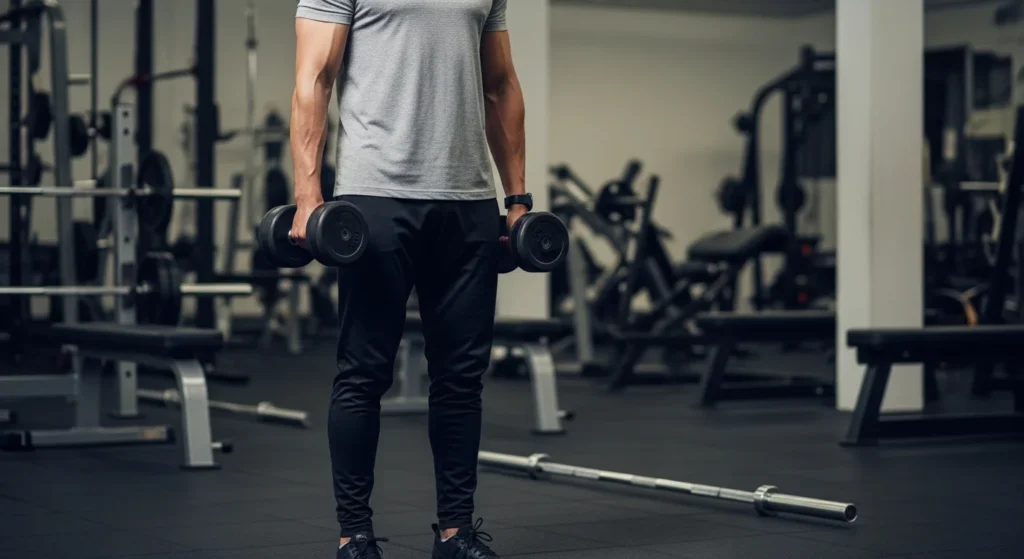
- Stand upright holding a dumbbell in each hand.
- Position your feet hip-width apart.
- Keep your arms relaxed at your sides.
- Engage your core and maintain a neutral spine.
- Slowly rise onto the balls of your feet.
- Pause briefly at the top for maximum contraction.
- Lower your heels back down in a controlled motion.
Maintaining straight knees and smooth, controlled movement is essential for proper activation and safety.
Perfect Form Checklist
Use this quick checklist to ensure every rep counts:
- Keep your chest upright and shoulders relaxed
- Avoid bouncing or using momentum
- Control both the lifting and lowering phases
- Achieve full range of motion (deep stretch and full contraction)
- Focus on mind-muscle connection
Common Mistakes to Avoid
Even a simple exercise can become ineffective with poor execution.
1. Rushing Through Reps
Fast repetitions reduce muscle tension and limit growth.
2. Partial Range of Motion
Stopping halfway eliminates the stretch needed for hypertrophy.
3. Leaning Forward or Backward
Improper posture shifts tension away from the calves.
4. Using Too Much Weight
Excessive load compromises form and increases injury risk.
5. Neglecting the Eccentric Phase
Lowering slowly builds more strength and control.
Best Variations of Calf Raises with Dumbbells
Adding variety ensures complete calf development and prevents plateaus.
1. Seated Dumbbell Calf Raise
- Sit on a bench or chair
- Place dumbbells on your knees
- Raise your heels while keeping knees bent
This variation emphasizes the soleus muscle for deeper calf development.
2. Single-Leg Dumbbell Calf Raise
- Perform the movement on one leg
- Hold a dumbbell in one hand
- Use support if needed
This improves balance and corrects muscle imbalances.
3. Elevated Calf Raises (Step Version)
- Stand on a raised platform or step
- Allow heels to drop below the level of your toes
This increases range of motion and enhances muscle stretch.
4. Farmer’s Walk on Toes
- Walk forward while holding dumbbells
- Stay on your toes throughout
This builds endurance and functional strength.
5. Tempo Calf Raises
- 3 seconds up
- 1 second hold
- 3 seconds down
Slower tempo increases time under tension for hypertrophy.
Standing vs Seated Calf Raises
| Feature | Standing Calf Raise | Seated Calf Raise |
|---|---|---|
| Primary Muscle | Gastrocnemius | Soleus |
| Knee Position | Straight | Bent |
| Goal | Size and shape | Depth and endurance |
| Difficulty | Moderate | Beginner-friendly |
Using both variations ensures balanced calf development.
How to Progress Over Time
Calves adapt quickly, so progression is key.
Progressive Overload Strategies
- Increase dumbbell weight gradually
- Add more repetitions
- Extend time under tension
- Incorporate single-leg variations
- Reduce rest time between sets
Consistency is the most important factor for long-term results.
Sample Dumbbell Calf Workout Plan
Beginner Routine
- Standing calf raises: 3 × 12–15 reps
- Seated calf raises: 2 × 15–20 reps
Intermediate Routine
- Standing calf raises: 4 × 12 reps
- Seated calf raises: 3 × 15 reps
- Single-leg calf raises: 2 × 12 each leg
Advanced Routine
- Heavy standing calf raises: 5 × 8–10 reps
- Seated calf raises (slow tempo): 4 × 15 reps
- Drop sets or supersets for intensity
How Often Should You Train Calves?
Calves recover quickly due to frequent daily use.
- Beginners: 2–3 times per week
- Intermediate: 3–4 times per week
- Advanced: Up to 5 times per week
Allow at least one rest day between intense sessions.
Pro Tips for Maximum Calf Growth
- Train calves at the end of your workout for full focus
- Use full range of motion on every rep
- Pause at the top to maximize contraction
- Stretch your calves after training
- Train both heavy and high-rep ranges
Who Should Do Calf Raises with Dumbbells?
This exercise benefits a wide range of people:
- Beginners building foundational strength
- Athletes improving performance
- Runners reducing injury risk
- Bodybuilders targeting lower-leg aesthetics
- Home gym users needing minimal equipment
Are Dumbbell Calf Raises Enough?
Dumbbell calf raises can be highly effective, especially when combined with:
- Proper programming
- Progressive overload
- Variation in angles and tempo
However, pairing them with other lower-body exercises enhances overall leg development.
Frequently Asked Questions (FAQs)
Are calf raises with dumbbells better than bodyweight?
Yes, adding dumbbells increases resistance, which leads to greater muscle growth and strength gains.
How heavy should dumbbells be?
Choose a weight that allows controlled reps while still challenging your muscles by the final repetition.
Why are calves hard to grow?
Calves are used daily for walking and standing, making them more resistant to growth and requiring higher training volume.
Should I train calves every day?
Daily training is possible for advanced lifters, but most people benefit from 3–4 sessions per week.
Do calf raises help with running?
Yes, stronger calves improve push-off power and running efficiency.
Can beginners do calf raises with dumbbells?
Beginners should start with bodyweight and gradually add dumbbells as strength improves.
Should heels touch the ground between reps?
Allow heels to lower fully for a stretch, but maintain tension rather than resting completely.
What is the best variation for size?
Standing calf raises with heavy dumbbells are best for building visible muscle mass.
Want stronger, more defined legs? Don’t miss these 11 Best Hamstring Exercises With Dumbbells to target your hamstrings effectively at home.