
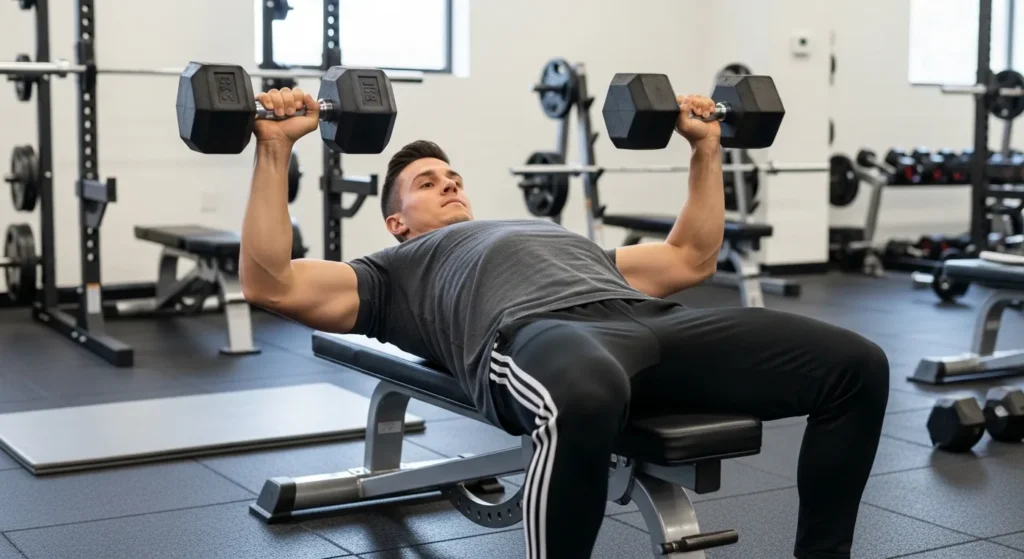
The dumbbell chest press is one of the most effective upper-body exercises for building strength, muscle size, and pushing power. Unlike barbell pressing variations, dumbbells force each arm to work independently, improving muscle balance, coordination, and stability. This added control makes the dumbbell chest press ideal for beginners and advanced lifters alike.
What Is the Dumbbell Chest Press?
The dumbbell chest press is a compound strength exercise performed by pressing two dumbbells upward from chest level while lying on a bench or the floor.
It primarily targets the chest muscles while engaging supporting muscle groups such as the shoulders and triceps.
This movement mimics natural pushing patterns, making it highly functional for everyday strength and athletic performance.
Muscles Worked in the Dumbbell Chest Press
Understanding the muscles activated during the dumbbell chest press helps improve your mind-muscle connection and training efficiency.
Primary Muscles
- Pectoralis Major (Chest): The main muscle responsible for pushing the weights upward
- Anterior Deltoids (Front Shoulders): Assist in lifting and stabilizing the dumbbells
- Triceps Brachii: Extend the elbows during the pressing phase
Secondary Muscles
- Serratus anterior for scapular stability
- Rotator cuff muscles for shoulder support
- Core muscles for maintaining balance and posture
Because multiple muscle groups are involved, the dumbbell chest press is considered a highly efficient compound movement.
Benefits of the Dumbbell Chest Press
1. Builds Chest Size and Strength
This exercise directly targets the pectoral muscles, making it one of the best movements for hypertrophy and strength development.
2. Improves Muscle Balance
Each arm works independently, helping correct strength imbalances that often occur with barbell training.
3. Greater Range of Motion
Dumbbells allow a deeper stretch at the bottom of the movement compared to barbells, leading to better muscle activation.
4. Enhances Stabilization
Your shoulders and core must work harder to control the weights, improving joint stability and coordination.
5. Functional Strength Transfer
The pressing motion translates into real-world activities like pushing doors, lifting objects, and sports performance.
How to Do the Dumbbell Chest Press (Step-by-Step)
Mastering proper form is critical for maximizing results and preventing injury.
Setup
- Lie flat on a bench with your feet firmly planted on the floor
- Hold a dumbbell in each hand with palms facing forward
- Position the dumbbells at chest level, slightly wider than shoulder-width
- Retract your shoulder blades and keep your core engaged
Execution
- Inhale and slowly lower the dumbbells toward your chest
- Keep your elbows at about a 45-degree angle from your torso
- Lower until your elbows reach roughly chest level
- Exhale and press the dumbbells upward until your arms are nearly straight
- Avoid locking your elbows at the top
- Repeat for the desired number of reps
Maintaining controlled movement during both lifting and lowering phases ensures proper muscle activation and reduces injury risk.
Proper Form Tips for Maximum Results
Small adjustments in technique can significantly improve your performance.
- Keep your spine neutral and avoid excessive arching
- Maintain shoulder blade retraction throughout the set
- Keep wrists straight to prevent strain
- Press the dumbbells in a slight arc rather than straight up
- Focus on squeezing your chest at the top
These cues ensure that the chest remains the primary driver of the movement.
Common Dumbbell Chest Press Mistakes (And Fixes)
1. Flaring Elbows Too Wide
This places unnecessary stress on the shoulders and reduces chest activation.
Fix: Keep elbows at about a 45-degree angle.
2. Using Too Much Weight
Heavy weights often compromise form and reduce effectiveness.
Fix: Choose a weight that allows full control and proper technique.
3. Bouncing the Weights
Dropping the dumbbells too quickly eliminates tension from the muscles.
Fix: Lower the weights slowly and with control.
4. Locking Out the Elbows
This shifts tension away from the chest and onto the joints.
Fix: Keep a slight bend at the top.
5. Poor Shoulder Positioning
Loose shoulders increase injury risk.
Fix: Keep shoulders retracted and stable throughout the movement.
Dumbbell Chest Press Variations
Adding variations keeps your workouts effective and targets different parts of the chest.
1. Flat Dumbbell Chest Press
The standard version that targets the middle chest.
2. Incline Dumbbell Chest Press
Performed on an inclined bench to emphasize the upper chest.
3. Decline Dumbbell Chest Press
Targets the lower chest for balanced development.
4. Floor Dumbbell Chest Press
Limits range of motion, making it safer for beginners and those with shoulder issues.
5. Single-Arm Dumbbell Press
Improves core stability and unilateral strength.
6. Neutral Grip Dumbbell Press
Reduces shoulder strain by keeping palms facing each other.
Dumbbell Chest Press vs Barbell Bench Press
| Feature | Dumbbell Chest Press | Barbell Bench Press |
|---|---|---|
| Range of Motion | Greater | Limited |
| Muscle Balance | Improves symmetry | Can create imbalances |
| Stability | Requires more control | More stable |
| Weight Load | Lower | Higher |
Both exercises are effective, but dumbbells provide more functional benefits and joint-friendly movement.
Best Rep Ranges for Different Goals
Muscle Growth (Hypertrophy)
- 8–12 reps
- 3–4 sets
Strength Building
- 4–6 reps
- 4–5 sets
Endurance
- 12–15 reps
- 2–3 sets
Research suggests that sufficient training volume plays a key role in muscle growth, making consistency essential.
Dumbbell Chest Press Workout Plan Example
Beginner Routine
- Dumbbell chest press: 3 sets of 10 reps
- Push-ups: 3 sets of 8–12 reps
- Dumbbell fly: 2 sets of 12 reps
Intermediate Routine
- Flat dumbbell press: 4 sets of 8–10 reps
- Incline dumbbell press: 3 sets of 10 reps
- Chest dips: 3 sets of 8–12 reps
Advanced Routine
- Heavy dumbbell press: 5 sets of 5 reps
- Incline press: 4 sets of 8 reps
- Superset with chest fly: 3 sets
Safety Tips and Injury Prevention
- Always warm up before lifting
- Start with lighter weights to master form
- Avoid lowering dumbbells too deep to protect shoulders
- Use a spotter when lifting heavy
- Stop immediately if you feel sharp pain
Proper technique is essential for long-term progress and injury prevention.
Dumbbell Chest Press for Home Workouts
One of the biggest advantages of this exercise is its versatility.
You only need:
- A pair of dumbbells
- A flat bench or even the floor
This makes it perfect for home gyms and minimal equipment setups.
How Often Should You Do Dumbbell Chest Press?
For optimal results:
- Train chest 2–3 times per week
- Allow at least 48 hours of recovery
- Combine with other upper-body exercises
Consistency is more important than intensity alone.
Pro Tips to Maximize Chest Growth
- Focus on mind-muscle connection
- Control both the eccentric and concentric phases
- Gradually increase weight over time
- Incorporate different angles and variations
- Maintain proper nutrition and protein intake
Frequently Asked Questions (FAQs)
Is the dumbbell chest press better than the barbell bench press?
Both are effective, but dumbbells offer a greater range of motion and improved muscle balance.
Can beginners do the dumbbell chest press?
Yes, beginners can start with light weights or perform the floor variation for safety.
How heavy should I go?
Choose a weight that challenges you while allowing perfect form for all reps.
How many times per week should I train chest?
Training 2–3 times weekly provides optimal results for most individuals.
Why don’t I feel it in my chest?
This usually happens due to poor form or excessive shoulder involvement.
Should my elbows flare out?
No, keeping them at a 45-degree angle is safer and more effective.
Can I do dumbbell chest press without a bench?
Yes, the floor press is a great alternative.
Does this exercise build bigger arms too?
Yes, it engages the triceps, contributing to arm development.
What’s the best tempo?
A controlled 2–3 second lowering phase and a strong press upward works best.
Is it safe for shoulder injuries?
It can be, but modifications like neutral grip or floor press are recommended.
Want to build a stronger core and back together? Learn the proper form in this guide on How to Do Renegade Row to maximize stability, strength, and control.