
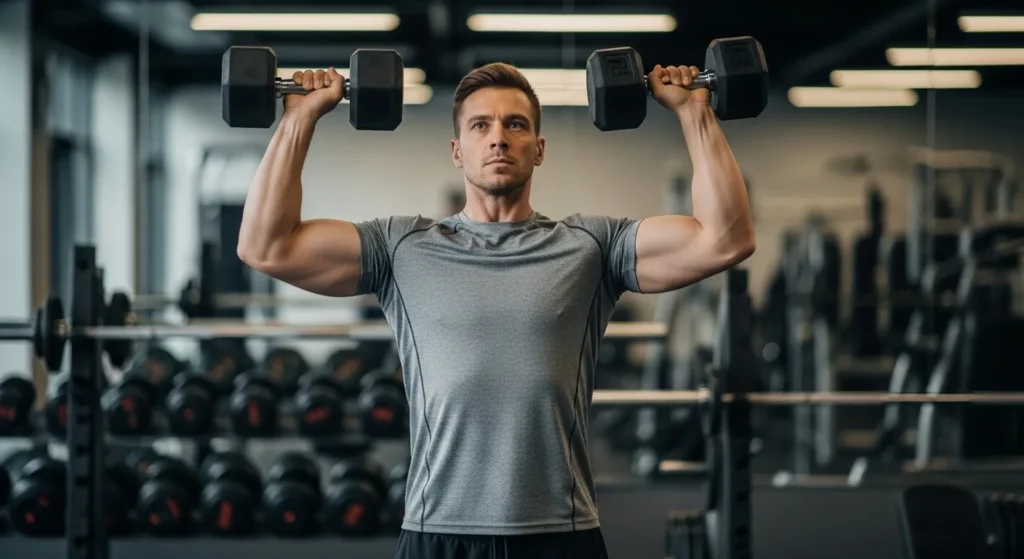
11 Dumbbell Deltoid Exercises for Bigger and Stronger Shoulders

May 5, 2026

deltoid exercises for shoulder workouts

If your shoulders look flat from the front and disappear from the side, the problem usually isn’t effort; it’s exercise selection. Most home lifters do three sets of overhead press, call it a shoulder day, and wonder why their delts never round out.

The best deltoid exercises for shoulder workouts hit all three heads of the muscle because each one responds to a different angle of pull. Skip one, and that’s the part of your shoulder that stays underdeveloped no matter how heavy you press.

What Are the Best Deltoid Exercises?

For a complete shoulder workout, you need at least one exercise per head:

  • Front delts: Seated or standing overhead dumbbell press, Arnold press
  • Side delts: Lateral raise, cable-free lateral raise variations, upright row
  • Rear delts: Bent-over reverse fly, face pulls (with bands), rear delt row

Most people already overtrain the front delts, so the side and rear delts usually need more direct attention.

The 11 Best Deltoid Exercises

1. Seated Dumbbell Overhead Press

Primary muscle: Anterior (front) deltoid, with triceps and upper chest assistance

This is the foundation movement for shoulder strength and one of the best overhead shoulder press variations for building pressing power. Sitting removes the leg drive you’d get standing, which forces the shoulders and triceps to do the actual work.

How to do it:

  1. Sit on a bench with back support, dumbbells at shoulder height, palms facing forward.
  2. Press the dumbbells up and slightly inward until your arms are extended but not locked out.
  3. Lower under control until the dumbbells are level with your ears.

Coaching cue: Keep your ribcage down and avoid arching your lower back to “help” the weight up. If you need to arch hard to finish a rep, the weight is too heavy for that rep range.

Common mistake: Flaring the elbows out to 90 degrees at the bottom. This puts unnecessary stress on the front of the shoulder joint. Keep the upper arms at roughly a 30-45 degree angle from your torso at the bottom position.

Home gym note: This is where adjustable dumbbells show their limits a bit. Loading and unloading plates between sets when you’re moving from a heavy press to a lighter lateral raise takes time. If you’re using a dial-adjustable set, this isn’t an issue — but with plate-loaded adjustables, factor the changeover time into your rest periods.

2. Arnold Press

Primary muscle: Anterior and lateral deltoid, with more rotator cuff involvement than a standard press

The rotation built into this exercise gives the side delt more time under tension compared to a regular overhead press, making it one of the better shoulder exercises for hypertrophy when you want more out of your pressing work.

How to do it:

  1. Start with dumbbells in front of your shoulders, palms facing your body, elbows bent.
  2. As you press up, rotate your wrists so your palms face forward at the top.
  3. Reverse the rotation as you lower back to the start.

Coaching cue: The rotation should happen smoothly through the entire range of motion, not as a separate step before or after the press.

Common mistake: Using too much weight and letting the rotation turn into momentum-driven swinging. If you can’t control the rotation, drop the weight by 10-15% until you can.

Who should use this: Intermediate lifters who’ve built a base of pressing strength with standard overhead presses. Beginners often struggle to coordinate the rotation and end up reinforcing poor pressing mechanics. If you’re new to shoulder training, master the standard seated press first.

3. Dumbbell Lateral Raise

Primary muscle: Lateral (side) deltoid

If there’s one exercise on this list that determines whether your shoulders look “wide” or not, it’s this one. Lateral raises are the most direct lateral raise exercise for wider shoulders because almost nothing else targets the side delt as specifically.

How to do it:

  1. Stand holding dumbbells at your sides, with a slight bend in the elbows.
  2. Raise your arms out to the sides until they’re roughly parallel to the floor.
  3. Lower with control. Don’t let gravity do the negative for you.

Coaching cue: Lead with your elbows, not your hands. Imagine pouring water out of a jug at the top of the movement, wrists tilted slightly down, pinkies slightly higher than thumbs.

Common mistake: Going too heavy and turning the movement into a shrug-and-swing. If your traps are doing most of the work, the weight is too heavy. This is genuinely one of the few exercises where lighter weight with strict form beats heavier weight with sloppy form.

What actually happens in real training: Most people can lateral raise far less than they think their “shoulder strength” should allow, because the side delt is a small muscle working at a poor leverage point. A 15-20 lb dumbbell for strict reps is genuinely hard for most lifters. Ego usually doesn’t survive this exercise, and that’s fine.

4. Bent-Over Reverse Fly

Primary muscle: Posterior (rear) deltoid, with rhomboid and trap involvement

This is one of the most under-trained rear delt exercises despite being simple and equipment-light. Rear delts respond well to higher rep ranges and controlled tempo rather than heavy loads.

How to do it:

  1. Hinge at the hips until your torso is close to parallel with the floor, dumbbells hanging straight down.
  2. Keeping a slight bend in the elbows, raise the dumbbells out to the sides until your arms are roughly in line with your torso.
  3. Squeeze briefly at the top, then lower under control.

Coaching cue: Think about pulling your shoulder blades together at the top, not just lifting your arms.

Common mistake: Standing too upright. If your torso is closer to vertical than horizontal, you’re turning this into a lateral raise variation that barely touches the rear delts.

Home gym limitation: This exercise demands more lower back and hamstring flexibility to hold the bent-over position for multiple sets. If hamstring tightness is an issue, doing this seated is a legitimate substitute that removes the lower back demand entirely.

5. Dumbbell Face Pull

Primary muscle: Posterior deltoid and external rotators

Face pulls for shoulder health are talked about constantly, but they’re a band or cable exercise, not really a dumbbell one. Including a dumbbell-friendly alternative matters here because most home gym setups don’t have a cable stack.

How to do it:

  1. Anchor a resistance band at chest height.
  2. Pull the band toward your face, leading with your elbows, separating your hands as you pull.
  3. Squeeze your shoulder blades together at the end position.

Dumbbell alternative: Bent-over rear delt rows with a wide grip and high elbows mimic the face pull movement pattern closely enough to serve the same purpose if you don’t have a band.

Common mistake: Pulling with the hands and biceps instead of the rear delts and upper back. The elbows should travel up and out, not just back.

Why this matters for shoulder health: This exercise pattern (external rotation, scapular retraction) directly counteracts the rounded-shoulder posture that comes from sitting at a desk and from heavy pressing work. It’s one of the few shoulder mobility exercises that doubles as a shoulder exercise to prevent injury, particularly for anyone doing regular bench press or overhead press work.

6. Cuban Press

Primary muscle: Rotator cuff (external rotators), lateral and posterior deltoid

This is a rotator cuff exercise disguised as a shoulder builder. It combines an upright row, external rotation, and overhead press into one continuous movement.

How to do it:

  1. Start in an upright row position, dumbbells in front of your thighs, pull them up to chest height with elbows leading.
  2. From there, rotate your forearms upward until the dumbbells point toward the ceiling, upper arms staying parallel to the floor.
  3. Press overhead from this position, then reverse the entire sequence back to the start.

Coaching cue: Use light weight, significantly lighter than your lateral raise weight. This is a control and stability exercise, not a load-bearing one.

Common mistake: Rushing through the rotation phase. The external rotation is the entire point of the exercise; skipping it turns this into a sloppy upright row.

Who needs this: Anyone who’s had shoulder impingement issues, does a lot of pressing, or sits at a desk all day with rounded shoulders. This is more of a “shoulder health investment” exercise than a size-builder, and it’s worth including even on lighter or deload weeks.

7. Standing Dumbbell Upright Row

Primary muscle: Lateral deltoid and upper traps

The upright row is a bit divisive — some coaches avoid it entirely because of shoulder impingement concerns at full range of motion. The fix isn’t to skip it; it’s to limit the range.

How to do it:

  1. Hold dumbbells in front of your thighs, palms facing your body.
  2. Pull the dumbbells up along your body, leading with the elbows, stopping when your elbows reach roughly chest height.
  3. Lower with control.

Coaching cue: Stop the movement before the elbows go above shoulder height. Pulling higher than that is where most of the impingement risk comes from.

Common mistake: Pulling the dumbbells too far up and too close to the chin, combined with internally rotated shoulders. If you’ve had any shoulder pain history, this might be one to skip entirely rather than modify — the lateral raise and Cuban press cover similar ground with less joint stress.

8. Incline Bench Rear Delt Raise

Primary muscle: Posterior deltoid

This is essentially the reverse fly, but performed lying face-down on an incline bench instead of bent over standing. For home gyms with an adjustable bench, this is often the better option because it removes the lower back stabilization demand entirely.

How to do it:

  1. Set an adjustable bench to a low incline (around 30 degrees) and lie face-down with your chest against the pad.
  2. Let the dumbbells hang straight down.
  3. Raise them out to the sides in the same motion as a reverse fly, squeezing the shoulder blades at the top.

Coaching cue: Because your torso is fully supported, you can focus entirely on the rear delts without worrying about your lower back or balance.

Common mistake: Using the same weight as standing reverse flys. Removing the stabilization demand means you’ll likely need to go lighter to keep the rear delts as the primary mover rather than the traps.

Home gym consideration: This is a strong argument for an adjustable bench being one of the better shoulder-training investments for a home gym; it opens up this variation along with several others on this list.

9. Front Dumbbell Raise

Primary muscle: Anterior deltoid

Front raises are often skipped because the front delts already get plenty of work from pressing movements. That said, there’s a case for including a small amount of direct front delt work, particularly for shoulder workout programming aimed at overall shoulder development rather than just strength.

How to do it:

  1. Hold dumbbells at your sides, palms facing your thighs.
  2. Raise one or both arms straight in front of you to roughly shoulder height.
  3. Lower with control.

Coaching cue: Keep the movement slow and avoid using momentum from your hips to start the raise.

Common mistake: Including this as a heavy main exercise. Given how much front delt work already happens during pressing, this is best used as a light, high-rep finisher. Many lifters get just as much shoulder development by skipping this entirely and putting that volume toward lateral raises or rear delt work instead.

Honest take: Of all 11 exercises here, this is the one most likely to be unnecessary depending on your program. If your shoulder workout already includes overhead pressing and incline pressing for the chest, your front delts are probably getting enough stimulus without this.

10. Dumbbell Cuban Rotation

Primary muscle: External and internal rotators of the rotator cuff

This is a more isolated rotator cuff exercise than the standing Cuban press, performed lying on your side. It’s a smaller, more clinical movement, but it has a place in shoulder workout programming, especially for injury prevention.

How to do it:

  1. Lie on your side, bottom arm supporting your head, top arm bent 90 degrees at the elbow with the upper arm against your side.
  2. Holding a light dumbbell, rotate your forearm upward (externally rotate) until it points toward the ceiling.
  3. Lower back down with control.

Coaching cue: Use a genuinely lightweight — 2.5 to 5 lbs for most people. This isn’t an exercise where heavier is better; it’s about controlled, repeatable motion through a specific range.

Common mistake: Treating this like a strength exercise and progressively overloading it the same way you would a lateral raise. Rotator cuff work responds better to consistent light volume than to heavy progression.

Who this is for: Lifters dealing with shoulder tightness, minor impingement symptoms, or anyone doing heavy pressing multiple times per week who wants to build in some protective volume. If your shoulders feel fine and you have limited training time, this is one of the more skippable exercises on the list — useful, but not essential for muscle growth.

11. Dumbbell Shrug with Overhead Reach

Primary muscle: Lower traps and posterior deltoid, with scapular stabilizer involvement

The Y-raise is less common than the others on this list, but it fills a gap that most shoulder routines miss entirely: the lower traps and the muscles that control the upward rotation of the shoulder blade.

How to do it:

  1. Hinge forward slightly at the hips, holding light dumbbells.
  2. Raise both arms up and out at roughly a 30-degree angle from your head, forming a “Y” shape with your body.
  3. Focus on rotating the shoulder blades upward as the arms rise, then lower with control.

Coaching cue: This should feel like a very light, controlled movement. If you’re using more than 5-10 lbs per hand, you’re almost certainly using momentum or your upper traps to compensate.

Common mistake: Confusing this with a rear delt raise. The angle and the scapular movement are different; the Y-raise emphasizes upward rotation of the shoulder blade, which most lifters never train directly.

Where this fits: This is a finisher exercise, not a main movement. Two to three sets of 12-15 reps at the end of a shoulder workout, after the heavier pressing and raise work, are enough.

Building a Shoulder Workout from These Exercises

A common mistake is trying to do all 11 exercises in one session. That’s not a shoulder workout; that’s a recipe for soreness that wrecks your next two training days. In real training, a shoulder session usually covers 4-6 of these, rotated across the week if you’re training shoulders more than once.

Example shoulder workout for hypertrophy (beginner to intermediate):

  1. Seated Dumbbell Overhead Press — 3 sets of 6-10 reps
  2. Dumbbell Lateral Raise — 4 sets of 12-15 reps
  3. Bent-Over Reverse Fly (or Incline Rear Delt Raise) — 3 sets of 12-15 reps
  4. Cuban Press — 2 sets of 10-12 reps (lighter weight)
  5. Y-Raise — 2 sets of 12-15 reps

This covers all three deltoid heads, includes one rotator cuff/mobility movement, and stays within a session length that’s realistic to recover from — usually 35-45 minutes including warm-up.

Shoulder Warm-Up Before Any of These

Most people skip this and pay for it later, usually in the form of shoulder impingement or that nagging ache that shows up a day after training. A 5-minute shoulder warm-up before working sets isn’t optional once you’re lifting anything meaningful.

  • Arm circles, both directions, 30 seconds each
  • Band or light dumbbell external rotations, 10-12 reps per side
  • 1-2 light sets of whatever your first exercise is, focusing on the full range of motion

Shoulder Training Volume for Muscle Growth

For most lifters training shoulders directly (separate from how much indirect work they get from chest and back day), somewhere around 10-16 total sets per week across the three deltoid heads tends to produce steady progress without burying you in soreness. That breaks down roughly as:

  • Front delts: 2-4 sets (often already covered by pressing on chest day)
  • Side delts: 6-8 sets — this is usually the priority for visible width
  • Rear delts: 4-6 sets

Beginners should start at the lower end of these ranges. Adding volume too fast is one of the most common reasons people get discouraged with shoulder training. The soreness shows up disproportionately compared to other muscle groups because the deltoids are smaller and recover more slowly relative to their size.

Progressive Overload for Shoulders: What Actually Works

Progressive overload for shoulders doesn’t look the same as it does for bigger muscle groups like legs or back. Once the weight gets heavier on lateral raises and rear delt work specifically, form tends to break down faster than the muscle can actually handle the load — the small stabilizer muscles around the shoulder fatigue before the deltoid does.

What works better in practice:

  • On pressing movements: progress weight in small increments, every 1-2 weeks, in the 6-10 rep range.
  • On raise movements: progress reps first, within a range like 12-15, before adding weight. Once you’re hitting 15 clean reps, add weight and drop back to 12.
  • On rotator cuff/mobility work: don’t chase progressive overload at all. Keep the weight light and consistent — the value is in the movement pattern, not the load.

Common Shoulder Training Mistakes

  • Only training the front delts: Neglecting the side and rear delts can lead to muscle imbalances and underdeveloped shoulders.
  • Using too much weight on raises: Heavy weights often reduce control and shift tension away from the target muscles.
  • Skipping rotator cuff work: Ignoring shoulder stability exercises can increase the risk of injury over time.
  • Training shoulders after chest day: Fatigued front delts can limit performance and recovery during shoulder workouts.
  • Using momentum instead of control: Swinging the weights reduces muscle activation and makes the exercise less effective.

Frequently Asked Questions (FAQs)

How many deltoid exercises should I do per workout?

Four to six is realistic for most people. Covering all three heads (front, side, rear) with one or two exercises each, plus an optional rotator cuff movement, gives you a complete session without excessive soreness.

Can I build wider shoulders with dumbbells only?

Yes. Lateral raises, in particular, are one of the most effective exercises for shoulder width, regardless of whether you’re using dumbbells, cables, or machines. The side delt doesn’t care what equipment creates the resistance; it responds to the angle and tension.

Why do my shoulders feel sore but not “pumped” after lateral raises?

This usually means the weight is too heavy and other muscles are compensating. Drop the weight and focus on a slow, controlled raise to roughly shoulder height. The side delt should feel like it’s working specifically, not your whole upper back.

Is overhead pressing enough for shoulder development?

No, overhead pressing primarily targets the front delts and triceps. Without dedicated lateral raise and rear delt work, the side and back of the shoulders tend to lag noticeably behind the front.

How often should I train my shoulders for muscle growth?

Once or twice per week directly is enough for most people, especially accounting for the indirect shoulder work from chest and back training. Twice per week with lower volume per session tends to work better than one very long session.

Do I need a cable machine for face pulls?

No. A resistance band anchored at chest height works well, or you can substitute bent-over rear delt rows with a wide grip and high elbows, which target a similar movement pattern.

What’s the biggest difference between training shoulders at home vs. at a gym?

The main differences are weight range and exercise variety. A gym cable station makes face pulls and certain raise variations easier, but nearly everything on this list has a dumbbell-based equivalent that works just as well with consistent effort. The bigger limitation at home is usually not having enough lightweight options for raises after using heavier dumbbells for pressing.

Conclusion

Building shoulders that look developed from every angle comes down to giving the side and rear delts the attention they don’t get from pressing alone. None of the 11 exercises here require anything beyond a set of dumbbells, and most don’t even need a bench.

Realistically, you don’t need all 11 in your rotation; pick 5-6 that cover all three heads, keep the raise weights honest, and give it 8-12 weeks before expecting to see a real difference. Shoulders are a slower-responding muscle group for most people, and that’s normal, not a sign the program isn’t working.


To build lower body strength and improve balance, check out this guide on How to Do Dumbbell Lunges?

Keep Reading

Related Articles

Quad Exercises With Dumbbells: 7 Best Moves to Build Bigger, Stronger Legs at Home

July 8, 2026

Gorilla Rows With Dumbbells: The Complete Guide for Better Back Training

July 3, 2026

Sumo Squat with Dumbbells: Proper Form, Benefits, Muscles Worked & Common Mistakes

June 29, 2026

← Back to

Published 

May 5, 2026
Scroll to Top