
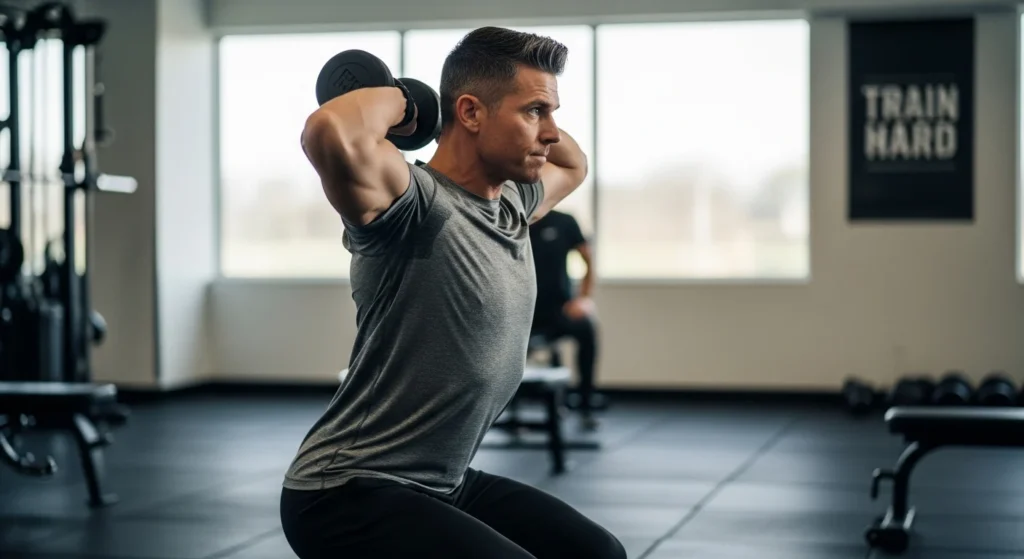
If you want fully developed arms, you cannot rely on biceps alone. The real size and power of your upper arms come from your triceps, and one of the most effective ways to train them is the overhead tricep extension.
This exercise is simple, accessible, and incredibly effective when done correctly. Whether you’re training at home with dumbbells or in the gym, mastering the overhead tricep extension can dramatically improve your arm strength, size, and definition.
What Is the Overhead Tricep Extension?
The overhead tricep extension is an isolation exercise that targets the triceps muscles at the back of your upper arms. Unlike compound movements like bench press or dips, this exercise focuses specifically on elbow extension.
What makes it unique is the overhead position, which places the triceps under a deep stretch—especially the long head. This stretched position leads to better muscle activation and growth potential.
Muscles Worked in Overhead Tricep Extension
Primary Muscle: Triceps Brachii
The triceps consist of three heads:
- Long head (largest, most important for size)
- Lateral head (outer arm definition)
- Medial head (supports elbow extension)
The overhead tricep extension is particularly effective because it targets all three heads, with extra emphasis on the long head due to the overhead stretch.
Secondary Muscles
Although it’s an isolation movement, several stabilizers are involved:
- Core muscles (for balance and posture)
- Posterior deltoids (shoulder stability)
- Anconeus (assists elbow extension)
Key Benefits of Overhead Tricep Extension
1. Maximum Long Head Activation
The overhead position stretches the long head more than other tricep exercises, leading to better hypertrophy.
2. Builds Bigger Arms
Since the triceps make up about two-thirds of your arm size, developing them significantly improves overall arm appearance.
3. Improves Lockout Strength
Stronger triceps help with pressing movements like bench press and shoulder press.
4. Minimal Equipment Required
You only need a single dumbbell, making it perfect for home workouts.
5. Joint-Friendly Movement
Dumbbells allow natural wrist and elbow positioning, reducing strain compared to fixed bars.
How to Do the Overhead Tricep Extension (Step-by-Step)
Setup
- Grab a dumbbell with both hands (holding one end).
- Sit or stand with your feet shoulder-width apart.
- Lift the dumbbell overhead with arms fully extended.
- Keep your core tight and spine neutral.
Execution
- Slowly lower the dumbbell behind your head by bending your elbows.
- Keep your upper arms stationary and close to your head.
- Lower until you feel a deep stretch in your triceps.
- Pause briefly at the bottom.
- Extend your arms back up by contracting your triceps.
- Repeat for desired reps.
Breathing Technique
- Inhale while lowering the weight
- Exhale while extending your arms
Pro Form Tips
- Keep elbows pointing forward—not flared out
- Move only at the elbow joint
- Maintain a slow and controlled tempo
- Avoid locking out aggressively at the top
Common Mistakes and How to Fix Them
Even though the overhead tricep extension looks simple, small mistakes can ruin its effectiveness.
1. Flaring the Elbows
Problem: Reduces tricep tension and increases shoulder strain
Fix: Keep elbows tucked close to your head
2. Using Momentum
Problem: Turns the movement into a swing
Fix: Use lighter weight and slow down the tempo
3. Partial Range of Motion
Problem: Limits muscle growth
Fix: Lower the dumbbell fully to achieve a deep stretch
4. Moving Upper Arms
Problem: Reduces isolation
Fix: Keep upper arms fixed in position
5. Arching the Lower Back
Problem: Increases injury risk
Fix: Engage your core and keep your spine neutral
Best Variations of Overhead Tricep Extension
Adding variation keeps your workouts effective and prevents plateaus.
1. Seated Dumbbell Overhead Tricep Extension
- Provides better stability
- Ideal for beginners
2. Single-Arm Overhead Tricep Extension
- Fixes muscle imbalances
- Improves mind-muscle connection
3. Standing Overhead Tricep Extension
- Engages the core more
- Builds overall stability
4. Cable Overhead Tricep Extension
- Provides constant tension
- Easier on joints
5. Resistance Band Overhead Extension
- Great for home workouts
- Beginner-friendly
Dumbbell vs Cable vs Barbell: Which Is Best?
| Equipment | Pros | Cons |
|---|---|---|
| Dumbbell | Natural movement, accessible | Harder to stabilize |
| Cable | Constant tension | Requires machine |
| Barbell | Heavier loads | Less joint-friendly |
Best choice: Dumbbells for versatility and safety
How to Add Overhead Tricep Extension to Your Workout
For Muscle Growth (Hypertrophy)
- 3–4 sets
- 8–12 reps
- Moderate weight
- Controlled tempo
For Strength
- 4–5 sets
- 5–8 reps
- Heavier weight
- Longer rest periods
Sample Arm Workout
- Dumbbell curls – 3 sets
- Tricep pushdowns – 3 sets
- Overhead tricep extension – 4 sets
- Skull crushers – 3 sets
Expert Tips for Maximum Results
1. Focus on Stretch
The deeper the stretch, the better the long head activation.
2. Use Mind-Muscle Connection
Actively think about your triceps during the movement.
3. Control the Eccentric
Lower the weight slowly (2–3 seconds) for better growth.
4. Choose the Right Weight
Too heavy = bad form
Too light = less stimulus
5. Train Triceps Twice Per Week
Frequency improves growth when combined with proper recovery.
Who Should Do Overhead Tricep Extensions?
This exercise is ideal for:
- Beginners learning isolation exercises
- Intermediate lifters building arm size
- Advanced lifters targeting long head development
- Home workout enthusiasts
Who Should Avoid It?
Avoid or modify if you have:
- Shoulder injuries
- Elbow pain
- Limited overhead mobility
Overhead Tricep Extension vs Other Tricep Exercises
| Exercise | Focus | Best For |
|---|---|---|
| Pushdowns | Lateral head | Isolation |
| Skull crushers | Overall triceps | Strength |
| Dips | Compound | Mass |
| Overhead extension | Long head | Stretch & growth |
The overhead tricep extension stands out because it trains the triceps in a fully stretched position, which many exercises fail to do.
Progression Strategy
To keep improving:
- Increase reps before weight
- Add time under tension
- Use drop sets occasionally
- Incorporate unilateral training
Frequently Asked Questions (FAQs)
Is overhead tricep extension good for beginners?
Yes, it’s beginner-friendly and easy to learn with light weights.
How heavy should I go?
Choose a weight that allows proper form for 8–12 reps without swinging.
Should I do it seated or standing?
Seated is better for stability; standing adds core engagement.
Why do I feel it in my shoulders?
You may be flaring your elbows or using too much weight.
Can I do it every day?
No, train triceps 2–3 times per week to allow recovery.
Is one-arm or two-arm better?
Both are effective; single-arm helps fix imbalances.
Does it build mass or tone?
It builds muscle mass, which improves definition.
What’s the best tempo?
2 seconds down, 1 second up is ideal.
Can I do it at home?
Yes, you only need a dumbbell.
Is it better than pushdowns?
Not better—just different. Both should be included in your routine.
For building chest strength and proper pressing form, check out this guide on How to Do a Dumbbell Bench Press?