
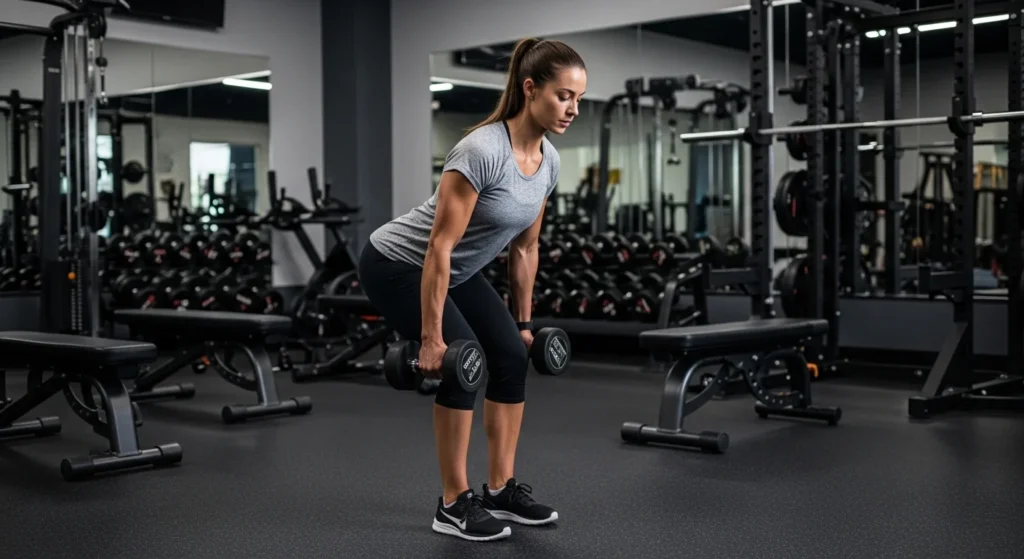
Hamstring exercises with dumbbells are often overlooked, yet ignoring them is one of the fastest ways to create muscle imbalances, weakness, and long-term injury risk.
Your hamstrings are not a secondary muscle group. They play a central role in nearly every lower body movement you perform — from running and jumping to squatting and even walking upstairs.
The good news is that building strong hamstrings does not require machines or complicated setups. With the right approach, hamstring exercises with dumbbells can deliver exceptional results by improving strength, balance, and muscle development.
Why Your Hamstrings Deserve More Attention
The hamstrings are a group of three muscles located on the posterior side of the thigh: the biceps femoris (which has a long head and a short head), the semitendinosus, and the semimembranosus. Together, they originate from the ischial tuberosity of the pelvis and insert below the knee on the tibia and fibula. Because they span both the hip and knee joints, they are classified as biarticular muscles — meaning they influence movement at two joints simultaneously.
Their primary functions include:
- Hip extension — essential for sprinting, jumping, and standing up from a seated position
- Knee flexion — required for walking, running, and decelerating
- Eccentric deceleration — during the late swing phase of running, the hamstrings brake the forward swing of the lower leg, which is also when most hamstring tears occur
- Posterior pelvic tilt — they help stabilize the pelvis and protect the lumbar spine
The quads are naturally stronger than the hamstrings due to their size and weight-bearing load. This creates a natural strength imbalance that, if left unchecked, leads to knee instability and a higher risk of lower body injuries. Training your hamstrings regularly is one of the most important things you can do for long-term leg health and athletic performance.
What Makes a Good Hamstring Exercise With Dumbbells
To fully train the hamstrings with dumbbells, you need exercises that target both of their primary functions: hip extension and knee flexion. Hip-dominant movements like Romanian deadlifts load the hamstrings through a lengthening stretch, producing high levels of time under tension. Knee-dominant movements like leg curls hit the hamstrings at the shortened end of their range.
A well-rounded dumbbell hamstring workout should include both types. Relying only on hip hinge movements is common, but it leaves the knee flexion function undertrained.
The Best Hamstring Exercises With Dumbbells
Hip-Dominant Dumbbell Hamstring Exercises
Dumbbell Romanian Deadlift (RDL)
The Romanian deadlift is widely regarded as the single best exercise for developing the hamstrings. It takes the muscle through a long, controlled stretch on the way down and requires full hip extension at the top, producing a powerful combination of eccentric and concentric loading.
Research shows that RDLs achieve between 75 and 100 percent hamstring activation while also generating 60 to 75 percent peak glute activation, making it one of the most efficient posterior chain movements you can do.
How to perform it:
- Stand with feet hip-width apart, holding a dumbbell in each hand in front of your thighs, palms facing your body.
- Brace your core and keep a slight bend in your knees throughout.
- Push your hips back and hinge forward, keeping your back flat and the dumbbells close to your legs.
- Lower until you feel a strong stretch in your hamstrings — typically just below knee height, or until your back is parallel to the floor.
- Drive your hips forward to return to standing, squeezing your glutes at the top.
Common mistakes: Rounding the lower back, letting the dumbbells drift away from the body, and bending the knees too much (turning it into a squat).
Sets and reps: 3 to 4 sets of 8 to 12 reps. Progressive overload is key — increase weight when you can consistently hit the top of your rep range with good form.
Dumbbell Stiff-Leg Deadlift
A close relative of the RDL, the stiff-leg deadlift takes the hamstrings through a greater range of motion by keeping the knees nearly straight throughout the movement. This increases time under tension and places a longer, deeper stretch on the hamstrings, which is a strong stimulus for hypertrophy.
The trade-off is increased spinal loading. If you have a history of lower back issues or a longer torso, stick with the RDL. For those without these limitations, the stiff-leg deadlift is a highly effective variation to rotate into your program.
How to perform it:
- Hold a single dumbbell with both hands or a dumbbell in each hand.
- Stand tall with feet shoulder-width apart and only the slightest bend in your knees.
- Hinge at the hips, keeping your back straight and core engaged.
- Lower the weight until you feel a deep hamstring stretch, typically to mid-shin level.
- Engage your hamstrings and glutes to reverse the movement and stand back up.
Sets and reps: 3 sets of 10 to 12 reps.
Single-Leg Dumbbell Romanian Deadlift
The single-leg RDL is one of the most valuable but underused dumbbell hamstring exercises. By working one leg at a time, you force each hamstring to work independently, which exposes and corrects strength imbalances between sides. It also demands significant core and hip stability, making it a highly functional movement with excellent carryover to athletic performance and everyday activity.
How to perform it:
- Hold a dumbbell in one hand (the contralateral hand — opposite to the planted foot).
- Stand on one leg with a slight bend in the knee.
- Hinge forward at the hip, letting the dumbbell descend in a straight line toward the floor while your free leg extends behind you.
- Lower until your torso is roughly parallel to the floor.
- Drive through the heel of the planted foot to return to standing.
- Complete all reps on one side before switching.
Tips: Keep your hips square throughout — do not let the hip of the raised leg rotate open. Move slowly and deliberately, and prioritize balance and control over load. 3 sets of 8 to 10 reps per leg.
Dumbbell Good Morning
Good mornings are an underrated posterior chain movement that places a heavy emphasis on the hamstrings, glutes, and lower back. They load the hamstrings primarily in the lengthened position and develop hip hinge mechanics that carry over to all deadlift variations.
How to perform it:
- Hold a dumbbell at chest height or place two dumbbells across your upper back at shoulder level.
- Stand with feet hip-width apart and a slight bend in your knees.
- Hinge forward from the hips, keeping your back flat and chest up.
- Lower until your torso is roughly parallel to the floor and you feel a clear hamstring stretch.
- Squeeze your glutes and drive your hips forward to return to the starting position.
Sets and reps: 3 sets of 10 to 15 reps. Start conservatively on load — this movement places meaningful demand on the lower back.
Dumbbell Deadlift
The conventional dumbbell deadlift differs from the RDL in that you start each rep from the floor. This makes it a true full-body strength movement and one of the most effective compound lifts for the hamstrings, glutes, quads, and back. Because both feet are planted and you can load heavier, it is excellent for building raw posterior chain strength.
How to perform it:
- Set dumbbells just outside your feet on the floor.
- Hinge at the hips and bend the knees enough to reach the handles while keeping your back straight.
- Grip the dumbbells firmly, brace your core, and squeeze your shoulder blades together.
- Drive through the floor to stand, extending your hips and knees simultaneously.
- At the top, stand fully upright with hips locked and glutes squeezed.
- Lower with control back to the start.
Sets and reps: 3 to 5 sets of 5 to 8 reps. This movement responds best to heavier loading and lower rep ranges.
Knee-Flexion Dumbbell Hamstring Exercises
These movements isolate the hamstrings by working the knee flexion function. They complement hip-dominant exercises and ensure the full muscle is developed.
Dumbbell Lying Leg Curl
The dumbbell leg curl is the closest replication of a machine hamstring curl using only a dumbbell. It directly isolates the hamstring muscles through knee flexion with no involvement from the glutes or lower back, making it one of the few true isolation exercises available with a dumbbell.
How to perform it:
- Elevate a flat bench on a step or block if possible — this increases range of motion.
- Lie face down on the bench with your knees at the edge.
- Place a dumbbell between your feet (the flat end resting on the arches), gripping it securely.
- Bending at the knees only, curl the dumbbell upward toward your glutes.
- Raise as far as comfortably possible — ideally past 90 degrees.
- Lower slowly and with full control back to the starting position.
Safety note: Ensure the dumbbell is completely secure before beginning. An adjustable dumbbell with extending bars may not be suitable for this exercise. 3 sets of 12 to 15 reps.
Dumbbell Hip Thrust
While primarily a glute exercise, the hip thrust becomes an effective hamstring movement when foot position is adjusted. Placing your feet slightly further from your body shifts the demand toward the hamstrings, particularly at the top of the movement.
How to perform it:
- Sit with your upper back resting on a bench, knees bent, feet flat on the floor.
- Place a dumbbell on your upper thigh and hold it in position.
- Drive your hips upward until your thighs and torso form a straight line.
- Squeeze your glutes and hamstrings hard at the top.
- Lower your hips with control and repeat.
Tip: To maximize hamstring involvement, place your feet slightly further away than you would for a glute-focused variation. 3 sets of 12 to 15 reps.
Compound Lower Body Exercises That Train the Hamstrings
These movements work the hamstrings significantly alongside other muscle groups. They add training volume and functional strength.
Dumbbell Reverse Lunge
The reverse lunge is a knee-friendly unilateral movement that trains the hamstrings, glutes, and quads while also challenging hip stability. The rear leg in a reverse lunge actively loads the hamstring in a lengthened position, making it a valuable addition to any dumbbell leg workout.
How to perform it:
- Hold a dumbbell in each hand at your sides, standing tall with feet shoulder-width apart.
- Take a controlled step backward, dropping your rear knee toward the floor.
- Keep your front shin as vertical as possible and your torso upright.
- Drive through the front heel to return to standing.
- Complete reps on one leg before switching, or alternate sides.
Sets and reps: 3 sets of 10 to 12 reps per leg.
Dumbbell Bulgarian Split Squat (Hip Hinge Variation)
The standard Bulgarian split squat is quad-dominant. But by changing the torso angle — hinging forward at the hip rather than staying upright — you shift the emphasis significantly toward the hamstrings and glutes. This is sometimes called the Bulgarian hip hinge and is one of the most demanding dumbbell hamstring exercises you can do.
How to perform it:
- Elevate your rear foot on a bench, holding dumbbells at your sides.
- Instead of descending vertically, hinge forward at the hip as you lower.
- Push your glutes back and lower your torso toward a table-top position.
- Feel the stretch in the hamstring of the front leg.
- Drive through the front foot to return to the start.
Sets and reps: 3 sets of 8 to 10 reps per side.
Dumbbell Step-Up
Step-ups are an often overlooked posterior chain exercise. As you press through your heel to step up, the rear leg pulls through your hamstrings to assist in driving your body upward. Using a deliberate, slow tempo maximizes hamstring engagement and minimizes reliance on momentum.
How to perform it:
- Stand in front of a sturdy bench or box, holding dumbbells at your sides.
- Place one foot firmly on the bench.
- Press through the heel of the elevated foot to step up, bringing your other knee to hip height.
- Lower yourself back down with control.
- Complete all reps on one side before switching.
Sets and reps: 3 sets of 10 to 12 reps per leg.
Sample Dumbbell Hamstring Workout
Here is a balanced dumbbell hamstring workout you can use on a dedicated leg day or as part of a lower body session:
| Exercise | Sets | Reps | Rest |
|---|---|---|---|
| Dumbbell Romanian Deadlift | 4 | 8–10 | 90 sec |
| Single-Leg Dumbbell RDL | 3 | 8–10 per leg | 60 sec |
| Dumbbell Reverse Lunge | 3 | 10–12 per leg | 60 sec |
| Dumbbell Lying Leg Curl | 3 | 12–15 | 60 sec |
| Dumbbell Hip Thrust | 3 | 12–15 | 60 sec |
Start with the heaviest, most technically demanding movements first when your nervous system is fresh. Isolation work like the leg curl is best placed at the end of the session.
How to Program Dumbbell Hamstring Training
Training frequency: Training your hamstrings 2 times per week is a reliable starting point for most people. This allows for sufficient recovery while providing enough stimulus for growth and strength improvement.
Volume: Aim for 10 to 20 working sets per week for your hamstrings. Beginners can start at the lower end. More experienced lifters may need more volume to continue progressing.
Progressive overload: This is non-negotiable. Add weight, reps, or sets over time. If you are performing 3 sets of 10 reps with the same dumbbells month after month, your hamstrings will not grow. When you can hit the top of your rep range with clean form across all sets, increase the weight.
Rep ranges: For hypertrophy (muscle growth), 8 to 15 reps per set is a useful target for most exercises. Compound movements like the deadlift respond well to lower rep ranges (5 to 8 reps) with heavier loads. Isolation exercises like the leg curl are often trained more effectively in the 12 to 15 rep range.
Tempo: Slow down the eccentric (lowering) phase of hip hinge movements. A 3-second descent increases time under tension, which is one of the primary drivers of muscle hypertrophy in the hamstrings.
Common Mistakes to Avoid
Rounding the lower back on hip hinge movements. This is the most common error in RDLs and deadlifts. It shifts stress away from the hamstrings and onto the lumbar spine. Brace your core before every rep and think about pushing the floor away rather than lifting the weight up.
Using momentum. Swinging the torso or using a bouncing motion reduces the eccentric demand on the hamstrings, which is exactly where much of the muscle-building stimulus comes from. Slow down.
Neglecting single-leg work. Most people have one hamstring that is stronger than the other. Bilateral exercises mask this imbalance. Including single-leg RDLs or split squat variations exposes and addresses these asymmetries before they develop into injury.
Only doing hip hinge exercises. As noted earlier, the hamstrings have two key functions. Training only hip extension leaves knee flexion underdeveloped. Include at least one knee-flexion movement in every hamstring session.
Going too heavy too soon. The hamstrings are one of the most commonly injured muscles in sport. They respond better to controlled, progressive loading than to sudden increases in weight. Especially when learning the RDL or single-leg deadlift, prioritize form and range of motion over load.
Tips for Maximizing Hamstring Activation With Dumbbells
- Warm up properly. A few sets of bodyweight hip hinges, leg swings, and glute bridges before loading will prepare the hamstrings and reduce injury risk.
- Focus on the stretch. The bottom of a Romanian deadlift is where the hamstrings are under maximum stretch and mechanical tension. Take your time getting there and do not rush through it.
- Drive through the heels. On all hip hinge variations, consciously driving through your heels rather than your toes shifts more load onto the hamstrings and glutes.
- Squeeze at the top. On RDLs, hip thrusts, and deadlifts, fully extend the hips and contract the glutes at the top of each rep. This reinforces the hip extension pattern and ensures full range of motion.
- Mind-muscle connection. Especially on isolation exercises like the leg curl, consciously focusing on feeling the hamstring contract and stretch with each rep significantly improves muscle activation.
Frequently Asked Questions (FAQs)
Can you build hamstrings with just dumbbells?
Yes, absolutely. Dumbbells are highly effective for hamstring development when you use a combination of hip hinge and knee flexion movements with progressive overload.
How often should I train hamstrings with dumbbells?
Training your hamstrings 2 times per week is sufficient for most people. This frequency allows for enough training volume to drive adaptation while giving the muscle group time to recover.
What is the best dumbbell exercise for hamstring isolation?
The dumbbell lying leg curl is the best isolation exercise for the hamstrings using a dumbbell. It targets the hamstrings purely through knee flexion without involving the glutes or lower back.
How heavy should I go on dumbbell hamstring exercises?
The appropriate weight depends on the exercise. For compound movements like the RDL or deadlift, you should be able to complete your target reps with perfect form while feeling genuine fatigue in the last 2 to 3 reps.
Why do my lower back muscles fatigue before my hamstrings on RDLs?
This usually indicates one of two issues: either your lower back is rounding under, or you are not bracing your core sufficiently. Try using lighter dumbbells, slow down the descent, and focus on keeping your spine neutral throughout the movement.
Can hamstring exercises with dumbbells help prevent injury?
Yes. Strong hamstrings are directly associated with reduced risk of hamstring strains, which are among the most common sports injuries.
Should beginners start with the Romanian deadlift or the conventional deadlift?
For most beginners, the Romanian deadlift is a better starting point. Once you are comfortable with the RDL, the conventional deadlift becomes an excellent progression.
How long does it take to see results from dumbbell hamstring training?
With consistent training twice per week and appropriate progressive overload, most people notice meaningful improvements in strength within 4 to 6 weeks. Visible changes in muscle size typically take 8 to 12 weeks of consistent training.
To improve your arm strength and triceps development, check out this guide on How To Do Skull Crushers With Dumbbells.