
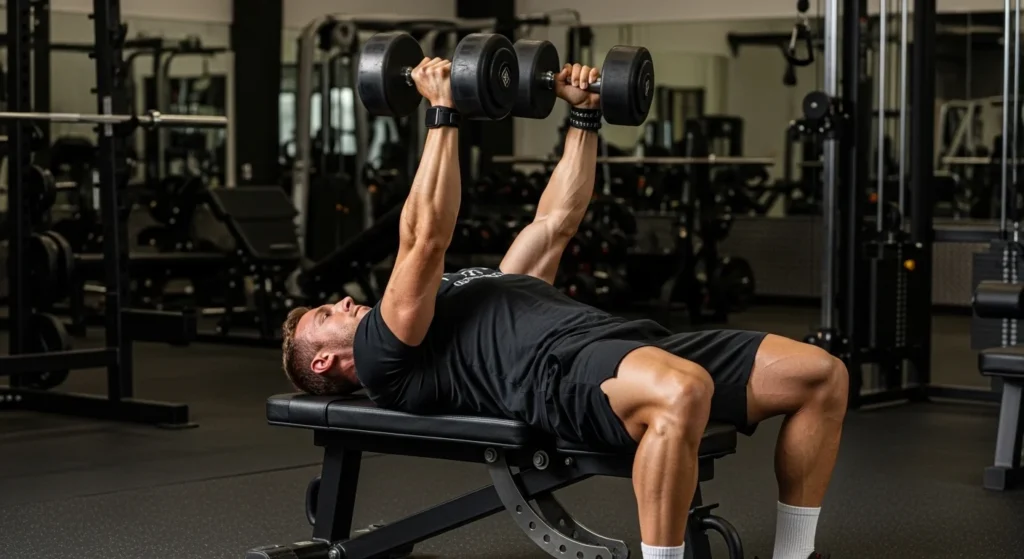
If you’re serious about building stronger, more defined arms, skull crushers with dumbbells should be a staple in your workout routine. Also known as lying triceps extensions, this exercise is one of the most effective ways to directly target all three heads of the triceps for maximum muscle growth and strength.
What Are Skull Crushers With Dumbbells?
Skull crushers with dumbbells are an isolation exercise that primarily targets the triceps—the muscle located at the back of your upper arm. The movement involves lying on a bench and lowering dumbbells toward your head by bending your elbows, then extending your arms back up.
Despite the intimidating name, this exercise is safe and highly effective when performed with proper form.
Alternate Names
- Lying triceps extensions
- Dumbbell skull crushers
- French press
Muscles Worked in Skull Crushers
The primary muscle worked is the triceps brachii, which consists of three heads:
- Long head (largest, contributes most to size)
- Lateral head (outer “horseshoe” shape)
- Medial head (deep stabilizer muscle)
All three heads are activated during the movement, making it a powerful mass-building exercise.
Secondary Muscles Involved
- Shoulders (stabilization)
- Forearms (grip and control)
- Core (for balance and stability)
Benefits of Skull Crushers With Dumbbells
1. Builds Bigger, Stronger Triceps
This exercise isolates the triceps, helping increase muscle size and definition.
2. Improves Pressing Strength
Stronger triceps translate to better performance in:
- Bench press
- Shoulder press
- Push-ups
Research shows targeted triceps work can improve pressing strength.
3. Enhances Muscle Symmetry
Using dumbbells forces each arm to work independently, correcting imbalances.
4. Better Joint Comfort
Compared to barbells, dumbbells allow a more natural wrist angle, reducing strain.
5. Targets the Long Head Effectively
Because your arms are overhead, the long head of the triceps is placed under greater stretch, increasing activation.
How To Do Skull Crushers With Dumbbells (Step-by-Step)
Setup
- Lie flat on a bench with your feet firmly on the ground.
- Hold a dumbbell in each hand.
- Extend your arms straight above your chest (palms facing each other).
Execution
- Keep your upper arms fixed and elbows pointing upward.
- Slowly bend your elbows to lower the dumbbells toward your forehead or just behind your head.
- Pause briefly at the bottom.
- Extend your elbows to return to the starting position.
Recommended Sets & Reps
- Beginners: 3 sets of 10–12 reps
- Intermediate: 3–4 sets of 8–12 reps
- Advanced: 4 sets of 6–10 reps
Proper Form Tips (Expert-Level)
To maximize results and avoid injury:
- Keep elbows tucked (don’t flare outward)
- Move only your forearms—not your upper arms
- Lower the weight slowly and with control
- Avoid locking out elbows aggressively
- Maintain a neutral wrist position
Control is crucial—most injuries occur from dropping the weight too quickly.
Common Mistakes to Avoid
1. Flaring Your Elbows
This reduces triceps activation and increases shoulder strain.
2. Using Too Much Weight
Heavy weights compromise form and increase injury risk.
3. Moving Your Upper Arms
Your shoulders should remain stable throughout.
4. Limited Range of Motion
Not lowering the dumbbells enough reduces effectiveness.
5. Rushing the Movement
Momentum removes tension from the triceps.
Best Variations of Dumbbell Skull Crushers
1. Incline Dumbbell Skull Crushers
- Targets the long head more intensely
- Bench angle: 30–45 degrees
2. Decline Skull Crushers
- Shifts focus to lateral head
- Increases difficulty
3. Single-Arm Skull Crushers
- Fixes muscle imbalances
- Improves mind-muscle connection
4. Floor Skull Crushers
- Safer for beginners
- Limits range of motion slightly
5. Neutral Grip (Hammer Style)
- Easier on wrists and elbows
Dumbbells vs Barbell Skull Crushers
| Feature | Dumbbells | Barbell |
|---|---|---|
| Range of Motion | Greater | Limited |
| Joint Comfort | Better | Moderate |
| Muscle Balance | High | Lower |
| Stability Required | High | Lower |
Dumbbells are generally better for beginners and injury prevention.
Programming Skull Crushers Into Your Routine
For Muscle Growth (Hypertrophy)
- 3–4 sets
- 8–12 reps
- Moderate weight
For Strength
- 4–5 sets
- 5–8 reps
- Heavier weight
Sample Triceps Workout
- Close-grip bench press – 4 sets
- Skull crushers with dumbbells – 3 sets
- Triceps pushdowns – 3 sets
Who Should Do Skull Crushers?
Ideal For:
- Beginners to advanced lifters
- Bodybuilders aiming for arm size
- Athletes needing stronger pushing power
Avoid If:
- You have elbow pain or injury
- You lack control with weights overhead
Safety Tips for Skull Crushers
- Start with light weights
- Always use controlled movement
- Keep wrists straight
- Stop if you feel joint pain
- Consider a spotter for heavy sets
Skull Crushers vs Other Triceps Exercises
| Exercise | Best For |
|---|---|
| Skull Crushers | Isolation & size |
| Triceps Pushdowns | Constant tension |
| Overhead Extensions | Long head focus |
| Dips | Compound strength |
Skull crushers stand out for pure triceps isolation and hypertrophy.
Advanced Tips for Maximum Gains
- Slow eccentric (3–4 seconds lowering)
- Add pause at bottom for extra tension
- Use drop sets for hypertrophy
- Combine with compound presses
Frequently Asked Questions (FAQs)
Are skull crushers with dumbbells effective?
Yes, they are one of the best exercises for building triceps size and strength.
Are skull crushers safe?
Yes, when performed with proper form and controlled movement.
Should I lower the dumbbells to my forehead or behind my head?
Lowering slightly behind your head increases range of motion and triceps activation.
How often should I do skull crushers?
2–3 times per week as part of your triceps training.
Can beginners do skull crushers?
Yes, but start with light weights and focus on form.
What weight should I use?
Choose a weight that allows you to complete reps with proper form.
Are dumbbells better than barbells?
For most people, yes—due to better joint comfort and range of motion.
Why do my elbows hurt during skull crushers?
Likely due to poor form, heavy weight, or lack of warm-up.
Can I do skull crushers at home?
Yes, all you need is a pair of dumbbells and a bench (or floor).
Do skull crushers build arm size fast?
They are highly effective when combined with proper diet and progressive overload.
You can also follow “What Are the Best Adjustable Dumbbells” for dumbbell workouts, and fitness tips to help you get better results.