If you’ve ever finished a leg workout and felt your quads and hamstrings doing all the work while your glutes stayed quiet, the issue isn’t effort — it’s execution and exercise selection.
Most people don’t realize that the glutes require specific loading patterns, angles, and intent to grow effectively. The good news is that you don’t need barbells or machines to fix this. Well-programmed glute exercises with dumbbells can fully develop your glutes when done correctly.
Understanding the Glutes
Your glutes consist of three muscles, each contributing differently:
- Gluteus Maximus: Drives hip extension and gives overall size
- Gluteus Medius: Stabilizes the pelvis and shapes the upper outer glutes
- Gluteus Minimus: Assists with stability and internal rotation
Most lifters overtrain the maximus through squats but neglect the medius and minimus, which leads to underdeveloped upper glutes and poor hip stability.
Effective training means combining:
- Hip hinge movements
- Squat/lunge patterns
- Lateral and unilateral work
Why Dumbbells Work Extremely Well for Glutes
Dumbbells are not a limitation — they are a tool with advantages:
- They allow natural hip movement, reducing compensation
- They make unilateral training easier, fixing imbalances
- They provide enough resistance for hypertrophy in the 8–15 rep range
- They are ideal for home training consistency
When used correctly, they can take you from beginner to advanced without needing anything else.
The 11 Best Glute Exercises With Dumbbells
1. Dumbbell Romanian Deadlift
The Romanian deadlift is the foundation of glute training because it loads the glutes in their lengthened position, which is critical for growth.
To perform it, stand upright holding dumbbells in front of your thighs. Begin the movement by pushing your hips backward rather than bending your knees. As your hips move back, your torso naturally leans forward while your spine remains neutral. Lower the dumbbells close to your legs until you feel a deep stretch in your hamstrings and glutes. From there, drive your hips forward to return to standing, finishing with a strong glute contraction.
What makes this movement effective is continuous tension. The dumbbells never rest on the ground, which forces the glutes to stay engaged throughout the set.
The most common mistake is turning it into a squat by bending the knees too much. When that happens, the quads take over and glute involvement drops significantly.
2. Dumbbell Hip Thrust
The hip thrust targets the glutes in their fully shortened position, complementing the RDL perfectly.
Set your upper back against a bench and place a dumbbell across your hips. With your feet flat and knees bent, drive your hips upward until your body forms a straight line from shoulders to knees. At the top, actively squeeze your glutes for one to two seconds before lowering under control.
This pause at the top is where most of the benefit comes from. Without it, you lose the peak contraction that makes this exercise so effective.
A critical detail here is pelvic positioning. If you arch your lower back at the top, the tension shifts away from the glutes and into the spine. Keeping your ribs down and pelvis slightly tucked ensures the glutes do the work.
3. Dumbbell Bulgarian Split Squat
This is one of the most powerful exercises for building both size and stability.
With your back foot elevated on a bench, lower your body until your front thigh approaches parallel. Keep your torso slightly leaned forward and push through your front heel to stand back up.
The forward lean is intentional. Staying completely upright turns it into a quad-dominant movement, while a slight lean shifts tension to the glutes.
This exercise also exposes imbalances between legs. If one side feels weaker or less stable, that’s exactly why it needs to be trained.
4. Dumbbell Single-Leg Romanian Deadlift
This variation adds a strong balance and stability component.
Stand on one leg while holding a dumbbell, then hinge forward as your free leg extends behind you. Keep your hips square and avoid rotating your body. Lower until your torso is nearly parallel to the ground, then return to standing.
This movement heavily recruits the gluteus medius to stabilize the pelvis, making it essential for both performance and injury prevention.
If balance is difficult, lightly tapping your back foot between reps can help without removing the challenge.
5. Dumbbell Sumo Squat
The sumo squat changes the angle of your hips, increasing glute involvement.
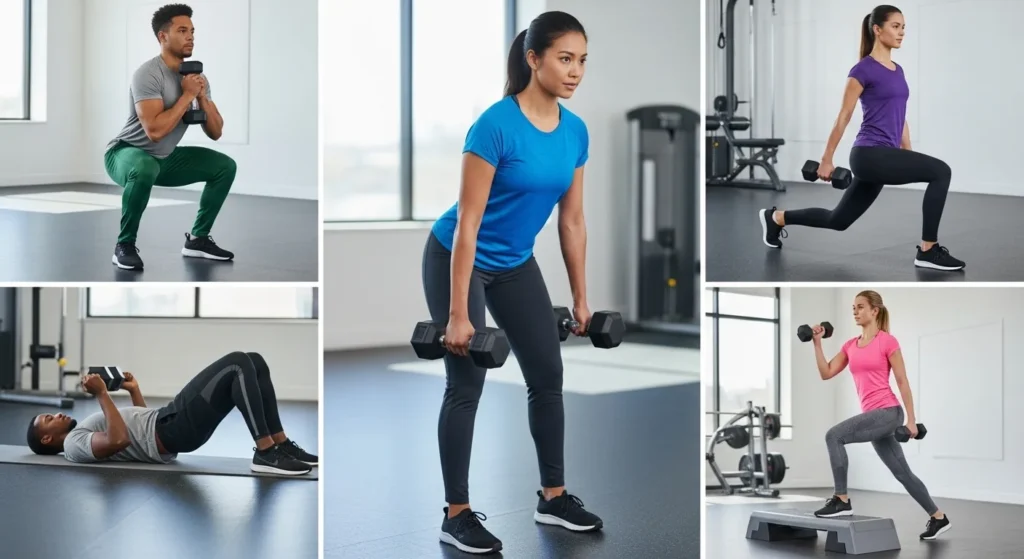
Stand with a wide stance and toes turned outward. Hold a dumbbell between your legs and lower yourself straight down, keeping your chest up and knees pushed outward. Drive through your heels to stand.
This stance activates not only the glutes but also the inner thighs, which assist in hip extension at deeper ranges.
Going deeper in this movement significantly increases its effectiveness.
6. Dumbbell Reverse Lunge
Reverse lunges are more glute-focused than forward lunges due to the mechanics of stepping backward.
Hold dumbbells at your sides and step one leg back into a lunge. Lower until your front thigh is close to parallel, then push through the front heel to return.
A longer step increases glute activation, while a shorter step shifts the load toward the quads.
This movement is also easier on the knees, making it a safer option for many lifters.
7. Dumbbell Step-Up
Step-ups are highly functional and effective when done correctly.
Place one foot on a bench and drive through that heel to lift your body upward. Bring your other foot up without pushing off the ground, then lower slowly.
The key is control. If you use momentum or push off the back leg, you reduce glute engagement.
Adjusting the height of the bench changes the difficulty. A higher platform increases glute involvement.
8. Dumbbell Walking Lunges
Walking lunges create continuous tension and demand stability.
Step forward into a lunge, then bring the back leg forward into the next step. Keep your strides long and controlled to emphasize the glutes.
Because there is no reset between reps, this exercise builds both strength and endurance.
9. Dumbbell Glute Bridge
This is the simplest but most important foundational movement.
Lie flat on your back and place a dumbbell securely on your hips. Drive your hips upward and squeeze your glutes at the top.
Although the range of motion is smaller than a hip thrust, it is excellent for learning proper glute activation and warming up before heavier lifts.
10. Dumbbell Lateral Lunge
Most glute exercises move forward and backward. This one trains side-to-side movement.
Step out to the side and sit your hips back into that leg while keeping the other leg straight. Push back to the starting position.
This directly targets the gluteus medius, which contributes to upper glute development and hip stability.
11. Dumbbell Kickback
This is an isolation exercise designed for maximum contraction.
Position yourself bent forward, holding a dumbbell behind your knee. Drive your leg backward and slightly outward, squeezing your glute at the top.
The diagonal motion aligns better with the natural function of the glutes compared to a straight-back kick.
This exercise works best at the end of a workout with higher reps and strict control.
How to Program These Exercises
A balanced glute workout should include:
- One hinge movement (RDL)
- One thrust/bridge movement
- One unilateral exercise
- One lateral or isolation movement
Sample Workout
- Romanian Deadlift – 4 sets (8–10 reps)
- Hip Thrust – 4 sets (10–12 reps)
- Bulgarian Split Squat – 3 sets (10 each leg)
- Lateral Lunge – 3 sets (12 each)
- Glute Bridge – 2 sets (15–20 reps)
Train this 2–3 times per week with progressive overload.
Key Principles That Drive Results
- Focus on full range of motion
- Control the lowering phase of every rep
- Use weights that challenge you near failure
- Actively squeeze the glutes during each movement
Common Mistakes
- Letting quads dominate every movement
- Using momentum instead of control
- Ignoring unilateral exercises
- Not progressing weight over time
Frequently Asked Questions (FAQs)
Can dumbbells really build glutes?
Yes, especially within hypertrophy rep ranges and proper programming.
Can you grow glutes with dumbbells?
Yes, you can effectively build glutes with dumbbells by applying progressive overload, proper form, and consistent training in the hypertrophy rep range.
Can glute activation help with knee pain?
Yes, proper glute activation improves hip stability and reduces stress on the knees, which can help alleviate certain types of knee pain.
What is the #1 best glute exercise?
The hip thrust is widely considered the most effective glute exercise due to its ability to maximize peak contraction and glute activation.
Do glute exercises help with cellulite?
Glute exercises can improve muscle tone and skin appearance, which may reduce the visible appearance of cellulite over time.
Can weak glutes cause knee problems?
Yes, weak glutes can lead to poor knee alignment and increased joint stress, contributing to knee pain and injury risk.
What is the king of all exercises?
The squat is often called the king of exercises because it targets multiple major muscle groups and builds overall strength.
What are signs of weak glutes?
Common signs include lower back pain, knee discomfort, poor balance, and difficulty activating glutes during exercises.
How to hit all three gluteal muscles?
You need a mix of hip thrusts, hinges, unilateral movements, and lateral exercises to fully target the maximus, medius, and minimus.
What are the biggest mistakes in glute workouts?
The biggest mistakes include poor form, lack of progressive overload, neglecting unilateral work, and letting the quads dominate movements.