Most people start doing bicep curls on day one and then never really revisit how they’re doing them. The movement feels simple, familiar, almost impossible to mess up. But that assumption is exactly why so many lifters spend years curling without seeing much to show for it.
The issue isn’t obvious mistakes or terrible form. It’s small inefficiencies repeated over thousands of reps—elbows drifting forward, tension dropping at the bottom, momentum creeping in as the weight gets heavier. None of it looks wrong at a glance. All of it quietly limits how much your biceps actually have to work. This guide fixes that.
What the Bicep Actually Does and Why It Matters for Your Curl
The biceps brachii has two heads: the long head runs along the outer side of your upper arm, and the short head sits on the inner side. Both originate at the shoulder blade and attach at the radius bone of the forearm.
The bicep does two things: it flexes the elbow and supinates the forearm, rotating it so your palm faces up. That second function is why grip orientation is not a trivial detail during dumbbell bicep curls. It directly determines how much of the muscle gets recruited on every rep.
Underneath the biceps brachii sits the brachialis — a separate muscle that runs from the humerus to the ulna. It is a pure elbow flexor with no involvement in supination, and it contributes to the thickness of your upper arm regardless of grip position. The brachioradialis, a forearm muscle, also gets involved depending on grip angle.
This anatomy explains why different curl variations produce different arm development, and why training with one variation indefinitely is a reliable path to a plateau.
How to Do Dumbbell Bicep Curls Correctly
The Setup
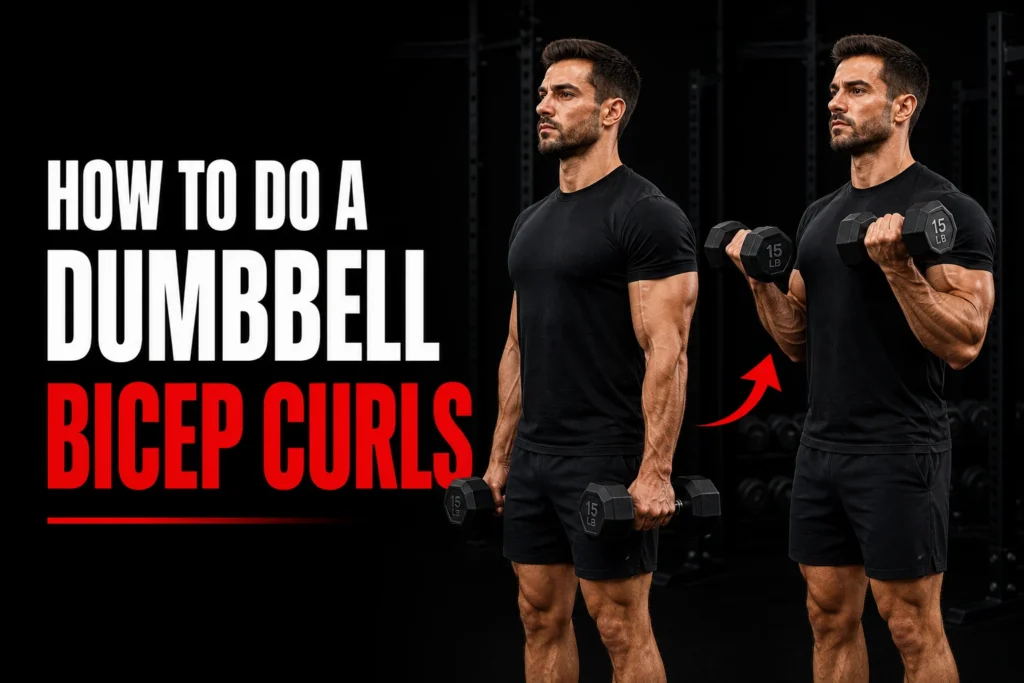
Stand with your feet about hip-width apart. Hold a dumbbell in each hand with your arms hanging at your sides. Palms should face forward before you even begin moving. Starting supinated pre-loads the bicep and puts the muscle under tension from the very first degree of the curl.
Keep your chest up and shoulder blades pulled back slightly. Your elbows should rest just in front of your hips — not clamped rigidly to your ribs, not flared wide. That position creates the most direct line of pull for the muscle.
The Curl: Going Up
Brace your core lightly and begin bending at the elbow. Only the forearm moves. The upper arm stays fixed. Your wrist stays neutral, aligned with your forearm throughout the lift. Do not let the wrist curl upward as you raise the weight. That small compensation shifts load to the forearm flexors, which fatigue faster than the bicep — your set ends before the target muscle is actually done.
Raise the dumbbells until your forearms are roughly vertical and the weights are near shoulder height. At the top, squeeze the bicep deliberately for one second. This isometric hold at peak flexion is where full motor unit recruitment happens. Most people skip it by immediately reversing direction.
The Lowering: Going Down
Take two to three seconds on the way down. Do not rush this. Research on training tempo shows that a slower eccentric phase produces greater increases in muscle cross-sectional area than fast lowering. The eccentric is where a substantial portion of the growth stimulus comes from, particularly for the distal portion of the bicep.
At the bottom, stop just short of fully locking out the elbow. A slight bend keeps constant tension on the muscle and protects the joint from hyperextension stress under load.
Breathing
Exhale as you curl up, inhale as you lower. This keeps intra-abdominal pressure managed and your core braced without overthinking it.
The Muscles Working During Dumbbell Bicep Curls
The primary target is the biceps brachii, with both the long and short head heavily recruited throughout the movement, and supination of the forearm maximizing activation. The brachialis works as a secondary mover — it builds the thickness of the upper arm and cannot be switched off during any elbow flexion exercise regardless of grip. The brachioradialis plays a tertiary role, more active during neutral-grip variations like hammer curls than during standard supinated curls. Your core stabilizers hold you upright and prevent compensatory rocking.
Common Dumbbell Bicep Curl Mistakes
Swinging the Torso
When the torso rocks backward to generate momentum, the front deltoid and lower back take on the lift instead of the bicep. The weight moves, the muscle does not do the work. The fix is dropping to a lighter dumbbell where strict reps are possible and the last two reps of a set feel genuinely hard without the back or hips compensating.
Flaring the Elbows
Elbows drifting forward or outward brings the anterior deltoid into the movement and effectively reduces how much the bicep has to do. Keep the elbows anchored just in front of your hips throughout the entire rep. Some lifters press their upper arms lightly against their torso while learning the pattern until proprioceptive awareness develops.
Cutting the Range of Motion Short
Stopping at 90 degrees, or not fully extending at the bottom, are both range-of-motion mistakes. A 2022 study on bicep training found meaningfully greater hypertrophy in groups training with longer muscle lengths — specifically, getting that full stretch at the bottom. Cutting short is not a time-saver. It is a growth-saver for the muscle.
Flexing the Wrist During the Curl
Curling the wrist upward as the dumbbell rises is a subconscious compensation. It shifts effort to the forearm flexors, which fatigue before the bicep is properly loaded. Hold the wrist in a neutral, straight position and the bicep stays in charge of the movement.
Rushing the Lowering Phase
Dropping the weight back down in half a second wastes the eccentric portion of every rep. The lowering phase creates more mechanical tension than the lifting phase, and mechanical tension drives hypertrophy. Slowing it down is not optional if muscle growth is the goal.
No Mind-Muscle Connection
A 2018 study split participants into two groups — one focused deliberately on feeling the bicep contract, the other did not — and found the attentional-focus group experienced nearly double the bicep growth over eight weeks. Before starting a set, flex the bicep with your arm at your side to establish the neural connection. Maintain that attention throughout.
Dumbbell Bicep Curl Variations
Standard Standing Dumbbell Curl
The baseline. Works both heads through a natural arc, appropriate for any training level, and the correct starting point for anyone building their foundation.
Alternating Dumbbell Curl
One arm at a time. Allows full concentration on each side during its working phase and is useful for developing bilateral awareness of strength differences. Recommended for beginners specifically because it slows down the rep cadence and forces deliberate attention.
Incline Dumbbell Curl
Set a bench to 45–60 degrees and recline against it with your arms hanging straight down behind your torso. This position places the long head in a deep stretch at the start of every rep. Because the body is anchored to the bench, momentum-cheating becomes physically difficult. This variation is one of the best choices for developing bicep peak.
Concentration Curl
Sit on a bench with your feet wide, rest your elbow on your inner thigh, and curl one dumbbell with strict attention on the contraction. The concentration curl removes almost all shoulder involvement and forces pure elbow flexion. It targets the short head more specifically than most variations and is the standard recommendation for correcting size imbalances between arms.
Hammer Curl
Neutral grip — palms facing each other — throughout the entire movement. This shifts emphasis to the brachialis and brachioradialis while still training the bicep. Hammer curls add thickness to the upper arm in a way that supinated curls cannot, because the brachialis physically pushes the bicep upward when developed. If your arms look flat despite regular curling, this is what is missing.
Zottman Curl
Curl up with a supinated grip and rotate to a pronated grip at the top before lowering slowly. The lowering becomes a reverse curl, training the brachioradialis and forearm extensors on the way down. The Zottman curl is one of the most comprehensive single-dumbbell movements for the entire arm and gets far less attention than it deserves.
Cross-Body Curl
Curl one dumbbell across the body toward the opposite shoulder rather than straight up. Some evidence points to a slight long-head advantage over standard alternating curls, and it tends to feel more comfortable for lifters with elbow discomfort during standard variations.
Frequently Asked Questions (FAQs)
How do you do dumbbell bicep curls correctly?
Stand hip-width apart with palms facing forward. Keep elbows anchored just in front of your hips throughout. Curl using elbow flexion only — upper arm stays still. Squeeze hard for one second at the top, then lower the weight slowly over two to three seconds. Stop just short of locking the elbow at the bottom. Keep the wrist neutral throughout and avoid any body swing.
Can I do bicep curls with tendonitis?
During an acute flare, any exercise that provokes pain at the tendon should stop. In the subacute phase, controlled low-load curls can support some people’s tendon recovery. Consult a physical therapist before resuming. The appropriate load and safe exercise selection varies by which tendon is affected and how irritated it is.
Are dumbbell curls good for biceps?
Yes, and they offer specific advantages over barbell curls. Each arm works independently, allowing a natural curling arc and making strength imbalances visible. The dumbbell also permits forearm supination during the lift, maximizing bicep brachii recruitment. The unilateral demand adds stabilizer involvement that barbell curls do not require.
What is the best bicep curl for beginners?
The alternating dumbbell curl. It slows down the rep cadence, forces attention on one arm at a time, and builds the mind-muscle connection that makes all future curl variations more productive. Bilateral (both arms simultaneously) curls are faster, but most beginners benefit from the unilateral focus early on.
What are common bicep curl mistakes?
Swinging the torso, letting the elbows drift, shortening the range of motion, flexing the wrist during the lift, rushing the eccentric, and choosing weight that forces form breakdown. Any one of these individually reduces bicep activation and limits how much growth the exercise produces.
Which part of the bicep curl is most important?
The eccentric — the lowering phase — produces more hypertrophy stimulus than the concentric based on current research. The isometric hold at peak contraction is the second most underused element. Both get rushed by most lifters. Slowing the lowering and adding a deliberate squeeze at the top are the two form corrections with the biggest immediate impact on training quality.
What is the biggest mistake when growing biceps?
Stopping sets too early. Most people end a set when it starts to burn rather than when the muscle genuinely cannot complete another rep with good form. Research on hypertrophy is clear that training within two to three reps of muscular failure is necessary for maximizing the growth stimulus. Stopping at five reps into a set of ten because it becomes uncomfortable is not the same as actually training hard.
What muscle is hardest to grow?
The calves, for most people — predominantly slow-twitch, conditioned by daily walking, requiring very high training volumes and frequency to keep adapting. Forearms present similar resistance. For biceps, the main barrier is not the muscle’s physiology but insufficient training intensity and lack of progressive overload over time.
How do I know if I am doing bicep curls right?
You should feel tension in the upper arm, not the shoulder or forearm, throughout the movement. At the top, the bicep should feel fully contracted and hard. On the way down, you should feel it working against the weight. If you feel nothing in the bicep at all, try pre-activating: flex the bicep hard with your arm at your side before beginning the set. That neural priming makes the muscle significantly easier to feel and control during reps.
What are the best bicep exercises?
For overall size: standard dumbbell curl, incline dumbbell curl, barbell curl. For peak (short head): concentration curl, preacher curl, spider curl. For arm thickness (brachialis): hammer curl, Zottman curl, cross-body curl. Most people benefit from combining one variation that emphasizes stretch (incline), one that emphasizes contraction (concentration), and one that trains the brachialis (hammer) in the same session.
What are 7-7-7 bicep curls?
Also called “21s,” this method divides one extended set into three phases: seven reps in the bottom half of the range, seven in the top half, and seven full-range reps — 21 total without resting. It increases time under tension across the full strength curve of the bicep. The technique is best used as a finisher with lighter weight than your standard curling weight. By the final seven reps, lighter will feel like plenty.
Should bicep curls be fast or slow?
Slow eccentrics (three seconds down) are well-supported by the hypertrophy literature. Moderate concentric speed (two seconds up) works for most muscle-building goals. Very slow concentric lifting does not meaningfully outperform moderate speeds for strength. Fast, explosive lifting has a role for power development but does not accumulate the time under tension needed for hypertrophy. If bigger arms are the goal, make the lowering slow and deliberate.
In conclusion
Dumbbell bicep curls are a simple exercise made significantly less effective by a handful of specific errors: elbows drifting, wrist flexing, eccentric rushed, peak contraction skipped, weight too heavy for strict form. Address those and the exercise becomes genuinely different from what most gym-goers are currently doing.
Add variation across a training cycle — incline curls for stretch, concentration curls for peak, hammer curls for thickness — and you cover all the angles of arm development without needing complicated programming. Pick the right variations, train close to failure, track your weights and reps, and progress the load over time. The bicep responds to that. It does not respond to going through the motions indefinitely with the same dumbbells.
Most people who are unhappy with their arm development are not doing the wrong exercises. They are doing the right exercises badly, or not hard enough, or without any progressive overload. That is actually good news, because all three of those problems have straightforward fixes.
Want your weights to last for years? Check out Maintaining Your Adjustable Dumbbells for simple care tips, cleaning steps, and ways to keep your equipment working smoothly.