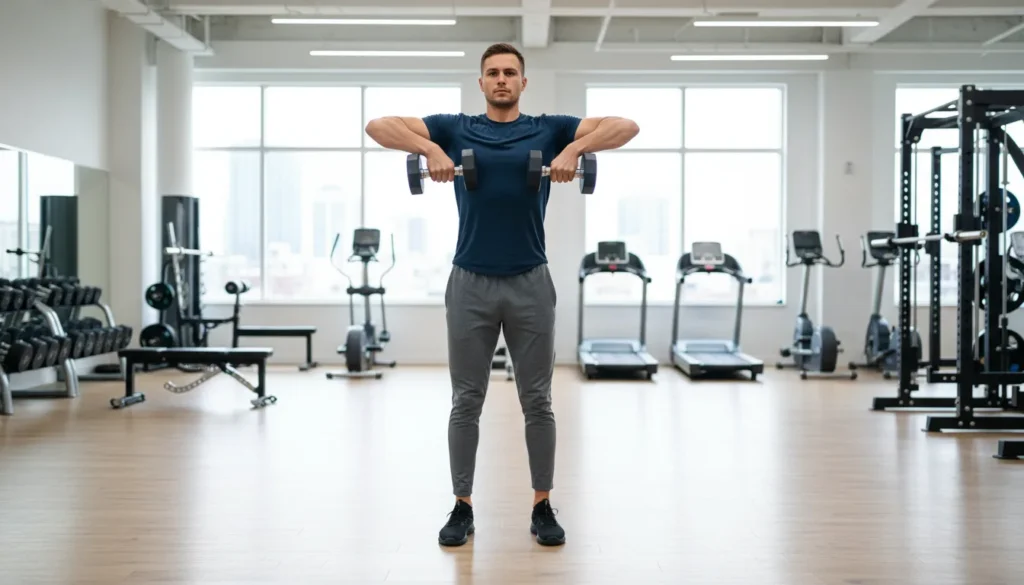
Most shoulder exercises get one thing right and ignore everything else. Lateral raises isolate the side delts well but offer no trap involvement. Overhead presses build pressing strength but skip the lateral head almost entirely. Dumbbell upright rows, done correctly, hit both in a single movement — which is exactly why they’ve stuck around in serious training programs for decades, despite the controversy that follows them.
That controversy deserves to be addressed upfront, not buried in a footnote. The upright row has a reputation for wrecking shoulders, and in certain situations, that reputation is earned. Narrow grip, pulling too high, too much weight, no warmup — those are genuine recipes for shoulder impingement. The dumbbell variation with a proper grip width and a controlled range of motion is, in practice, a different exercise from the one coaches warn you about. This guide breaks down how to tell the difference.
What Are Dumbbell Upright Rows?
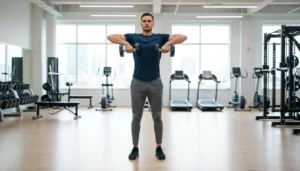
The dumbbell upright row is a compound pulling exercise performed in a standing position. You hold a dumbbell in each hand in front of your hips, then drive your elbows up and out until your upper arms reach roughly shoulder height, keeping the weights close to your body throughout.
It trains the deltoids and trapezius simultaneously, which makes it one of the few free-weight movements that can develop the shoulder’s lateral head and upper traps in the same set. The compound nature also recruits the biceps and brachialis as synergists, and your core works hard to keep your torso from swinging.
Unlike the barbell version, dumbbells allow each wrist and shoulder to move independently through their natural arc. That freedom is not a small thing — it means you can adjust hand position on the fly if a particular range of motion causes discomfort, and you can develop both sides equally rather than compensating for a dominant arm.
Muscles Worked
Primary muscles: The lateral deltoid, the outer portion of your shoulder, does the bulk of the work in elevating your arm during an upright row. Most people who do this exercise are chasing shoulder width, and this is the muscle responsible for it. The anterior (front) deltoid assists depending on grip width — narrower grips bring the front delt in more, while wider grips shift emphasis toward the lateral head. The upper trapezius elevates the scapula and contributes significantly to the shrug-like top portion of the movement.
Secondary and stabilizing muscles: The biceps brachii and brachialis flex the elbow as you pull the weight upward. Your rhomboids and mid-traps work to keep the shoulder blades from flaring forward. The forearms maintain grip throughout the set. And your core — specifically the obliques and erector spinae — resists the rotational and forward pull of the dumbbells to keep your spine neutral.
How to Do Dumbbell Upright Rows: Step-by-Step
Starting Position
Stand with feet hip-width apart, a slight bend in your knees. Hold a dumbbell in each hand with an overhand grip, palms facing your body, arms hanging in front of your thighs. Pull your shoulder blades back and down before you begin — not aggressively squeezed together, just set. Brace your core as if you’re about to take a punch.
Your grip width should be roughly shoulder-width or slightly wider. This is non-negotiable for shoulder safety. A narrow grip forces the shoulder into internal rotation as you elevate the arm, and that internal rotation at the top of the range is where impingement happens.
The Pull
Inhale at the start. As you exhale, initiate the movement by driving your elbows upward and outward — not your hands. Think of your elbows leading the dumbbells rather than your wrists pulling them. The dumbbells stay close to your body throughout, tracking up the front of your torso.
Stop when your elbows reach shoulder height. This is the critical cutoff. Research published in the Journal of Strength and Conditioning Research found that impingement in the shoulder joint typically occurs between 70 and 120 degrees of arm elevation — stopping at parallel keeps most people well below that threshold. Going above shoulder height, especially with a narrower grip, compresses the subacromial space. It adds nothing useful and meaningfully increases injury risk.
At the top, your elbows are slightly higher than your hands, your upper arms are parallel to the floor, and the dumbbells are at roughly collarbone or lower chest height. Pause for a moment and actively squeeze the upper back musculature.
The Lowering Phase
Lower the dumbbells with control over two seconds. Resist the temptation to drop them quickly — the eccentric phase builds muscle and trains the joint to handle load in a lengthened position. Return fully to the starting hang before beginning the next rep.
The Grip Width Debate: Narrow vs. Wide
This single variable changes the exercise significantly — in terms of both muscle emphasis and shoulder stress.
A narrow grip (hands closer than shoulder width) increases the demand on the upper traps and front deltoid. It also forces the shoulder into greater internal rotation at the top of the pull, which is exactly what crowds the rotator cuff tendons. If you see someone doing upright rows that look like they’re pulling the weight toward their chin with elbows pointing straight up, that’s the narrow version — and it’s the version most frequently associated with shoulder complaints.
A shoulder-width to slightly wider grip shifts more emphasis onto the lateral deltoid, which is usually the reason people include upright rows in their program to begin with. It also allows the shoulder to maintain a more neutral position at the top of the range, reducing subacromial compression.
For most lifters, a shoulder-width grip with the elbow-stop at parallel is the version to run. If you have prior shoulder issues or feel discomfort even with a wider grip, dumbbells and cables are more forgiving than a fixed barbell because they allow your hands to drift into whatever position your shoulder anatomy actually prefers.
Common Mistakes That Undermine the Exercise
Pulling Too High
Raising the dumbbells past collarbone height — especially pulling them toward your chin — is the single fastest way to aggravate a shoulder doing this exercise. The subacromial space narrows as the arm elevates above 90 degrees, and a narrow grip makes this worse. Stop at shoulder height, feel the contraction, and come back down.
Using Momentum
Swinging the torso backward or using hip drive to heave the weights upward removes load from the shoulders and traps and transfers it to the lower back. The moment you start jerking reps, you’ve either gone too heavy or too fatigued to continue with effective technique. Drop the weight before you start compensating.
Shrugging the Shoulders Up
Many people unconsciously raise their shoulders toward their ears as they lift. That shrug shortens the neck and eliminates the shoulder blade control that keeps this exercise safe. Focus on keeping your shoulder blades set and back throughout — down and back, not pinched together, just stable.
Wrists Breaking Forward
If your wrists bend forward under the load, the forearms are absorbing tension that should be in the delts and traps. Keep the wrist in neutral alignment with the forearm throughout the set. If you can’t manage this at a given weight, reduce the load.
Neglecting the Eccentric
A lot of lifters treat the upward pull as the only work and let the dumbbells fall back to the start. The lowering phase is where a significant portion of muscle damage and adaptation occurs. Two-second negatives on each rep make the exercise considerably more effective.
Dumbbell Upright Row Variations
Single-Arm Dumbbell Upright Row
Performing the exercise one arm at a time exposes any strength discrepancy between sides immediately. It also forces greater core engagement because the offset load pulls your torso toward the working side and your obliques have to resist that. Extend your free arm out to the side for balance. Match rep counts side to side and always start with the weaker arm.
Wide-Grip Upright Row
Taking your hands wider than shoulder-width further reduces internal rotation demand and shifts more emphasis to the lateral deltoid. This version is particularly useful for people with any history of shoulder impingement because the mechanics are more forgiving. The trade-off is slightly less upper trap involvement, but for most people building shoulder width, that’s an acceptable exchange.
Dumbbell Upright Row to Squat Combo
At the bottom of each rep, before pulling, add a squat. You add glute and quad work without extending the session length, and the lower body drive can be used to learn the rhythm of the pull before isolating it. This combo also works well in metabolic circuits.
Dumbbell Upright Row to Overhead Press
At the top of the upright row, instead of lowering, press the dumbbells overhead. This turns a two-muscle movement into a full shoulder circuit in one fluid exercise. It demands good shoulder mobility and a solid foundation in both movements before attempting, but it creates significant time-under-tension for the deltoid complex.
Dumbbell vs. Barbell Upright Row: Which Should You Choose?
Both versions train the same muscles through the same basic movement pattern. The practical differences come down to joint mechanics, equipment access, and individual anatomy.
A barbell fixes your grip. Your hands stay in one position throughout the rep, and if that position doesn’t suit your wrist or shoulder anatomy, you feel it. Barbells also typically allow you to load more total weight, which matters if you’re chasing trap and shoulder strength specifically.
Dumbbells give each arm freedom to move independently. Your hands can rotate slightly, your wrists can adjust, and if one shoulder needs a slightly different arc than the other, it can take it. This makes the dumbbell version considerably more shoulder-friendly for people with wrist or rotator cuff sensitivity. Dumbbells also reveal and address side-to-side strength imbalances in a way a barbell simply can’t.
For most recreational lifters, the dumbbell version is the smarter default. It offers the same muscle development with less joint stress and more room to self-correct.
How to Program Dumbbell Upright Rows
Sets and Reps by Goal
For hypertrophy (muscle growth), three to four sets of 10–15 reps works well. The deltoids and traps respond well to moderate rep ranges with controlled tempo, particularly on the eccentric phase. Use a weight that makes the last two or three reps genuinely challenging while still allowing full form.
For strength, four to five sets of 6–8 reps with heavier loads applies. Keep in mind that ego-lifting on upright rows is particularly unforgiving — the shoulder mechanics leave little room for the form breakdown that heavier loads tend to cause. Use lifting straps if grip is limiting you before the target muscles are fatigued.
For beginners, three sets of 10–12 reps is a straightforward starting point. Focus entirely on mechanics for the first few weeks. Progress weight only when you can complete all reps with the elbow-at-parallel rule maintained.
Placement in Your Workout
Dumbbell upright rows work best early in a shoulder or upper back session, after a thorough warmup but before isolation work. They’re too demanding on the shoulder joint to be relegated to the end of a session when the stabilizers are already fatigued.
Pair them effectively with: overhead press (perform the press before upright rows), face pulls, lateral raises, and rear delt work. This creates a complete shoulder session that covers all three deltoid heads and the upper traps without redundancy.
Rest and Recovery
Allow 48 to 72 hours before training the same muscle groups again. The deltoids and traps are involved in a wide range of upper body movements, so cumulative fatigue accumulates faster than with larger muscle groups like the back or legs.
The Shoulder Impingement Question: An Honest Assessment
The concern around upright rows is not manufactured by overly cautious trainers. Shoulder impingement syndrome (SIS) is a real condition where the supraspinatus tendon and subacromial bursa get compressed between the humeral head and the acromion during shoulder elevation. The upright row can create this problem specifically when performed with a narrow grip, pulled above chin height, with excessive internal rotation, especially under heavy loads.
The dumbbell wide-grip version pulled to shoulder height is, from a biomechanics standpoint, a substantially different exercise from the narrow-grip barbell pull-to-chin version. Grip width affects how much internal rotation the shoulder undergoes at the top of the lift, and research in the Journal of Strength and Conditioning Research confirms that wider grips reduce subacromial stress considerably.
That said, no modification makes upright rows risk-free for everyone. People with pre-existing rotator cuff tears, AC joint injuries, or significantly limited shoulder mobility should consult a physical therapist or sports medicine physician before including this exercise. And anyone who feels a pinching sensation — not muscular fatigue, but an actual joint pinch — should stop immediately and investigate the cause before returning to the movement.
If you’re uncertain whether the exercise is appropriate for you, the face pull and dumbbell lateral raise accomplish much of the same work without the impingement risk.
Effective Alternatives to Dumbbell Upright Rows
Sometimes the right answer is to train around a problem rather than through it. These exercises cover the same muscle territory with less shoulder joint stress.
Cable Face Pull: Trains the rear deltoid, lateral deltoid, and upper traps with the shoulder in a much safer mechanical position. Attach a rope to a high pulley, grip with a neutral hold, and pull toward your face with elbows flaring out to the sides. This is an excellent staple for shoulder health and should probably be in every lifter’s program regardless of whether they do upright rows.
Dumbbell Lateral Raise: The go-to isolation movement for the lateral deltoid. While it lacks the trap involvement of the upright row, it eliminates impingement risk entirely when performed with correct form and appropriate load. Keep a slight bend in the elbow, lead with the pinky-side of the hand, and stop at shoulder height.
Dumbbell Shrug: If the goal is upper trap development specifically, shrugs train that muscle directly without involving the shoulder joint in a compromised position. Hold heavy dumbbells at your sides and elevate the shoulders straight up toward the ears.
Cable Lateral Raise: Provides continuous tension through the entire range of motion, unlike dumbbells which lose tension at the bottom. This makes it particularly effective for developing the lateral deltoid when combined with a slow eccentric.
Single-Arm Dumbbell Power Snatch: For lifters interested in athletic power development rather than strict hypertrophy, the power snatch trains the same elbow-high pulling pattern explosively with lower body drive. The movement arc resembles the upright row at the mid-point, and it develops total-body coordination alongside trap and delt strength.
Warming Up Properly Before Upright Rows
The shoulder is a complex, relatively unstable joint. Going into upright rows cold is asking for problems.
A solid warmup takes five to eight minutes and targets mobility before loading. Start with arm circles, both forward and backward, ten to fifteen in each direction. Follow with band pull-aparts to activate the rear deltoids and scapular retractors. Wall slides — standing with your back against a wall, arms in a W position, then sliding them overhead — open the shoulder into the range you’ll use during the exercise. A few light sets of lateral raises before your first work set of upright rows primes the lateral deltoid and tells you quickly if anything feels off.
If any position during the warmup causes a pinching sensation rather than a stretch or muscle activation, that’s useful information before you pick up heavier dumbbells.
Frequently Asked Questions (FAQs)
Are dumbbell upright rows safe for beginners?
Yes, with important conditions. Beginners should start with light dumbbells, prioritize a shoulder-width grip, and stop the pull at shoulder height rather than pulling toward the chin. Learning the elbow-leading pattern before adding load is the critical first step. A few weeks of practice with minimal weight builds the neuromuscular pattern that makes heavier loads safer later.
How heavy should I go on dumbbell upright rows?
Start light enough to complete every rep with the elbow-at-parallel rule intact and no shoulder shrugging. For general reference, beginners often start in the 5–15 lb range for women and 10–20 lb range for men. Intermediate lifters typically work in the 15–30 lb range. The right weight is one that makes the final two reps of a set challenging without causing form breakdown or joint discomfort.
Should I do upright rows if I have shoulder impingement?
Not without clearance from a physical therapist or sports medicine doctor. Active shoulder impingement is a contraindication for upright rows in most presentations. Once the impingement is addressed and mobility restored, the wide-grip dumbbell variation may be reintroduced gradually under guidance — but it should not be pushed through pain.
How are dumbbell upright rows different from lateral raises?
Lateral raises isolate the lateral deltoid without significant trap involvement and with the arm moving in the frontal plane. Upright rows are a compound movement that also trains the upper traps, front deltoid, and biceps with a different pulling mechanic. They serve different purposes and work well together in the same session.
Can I do upright rows every shoulder session?
Two times per week is a reasonable upper limit for most people. The deltoids and traps recover reasonably quickly, but the shoulder joint itself accumulates stress under repeated load. Varying between upright rows and alternatives like face pulls across sessions distributes that stress.
Why do my wrists hurt during dumbbell upright rows?
Wrist pain usually means the wrists are bending under load rather than staying neutral, or the grip is too narrow. Widen your grip, lighten the weight, and consciously keep the wrist in alignment with the forearm. Dumbbells are more forgiving than a straight barbell in this regard because they allow the wrists to rotate into a slightly more comfortable position.
Do dumbbell upright rows build a V-taper?
The lateral deltoid is the primary muscle responsible for shoulder width, and upright rows train it directly. Well-developed lateral delts visually widen the shoulder-to-waist ratio, which is the foundation of the V-taper. They won’t do the job alone — lats, rear delts, and trap development all contribute — but they’re a useful piece of that structure.
What grip should I use — overhand or neutral?
Standard upright rows use an overhand grip (palms facing your body at the start). Dumbbells naturally allow a slight rotation toward neutral as you pull, which many lifters find more comfortable at the shoulder. Kettlebells can also be used for a similar neutral-ish grip at the top. Both are acceptable as long as the elbow height and range of motion rules are respected.
In conclusion
Dumbbell upright rows are not the shoulder-destroyer they’re sometimes made out to be — and they’re not a shortcut to capped delts either. Done with a shoulder-width grip, a controlled stop at elbow-parallel, and appropriate load, they’re a useful compound movement for the lateral deltoid and upper traps at the same time.
The version worth avoiding is the narrow-grip, chin-height pull with maximum weight. That version earns every bit of its bad reputation. The version described in this guide — wider hands, elbow stop at shoulder height, proper warmup — is functionally a different exercise.
Healthy shoulders and good form? Upright rows belong in your rotation. Existing rotator cuff problems or an AC joint that’s already been through it? Face pulls and lateral raises cover the same ground without the compromise. Either way, knowing what actually fires during a movement, which positions create risk, and how to adjust for your own anatomy will take you further than copying a pattern you don’t fully understand.
Want to build a stronger chest and improve pressing power at home? Learn the proper technique in this guide on How to Do Dumbbell Floor Press to maximize strength and control safely.