Your upper back is probably the most undertrained part of your body. Not because you skip it on purpose — more that it is easy to ignore muscles you cannot see, and most people gravitate toward what shows up in the mirror muscles first. Add in eight or ten hours of sitting hunched over a screen, and you end up with shoulders that have slowly crept forward, a stiff thoracic spine, and a neck that is doing work it was never designed to do.
The muscles you need to fix this are the rhomboids, the middle and lower trapezius, the rear deltoids, and the teres major. They are not glamorous. They do not get their own dedicated day in most workout programs. But once you start training them properly with a pair of dumbbells, the payoff is faster than you would expect.
What You Are Actually Training When You Work Your Upper Back
The Trapezius
The trapezius is a large diamond-shaped muscle covering most of your upper and mid-back. It has three distinct sections, each doing something different. The upper traps elevate your shoulders — the shrugging motion. The middle traps retract your shoulder blades, pulling them toward your spine. The lower traps pull the shoulder blades down and stabilize them during overhead movements.
Here is the problem most people have: years of stress, heavy lifting, and bad posture overdevelop the upper traps while the middle and lower portions stay chronically weak. That imbalance is a big part of why people get that tense, elevated shoulder look even when they are trying to relax.
The Rhomboids
The rhomboids sit underneath the trapezius and run diagonally between your thoracic spine and the inner edge of each shoulder blade. Their main function is scapular retraction — drawing your shoulder blades back toward each other. When they are weak, your shoulders roll forward and your upper back rounds. Research published in the Journal of Physical Therapy Science confirms that rounded shoulder posture directly involves inhibited scapular retractors, with the rhomboids as primary targets for correction.
The Rear Deltoids
Technically part of the shoulder, the rear delts are trained almost entirely in the context of upper back work. They assist with horizontal abduction — the reverse fly motion — and help keep the head of the humerus centered in the shoulder socket. Neglect them long enough, and the anterior-to-posterior shoulder imbalance becomes visible even when you are just standing still.
The Teres Major and Minor
These two muscles run along the outer edge of the shoulder blade. The teres major assists the lats in pulling the arm down and back. The teres minor — a rotator cuff muscle — handles external rotation of the humerus. Both light up during rows and pullovers, and building them improves shoulder stability in a way that protecting the joint during bench pressing cannot.
Why Dumbbells Are Worth Taking Seriously for Upper Back Training
Cables and machines are effective. But dismissing dumbbells as a second-best option is a mistake, especially for upper back work.
They fix imbalances that bilateral exercises hide. With a barbell row or cable row, your stronger side compensates for your weaker side automatically. Over months and years, the gap widens without you noticing. A single-arm dumbbell row forces each side to do equal work, every session.
They allow a fuller range of motion. At the bottom of a dumbbell row, the weight hangs freely and your shoulder blade can fully protract. That full stretch before the pull is where a lot of the training stimulus comes from. A barbell stops when it hits your torso; the dumbbell keeps going.
They recruit more stabilizing muscles. Because the load is not guided by a machine or a fixed bar, your stabilizers have to control each rep. Studies show dumbbell exercises recruit roughly 20–30% more stabilizer activity than machine equivalents, which produces better functional strength over time.
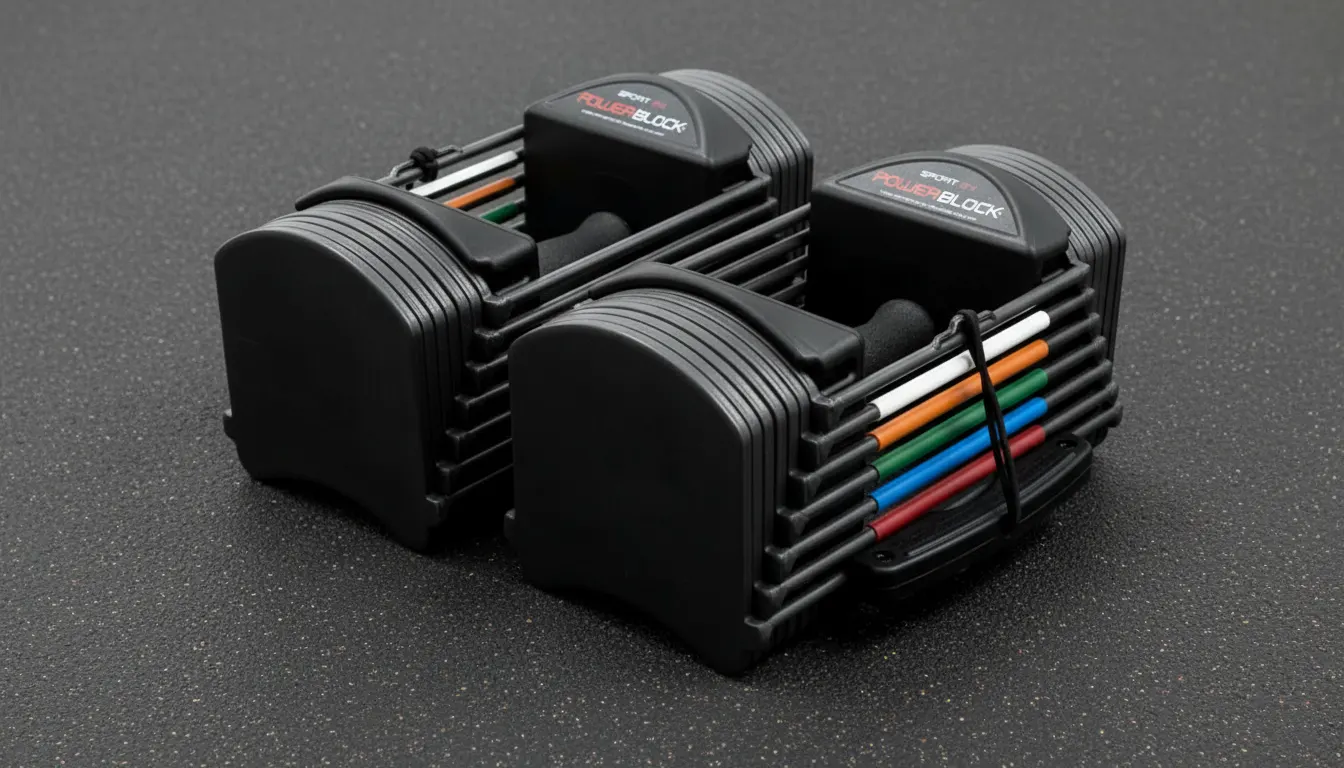
They work at home. A single pair of adjustable dumbbells can cover most of what a cable tower does for upper back training. That matters if you train at home, travel often, or just prefer not to commute to a gym for every session.
The 9 Best Upper Back Exercises With Dumbbells
1. Chest-Supported Dumbbell Row
This is the best starting point for most people, full stop. Lying on an incline bench removes lower back fatigue and momentum from the equation entirely. Your torso is supported, so the only muscles moving the weight are your upper back muscles. You cannot cheat. You cannot swing. You have to earn every rep.
Setup: Set an adjustable bench to 45 degrees. Hold a dumbbell in each hand with a neutral grip (palms facing each other) and lie face-down on the bench with your arms hanging toward the floor.
Execution: Press your toes into the floor. Initiate the movement by pulling your shoulder blades toward each other, then drive your elbows back toward your hips. Stop when the dumbbells are at bench height. Hold the contraction for one full second. Lower slowly over 3–4 seconds.
What to watch: If your chest is lifting off the bench to get extra range, you are using momentum and reducing the training effect. The contraction at the top should feel like pinching a pencil between your shoulder blades.
Rep range: 10–15 reps, 3–4 sets.
Muscles worked: Rhomboids, middle trapezius, rear delts, teres major, biceps.
2. Single-Arm Dumbbell Row
The workhorse of any dumbbell back program. The single-arm variation lets you load heavier than most bilateral exercises because your full focus goes to one side at a time. It is also the best tool for building the lat and rhomboid thickness that gives the back that dense, wide appearance.
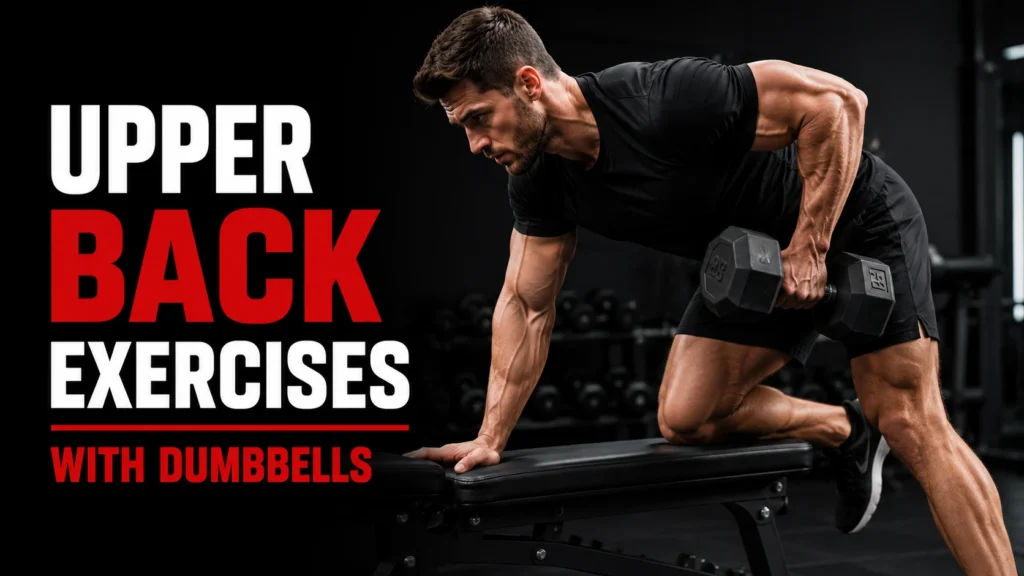
Setup: Place your left knee and left hand on a flat bench. Keep your spine neutral — think of it as a tabletop. Let the dumbbell hang directly under your right shoulder.
Execution: Drive your right elbow back toward your hip. Not up toward the ceiling — back. At the top, think about your shoulder blade pulling toward your spine. Lower slowly.
The most useful cue: Imagine you have no hands. Row with your elbow. If you focus on the hand or the dumbbell, the biceps dominate. If you focus on the elbow, the back leads.
Rep range: 8–12 per side, 3–4 sets.
Muscles worked: Lats, rhomboids, rear delts, biceps, core.
3. Bent-Over Dumbbell Row
The compound movement trains the upper back, erector spinae, and core simultaneously. It requires more from your lower back than the supported version, so this is the right step once you have built some baseline stability.
Setup: Stand with feet hip-width apart, holding a dumbbell in each hand. Hinge at the hips until your torso is roughly parallel to the floor. Let the dumbbells hang at arm’s length with a neutral grip.
Execution: Pull both dumbbells toward your hips, squeezing the shoulder blades together at the top. Lower with control until your arms are fully extended.
The error almost everyone makes: Using body momentum — swinging the torso upward to heave the weight. If this is happening, the weight is too heavy. Drop it and feel the upper back actually contract rather than just moving the dumbbells from point A to point B.
Rep range: 8–12 reps, 3–4 sets.
Muscles worked: Lats, middle traps, rhomboids, erector spinae, biceps, and core.
4. Dumbbell Reverse Fly (Bent-Over)
You cannot use much weight on this exercise. That is not a problem — it is the point. The reverse fly directly targets the rear delts and middle trapezius, and those muscles respond better to controlled, moderate loads than to heavy weights swung through partial range.
Setup: Hold a light dumbbell in each hand. Hinge forward at the hips until your torso is near-parallel, arms hanging straight down, palms facing each other.
Execution: With a very slight bend in your elbows, raise both arms out to your sides in a wide horizontal arc. Your hands should reach roughly shoulder height. Squeeze your shoulder blades together at the top. Lower slowly.
Critical distinction: This is a horizontal arc, not a vertical lift. If your elbows are bending significantly, the lats and biceps are taking over. If you are shrugging, the upper traps are compensating. Keep the weight light enough to isolate the movement.
Rep range: 12–15 reps, 3–4 sets.
Muscles worked: Rear delts, middle and lower trapezius, rhomboids.
5. Dumbbell IYT Raises
Most people have never done these. That is a shame, because an ACE-sponsored electromyography study found the IYT sequence produces higher activation in the middle and lower trapezius than most standard back exercises. Each angle recruits a different portion of the muscle, so working through the full sequence gives you comprehensive trap development in one exercise.
Setup: Lie face-down on a 30–45 degree incline bench holding very light dumbbells — 2.5 to 5 lbs for most people to start. The leverage here is brutal.
Execution (three positions performed back-to-back):
- I raise: Arms forward overhead. Raise both arms straight up. Hold one second.
- Y raise: Arms at a 45-degree angle from your body. Raise both arms to form a Y. Hold one second.
- T raise: Arms directly out to your sides. Raise both to form a T. Hold one second.
That is one complete sequence.
On the weight: People consistently underestimate how light they need to go. Start with no weight at all if needed. The lower traps are working at a severe mechanical disadvantage in these positions, and even 5 lbs will feel heavy by the third sequence.
Rep range: 8–10 sequences, 2–3 sets.
Muscles worked: Lower and middle trapezius, rear delts, rhomboids.
6. Dumbbell Shrug (With Hip-Hinge Variation)
The standard shrug builds upper trap thickness and the neck-to-shoulder shelf. Most people do it wrong — they roll the shoulders or use too much momentum, neither of which adds useful training stimulus.
Standard version: Stand holding dumbbells at your sides, palms facing in. Without rolling your shoulders, lift them straight toward your ears as high as possible. Hold 1–2 seconds. Lower slowly.
Hip-hinge variation: Before shrugging, hinge forward slightly at the hips — about 15–20 degrees. This puts the traps in a stretch-loaded starting position. Contracting from a stretch produces a stronger contraction and more muscle growth stimulus than starting from a neutral position. This small adjustment makes a noticeable difference in how the exercise feels.
Rep range: 12–15 reps, 3 sets.
Muscles worked: Upper trapezius, levator scapulae.
7. Dumbbell High Row (Elbow-Out Variation)
The high row shifts the loading from the lats — which dominate most standard rows — toward the rhomboids and rear delts. It does this through one simple change: instead of driving your elbow back toward your hip, you drive it out to the side and upward.
Setup: Support yourself with one hand on a bench or rack. Hold a dumbbell in your free hand with your torso roughly parallel to the floor.
Execution: Drive your elbow out and up to the side. The dumbbell travels in a wide arc. At the top, your elbow should be at or slightly above shoulder height and your shoulder blade fully retracted. Hold one second, then lower under control.
Rep range: 10–12 per side, 3 sets.
Muscles worked: Rear delts, rhomboids, middle trapezius.
8. Dumbbell Pullover
The pullover trains the lats through a vertical arc of motion without needing a pull-up bar or cable machine. It also engages the serratus anterior — a muscle that helps rotate the shoulder blade upward and almost never gets direct training attention.
Setup: Lie perpendicular across a flat bench so only your upper back makes contact with the bench. Drop your hips slightly toward the floor. Hold a single dumbbell with both hands in a diamond grip above your chest.
Execution: With a slight bend in your elbows, lower the dumbbell back over your head in a controlled arc until you feel a strong stretch through your lats. Pull back up to the starting position. Focus on the lats doing the pulling — if you are feeling your triceps doing most of the work, your elbows are too bent.
Rep range: 10–12 reps, 3 sets.
Muscles worked: Lats, teres major, rear delts, serratus anterior, long head of triceps.
9. Prone Y-Raise (Dumbbell Face Pull Substitute)
Cable face pulls are among the most effective upper back and rear delt exercises in existence. Without a cable machine, the prone Y-raise with external rotation is the best approximation you can do with dumbbells.
Setup: Lie face-down on a 30–45 degree incline bench holding light dumbbells.
Execution: From hanging straight down, raise both arms in a Y pattern — up and out at roughly 45 degrees from your body — with your thumbs pointing toward the ceiling. That thumb-up position is external rotation, and it is the detail that makes this exercise worth doing. Hold the top for one second. Lower slowly.
Why external rotation changes everything: Raising with your thumbs up activates the lower traps and rear delts together in a way that a palms-down position cannot replicate. These are specifically the muscles that prevent shoulder impingement and keep the shoulder blade tracking correctly during pressing movements.
Rep range: 12–15 reps, 3 sets.
Muscles worked: Lower and middle trapezius, rear delts, external rotators.
The Mistakes That Kill Upper Back Progress
Rowing with your biceps. The most common problem across every rowing exercise. The biceps are small — they fatigue fast and cap how hard you can actually load the back. The fix: slow the weight down and focus on initiating the movement by squeezing your shoulder blade before your elbow bends. If you feel the contraction in your upper arm more than between your shoulder blades, something is off.
Going too heavy too early. Heavy loads in rows often mean the lower back and momentum take over and the upper back gets minimal stimulus. Upper back isolation muscles are relatively small. They respond better to controlled moderate loads with a deliberate pause at peak contraction than to heavy weights moved through partial range.
Skipping the eccentric. The lowering phase of every row, fly, and raise produces significant mechanical stress on the muscle — the kind that drives growth and strength adaptations. A 3–4 second lower on chest-supported rows is genuinely harder than adding 10 lbs to the weight and moving through the full range carelessly.
Neglecting the low-load exercises. IYT raises and prone Y-raises are not impressive. Nobody posts videos of their personal record on IYT raises. But they train the mid and lower trapezius in positions that heavy compound rows cannot replicate, and leaving them out means your posture work has a real gap in it.
Training upper back only once per week. The upper back recovers faster than larger muscle groups. Most people make better progress spreading their upper back volume across two or three sessions per week rather than loading one long weekly session.
How to Keep Making Progress Over Time
Progressive overload is the principle behind any program that actually produces results. You have to give your muscles a reason to adapt.
With dumbbells, overload is not just about adding weight. Several approaches work:
Add reps before adding weight. If your target is 3 sets of 10, work up to 3 sets of 15 with clean form before reaching for the next dumbbell size.
Slow the eccentric phase. Taking 3–4 seconds to lower the weight on every rep of your rows and flys dramatically increases time under tension without changing the load at all.
Shorten rest periods gradually. Cutting from 90 seconds to 60 seconds while maintaining the same load and rep count is a legitimate form of progressive overload.
Add a longer pause at peak contraction. Holding the squeeze at the top of a row for 2 seconds instead of 1 second adds meaningful total time under tension across a full set.
Add sets before adding load. Moving from 3 working sets to 4 working sets on your main movements is often safer and more productive than jumping immediately to a heavier dumbbell.
How Long Until You Notice a Difference?
Strength improvements come quickly. Most people notice their upper back feeling more responsive and controlled within two to three weeks. Visible muscle development takes longer — six to eight weeks is a realistic window for noticeable changes, assuming your nutrition supports it.
Posture is slower. Rounded shoulders and forward head posture develop over years of accumulated habit. They do not reverse in a month. Most people start noticing sustained improvements in their resting posture after four to eight weeks of consistent upper back training, combined with making some changes to how they sit and how often they stay in a forward-flexed position throughout the day.
Consistency is the only thing that moves this timeline. Two weeks on and three weeks off does not produce adaptation. The changes you are after — stronger rhomboids, better-functioning middle traps, a resting scapular position that is not pulling your shoulders forward — require repeated, sustained stimulus.
Frequently Asked Questions (FAQs)
Can I build a strong upper back with only dumbbells and no cable machine?
Yes. The chest-supported row, single-arm row, reverse fly, IYT raises, and pullover collectively cover every major upper back function. Cables offer continuous tension through a full range of motion, which is a genuine advantage, but they are not necessary for building real strength and muscle. Many serious lifters have built impressive upper backs with nothing more than dumbbells and a bench.
How many times per week should I train my upper back?
Two to three sessions work well for most people. The upper back recovers faster than larger muscle groups like legs or chest. Spreading your total volume across multiple sessions — rather than doing everything once per week in one long workout — tends to produce better results and keeps soreness at a manageable level.
What weight should I start with for upper back exercises?
It depends on the exercise. For compound rows (single-arm, bent-over), most men start between 20–35 lbs and most women between 10–20 lbs. For isolation movements like the reverse fly and IYT raises, go much lighter — 5–10 lbs for men and 3–8 lbs for women is typical, because the leverage in these positions makes even light weights challenging. If you feel the exercise in your arms and traps rather than the target muscles, the weight is too heavy, regardless of the number.
Will upper back exercises fix my posture?
They are a significant part of the solution. Consistently strengthening the rhomboids, middle traps, and rear delts pulls the shoulder blades back toward a better resting position. But exercise alone is one piece. If you spend eight to ten hours daily in a forward-flexed position and never address chest tightness or thoracic mobility, the improvement will be slower. Combining dumbbell upper back work with regular chest stretching and reducing prolonged sitting time gives the best results.
What is the difference between upper back exercises and lat exercises?
The distinction mostly comes down to elbow path. When your elbow drives back toward your hip, the lats dominate. When your elbow drives out to your side and upward, the upper back muscles — rear delts, rhomboids, middle traps — take over. Many exercises recruit both, but you can deliberately shift emphasis based on how you pull.
Is it normal for my neck to feel sore after upper back training?
Some fatigue in the upper traps and neck region is normal after heavier rowing or shrug work. Sharp pain, pinching, or numbness that radiates down the arm is not normal and warrants a conversation with a medical professional. If soreness is your concern, it often means the upper traps are overworking to compensate for underfiring middle traps and rear delts. That imbalance tends to correct itself over weeks as the weaker muscles get stronger.
Should I train upper back before or after chest?
The research does not strongly favor either order. Practically, many coaches recommend pairing chest and upper back in the same session (push-pull pairing) because the opposing muscles warm each other up and neither group is pre-fatigued by the other. Others run dedicated pulling days. Both approaches produce results. The more important variable is total weekly volume, not what order you put the exercises in.
How do I know if my form is correct on the rows?
The muscle you should feel working is your upper back. If you feel it mainly in your biceps, your arms are doing too much of the work. If you feel it in your lower back, something in your hip hinge position is off. The most reliable fix: slow the movement down significantly and focus on initiating each rep by moving your shoulder blade before your elbow bends. If that still does not produce the right sensation, reduce the weight. Mind-muscle connection on rows takes most people several sessions to develop properly.
In conclusion
Upper back training is one of the most neglected areas in most workout programs and one of the highest-return investments you can make in how you feel and move. Stronger rhomboids and trapezius muscles mean better posture, less neck and shoulder tension, improved performance on every other upper body lift, and a back that actually looks developed rather than just flat.
The nine exercises here cover everything your upper back needs — horizontal pulling, vertical pulling, isolation work for the rear delts and traps, and the stabilizer training that most programs never bother including. You do not need a cable machine or a commercial gym to do any of it.
Start with the basics. Learn to feel the right muscles working. Build the load progressively. Within a few weeks, the difference in how your upper back feels will be obvious. Give it a few months, and the difference in how it looks will follow.