If you’ve been hunting for a single dumbbell set that genuinely replaces a full rack, you’re probably already overwhelmed by the choices. I was too. After weeks of research, late nights reading forums, and watching every YouTube comparison video imaginable, I finally pulled the trigger on the NordicTrack Select-a-Weight Adjustable Dumbbells — and I haven’t looked back since.
What’s in the Box
Let me get one thing out of the way upfront: the outer packaging takes a beating in transit. That 110-pound box is going to show up looking like it got into a fight with a forklift. This seems to be universal across nearly every buyer’s experience, and honestly, it had me holding my breath when I first opened it.
But here’s what matters — once you get past the battered Styrofoam and torn cardboard, the dumbbells inside are typically in perfect shape. I still recommend doing what several buyers suggest: check every single plate carefully for cracks right after unboxing, especially the smaller 2.5-pound plastic ones. That five-minute inspection could save you a lot of headaches later. One reviewer even mentioned receiving what appeared to be a returned or defective set, so just give everything a thorough once-over before your first workout.
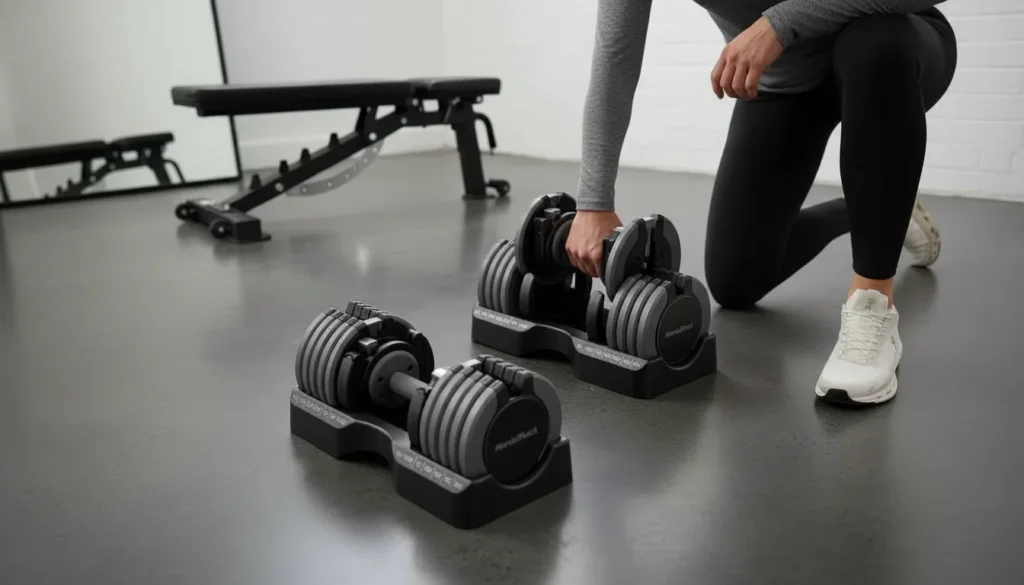
The box includes two 55-pound dumbbells and their custom-molded storage trays. No stand is included, and a few experienced users strongly recommend mounting the trays at bench height so you’re not hunching down to pick them up every set — something your lower back will thank you for at the heavier weights.
Design That Actually Makes Sense for Home Gyms
This is where the NordicTrack Select-a-Weight genuinely earns its place in a home gym. The design philosophy is completely different from competitors like the Bowflex SelectTech, and the difference matters far more than you’d expect during an actual workout.
When you set a Bowflex to 10 pounds, you’re still holding a 15.75-inch bar. Every plate is attached to that full-length frame. The NordicTrack works the opposite way — at 10 pounds, only the inner plates come out with the handle, giving you a compact dumbbell roughly 9 inches long. As you dial up the weight, the dumbbell grows only as wide as it needs to be. By the time you’re at 40 or 50 pounds, it resembles a traditional fixed-weight dumbbell in both size and feel.
I first noticed this during lateral raises. Swinging around a two-foot bar at 10 pounds would limit your range of motion and feel awkward — with these, it’s just a normal dumbbell. For exercises like chest flyes, overhead presses, and concentration curls, that compact size at lower weights is a genuine functional advantage, not just a cosmetic one.
One reviewer described it perfectly: when you lift these out of the cradle, the plates stay together and feel like one solid unit — not the open “skeleton” frame style that some adjustable dumbbells use. It’s much closer to the feel of traditional gym dumbbells, which matters when you’re trying to focus on form rather than awkwardly holding a mechanical contraption.
The ends are flat, which is another thoughtful design choice. You can rest these on your thighs when getting into position for chest presses — something that sounds minor until you’ve tried doing that with dumbbells that have protruding end caps digging into your legs.
The Weight Range and Increment System
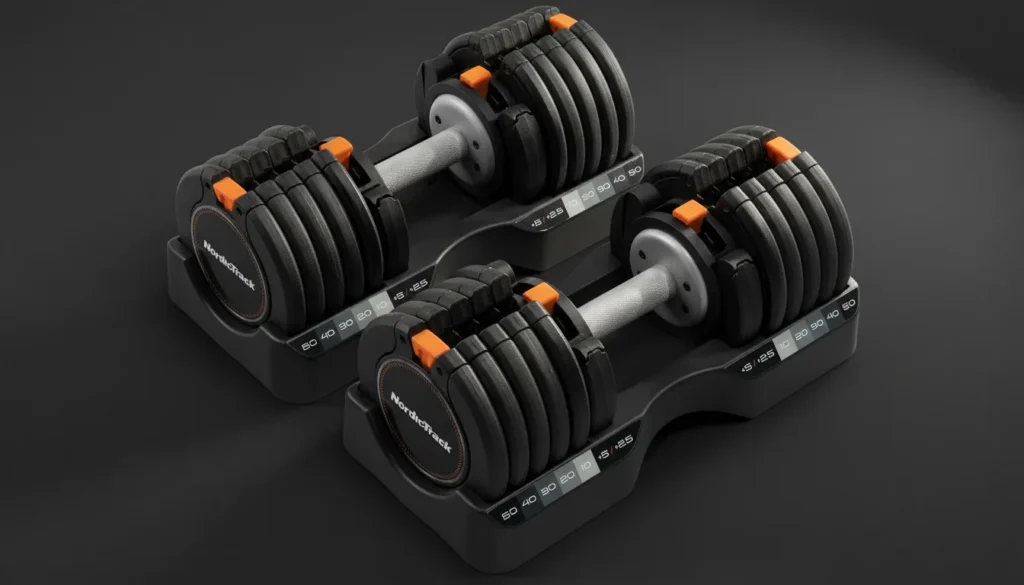
The 55-pound max capacity covers a wide range of training goals. Each dumbbell starts at 10 pounds and works up in a combination of 10-pound base increments with 2.5 and 5-pound fine-tuning adjustments, giving you these available weights:
10, 12.5, 15, 20, 22.5, 25, 30, 32.5, 35, 40, 42.5, 45, 50, 52.5, 55 lbs
That’s 15 possible weight configurations per dumbbell — effectively 30 individual dumbbells in two compact units. The 2.5-pound increment is genuinely useful for progressive overload, particularly on isolation movements where jumping 10 pounds at once is too aggressive.
The one gap worth knowing about upfront: there’s no 17.5, 27.5, 37.5, or 47.5-pound option. The fine adjustment weights (2.5 and 5 lbs) can only be added to the lower end of each 10-pound block — so you can hit 12.5 and 15, but the next step after 15 is 20. For most lifting scenarios this isn’t an issue, but if you’re at a point in your training where those in-between weights matter for specific exercises, it’s worth knowing.
There is a clever workaround that a few buyers mention: you can technically set each side of the dumbbell to a different weight, giving yourself something like 17.5 by having one side at 15 and the other at 20. The manufacturer doesn’t recommend this because of the imbalance it creates, and honestly, for most exercises I’d agree — but it’s there if you ever need it.
For anyone wondering about the lower end, 10 pounds is the minimum. You can’t go to 5 or 7.5 pounds with this set, so if you’re buying for someone just starting out or for very light rehabilitation work, you may want to keep a few lighter fixed dumbbells around.
The Adjustment Mechanism: Quick, But With a Learning Curve
The adjustment system uses a slider-based design rather than a rotating dial. There are two types of selectors: a primary slider that sets your base weight in 10-pound increments, and a secondary lever that adds 0, 2.5, or 5 pounds. To change weight between sets, you place the dumbbell back in its tray, adjust the levers, and lift.
In practice, changing from, say, 30 to 50 pounds takes about 10 seconds — you’re moving up to four levers, two per side, which is more steps than a single-knob system. But “more steps” doesn’t mean “slow.” After a few workouts, the motion becomes muscle memory and doesn’t interrupt your training rhythm in any meaningful way.
The bigger frustration — and nearly every buyer mentions this — is the lack of labeling on the 2.5/5-pound fine adjustment lever. There’s no indicator showing which direction adds 2.5 pounds versus 5 pounds. You essentially have to memorize it, or do what many buyers have done: add a small sticker, a dab of nail polish, or a paint marker to permanently mark which side is which. One long-term owner described using a small dab of silver automotive touch-up paint, which solved the problem permanently. It’s a real design oversight for a product at this price point.
The secondary mechanism can also get sticky, particularly if the dumbbell isn’t placed back into the tray perfectly aligned. The bottom of each weight plate has a small flat section that needs to seat properly in a groove at the base of the tray. When it’s not quite right, the lever feels jammed. Once you learn to feel for that proper seating and give the dumbbell a slight jiggle to confirm alignment, this almost never happens — but it does take a few weeks to develop that habit.
A couple of users reported that the inner 2.5/5-pound weight occasionally failed to engage correctly, meaning the extra weight would detach mid-exercise. This seems rare based on the overall review volume, but it’s a real enough concern that you should double-check the mechanism is fully engaged before picking up the dumbbell, especially at lighter weights where the smaller plates are involved.
Build Quality: Metal Where It Counts
The handle is metal with proper knurling — the same kind of textured grip you’d find on a barbell in a commercial gym. This isn’t rubber or foam that peels off after a year of sweaty workouts. The knurling is firm without being aggressive, meaning you’ll get a solid grip without tearing up your hands during high-rep sets.
The main weight plates in the orange version are metal. The smaller 2.5-pound fine-adjustment weights are plastic, which is where the durability concern exists. These smaller pieces have broken for some users — typically from drops or from the mechanism taking repeated stress. The overall construction of the larger plates and handle feels genuinely solid, but treating these like traditional gym dumbbells you can slam down after a heavy set is asking for trouble. Multiple buyers who have used these for over a year note they’re holding up well with normal use, but none of them drop them.
There is some minor plate rattle and movement during exercises — you’ll notice it, particularly on slower movements. It’s less than you’d get with older-style adjustable dumbbells that use threaded collars, but it’s there. One buyer described it as a slight wiggle that you stop noticing after the first week. For heavier, controlled movements it’s genuinely not an issue. For very explosive movements, it’s more noticeable.
The orange model (the current version) is an improvement over the previous blue version in key ways: the handle is metal instead of plastic, the main weight plates are metal instead of plastic, and the design feels more premium overall. If you’re looking at both versions, the orange is the one worth getting.
Durability Over Time: What Long-Term Owners Say
One of the most reassuring things I found while researching these was how many buyers had been using them for 12 to 24 months with no significant issues. Several owners reported daily use with the weights holding up without degradation in the adjustment mechanism or the plate integrity.
The most common failure point for those who did experience problems was the small plastic component that holds the 2.5/5-pound adjustment — either the lever mechanism becoming loose or a piece cracking, typically from drops. A few users reported screws on the handle working loose over time, which is addressable with a small amount of thread-locking compound.
What I’d call the honest verdict on durability: these are built to last through years of normal home gym use if you treat them the way you should treat any precision adjustable mechanism — with care. They are not built for CrossFit-style drops, man makers, or being used as a pushup handle on hard floors. Treat them like a tool with moving parts and they hold up well. Treat them like indestructible iron plates and they won’t be.
Customer Support: A Known Weak Point
I’d be doing you a disservice if I didn’t flag this honestly. NordicTrack’s customer support for this specific product line has been a recurring complaint from multiple buyers who needed help.
One buyer reported spending nearly 90 minutes across two calls only to be told there was a recall, then told there wasn’t, with no resolution. Another needed a single replacement plastic part and was informed by the support team that they couldn’t identify the part number because they didn’t have the manual for their own product — even though the product was still actively being sold at the time.
If you buy these and something breaks outside Amazon’s return window, getting replacement parts or meaningful support from NordicTrack directly may be a frustrating experience. Amazon’s own support has been more responsive for buyers in this situation. This is worth factoring into your decision, especially if you’re concerned about long-term serviceability.
Who These Are Best For
After everything, here’s my honest take on who should buy these:
These dumbbells are an excellent fit if you’re building or maintaining a serious home gym, train with weights in the 10–55 pound range, and want a set that feels and functions closer to traditional dumbbells than most adjustable alternatives. The compact design at lower weights, the knurled metal handle, the 2.5-pound increment capability, and the overall value relative to buying a full rack of fixed dumbbells make them genuinely one of the better home gym investments at this price point.
They’re also well-suited for people doing structured programs like P90X, LIIFT4, or similar workout systems that involve frequent weight changes between exercises — the adjustment speed is more than adequate for those formats.
They’re a less ideal fit if you regularly need weights below 10 pounds, if you’re the type who drops weights after a heavy set, or if you prioritize the single-knob speed of a dial-style system over the compact design advantage. If you do a lot of grip-intensive work using the sides of the dumbbell rather than the handle, the plate shape on these also isn’t ideal for those exercises — you’d want a kettlebell or fixed plates for those specific movements.
Final Verdict
I went into this purchase cautiously — spending several hundred dollars on adjustable dumbbells is not a casual decision. Several months later, I genuinely don’t have regrets. The compact design at lower weights is more useful in practice than it sounds on paper. The metal handle feels right. The adjustment system, once you learn its quirks, doesn’t slow down workouts. And the fact that two dumbbells replace what would otherwise be eight or more pairs of fixed weights — and the space those would require — makes this a practical win for most home gym setups.
The unlabeled fine-adjustment lever is an annoying oversight, the packaging arrives rough, and the customer support track record is something to be aware of. But as a piece of exercise equipment for home use, the NordicTrack Select-a-Weight 55 lb pair earns a strong recommendation.
Important purchasing note: If you decide to buy NordicTrack Select-a-Weight Adjustable Dumbbells, purchase exclusively through Amazon’s official listing. Amazon provides the most reliable purchase protection and return process for a product of this weight and price.
Looking to upgrade your home workouts? Check out the Best Dumbbells for Home Gym to find the perfect set based on your space, budget, and fitness goals.