How to Do Dumbbell Face Pull Correctly for Maximum Results

April 19, 2026

dumbbell face pull

Most shoulder training is one-sided. Literally. Overhead press, lateral raises, bench press — the front and sides of the shoulder get hit repeatedly across almost every training session. The rear deltoids, which sit at the back of the shoulder and do a completely different job, get whatever scraps are left over, which is usually nothing.

That imbalance is not just an aesthetic problem. It contributes to rounded shoulder posture, reduces pressing strength over time, and puts the shoulder joint in a position where injury becomes increasingly likely. The dumbbell face pull is one of the most direct and practical ways to address it, without a cable machine or any specialized equipment.

What Is a Dumbbell Face Pull

A dumbbell face pull is a free-weight exercise where you pull two dumbbells toward your upper face while simultaneously retracting your shoulder blades and externally rotating your shoulders. It belongs to the horizontal pulling category, which targets the upper back and posterior shoulder through a different line of pull than vertical movements like lat pulldowns and pull-ups.

The distinction matters because vertical pulling — which dominates most back training — works the latissimus dorsi heavily and largely skips the rear deltoid, middle trapezius, and rotator cuff muscles. You can do years of rows and pulldowns and still have chronically underdeveloped rear delts if you never train them directly.

There are two practical ways to do the dumbbell version. The bent-over variation has you hinged forward with the torso roughly parallel to the floor, which closely replicates the cable face pull’s line of pull. The standing variation is done upright and is slightly easier to learn. Both work.

Muscles Worked

Posterior Deltoid

This is the main target. The rear head of the deltoid sits at the back of the shoulder and handles shoulder extension and external rotation — both of which happen during the pull. Since most pressing exercises bias the front deltoid, the rear head gets systematically under-trained in programs that do not include dedicated posterior shoulder work.

Middle Trapezius and Rhomboids

These muscles run horizontally across the mid-back and are responsible for pulling the shoulder blades together. At the top of each rep, when you squeeze, the middle traps and rhomboids are doing most of the work. Weak middle traps are one of the main structural contributors to the rounded-shoulder posture that develops after years of desk work or heavy pressing.

Infraspinatus and Teres Minor

Two of the four rotator cuff muscles, the infraspinatus and teres minor drive the external rotation component of the face pull. They stabilize the head of the humerus inside the shoulder socket, which is exactly the function that fails when people develop shoulder impingement from bench pressing or overhead pressing. Strengthening them through face pulls is more targeted and lower-risk than most other options.

Biceps Brachii

The biceps assist with elbow flexion during the pull and control the descent. They are secondary movers, not the target. When the weight is too heavy, the biceps take over and the rear delts stop doing meaningful work — which is why load selection matters so much in this exercise.

Upper Trapezius

The upper traps stabilize the scapula during the movement without being the primary driver. They get some incidental work here, but this is not a shrug or an upright row.

How to Do the Bent-Over Dumbbell Face Pull

This is the most common variation and the one that most closely replicates the cable version.

Step 1: Weight Selection

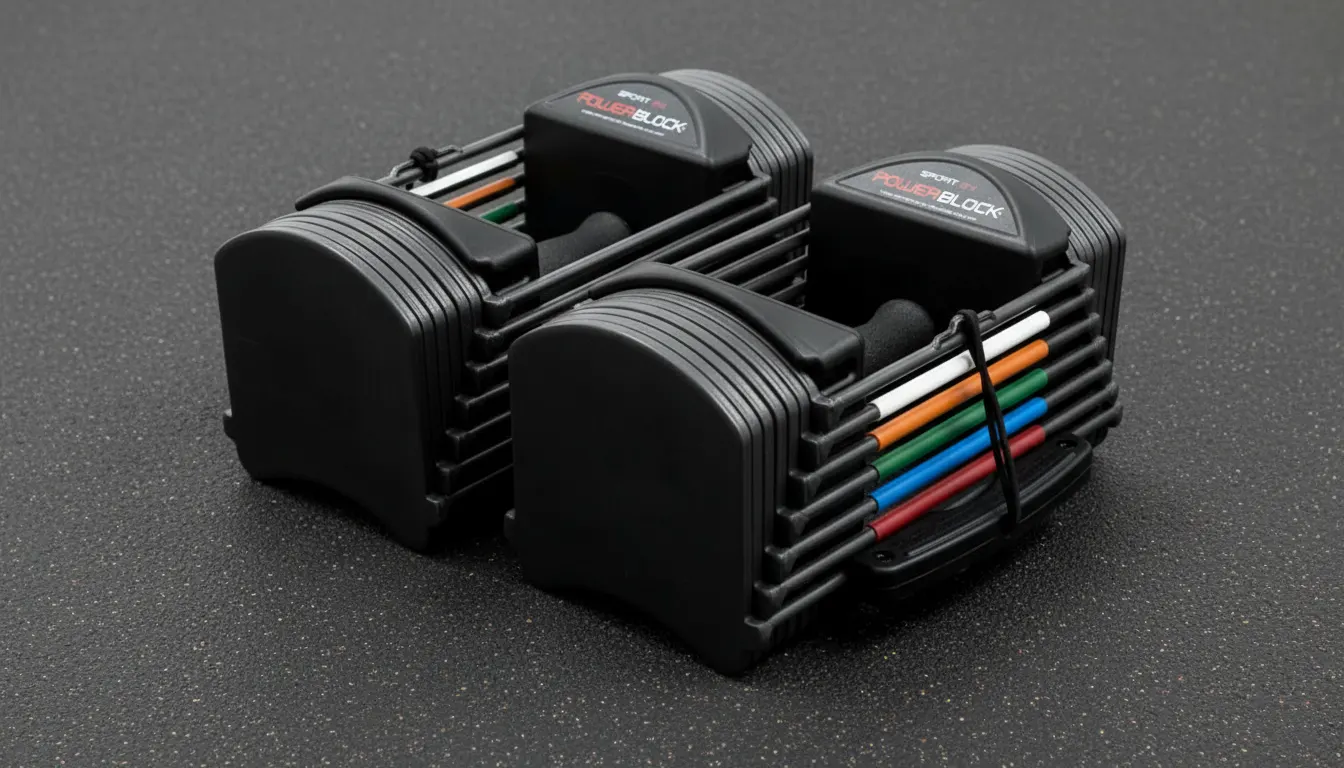
Pick lighter dumbbells than you think you need. For most people, 5 to 15 pounds per hand is the right starting range. The rear deltoid is small. If you grab the same dumbbells you use for lateral raises, you are probably already too heavy.

Step 2: Hip Hinge

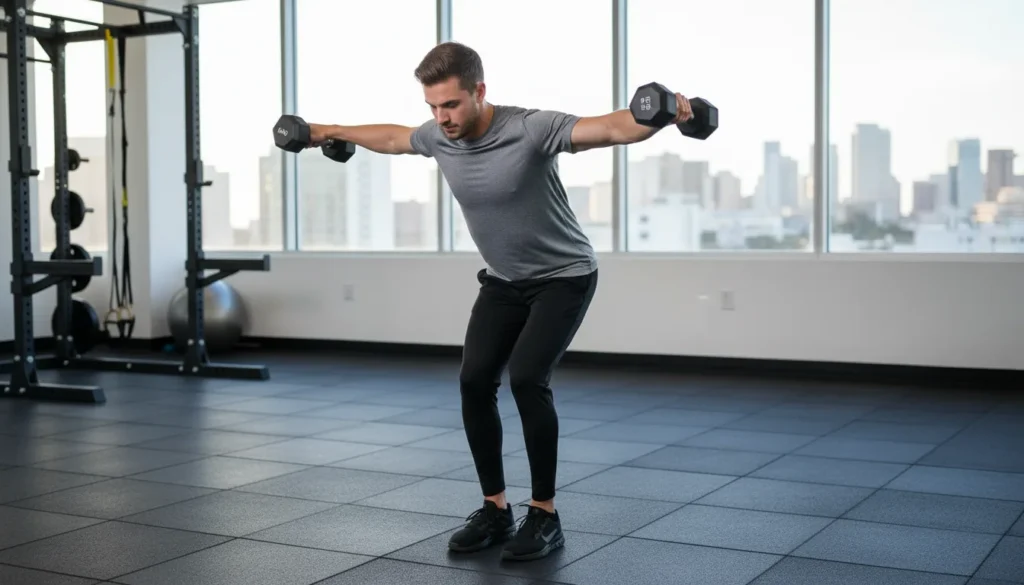
Stand with feet hip-width apart. Push your hips back and hinge forward until the torso is roughly parallel to the floor, or at a minimum 45-degree angle. Keep the spine neutral — no lower back rounding, no excessive arch. Let the dumbbells hang straight down from the shoulders with arms extended.

Step 3: The Pull

Drive your elbows up and out to the sides, keeping them at or above shoulder height throughout. Pull the dumbbells toward your face — specifically toward eye or upper cheek level, not your chin or collarbone. As you pull, externally rotate your shoulders so the dumbbells end up beside your head with forearms angled upward. Hands above elbows at the top.

Step 4: The Hold

Pause for one to two seconds at the top and actively squeeze your shoulder blades together. This brief hold is not optional — it is where a significant portion of the exercise’s training effect comes from.

Step 5: The Descent

Lower the dumbbells under control, taking two to three seconds. Do not let the shoulders roll forward at the bottom. Keep scapular stability throughout the full range of motion.

How to Do the Standing Dumbbell Face Pull

This version works well if you have trouble maintaining a flat back in the bent-over position, or if you want to use it as a warm-up.

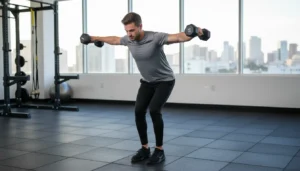
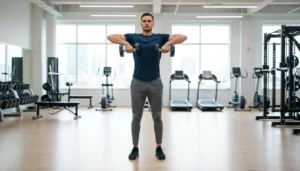
Stand upright with feet shoulder-width apart. Hold a dumbbell in each hand and raise your arms until they are parallel to the floor with elbows bent at 90 degrees, dumbbells positioned in front of your face. Drive your elbows back and out, as if you are trying to pull the dumbbells apart from each other. End with elbows flared wide and hands beside your ears. Pause, squeeze the shoulder blades, and return under control.

The useful cue here: think about pulling the dumbbells apart like a rubber band rather than just pulling them backward. That mental image activates the external rotation component more reliably.

How to Do the Incline Bench Dumbbell Face Pull

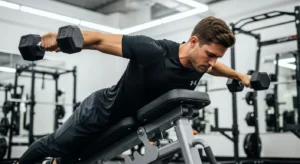
Lie chest-down on an incline bench set to roughly 45 degrees, with a dumbbell in each hand hanging toward the floor. Pull up and out to the sides, replicating the same elbow-high, externally rotated finish position as the other variations.

Because the chest is supported, you cannot use body momentum or lower back compensation. The upper back and rear delts have to do all the work. This version is particularly useful for lifters who cannot feel the target muscles in the bent-over position — removing the compensation option forces the right muscles to engage.

Dumbbells vs. Cables for Face Pulls

Cables have one real advantage: constant tension throughout the range of motion. At no point does the resistance drop off. Dumbbells, because they interact with gravity rather than a cable stack, produce varying resistance at different joint angles.

But dumbbells have their own advantages. Each arm works independently, which means side-to-side strength imbalances cannot be masked the way they can with cables. If your left rear delt is weaker, you will feel it. Dumbbells also require more grip, wrist, and forearm stabilization, which contributes to functional strength that carries over into other movements. And for anyone training at home or traveling, dumbbells are just there.

For most people with cable access, the cable version is the primary movement and the dumbbell version is the substitute. But the dumbbell version is not a lesser exercise — it is a different tool with different trade-offs.

Why Dumbbell Face Pulls Are Worth Your Time

They Fix the Most Common Imbalance in Weight Training

Almost every standard training program is pressing-heavy. Bench press, overhead press, push-ups, dips — all of these bias the anterior shoulder and chest. Without deliberate posterior work, the front of the shoulder becomes disproportionately strong. That imbalance is not just a cosmetic issue. It pulls the shoulder blade into a position where impingement becomes more likely during pressing and overhead movements.

They Work Directly on Desk Posture Problems

The muscles weakened most by prolonged sitting and forward head posture are the middle trapezius, rhomboids, and rear deltoids — the exact muscles targeted by the face pull. Research on elastic band and resistance exercises for rounded shoulder posture has shown measurable improvements in scapular positioning from consistent training of these muscle groups. You do not need a physical therapy clinic to address this.

They Protect the Shoulder Joint for Heavy Pressing

Anyone who bench presses or overhead presses regularly needs rotator cuff work. The external rotation component of the face pull directly strengthens the infraspinatus and teres minor, which are responsible for stabilizing the shoulder under load. Rotator cuff injuries are among the most common training setbacks. A few sets of face pulls twice a week is cheap insurance.

They Develop Upper Body Aesthetics Most Lifters Are Missing

Developed rear delts give the shoulder a round, three-dimensional look from any angle. Without them, shoulders look flat from the side. The middle trapezius, when trained, adds thickness to the upper back that reads as muscular even through clothing. These are muscles that go directly undertrained in most people’s programs, which means there is genuine growth potential here regardless of training experience.

Common Mistakes That Kill the Exercise

Loading Too Heavy

The most frequent problem, by a wide margin. When the weight is too heavy, the biceps and upper traps compensate, and the rear delts barely activate. Signs you are too heavy: you are swinging the torso, momentum is doing the work, or you cannot feel anything in the back of the shoulder. Cut the weight significantly and rebuild from there.

Pulling Toward the Chin or Chest

The target is eye or forehead level. Pulling lower shifts the primary work to the rhomboids and reduces rear delt activation. The height of the pull matters more than most instructional guides acknowledge.

Elbows Dropping Below Shoulder Height

When the elbows drop, the movement becomes a row, and the external rotation component disappears. Drive the elbows high and wide throughout the entire range. If maintaining elbow height is difficult, the weight is probably too heavy.

No Scapular Retraction at the Top

Many lifters complete the arm movement but never actually squeeze the shoulder blades together at the top. Scapular retraction activates the middle trapezius and rhomboids. Without it, you are performing a partial movement that misses roughly half the muscles involved.

Shoulders Rolling Forward at the Bottom

At the lowest point, the shoulders should stay stable and neutral. Allowing them to roll forward and internally rotate at the bottom of each rep places repeated stress on the anterior shoulder capsule and causes overuse irritation over time.

Rushing the Lowering Phase

The descent is training, not dead time. A controlled two-to-three second negative builds meaningful time under tension in the rear delts and produces more stimulus per set than dropping the weight back down. Slow it down.

Programming the Dumbbell Face Pull

Sets and Reps by Goal

The rear deltoid responds well to moderate-to-high rep ranges. Heavy triples do not make much sense here — this is not a maximum strength movement.

Goal Sets Reps Load
Muscle growth 3-4 12-15 Light to moderate
Shoulder health / endurance 2-3 15-20 Light
Postural correction 2-3 15-20 Very light
Strength 4-5 8-12 Moderate

Where It Fits in Different Splits

Upper/Lower: On upper days, after compound pressing and primary pulling movements. Do not put face pulls first — pre-fatiguing the rear delts can compromise stability in heavy rows.

Push/Pull/Legs: On pull days, after heavier horizontal rows. Paired with rear delt flyes, they make a complete posterior shoulder finisher.

Full Body: Toward the end of the session as a postural accessory. The recovery cost is low enough that it does not interfere with the rest of the training week.

Daily Practice: Because the load is light and the muscles worked are chronically undertrained, some coaches recommend performing face pull variations daily or between working sets of other exercises. The recovery demand is low enough that this frequency is generally well-tolerated.

Exercise Pairings

Face pulls work well alongside:

  • Band pull-aparts (similar muscles, slightly more emphasis on horizontal abduction)
  • Rear delt flyes (rear delt isolation without the external rotation component)
  • Prone Y and T exercises (scapular stability, deeper upper back work)
  • Light external rotation drills (direct rotator cuff isolation)

Alternatives When Face Pulls Are Not an Option

Cable Face Pull: The standard version, with constant tension throughout the range of motion. If you have cable access, this is generally the better primary movement. The dumbbell version serves well as a substitute or accessory.

Band Face Pull: A resistance band anchored at upper-chest height or above. More accessible than cables and provides a tension profile closer to cables than dumbbells. Good for travel or home settings.

Rear Delt Row: A dumbbell row performed with elbows flared wide rather than tucked close to the torso. Similar muscle emphasis to the face pull but without the external rotation component.

Rear Delt Flye: Performed bent-over or on an incline bench. Direct posterior deltoid isolation through horizontal abduction, with less rotator cuff involvement than the face pull.

Band Pull-Apart: A lightweight daily movement that closely mimics the face pull’s horizontal abduction pattern. Takes about 30 seconds to perform and has essentially zero recovery cost, making it useful as a warm-up, between-set filler, or posture-correction practice.

Who Should and Should Not Do This Exercise

This exercise makes sense for:

  • Beginners learning how to activate the scapular muscles and posterior shoulder
  • Anyone with desk-related posture problems (rounded shoulders, forward head posture)
  • Intermediate and advanced lifters whose programs are pressing-heavy without sufficient posterior counterbalancing
  • Athletes in shoulder-demanding sports: swimming, tennis, baseball, rock climbing, volleyball
  • Lifters working back from minor shoulder impingement, with medical clearance

This exercise does not make sense for:

  • Anyone with an active rotator cuff tear or diagnosed shoulder pathology, without explicit guidance from a physical therapist or orthopedic specialist
  • Lifters who cannot maintain a neutral spine in the bent-over position (use the incline bench variation instead)
  • Anyone who experiences pain during external shoulder rotation

Dumbbell Face Pulls for Posture Correction

Most posture problems that come from muscular weakness — as opposed to structural issues — involve a predictable set of muscles: middle trapezius, rhomboids, deep cervical flexors, and posterior deltoids. These muscles become chronically lengthened and weak when someone sits for extended periods, uses a phone with their head tilted forward, or trains the chest and anterior shoulder without balancing the posterior chain.

The dumbbell face pull hits three of those four muscle groups at once. Practiced consistently over months, combined with addressing chest and anterior shoulder tightness through stretching and mobility work, it produces real structural improvement in how the shoulder girdle sits at rest.

One thing that does not get said often enough: form quality is not just an injury concern in this exercise — it determines whether the postural benefit actually happens. If you pull toward your chin, let the elbows drop, or skip the scapular retraction, you are not doing the exercise that improves posture. You are doing something else with lighter weight.

Frequently Asked Questions (FAQs)

Can I do dumbbell face pulls without a cable machine?

Yes. The dumbbell version was built for exactly this situation. It trains the same muscles through the same movement pattern. The cable version offers constant tension throughout the range of motion, which the dumbbell version cannot replicate, but both produce meaningful results.

How heavy should the dumbbells be?

Lighter than you expect. 5 to 15 pounds per hand covers most lifters when starting out. If you cannot isolate the feeling of the rear delts working — if you mostly feel your biceps or upper back working broadly — the weight is probably too heavy or the form needs adjustment.

Are these safe for people with shoulder pain?

It depends entirely on the cause of the pain. For muscular weakness contributing to impingement-type discomfort, face pulls are often part of the solution. For acute injuries, structural damage, or significant shoulder pathology, consult a medical professional before performing this exercise.

How often should I do them?

Two to four times per week is a standard starting point. Because the load is light and the muscles worked are not heavily taxed by most other exercises, some lifters do light sets daily without accumulating fatigue.

What is the difference between a face pull and a rear delt row?

External rotation. In the face pull, the forearms rotate upward at the top, creating a position resembling a front double bicep pose. That rotation is what recruits the infraspinatus and teres minor. A rear delt row lacks this rotation and focuses more purely on horizontal abduction of the posterior deltoid and rhomboids.

Should I do them before or after my main workout?

Light sets before a pressing session work fine for warm-up purposes. For muscle building, after compound movements is better — the target muscles need to be warm but not pre-fatigued. Avoid heavy face pulls immediately before heavy bench press; a fatigued rotator cuff is less able to stabilize the shoulder under load.

Why do I feel face pulls in my biceps instead of my rear delts?

Two likely causes. The weight is too heavy, forcing the biceps to compensate. Or the elbows are dropping below shoulder height, turning the movement into a bent-over row. Reduce the load, keep the elbows high, and focus on rotating the shoulder outward at the top.

How long before I see results?

Postural improvements are often noticeable within two to four weeks of consistent practice. Visible rear deltoid development takes longer — three to six months of consistent, progressive training under adequate nutrition is a realistic expectation for meaningful aesthetic change.

In conclusion

The dumbbell face pull will not make anyone’s training highlight reel. There is no one-rep-max to chase, no dramatic loading to photograph. What it does, consistently, is build the muscles that protect your shoulders, keep your posture from deteriorating, and make every heavy pressing movement you do more structurally sound.

Rear deltoids and middle trapezius go undertrained in most people’s programs for years. Adding two to three sets of dumbbell face pulls twice a week addresses that directly. The equipment requirement is minimal. The recovery cost is low. The long-term return — in joint health, posture, and the kind of shoulder development that looks good from any angle — is real.


New to strength training? Start with these 13 Dumbbell Workouts for Beginners to build a strong foundation, improve form, and grow muscle safely at home.

Keep Reading

Related Articles

Quad Exercises With Dumbbells: 7 Best Moves to Build Bigger, Stronger Legs at Home

July 8, 2026

Gorilla Rows With Dumbbells: The Complete Guide for Better Back Training

July 3, 2026

Sumo Squat with Dumbbells: Proper Form, Benefits, Muscles Worked & Common Mistakes

June 29, 2026

← Back to

Published 

April 19, 2026
Scroll to Top