
Triceps Workouts with Dumbbells: 8 Proven Exercises for Bigger Arms Fast

April 26, 2026

triceps workouts with dumbbells

Most people training arms at home hit a wall with triceps. They do kickbacks, maybe some overhead extensions, and then wonder why their arms aren’t growing. The problem usually isn’t effort; it’s exercise selection and understanding what triceps actually need to respond.

Tricep workouts with dumbbells can be highly effective. But only if you pick the right exercises, understand why each one is placed in a routine, and know the realistic limitations of training without cables or a fixed bar.

What the Triceps Actually Do

The triceps brachii has three heads: the long head, the lateral head, and the medial head. The long head is the largest and crosses the shoulder joint. The lateral head gives the arm that horseshoe look from the outside. The medial head sits underneath and contributes to the most pressing movements.

This isn’t anatomy trivia. It directly determines which exercises belong in your routine.

If you only do kickbacks and pushdowns, you’re barely touching the long head. That’s the biggest chunk of the muscle. You need overhead work to fully stretch and load it. Most home trainers skip this entirely, and it shows.

The 8 Best Dumbbell Tricep Exercises

1. Overhead Tricep Extension

What it does: This is the single best exercise for the long head of the triceps. When your arm is overhead, the long head is fully lengthened, meaning you’re training it through its complete range of motion.

How to do it:

  • Hold one dumbbell with both hands (or one in each hand for the single-arm version)
  • Raise your arms directly overhead, elbows close to your head
  • Lower the dumbbell behind your head by bending only at the elbow
  • Stop when you feel a strong stretch in the back of your arm
  • Press back to full extension

Coaching cues:

  • Keep your elbows pointing forward — don’t let them flare out to the sides
  • Don’t arch your lower back to compensate for tight lats; if you do, your lats are limiting your range, not your triceps
  • Control the lowering phase — this is where the long head gets most of the work

Common mistake: Using too much weight and turning it into a shoulder movement. Drop the weight until you can feel the stretch clearly in the back of your arm on every rep.

At home reality: If you’re using fixed dumbbells, you’ll need to stack two lighter ones or accept a grip compromise. With adjustable dumbbells, this is straightforward, but be aware that the balance point changes at heavier weights.

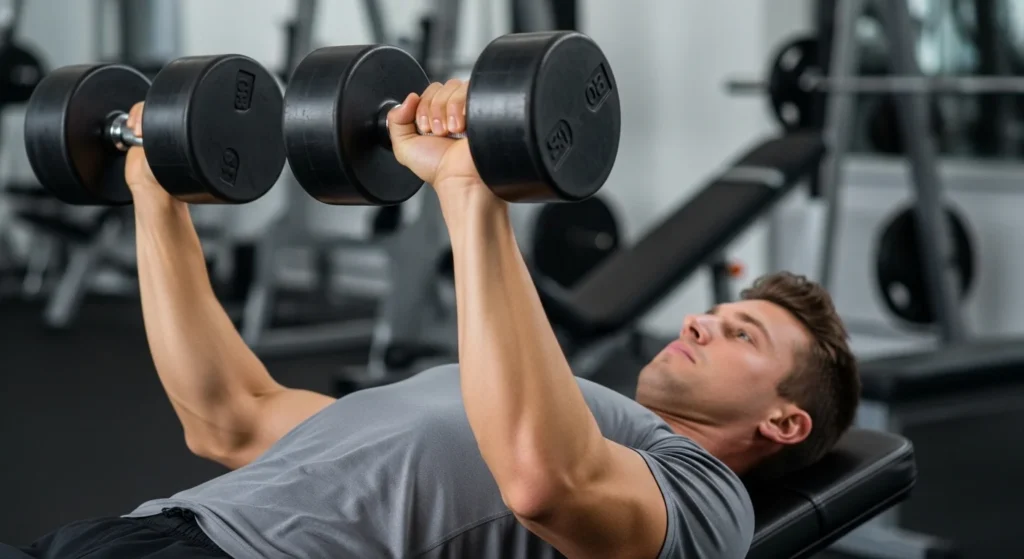
2. Close-Grip Dumbbell Press

What it does: Mimics a close-grip bench press. Heavy compound loading for the triceps, especially the lateral and medial heads. This is your mass-building movement.

How to do it:

  • Lie on a bench or the floor
  • Hold two dumbbells and press them together (or as close as possible) directly over your chest
  • Lower slowly, keeping your elbows tucked — not flared
  • Press back up, maintaining the narrowed grip throughout

Coaching cues:

  • The goal is to keep tension on the triceps, not the chest. If you let the elbows drift wide, it turns into a chest press.
  • The floor press version is a legitimate substitute if you don’t have a bench. The range of motion is shorter, but the triceps still get loaded effectively.

A note on heavy loading: This exercise responds well to progressive overload. It’s one of the few dumbbell tricep movements where you can use meaningful weight. Don’t underestimate it.

3. Skull Crushers

What it does: High-tension eccentric loading across all three tricep heads. One of the best exercises for building thickness in the back of the arm.

How to do it:

  • Lie flat on a bench or the floor
  • Hold dumbbells with arms extended directly over your shoulders (not chest)
  • Lower the dumbbells toward your forehead/temples by bending at the elbows only
  • Keep upper arms as vertical and stationary as possible
  • Press back to full extension

Coaching cues:

  • Don’t let the upper arm drift back toward your head as you lower — that turns the stretch into a shoulder movement
  • The dumbbells should feel like they’re pulling apart as you lower — a sign of proper isolation
  • Floor version: same execution, just stop when your triceps nearly touch the floor

Common mistake: Starting with the dumbbells over the chest instead of the shoulders. Over the chest means the bar path travels backward, loading the shoulder. Over the shoulders means the path is more vertical.

4. Dumbbell Kickback

What it does: Isolates the triceps in the contracted position. It’s overused, often done poorly, and rarely produces the results people expect — but when done correctly, it’s a useful finishing exercise.

How to do it:

  • Hinge forward so your torso is roughly parallel to the floor
  • Upper arm stays pinned parallel to the floor throughout the movement
  • Extend your forearm backward until your arm is fully straight
  • Hold for 1 second, then lower with control

Coaching cues:

  • The upper arm parallel to the floor requirement is non-negotiable. If your elbow is below parallel, you’re using gravity assistance on the way up — the muscle is barely working through most of the range.
  • This is not a heavy exercise. It’s not meant to be. Lightweight, full contraction, controlled return.

Honest assessment: Most people do kickbacks with their elbow drooping, using momentum, and never feeling the tricep. When done right, it’s a solid isolation movement for feeling the lateral and medial heads contract. But if you’re only doing kickbacks and skipping the overhead work, you’re leaving most of your tricep development on the table.

5. Dumbbell Tate Press

What it does: A lesser-known but highly effective exercise that loads the triceps through a different angle than most pressing movements.

How to do it:

  • Lie on your back holding dumbbells directly over your chest, palms facing your feet
  • Bend your elbows outward (elbows flare to the sides, pointing outward)
  • Lower the dumbbells toward your chest, pointing the elbows wide
  • Extend back to the start

Why it’s worth including: The lateral movement of the elbow creates a unique loading position that many trainees have never used. It fills a gap that kickbacks and skull crushers miss.

At home: Works well with any dumbbell, no bench required. The floor version is identical.

6. Single-Arm Overhead Extension

What it does: Same long-head emphasis as the two-hand version, but allows each arm to work independently. Useful for catching side-to-side imbalances.

How to do it:

  • Hold one dumbbell, raise your arm overhead, palm facing inward
  • Keep the upper arm vertical and close to your head
  • Lower the dumbbell behind your head
  • Return to full extension

When to use it over the two-hand version: If one arm is noticeably weaker or you notice your stronger arm compensating, switch to single-arm work for a training cycle. It’s also easier to manage balance on lighter weights.

7. Diamond Push-Up

If you’re training at home with dumbbells, you’re probably open to bodyweight work too. The diamond push-up is one of the most underused tricep exercises in home training.

How to do it:

  • Place hands in a diamond shape (thumbs and forefingers touching) directly under your chest
  • Perform a push-up, keeping your elbows tucked close to your body

When it’s worth adding: When you’re between weight increments on dumbbells, when you want to add volume without adding weight, or as a finisher after pressing work. It’s not glamorous, but it loads the triceps with bodyweight, which for most people is still challenging enough to drive adaptation.

8. JM Press

What it does: A hybrid between a close-grip press and a skull crusher. Popularized by powerlifter JM Blakley. It trains the triceps through a longer range than a standard press, but with more load than a pure skull crusher.

How to do it:

  • Lie flat with dumbbells over your chest
  • Lower by simultaneously bending the elbows and slightly pulling the upper arms back
  • The dumbbells travel toward the chin/neck area
  • Press back to the start by reversing the motion

Be honest about the learning curve: This takes a few sessions to figure out. It doesn’t feel right immediately. But once the movement pattern clicks, it’s a serious tricep builder and a good middle ground between compound pressing and isolation work.

Progression: How to Keep Getting Stronger Over Time

Progressive overload is the only thing that makes muscles grow consistently. The challenge with dumbbell training at home is that weight jumps are often too large — going from 20 lb to 25 lb dumbbells is a 25% increase, which is often too much to handle cleanly.

Here’s how to manage progression realistically:

Rep range progression: If your target is 3 sets of 10, start conservatively and aim to add reps before adding weight. When you can hit 3×12 clean, increase weight and drop back to 3×8–9.

Tempo manipulation: Slow the eccentric (lowering phase) to 3–4 seconds. This increases time under tension without requiring heavier weights. Useful when you’re stuck between weight increments.

Volume cycling: When you can’t add weight or reps, add a set. Going from 3 sets to 4 sets is a legitimate progression step.

What actually happens in real training: Most beginners see fast early gains, then hit a plateau around weeks 8–12, where dumbbells feel heavy, and form starts breaking down. That’s usually a sign to drop weight slightly, rebuild the pattern, and then progress again. Chasing reps with bad form just entrenches poor movement habits.

Mistakes That Stall Progress

Using too much weight on isolation exercises. The overhead extension and skull crusher are not exercises to load heavily. When the form breaks and the shoulders start compensating, the triceps are no longer doing the work. Use the minimum weight that allows clean technique, then progress from there.

Skipping overhead work. This is the biggest gap in most home dumbbell tricep training. The long head is the largest part of the muscle. If you’re only pressing and kicking back, you’re under-developing it.

Training triceps when they’re already fatigued from pressing. If you just did heavy dumbbell chest pressing, your triceps have already absorbed significant volume. Keep that in mind when programming, either place tricep isolation work after pressing or on a separate day.

Not tracking anything. At home, it’s easy to just “do a workout” without tracking sets, reps, or weight. Without tracking, you can’t know if you’re actually progressing. Even a phone note works fine.

Home Gym Realities and Equipment Considerations

Adjustable dumbbells vs. fixed sets: Adjustable dumbbells are more practical for tricep training because the exercises span a wide weight range; you might use 15 lb for kickbacks and 40 lb for close-grip pressing. A full fixed set would cost substantially more and take up far more space.

No bench? The floor works. Range of motion is slightly reduced on pressing exercises, but for tricep isolation work like skull crushers and Tate presses, the floor version is nearly identical. The overhead extension works seated, standing, or kneeling.

Limited ceiling height: Standing overhead extensions require clearance. If your ceiling is low, seated or kneeling variations are the straightforward fix.

Weight limits of adjustable dumbbells: If you’re using a 50 lb adjustable set, you may outgrow it faster than expected on pressing movements. Tricep isolation exercises tend to stay in a lower weight range longer, so this is more of a concern for your pressing work than for dedicated tricep training.

Frequently Asked Questions (FAQs)

How often should I train triceps with dumbbells?

For most people, 2–3 times per week with appropriate volume (10–20 sets total across the week) is sufficient. Triceps also get indirect work during chest and shoulder pressing, so total weekly volume adds up faster than you might think. If you’re doing 4 pressing sessions per week, adding another dedicated tricep day may push recovery past its limit.

Can you build big triceps with just dumbbells?

Yes, but exercise selection matters. The two most common mistakes are skipping overhead work (which limits long head development) and relying only on kickbacks. Add overhead extensions and a pressing movement to your routine, progress consistently, and you’ll see real results.

What weight should I start with for dumbbell tricep exercises?

Start lighter than you think you need to. For overhead extensions, most beginners manage 10–20 lb depending on their pressing history. For close-grip pressing, closer to 25–35 lb is typical. The specific numbers matter less than starting with a weight that allows a clean form; you can always add more.

Why do my elbows hurt during skull crushers?

Usually, one of two things: the dumbbells are starting over your chest instead of your shoulders, or the weight is too heavy, and form is breaking down. Move the starting position over your shoulders and reduce the weight. If pain persists beyond a few sessions, skip skull crushers temporarily and use overhead extensions instead; they tend to be more elbow-friendly.

Are skull crushers or overhead extensions better for tricep growth?

They emphasize slightly different positions. Skull crushers load the long head more through the mid-range; overhead extensions load it more at full stretch. Both have value. If you have to pick one as a beginner, overhead extensions are more versatile and tend to be more elbow-friendly at moderate weights.

Do I need to train triceps separately if I’m already doing chest pressing?

Chest pressing does load the triceps, especially the lateral and medial heads. But the long head is significantly undertrained in flat and incline pressing. Adding one or two sets of overhead extensions is a low-effort way to close that gap.

Conclusion

Tricep workouts with dumbbells are genuinely effective, but only if you build them around the right exercises. The overhead extension is non-negotiable for long head development. A pressing movement (close-grip or JM press) provides the heavy compound loading. Skull crushers add thickness. Kickbacks are finishers, not the foundation.

Most home trainers underestimate how far a well-structured two or three-exercise routine can take them. You don’t need six tricep exercises or a cable machine. You need progressive overload, consistent technique, and enough weekly volume to drive adaptation.

Start simple. Master the overhead extension and close-grip pressing. Add the third and fourth exercises when those feel dialed in. Track your reps and weight. That process, repeated consistently over months, builds arms.


Want to build strong, defined shoulders? Check out How to Do Shoulder Press with Dumbbells for proper form, key benefits, and tips to maximize muscle growth safely.

Keep Reading

Related Articles

Quad Exercises With Dumbbells: 7 Best Moves to Build Bigger, Stronger Legs at Home

July 8, 2026

Gorilla Rows With Dumbbells: The Complete Guide for Better Back Training

July 3, 2026

Sumo Squat with Dumbbells: Proper Form, Benefits, Muscles Worked & Common Mistakes

June 29, 2026

← Back to

Published 

April 26, 2026
Scroll to Top