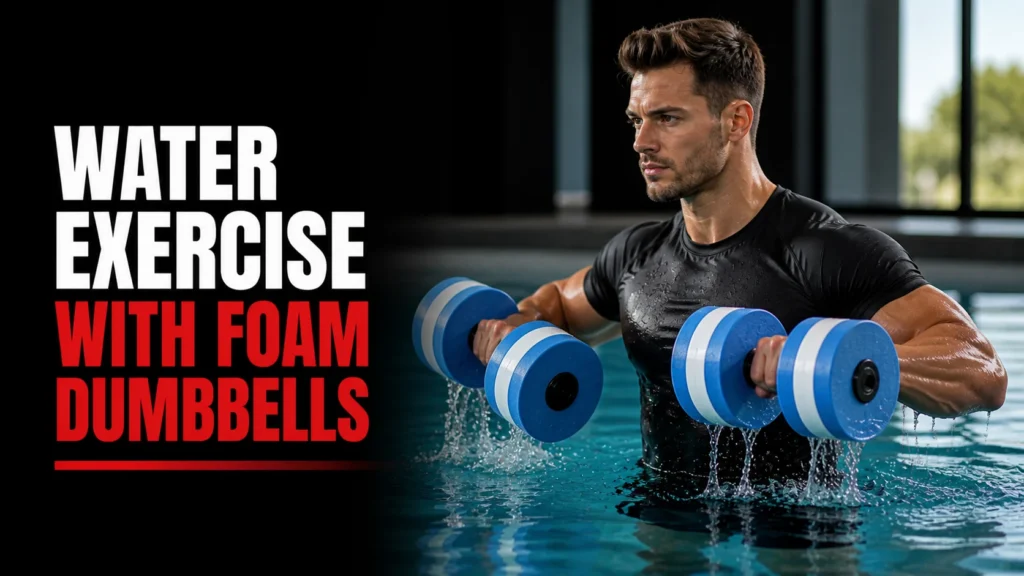
Most people assume pool workouts mean swimming laps or quiet floating. That assumption leaves a genuinely effective training tool sitting unused at the edge of every community pool. Water exercise with foam dumbbells is more demanding than it looks, and the physics behind it are different enough from land training that experienced lifters often get humbled by their first session.
What Foam Dumbbells Are and How They Work in Water
The Direction of Resistance Is Reversed
Foam dumbbells look like gym dumbbells but behave completely differently once submerged. They’re made from closed-cell EVA foam — dense, chlorine-resistant, and nearly weightless on land. Push one underwater and it immediately tries to float back up. That upward force is buoyancy, and it’s where the resistance comes from.
On land, you curl a metal dumbbell against gravity. Up is hard; down is easy. With foam dumbbells in water, pushing down is the work. Letting the buoy rise back toward the surface is the eccentric phase — the part of a repetition where muscles are lengthening under load, which is the phase most associated with strength development and delayed soreness. People who bench press or row significant weight on land often find the shoulder and chest work from foam dumbbells surprisingly taxing because the loading arc is unfamiliar.
There’s a second resistance mechanism beyond buoyancy: drag. Moving any object through water generates friction proportional to that object’s surface area and velocity. Move a foam dumbbell slowly and the drag is modest. Move it quickly and resistance multiplies. This means the same pair of buoys can provide a controlled strength stimulus at slow tempos and a cardiovascular challenge at faster ones — no equipment change needed.
360-Degree Resistance
Land-based resistance tools are directional. A dumbbell resists upward movement. A resistance band resists the direction you’re pulling away from its anchor. Water resists movement in every direction equally, because its density doesn’t care which way you’re pushing. Pull foam dumbbells across the body laterally, sweep them in arcs, push them diagonally toward the pool floor — resistance is present throughout every path. This is genuinely difficult to replicate on land without cable machines.
Why Metal Dumbbells in Water Don’t Work
Metal dumbbells in a pool are a corroding liability that makes controlled movement nearly impossible. The weight of a metal dumbbell combined with the drag of moving it through water makes the load uncontrollable and the risk of injury real. Foam and plastic aquatic dumbbells are built for this specific environment — chlorine-stable materials, quick-drying construction, padded grips that stay comfortable when wet.
The Benefits, With Actual Numbers
What Water Does to Joint Load
Immersed to chest depth, the body experiences approximately 85% reduction in gravitational joint load compared to standing on land. A person who weighs 200 pounds is effectively putting about 30 pounds of stress on their knees, hips, and spine while chest-deep. Exercises that cause genuine pain on land — squats for arthritic knees, lateral raises for rotator cuff problems — often become manageable in water because the compressive forces on joint cartilage drop significantly.
Harvard Health also notes that water’s density slows movement naturally. Jerky, momentum-driven range of motion — the kind that strains tendons during land-based strength training — is hard to produce in water because the medium itself brakes the movement. This isn’t just making exercise easier. It’s making injurious movement mechanics structurally harder to perform.
Calorie Burn and Cardiovascular Load
A moderate 30-minute aquatic session burns roughly 200–400 calories depending on body weight and how hard you’re working. Water also demands thermoregulation — the body expends additional energy maintaining core temperature in a cooler medium, which increases total caloric expenditure by an estimated 5–15% compared to equivalent exercise intensity on land. A 2025 systematic review and meta-analysis published in BMJ Open found that water aerobics programs sustained for 10 or more weeks produced measurable reductions in waist circumference in overweight and obese adults.
Strength and Cardio at the Same Time
Water is 12–14 times more resistant than air, which means every movement performed while submerged demands more muscular effort than its land equivalent even before adding foam dumbbell resistance. Harvard Health describes aquatic exercise as a “double-duty workout” — you’re building cardiovascular fitness and muscular endurance simultaneously, in the same movement, without alternating between machines. Adding foam dumbbells layers buoyant resistance on top of that baseline, targeting the upper body specifically while the cardiovascular demand continues.
The Core Work People Don’t Expect
Standing in moving water requires constant stabilization from the trunk musculature. When you add the force of pushing foam dumbbells below the surface, the rotational demand on the core compounds. Every bicep curl or chest fly becomes a partial core exercise because the torso has to resist the destabilizing forces the dumbbell creates on its way down and up. A common experience among people trying foam dumbbell training for the first time is unexpected soreness in the obliques the next day — not because the session felt hard, but because the stabilization demands were working muscles that rarely get challenged this way.
Who Benefits Most
People with arthritis often get disproportionate relief from aquatic training because the hydrostatic pressure of water provides gentle, even compression around swollen joints, which can reduce inflammation during exercise. Those recovering from shoulder surgery or rotator cuff repair frequently use foam dumbbell work as a stepping stone between complete rest and land-based resistance — the buoyant resistance is controllable in a way that free weights aren’t during early rehabilitation. People managing obesity benefit because body weight alone creates significant impact load during land exercise, and the pool removes that barrier. Older adults gain useful balance training as a side effect, since maintaining stable standing position against moving water challenges the vestibular and proprioceptive systems without the fall consequences present on dry ground.
Picking the Right Foam Dumbbells
Size Is Resistance
Foam dumbbell resistance doesn’t come from a number stamped on the side. It scales with surface area — a larger buoy generates more upward force and more drag. The immediate instinct for many people, particularly those who lift heavy on land, is to grab the largest pair available. This is wrong, and it causes shoulder injuries.
Small buoys (approximately 6 inches in diameter) are the correct starting point regardless of land-based fitness level. The shoulder stabilizers — particularly the rotator cuff muscles — are not accustomed to resisting the specific upward force pattern that foam dumbbells create. Starting large before those muscles are conditioned to this demand leads to elevated, hunched shoulders throughout the session, which puts the rotator cuff in an impingement position. Instructors with 20-plus years of aquatic fitness teaching consistently name oversized buoys as the primary equipment-related cause of shoulder injury in pool classes.
Medium buoys (around 8 inches) suit intermediate exercisers after several weeks of building aquatic movement patterns. Large buoys (10–12 inches) require established shoulder stability and controlled technique throughout the entire session. There’s no shame in spending two months on small buoys before progressing — the resistance on those is already substantial for most people.
Material Matters
EVA foam is the standard and the right choice for most people. It resists chlorine degradation, dries quickly after use, and provides a comfortable grip without added padding. Plastic shell dumbbells create resistance primarily through drag rather than buoyancy, and they appear more in physical therapy settings where a therapist has chosen that specific resistance profile intentionally. For general pool exercise and home pool use, EVA foam with a padded inner handle gives the most comfortable and durable experience.
Grip Design
Sustained gripping fatigues the forearm flexors faster than most people expect. A rubberized or padded handle reduces the clenching impulse and allows a more relaxed hold throughout the session. This matters particularly for people with hand arthritis, circulation issues, or simply anyone planning to train for 40–50 minutes — grip fatigue shifts compensatory forces up the chain into the wrists and shoulders.
Exercises: Technique and What They Target
Bicep Curls
Hold one foam dumbbell with palm facing upward, elbow drawn close to the side. Push the dumbbell downward through the water until the arm is extended. Control its buoyant rise back to the surface as the working phase. Both arms can be worked simultaneously or alternately.
The most common form error is letting the elbow drift away from the torso, which converts a bicep isolation into a shoulder movement. The upper arm stays pinned throughout.
Tricep Pressdowns
Hold both dumbbells in front of the body at roughly water-surface height, arms extended. Without bending the elbows, press both dumbbells downward until they contact the thighs. Control the return. The triceps do the pushing work on the downward phase and receive an eccentric challenge on the ascent.
Chest Flies
Lean slightly forward so the torso approaches parallel to the pool floor, knees bent. Extend both arms out to each side with dumbbells submerged. Using the chest muscles rather than shoulder momentum, sweep both arms inward until the dumbbells meet below the sternum. Return slowly. This replicates a cable fly — a movement that genuinely benefits from the continuous resistance water provides throughout the arc of motion.
Lateral Raises
Stand upright with dumbbells at the sides, submerged. Raise both arms laterally until they’re level with the shoulders. Lower with control. The resistance profile here differs from land lateral raises because you’re pushing downward through water on the ascent, then resisting the buoyant rise on the way down — both phases load the deltoids differently than gravity alone.
Shoulder Shrugs
Hold both dumbbells submerged at the sides. Shrug both shoulders as high as possible, focusing on the trapezius contraction. Press the dumbbells back down to return to the starting position. This is a useful exercise for people with cervical spine sensitivity who can’t load the trap effectively through barbell shrugs.
Vertical Push-Downs
Hold both dumbbells next to each other, horizontal, at the water’s surface. Press them straight down to thigh level. Control the ascent. The anterior deltoid and chest do significant work here — this is often harder than it looks for people whose shoulder stability is primarily trained through pressing movements rather than downward pushing.
Dumbbell Dips
Stand with the dumbbells at the sides, elbows slightly bent. Pull the dumbbells upward along the sides of the torso toward the armpits, then press them back down. This targets the lats, teres major, and posterior deltoid through a range that some people find impossible with land-based dip equipment.
Deep Water Plank
This requires a buoyancy belt. Grip both dumbbells and lean forward into a horizontal body position, using the buoys as stabilizing anchors against the water’s surface. Hold for 20–40 seconds. The core, hip flexors, and shoulder stabilizers all work to maintain position against water movement. This is substantially harder than a land plank because the instability is multidirectional.
Form and Safety
The Shoulder Is Where Things Go Wrong
Every foam dumbbell exercise loads the shoulder through the pushing-down mechanism. The rotator cuff — a set of four smaller muscles that stabilize the glenohumeral joint — is doing stabilization work throughout every repetition. When shoulders are elevated or hunched, the rotator cuff is in an impingement position, meaning the tendons are being compressed between bones with each movement cycle. Pinching or sharp pain at the top of the shoulder during any foam dumbbell exercise is an impingement signal. Reduce buoy size, shorten range of motion, or stop.
Maintain neutral shoulder alignment throughout every set: blades slightly retracted and depressed, not creeping toward the ears. This applies even when the exercise is working the biceps or chest — the shoulder position determines whether the stabilizers are protecting the joint or being ground into it.
Alternate Equipment and Non-Equipment Segments
Never hold foam dumbbells through an entire workout session without giving the hands a break. Forearm flexor fatigue under sustained gripping leads to compensatory shoulder tension that accumulates across the session. Any well-structured aquatic fitness class alternates between equipment and no-equipment intervals. The same principle applies to solo training.
Depth and Buoyancy Belts
Waist-to-chest-deep water is the right environment for all standard foam dumbbell exercises. Deep water is available for advanced users who want the added stability challenge, but a buoyancy belt is not optional in that context — without it, the body fights to stay afloat rather than focusing on the exercise mechanics. The buoyancy belt keeps you in the correct anatomical position so the exercises work as designed.
Water Temperature and Warm-Up
Pool water between 83–88 degrees Fahrenheit suits most aquatic fitness use. Cooler water increases caloric expenditure through thermoregulation but also reduces muscle tissue elasticity. Start every session with 5–10 minutes of lighter movement — water walking, arm swings, gradual movement escalation — before adding foam dumbbell resistance. Working cold muscle tissue hard is how strains happen, and the pool environment creates a false sense of warmth that makes skipping the warm-up feel like a smaller risk than it is.
Foam Dumbbells vs. Other Aquatic Equipment
Resistance Gloves
Water resistance gloves add webbing between the fingers to increase drag during open-hand movements. They’re more useful for swimming-based training and exercises that use sweeping arm movements. They can’t replicate buoyant resistance — the upward force the foam creates when pushed below the surface — which is the distinctive stimulus foam dumbbells offer. Both have a place in a varied aquatic program.
Pool Noodles as Substitutes
A pool noodle cut into quarters produces hand-sized sections that work on the same buoyancy principle as foam dumbbells. The resistance is less structured because the shape isn’t designed for grip, but the physics are the same. This is confirmed in professional aquatic instruction literature — noodle sections are a legitimate substitute for learning movement patterns before investing in dedicated equipment.
Ankle Weights
Ankle weights create downward gravitational resistance on the legs and primarily target hip flexors, hip extensors, and quadriceps during leg raise movements. They don’t replicate what foam dumbbells do for the upper body and core. These are complementary tools for a complete aquatic training program, not interchangeable ones.
Progressive Training Over 8 Weeks
Weeks 1–2 focus on adaptation — learning the mechanics of buoyant resistance, identifying the right buoy size, and developing shoulder position awareness. Three sessions per week at 25–30 minutes is sufficient. Intensity isn’t the priority yet.
Weeks 3–4 add one set per exercise and introduce slow eccentric control for two exercises per session. Mix in no-equipment cardio intervals between circuits to develop cardiovascular conditioning alongside strength.
Weeks 5–8 introduce medium buoys if small buoys have become genuinely easy across full sessions with clean form. Add the deep water plank with buoyancy belt. Extend session length to 40–45 minutes. Begin tracking repetitions to monitor progressive overload.
After 8–10 weeks of consistent training, shoulder endurance improves noticeably, joint pain during daily activities often decreases, and the stabilizer muscles supporting the shoulder and spine are better conditioned than they were before. At this point, foam dumbbell sessions fit naturally into a broader schedule — two or three pool sessions per week alongside land-based training, or as a primary training modality for those whose joints make land exercise impractical.
Mistakes That Reduce Results or Cause Injury
Grabbing oversized buoys first is the most documented error in aquatic fitness instruction. People assume larger means more productive. In practice, buoys that exceed the current capacity of the shoulder stabilizers force the shoulders to hunch and elevate as a compensation strategy. That position puts the rotator cuff in sustained impingement throughout the session.
Waving the dumbbells above the water line produces no training effect. Buoyancy only creates resistance below the surface. Lifting foam into air just moves foam through air, which is trivially easy and accomplishes nothing useful. All effective foam dumbbell exercise happens underwater.
Holding the grips continuously for the full session fatigues the forearms faster than the target muscle groups and shortens the productive portion of the workout. Alternate between equipment and no-equipment segments throughout.
Skipping the warm-up because pool water “feels fine” ignores the thermal reality. Water at 84 degrees is substantially cooler than core body temperature, and muscles working in that environment are cooler and less extensible than they’d be after an adequate warm-up. Starting heavy and fast in cool muscle tissue is where aquatic strains originate.
Frequently Asked Questions (FAQs)
Can water exercise with foam dumbbells build real muscle?
Yes, though the stimulus is different from heavy land-based loading. Buoyant resistance through a controlled range of motion with slow eccentric phases creates genuine strength and hypertrophy stimulus, particularly in the shoulder complex, chest, upper back, and arms. Research on aquatic resistance programs consistently documents increases in lean body mass. For people whose primary goal is maximal muscle size, land-based progressive overload will outperform water training. For functional strength, shoulder endurance, and muscle maintenance — especially for those who can’t load heavily on land — foam dumbbell work is legitimate resistance training, not a watered-down substitute.
How many times per week should I train with water dumbbells?
Two to three sessions per week is the sweet spot for most people. Daily training without recovery days prevents the muscle adaptation process. Because aquatic training is low-impact, recovery between sessions tends to be faster than after equivalent land-based training, making three sessions per week consistently sustainable.
Do I need to know how to swim?
No. All standard foam dumbbell exercises are performed standing in waist-to-chest-deep water with your face above the surface the entire time. Non-swimmers can participate fully in shallow-water sessions. Deep-water variations require a buoyancy belt and comfort with not touching the pool floor, but actual swimming ability is not part of the equation.
Will this help with weight loss?
A 30–60-minute moderate session burns 200–500 calories. A 2025 BMJ Open meta-analysis found that 10 or more weeks of consistent water aerobics produced measurable waist circumference reductions in overweight and obese adults. Weight loss depends on total energy balance — aquatic exercise contributes meaningfully to expenditure and, for many people, allows consistent training that would be painful or impossible on land.
Is it safe for shoulder injuries?
It can be, and physical therapists do use aquatic resistance training in shoulder rehabilitation programs. The buoyant resistance is controllable and the water environment reduces overall joint stress. Anyone working through an active shoulder injury, post-surgical recovery, or diagnosed rotator cuff pathology should confirm exercise selection and load parameters with their treating clinician before training independently.
What is the difference between foam dumbbells and water weights?
“Water weights” is an umbrella term covering foam dumbbells, strap-on wrist and ankle weights designed for pool use, and various plastic resistance devices. Foam dumbbells specifically are the bar-and-buoy shaped equipment that creates resistance through buoyancy when submerged. They’re the most common tool in aquatic fitness classes and the equipment this guide focuses on.
Are they safe for older adults?
Aquatic resistance training with foam dumbbells is well-suited to older adults because it addresses the most common exercise barriers in this population: joint pain, fall risk, and difficulty sustaining higher-impact activity. The resistance is scalable through buoy size selection, the pool environment eliminates fall impact, and the stabilization demands of working in water provide a low-risk form of balance training.
Do they work for lower body exercises?
Not directly — foam dumbbells are designed for upper body and core loading. The water environment provides lower body resistance during any standing exercise as the legs stabilize the body, but for dedicated lower body aquatic training, ankle resistance bands and pool wall leg raises target those muscle groups more effectively.
How do I progress between buoy sizes?
Start with small (6-inch) buoys, stay there until small feels genuinely manageable across complete sets with clean shoulder mechanics, then move to medium (8-inch). Large buoys (10–12 inches) require established shoulder stabilizer capacity and no rotator cuff history that would make sustained impingement risk dangerous. The progression is slower than land-based weight increases because the shoulder stabilizers adapt on their own timeline.
Can pool noodles substitute for foam dumbbells?
A pool noodle cut into quarters works on the same buoyancy principle and is confirmed as a functional substitute in professional aquatic instruction literature. The grip is less ergonomic, but the physics are identical. For anyone testing the format before buying dedicated equipment, noodle sections are a cost-free way to learn the movement patterns.
In conclusion
Water exercise with foam dumbbells is genuinely demanding in ways that aren’t obvious from the outside. The buoyant resistance inverts the normal direction of loading, the 360-degree drag challenges muscles through planes of motion that land training rarely touches, and the stabilization demands on the core and shoulder complex are continuous throughout every exercise. The pool environment that makes this look easy is the same environment creating those demands.
The common errors are consistent: buoys that are too large for current shoulder capacity, dumbbells waved above the waterline where no resistance exists, continuous gripping without hand breaks, and skipping the warm-up in water that feels comfortable but is cooler than the muscles need.
Start with small buoys, respect the shoulder stabilizer adaptation curve, alternate equipment and no-equipment segments within sessions, and this becomes one of the more effective training tools available to anyone whose joints make land-based resistance work difficult or painful. The physics are what they are — and they work.
Want a low-impact way to build strength and burn calories? Check out Water Dumbbell Workouts to learn how these pool-based exercises use water resistance to train your muscles, improve cardio, and protect your joints at the same time.