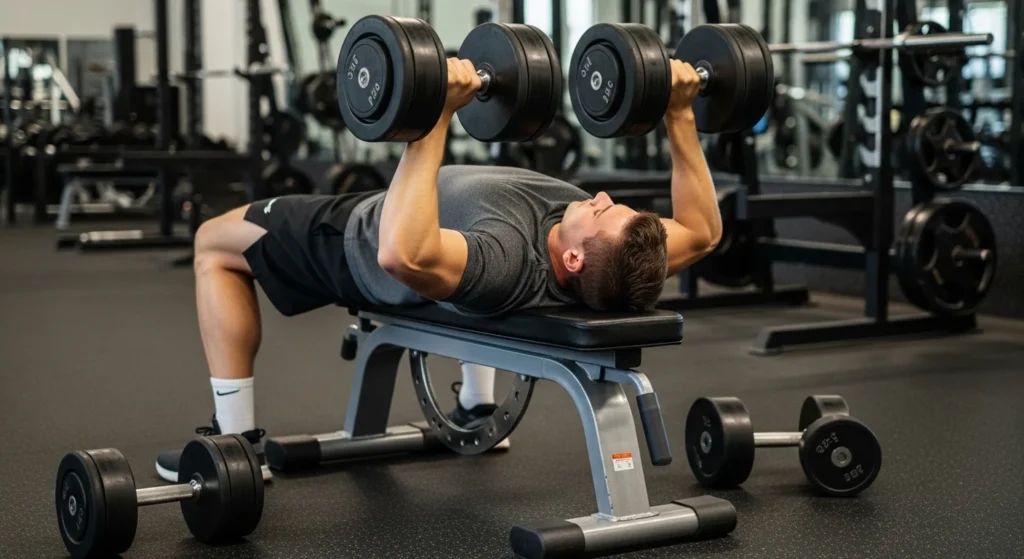
The dumbbell floor press is one of the most effective upper-body pressing variations used in modern strength training programs to develop chest and triceps power while minimizing shoulder stress. It eliminates the deep stretch phase of a bench press, which makes it highly joint-friendly and ideal for controlled strength development.
Fitness professionals often recommend this movement as a foundational pressing pattern for athletes, beginners, and lifters recovering from shoulder discomfort. The simplicity of the setup also makes it one of the most accessible exercises for home workouts.
Understanding the Dumbbell Floor Press
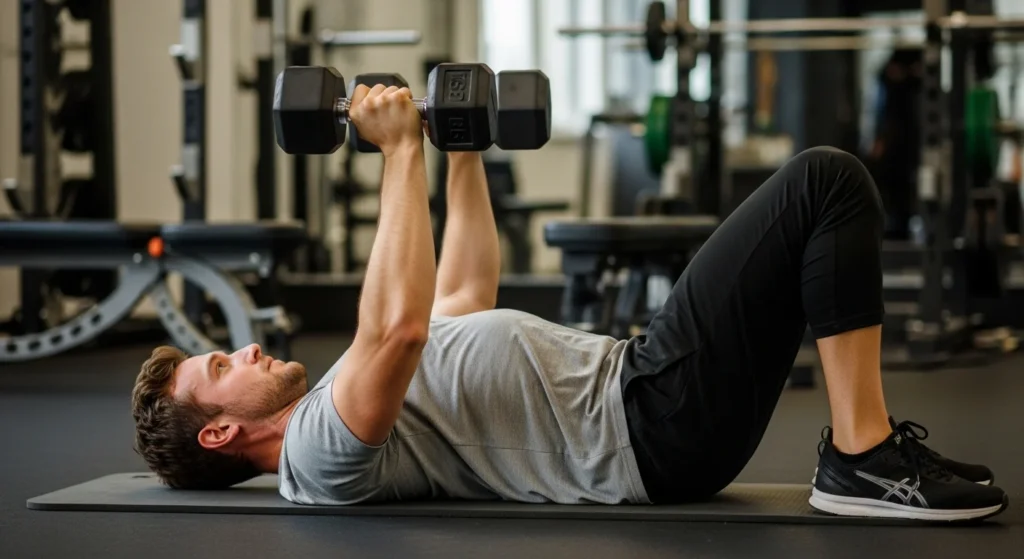
The dumbbell floor press is a compound resistance exercise performed while lying on the floor, pressing dumbbells vertically until full arm extension is reached. The floor limits elbow depth, which reduces shoulder extension and places more emphasis on triceps activation.
Unlike machine presses or barbell bench presses, this movement requires independent control of each arm, improving muscular balance and coordination.
The exercise is widely used in strength conditioning, bodybuilding, rehabilitation training, and functional fitness programs due to its versatility and safety profile.
Muscles Targeted in Dumbbell Floor Press
Primary Muscles
The pectoralis major drives the pressing motion, contributing significantly to chest development and upper-body pushing strength.
Secondary Muscles
The triceps brachii are heavily engaged during lockout, making the movement highly effective for arm strength development.
The anterior deltoids assist in stabilizing and initiating the pressing phase, ensuring smooth movement execution.
Stabilizing Muscles
The core muscles, including the rectus abdominis and obliques, maintain body stability during the lift, while the serratus anterior supports scapular positioning.
Step-by-Step Execution of Dumbbell Floor Press
Step 1: Prepare Your Position
Lie on a flat surface with knees bent and feet firmly grounded to enhance balance and stability.
Step 2: Hold Dumbbells Correctly
Grip the dumbbells with neutral or slightly angled wrists and position them near chest level.
Step 3: Engage Core Muscles
Activate your core to maintain spinal alignment and prevent excessive arching.
Step 4: Press Upward
Push the dumbbells upward in a controlled motion until arms are nearly fully extended.
Step 5: Pause at Top Position
Hold briefly at the top to maximize contraction and control.
Step 6: Lower with Control
Bring the dumbbells back down slowly until your elbows touch the floor.
Benefits of Dumbbell Floor Press
Enhanced Triceps Development
The shortened range of motion shifts emphasis toward triceps strength, improving lockout performance in other pressing movements.
Reduced Shoulder Stress
Limiting deep shoulder extension makes this exercise safer for individuals with joint sensitivity or past injuries.
Improved Pressing Strength
The controlled environment helps build raw pressing power, which translates to better bench press performance.
Better Muscle Symmetry
Independent arm movement ensures balanced strength development between both sides of the body.
Convenient Home Exercise
The lack of a bench requirement makes it ideal for minimal equipment training setups.
Dumbbell Floor Press vs Bench Press
The bench press allows a greater range of motion, which increases chest stretch and hypertrophy potential, while the floor press prioritizes triceps engagement and joint safety.
The floor press also reduces shoulder involvement at the bottom phase, making it more controlled and less injury-prone.
Both exercises complement each other and should be included strategically in a balanced training program.
Common Mistakes in Dumbbell Floor Press
- Many lifters fail to maximize results due to improper execution habits.
- One common error is flaring elbows too wide, which places unnecessary stress on shoulder joints.
- Another mistake is using excessive weight that compromises control and reduces time under tension.
- Some lifters also rush repetitions instead of maintaining slow and controlled movement patterns.
- Improper wrist alignment can also lead to discomfort and reduced pressing efficiency.
Variations of Dumbbell Floor Press
Neutral Grip Variation
This variation reduces shoulder strain and enhances comfort during pressing.
Single-Arm Floor Press
This version improves core stability and corrects muscular imbalances.
Explosive Floor Press
Used for power development, this variation emphasizes speed during the pressing phase.
Training Tips for Maximum Results
- Focus on progressive overload by gradually increasing weight or repetitions over time.
- Maintain strict form rather than chasing heavier loads prematurely.
- Incorporate tempo training by slowing the lowering phase to increase muscle tension.
- Use full concentration on chest contraction instead of relying on momentum.
Programming the Dumbbell Floor Press
- Beginners should perform moderate sets focusing on learning proper form before increasing intensity.
- Intermediate lifters benefit from moderate to heavy loads with structured rep ranges for strength development.
- Advanced athletes can integrate the exercise into power-focused training splits or accessory pressing days.
Who Should Use Dumbbell Floor Press
This exercise is ideal for beginners learning pressing mechanics and experienced lifters seeking triceps-focused overload.
It is also beneficial for athletes recovering from shoulder strain who need controlled movement patterns.
Home fitness enthusiasts can use it as a primary chest exercise when equipment is limited.
Safety Considerations
- Always maintain neutral wrist positioning to avoid joint stress.
- Avoid dropping elbows too fast during the lowering phase.
- Ensure the floor surface is stable and non-slippery.
- Warm up shoulder joints properly before lifting heavier weights.
Frequently Asked Questions (FAQs)
Is dumbbell floor press effective for building chest muscle?
Yes, it effectively builds chest strength while emphasizing triceps involvement due to reduced range of motion.
Is dumbbell floor press safer than bench press?
It is generally considered safer for shoulders because it limits deep shoulder extension.
Can beginners do dumbbell floor press?
Beginners can safely perform it with light weights and proper guidance.
What is the difference between floor press and bench press?
The floor press limits elbow depth, reducing chest stretch but increasing triceps focus.
How heavy should I go on dumbbell floor press?
Start with moderate weights that allow controlled movement without compromising form.
Does dumbbell floor press build triceps?
Yes, it significantly engages the triceps during the lockout phase.
How many sets should I do?
Most lifters benefit from 3 to 5 sets depending on experience level.
Can I do it at home?
Yes, it is one of the best home-friendly chest exercises requiring only dumbbells.
Should I pause on the floor?
A brief pause increases tension and improves strength development.
Is it good for shoulder pain?
It can be beneficial for some individuals, but persistent pain should be evaluated professionally.
Want to build a stronger, more defined chest? Learn the correct technique in this guide on How to Do Dumbbell Chest Press Correctly to improve form, strength, and muscle activation.