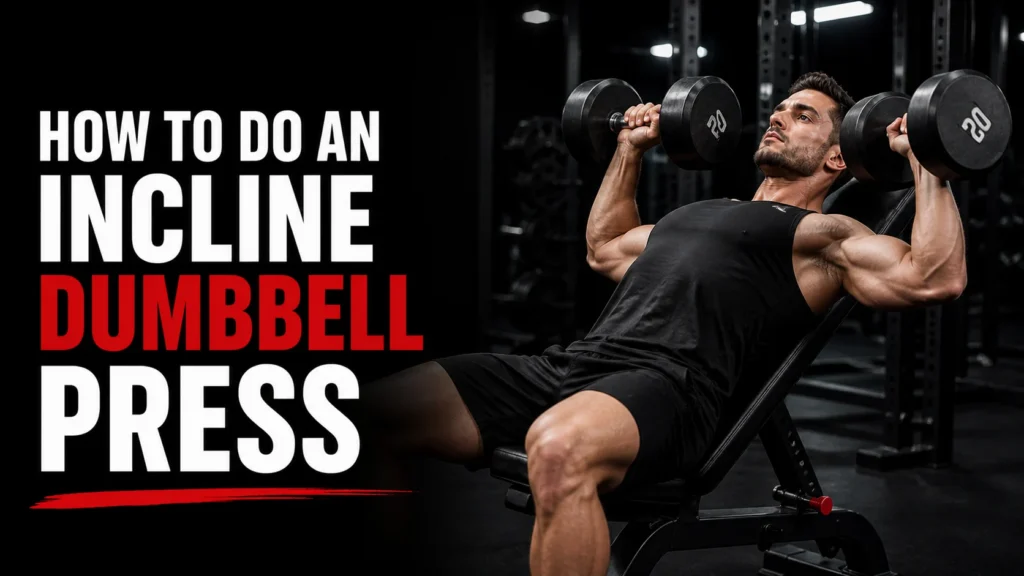
Most people who train chest consistently still end up with a flat, underdeveloped upper pec shelf. It’s one of the most common aesthetic complaints in the gym, and the fix usually comes down to one exercise done correctly: the incline dumbbell press.
What Is the Incline Dumbbell Press?
The incline dumbbell press is a compound upper-body pressing movement performed on an adjustable bench set at an angle, using two independent dumbbells. Unlike a flat bench press, the inclined position shifts the line of force upward, placing greater mechanical demand on the clavicular head of the pectoralis major — the fibers that run along the top of the chest near the collarbone.
It goes by several names: incline chest press, incline dumbbell bench press. The mechanics are the same regardless. You press the dumbbells from a position near your upper chest to full arm extension, working against the angle of gravity created by the bench.
The use of dumbbells rather than a barbell introduces one critical difference: each arm moves independently. There’s no bar connecting both hands, which means the stronger side can’t compensate for the weaker one. That’s frustrating when you’re new to the movement, but it’s exactly why dumbbells tend to produce more balanced development over time.
Muscles Worked During the Incline Dumbbell Press
Pectoralis Major — Clavicular Head
This is the upper portion of the chest, running from the collarbone down toward the sternum. It’s the primary target. A 2020 study in the International Journal of Environmental Research and Public Health found that a 30-degree inclination produces greater activation of the upper portion of the pectoralis major compared to other angles. Most lifters never train this area hard enough with flat pressing alone, which is why the upper chest lags even on people who bench press regularly.
Anterior Deltoid
The front shoulder head works during any inclined pressing pattern. Research using EMG confirms that inclinations greater than 45 degrees produce significantly higher activation of the anterior deltoid and decrease muscular performance of the pectoralis major. In other words, the angle of the bench determines whether you’re primarily training your chest or your shoulder — more on this below.
Triceps Brachii
The triceps extend the elbow through the press. They’re not the focus, but they contribute meaningfully — especially in the final portion of the press as the arms approach lockout.
Rotator Cuff (Stabilizers)
Because of the greater instability inherent to dumbbell pressing, the rotator cuff works more to maintain shoulder stability and coordination than it would during barbell pressing. This isn’t a weakness of dumbbells — it’s a feature. Stronger rotator cuffs mean more long-term shoulder health.
Core and Serratus Anterior
The abdominals and lower back hold the torso stable against the bench throughout the movement. The serratus anterior, running along the ribcage, helps control scapular movement as the arms extend. Neither is the primary focus, but both are working every rep.
Why This Movement Belongs in Your Program
It Trains the Part of the Chest Most People Neglect
The upper chest is often underdeveloped compared to the middle and lower regions, and the incline dumbbell press specifically targets the clavicular portion of the pectorals that flat pressing tends to underwork. The result of ignoring incline work is a chest that looks full in the middle and hollow at the top — a common look even among experienced lifters who live on flat bench.
Dumbbells Allow a More Natural Arc of Motion
A barbell locks both arms into the same fixed path. If your shoulder anatomy doesn’t suit that path exactly, you’ll feel it over time. Dumbbells allow for a personalized range of motion, making it easier to find a pressing arc that suits you — particularly if incline barbell pressing feels awkward on your shoulders.
It Reveals and Corrects Strength Imbalances
Dumbbells improve muscle symmetry and stabilization by forcing each arm to work independently, preventing any potential compensation from the stronger side. The moment you start pressing with dumbbells instead of a barbell, any side-to-side strength difference becomes obvious. Letting the weaker side dictate the pace corrects those imbalances over time.
Real-World Carryover
For someone training recreationally to maintain strength or quality of life, incline dumbbell chest pressing helps with overhead activities due to the increased involvement of the upper chest and shoulders — including actions like lifting a suitcase into an overhead bin. For athletes in overhead sports like volleyball, tennis, or baseball, the strength built through this pattern transfers directly into force production through the shoulder.
The Ideal Bench Angle: What the Research Actually Says
Walk into most gyms and you’ll see incline benches parked at 45 or even 60 degrees. Those aren’t necessarily wrong, but they’re not optimal for upper chest development.
Research indicates the correct incline bench press angle is 30 degrees from flat to target the upper chest for muscle growth. At 30 degrees, the strain is placed on the upper pecs while minimizing the effect on the anterior deltoid muscles. Push the angle to 60 degrees and the front deltoid dominates — it becomes more of a shoulder exercise than a chest exercise, regardless of your intent.
The 30-to-45-degree range covers most lifters well. Bias toward 30 if upper chest is the priority. Use 45 if you want more shoulder involvement alongside upper chest. Stay below 45 when the goal is pectoral development.
One reason this matters: the anterior deltoid and upper chest fibers are anatomically close to each other, and the front delt is chronically overworked in most training programs. It will happily take over an incline press if the angle gives it the opportunity. Keeping the bench low forces the chest to stay in charge.
How to Do the Incline Dumbbell Press: Step-by-Step
Equipment Setup
Set the adjustable bench to 30–45 degrees. Most benches have a pin on the back or side — pull it, reposition the backrest, and lock it in. Select dumbbells that allow clean, controlled reps across 8–12 repetitions. If this is new to you, go lighter than instinct suggests.
Getting Into Position
Sit on the edge of the bench with the dumbbells resting on your thighs. To get into position, lay back while keeping the weights close to your chest. The classic technique is to “kick” the dumbbells up one at a time using your thighs as leverage as you lower yourself back — it’s the safest way to get heavier weights into position without straining the shoulder.
Once lying back, position the dumbbells at chest height with palms facing forward or slightly inward toward each other. Pull the shoulder blades back and down into the bench. This scapular retraction creates a stable base and reduces anterior shoulder stress. Plant both feet flat on the floor and brace the core lightly.
The Press
Press the dumbbells toward the ceiling. Your palms should be facing forward. Rotate your shoulders outward to engage your lats. Your upper back should remain tight and stable throughout the entire set.
Your elbows should track at roughly a 45-degree angle from the torso — not flared perpendicular to the body, and not pinned against the sides. Press in a slight arc so the dumbbells converge slightly at the top. They don’t need to touch, but they should approach each other. Maintain distance between the dumbbells at the end of the repetition to keep the chest under tension rather than offloading it at lockout.
Pause briefly at the top and squeeze the upper chest actively. This peak contraction improves the mind-muscle connection and ensures you’re not just going through a mechanical motion.
The Descent
Lower the dumbbells with deliberate control. The eccentric portion — the lowering — generates significant hypertrophic stimulus. The descent in the incline dumbbell bench press is equally as important as the ascent, and controlling it will drive more muscle growth. Aim for a 2–3 second lowering phase.
Aim to lower the dumbbells toward your upper chest, near or just below the collarbones. This is different from flat pressing, where the bar travels to mid-chest. On the incline, lowering too far down reduces the quality of the upper chest stretch and shifts the mechanics closer to flat pressing.
Lower until the upper arms are roughly parallel to the floor or slightly past, producing a genuine stretch across the upper chest. Then exhale and press into the next rep.
Exiting Safely
Ideally, bring your knees up so the ends of the dumbbells are touching your thighs, then use the weight of the dumbbells to rock back to an upright, seated position. Don’t drop heavy dumbbells sideways off the bench unless you’re experienced with that technique and the floor space is clear.
The Most Common Mistakes and How to Fix Them
Setting the Bench Too High
Setting the incline bench too high, above 45 degrees, shifts the focus from your chest to your shoulders. This is the most widespread technical error. Lower the bench to 30–40 degrees and you’ll often notice immediately that the upper chest is working harder than it was before.
Elbow Flare
Allowing the elbows to flare out to 90 degrees places undue stress on the shoulder joints. Keep your elbows at a 45-degree angle from your torso — this engages the chest effectively while protecting the shoulders. The 45-degree elbow angle is a consistent recommendation across sports medicine and strength coaching literature, and it’s biomechanically sound.
Too Much Weight
This single mistake cascades into nearly every other form error. When the load is too heavy, lifters shorten the range of motion, lose scapular retraction, arch the lower back off the bench, and recruit more shoulder than chest. Choose a weight that allows you to maintain full control throughout the movement — quality first, then progressively increase weight.
Losing Scapular Retraction
Shoulder blades should stay pulled back and down against the bench through every rep. Maintain constant upper back tension with the shoulder blades pulled back and down. The cue “crack a walnut between your shoulder blades” helps maintain this position. When scapulae start sliding forward mid-set, the shoulder rolls forward with them and the upper chest loses tension.
Bouncing at the Bottom
Quickly lowering the weights and bouncing at the bottom uses momentum instead of muscle action, diminishing the exercise’s effectiveness and increasing injury risk. Lower deliberately, make contact near the upper chest, pause briefly, and press from a controlled position. Every rep should look the same.
Excessive Lower Back Arch
A slight natural lumbar curve is normal during pressing. Excessive arching changes the pressing angle toward flat or decline, defeats the purpose of the incline, and potentially strains the lower back. If the arch is dramatic, the weight is too heavy or the hip placement on the bench needs adjustment.
Incomplete Range of Motion
Not locking out at the top or not bringing the dumbbells all the way down at the bottom is one of the biggest incline dumbbell bench press mistakes — by reducing the range of motion, you are only self-sabotaging. Full range of motion means fully extending the arms at the top (without hyperextending the elbow) and lowering until a meaningful stretch is felt at the bottom.
Useful Variations
Neutral Grip Incline Dumbbell Press
Palms face each other throughout, rather than facing forward. This grip often reduces anterior shoulder stress and can feel more comfortable for lifters with shoulder issues. The triceps take on slightly more work in this variation, and the shoulder external rotation demand decreases.
Incline Hex Press
The movement and angle of the incline are identical to the standard press. Both dumbbells are pressed together with palms facing inward and they remain in contact throughout the movement. This variation is great for activating the inner chest while also working the upper chest, and the triceps are used somewhat more than in the standard incline press.
Single-Arm Incline Dumbbell Press
Pressing one dumbbell at a time forces the core to resist rotational forces. The stability demand is substantially higher than the two-arm version — start lighter than expected. This variation is useful for addressing unilateral weakness and building coordination.
Paused Incline Dumbbell Press
Add a 1–2 second pause at the bottom of each rep with the dumbbells near the upper chest. Eliminating the stretch reflex forces the chest to generate force from a dead stop, increasing muscular demand. Implementing paused reps is a useful technique for intermediate lifters looking to increase upper chest stimulus and work past plateaus.
Incline Dumbbell Fly-to-Press
Start each rep with a wide fly arc at the bottom, then transition into a press as you drive the weights upward. Use substantially lighter weight than your standard press. This hybrid movement combines the stretch from the fly with the loaded mechanics of the press, producing a longer range of motion and a deeper chest stimulus.
How to Program the Incline Dumbbell Press
Beginners (0–6 months)
Start with a weight that allows 10–12 controlled repetitions with proper form, focusing on learning the movement pattern and developing the mind-muscle connection with the upper chest. Aim for 2–3 sets, training chest 1–2 times per week. The priority at this stage isn’t load — it’s developing the neuromuscular connection with the upper chest so heavier training eventually produces results.
Intermediate Lifters (6 months – 2 years)
Aim for 3–5 sets of 8–12 reps with moderate to heavy weights that challenge the muscles by the last rep of each set. Train chest 1–2 times per week, ensuring at least 48 hours of rest between sessions targeting the same muscle groups. Progressive overload becomes the primary driver here — adding weight or reps systematically over weeks and months.
Advanced Lifters (2+ years)
Utilize periodization with varied rep ranges: 6–8 for strength, 8–12 for hypertrophy, 12–15 for muscular endurance. Advanced techniques like drop sets, rest-pause training, or mechanical drop sets (changing bench angles within a set) can be cycled in periodically. Rest periods of 2–3 minutes for strength work, 60–90 seconds for hypertrophy work.
Where It Fits in a Session
The incline dumbbell press works best at the start of a chest or push session, before isolation work. If upper chest development is a lagging priority, make it the first movement of the workout when strength and focus are both at their peak. Isolation exercises like cable flyes and pec-deck are better saved for the end of a session when the pressing work is done.
How to Actually Feel the Upper Chest Working
Many lifters perform this exercise correctly on paper but still feel it mostly in the shoulders. These strategies help develop better muscle activation:
Intentional pre-set activation: Before picking up the dumbbells, place a hand on your upper chest and consciously flex it. This takes about five seconds and improves the neuromuscular signal during the actual set.
Peak contraction hold: At the top of each rep, before beginning the descent, squeeze the chest actively rather than just pausing. The difference between mindlessly reaching lockout and actively contracting is significant for muscle development over time.
Slow eccentric focus: Lengthen the descent to 3 seconds and focus on feeling the stretch across the upper chest as the dumbbells descend. This stretch sensation is confirmation that the right muscle is being loaded through its full range.
Bench angle experimentation: If the shoulder is consistently dominating, lower the bench by another 5–10 degrees and see whether the upper chest recruitment improves.
Shoulder Health and Safety Considerations
The incline dumbbell press is generally more shoulder-friendly than the flat barbell bench press. The dumbbell version is also likely to present less stress for the shoulders than the barbell version due to the more flexible positioning of the dumbbells and shoulders, making it a more comfortable movement for some lifters.
That said, certain errors consistently create shoulder problems regardless of the implement: excessive bench angle, elbow flare, lowering the dumbbells too far below the chest, and loading too heavily too fast.
For lifters with existing anterior shoulder issues, the neutral grip variation is often the most comfortable option. It reduces external rotation demand at the shoulder joint. If you have diagnosed rotator cuff pathology or impingement, clear the movement with a physical therapist before loading it.
A proper warm-up before heavy pressing takes only a few minutes. Band pull-aparts, face pulls, and light rotator cuff activation work done before the first working set reduce injury risk meaningfully — especially in cold weather or if you’re jumping straight from a desk to the gym.
Frequently Asked Questions (FAQs)
What angle should I set the bench for the incline dumbbell press?
Thirty degrees is supported by EMG research as the optimal angle for upper chest activation with minimum anterior deltoid dominance. A range of 30–45 degrees works for most lifters — lower angles bias the chest, higher angles bring in more shoulder. Staying below 45 degrees is important when upper chest development is the goal.
How is the incline dumbbell press different from the incline barbell press?
With a barbell, you are fixed into one bar path which may or may not suit your anatomy. With dumbbells, you get another degree of freedom, which makes it easier to find a range of motion that suits you. Dumbbells also make it easier to find and address side-to-side differences in strength.
How much weight should I use?
Start with a weight that allows 10–12 controlled reps with two reps left in reserve at the end of the set. Most people press noticeably less on incline than on flat due to the different leverage and greater shoulder involvement. That’s normal — go lighter and build from there.
Can I do this without a bench?
Improvised solutions like stairs or folded cushions can approximate an incline but lack stability and limit safe loading. An adjustable bench is the right tool. For home gym training, it’s one of the higher-value equipment purchases given how many exercises it enables.
Why can’t I feel my upper chest working?
The most likely cause is that the anterior deltoid is dominating. Check the bench angle first — lower it to 30 degrees if it’s currently higher. Next, slow the eccentric and consciously focus on the upper chest stretch during the descent. The peak contraction squeeze at the top of each rep also helps establish the mind-muscle connection with the clavicular head.
How often should I train the incline dumbbell press?
Once per week is appropriate for beginners. Intermediate and advanced lifters can train chest twice weekly with at least 48 hours between sessions. The quality of each session and the progressive overload applied over time matter considerably more than frequency alone.
Is the incline dumbbell press safe with shoulder problems?
It depends on the specific condition. Many people with anterior impingement or rotator cuff tendinopathy find the neutral grip variation more manageable. If there’s existing shoulder pathology, getting an assessment from a sports medicine physician or physical therapist before loading this movement is worth the time.
What exercises pair well with the incline dumbbell press?
A complete chest session pairs the incline dumbbell press with flat barbell or dumbbell pressing for mid-chest volume, cable crossovers or pec-deck flyes for isolation and stretch-focused stimulus, and triceps work like skull crushers or overhead cable extensions. On upper body push days, adding shoulder pressing and lateral raises rounds out the anterior chain effectively.
Should I do incline press before or after flat bench press?
The movement you want to prioritize goes first. For most people building overall chest mass, flat bench press allows heavier loading and trains more total pectoralis major fibers, so it makes sense first. If the upper chest is a specific lagging area, doing incline first when fresh will apply more quality effort to it.
Is the incline dumbbell press enough for complete chest development?
No single exercise covers the full chest. The incline press addresses the clavicular head well, but the sternal fibers (middle and lower chest) need flat and decline pressing, respectively. A complete chest program includes multiple angles. The incline dumbbell press is an essential component — not a standalone solution.
In conclusion
Understanding how to do an incline dumbbell press properly is more than just learning a pressing movement. The upper chest is often undertrained because lifters rely too heavily on flat pressing, which doesn’t fully target the clavicular fibers of the pectoralis major.
Consistency and execution matter more than weight. A controlled 30–45 degree incline, stable scapular positioning, and full range of motion will always outperform ego-driven lifting. Over time, this movement not only enhances aesthetics but also improves pressing strength, shoulder stability, and muscular balance between both sides of the body.
Want to build stronger glutes and improve lower-body power? Check out How to Do Hip Thrusts with Dumbbells for proper form, key benefits, and tips to maximize glute activation safely and effectively.