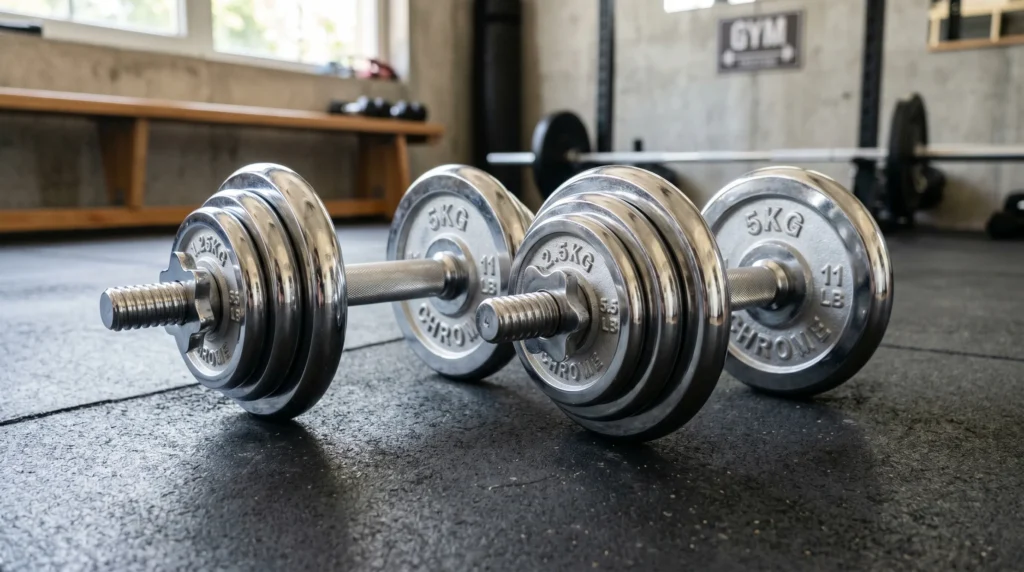
If you’ve been shopping for home gym equipment, chrome adjustable dumbbells keep coming up, and for good reason. They pack the weight range of an entire dumbbell rack into two compact handles, and the chrome finish means they’ll still look sharp years from now. But not all chrome adjustable systems are built the same, and choosing the wrong one will cost you either money or safety.
What Are Chrome Adjustable Dumbbells?
Chrome adjustable dumbbells combine chrome-plated steel construction with a variable loading system. You get one pair of handles—usually knurled or ergonomically contoured—that accept interchangeable weight plates or dial into a selectorized stack. The chrome coating is applied through an electrochemical process in which a thin layer of chromium bonds directly to the steel substrate, producing a hardness level between 68 and 72 on the Rockwell C scale.
That hardness number matters. Quality knife steel typically sits between 55 and 66 on the same scale, which means a well-plated chrome handle is harder than most cutting tools. That surface resists scratches, sweat-induced oxidation, and the kind of contact damage that leaves rubber-coated options looking beat up within a year.
The adjustable element is what makes them practical for home gyms with limited floor space. A good set can cover 5 lbs to 52.5 lbs—or in some commercial-grade configurations, up to 100 lbs per hand—within a footprint smaller than a single pair of fixed hex dumbbells.
The Chrome Plating Process
Most buyers focus on weight range and price. Chrome quality gets overlooked, and it’s where cheaper sets usually cut corners.
The electroplating process involves suspending the dumbbell handle or plates in a chromium-rich electrolyte bath. An electrical current deposits chromium atoms onto the metal surface. The thickness of that deposit, and the consistency of the current during application, determines how the finish performs under stress.
Decorative chrome is thin—applied fast for aesthetics, not performance. It looks identical to industrial chrome on day one. By year two, cheap decorative-chrome handles start showing micro-cracks, especially around the knurling where grip patterns interrupt the surface. Moisture finds those cracks and rust follows.
Hard or industrial chrome goes on more slowly, at greater thickness, and bonds more densely. Some high-end handles use a process called thin dense chrome (TDC), which skips the microcracking problem entirely by controlling deposition rate more precisely.
When a manufacturer’s listing says “chrome coated” without specifying the grade, decorative is the safe assumption. Brands like Ironmaster, Kensui, and Titan Fitness that offer lifetime or long-term warranties are generally using higher-grade plating because they have to stand behind it.
Types of Adjustment Mechanisms
Spin-Lock / Threaded Collar Systems
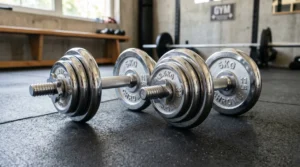
The oldest design. Plates slide onto a straight chrome-plated bar, and threaded collars screw inward to secure them. Ironmaster’s Quick-Lock system is a refined version of this concept: chrome-plated steel handles with solid cast iron plates, secured by locking screws rather than collars. The company claims adjustments take under 15 seconds and offers a lifetime warranty because there are no plastic components to fail.
The tradeoff with spin-lock systems is speed. During circuit training or drop sets, stopping to unscrew and rescrew collars interrupts flow. For straight sets with rest periods, it’s rarely an issue.
Selectorized Dial Systems
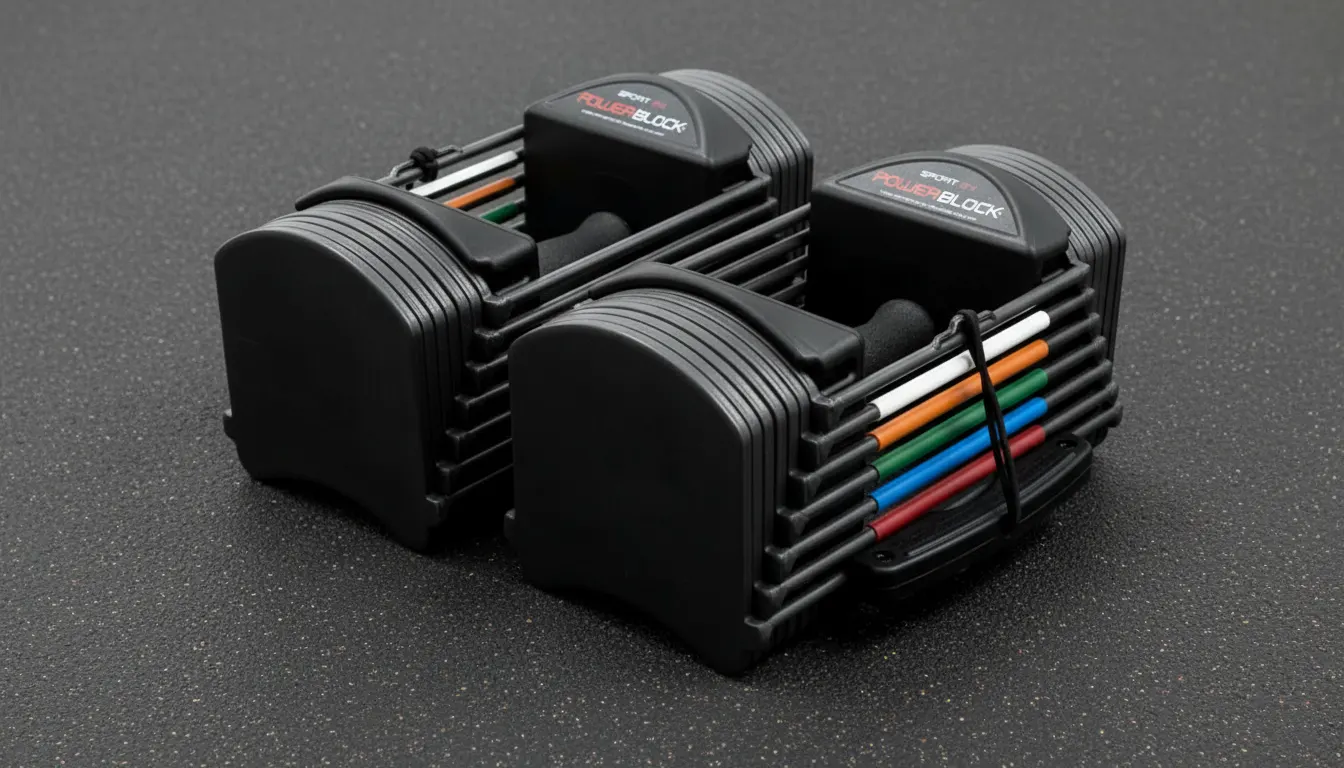
Turn a dial on each end of the handle, lift, and only the selected plates come up with you. Bowflex’s SelectTech and CAP Barbell’s dial-system sets are the most widely sold examples. Dial systems change weight in seconds, which suits high-rep, low-rest training styles.
The engineering tradeoff is mechanical complexity. More moving parts means more potential failure points. Bowflex’s own manual explicitly warns against dropping the dumbbell, because impact can cause weight plates to disengage from the handle. Chrome-handled selectorized models address this partially—a chrome sleeve around plastic internals still has plastic internals.
Lever-Lock and Push-Pin Systems
Some designs use a side lever that locks plates in place. Others use a quick-release pin similar to weight machines. These tend to sit between spin-lock and dial systems in terms of speed versus mechanical simplicity.
Titan Fitness offers lever-lock handles at multiple weight capacities, including chrome-coated versions up to 52.5 lbs per hand. Their Olympic-style handles use standard weight plates and are better suited for lifters who already own a plate collection.
Plate-Loaded Olympic Handles
Not technically a selectorized system, but worth including. Chrome-plated Olympic dumbbell handles with loadable sleeves accept standard plates. You get the most weight flexibility of any system, the most durable construction (no plastic, no dials), and the slowest weight changes. If you train heavy and your rest periods are long enough to change plates, these are the most cost-effective long-term option.
Chrome Adjustable Dumbbells vs. Other Dumbbell Types
Chrome Adjustable vs. Rubber Hex (Fixed)
Rubber hex dumbbells don’t roll, absorb floor impact, and need no maintenance beyond wiping them down. The hex shape makes exercises like renegade rows and devil’s presses easier because the flat edges sit stable on the floor. Their limitation is cost and storage—a full set from 10 to 50 lbs in 5 lb increments means ten pairs taking up significant rack space.
Chrome adjustable sets replace that entire collection with one pair. The storage advantage is real. The speed-of-use disadvantage is also real—you can’t grab two different weights simultaneously the way you can with fixed pairs. If you do a lot of supersets that require immediate weight switches, fixed dumbbells win on convenience.
Chrome vs. Urethane Round Dumbbells
Urethane dumbbells are what you find in premium commercial facilities. They’re compact, durable, nearly odor-free, and look professional. They’re also significantly more expensive than chrome and come in fixed weights only. Chrome adjustable sets offer more weight flexibility for a lower upfront investment. Urethane makes sense if you’re outfitting a studio or want the highest-end fixed pairs and budget isn’t the primary constraint.
Chrome vs. Neoprene
Neoprene dumbbells max out around 15 to 20 lbs and are designed for light cardio, barre, and rehabilitation work. Chrome adjustable sets overlap at the light end of the range but extend far beyond it. They’re different tools for different purposes.
Key Features to Evaluate Before Buying
Handle diameter and length. Most chrome adjustable handles run 1.25 inches in diameter. That’s a standard grip width comfortable for most hand sizes. Handle length determines how long the loaded dumbbell gets—check the loaded length at your target weight before buying, because longer dumbbells change leverage on certain pressing movements.
Knurling pattern. Chrome handles with aggressive knurling provide better grip under sweat than smooth chrome. However, very aggressive knurling tears up your hands on high-rep sets. Medium knurling is the practical sweet spot for most training.
Weight increment precision. Better chrome adjustable sets offer 2.5 lb increments in lighter ranges, stepping to 5 lb increments as weight increases. Coarser jumps (10 lbs at a time) make progressive overload harder to manage.
Locking mechanism material. Metal locking components last longer than plastic. If a dial or lever is plastic and the handle is chrome, the plastic is the failure point. Spin-lock collars and the Ironmaster-style locking screw are both all-metal systems.
Floor compatibility. Round chrome plate edges can mark hardwood or tile floors if you set the dumbbell down without a mat. Some chrome sets use slightly flattened or contoured plate edges to reduce this risk.
Warranty. A lifetime warranty (Ironmaster) signals confidence in material quality. One to two year warranties are standard for mid-range chrome adjustable sets. No warranty is a red flag at any price point.
Best Uses for Chrome Adjustable Dumbbells
Chrome adjustable sets are genuinely versatile. They work well for:
- Strength training: bench press, row variations, overhead press, deadlifts, and lunges all translate cleanly to dumbbell format
- Hypertrophy work: lighter weights at higher reps for arm isolation, lateral raises, and rear delt work
- Progressive overload: the ability to move from 10 lbs to 50+ lbs in a single set of handles supports long-term strength development
- Home gyms with space limits: replacing a 10-pair rack with one compact set is genuinely space-saving
- Rehabilitation and physical therapy: lighter chrome adjustable sets with 2.5 lb increments allow precise loading during injury recovery
They’re less ideal for:
- Exercises requiring you to drop the weight (Olympic lifts, ballistic movements)—most chrome adjustable mechanisms are not rated for drops
- Situations requiring simultaneous access to multiple weights (circuits where you switch between two loads within the same set)
- Very heavy training above 100 lbs per hand, where barbell work is generally more practical anyway
Maintenance and Care
Wipe down after every session. Sweat is mildly acidic. Even hard chrome will eventually show surface degradation if sweat sits on it between sessions. A dry cloth takes five seconds.
Storage matters more than people think. Humid environments—garages in rainy climates, basements without dehumidification—accelerate surface oxidation on any exposed metal. A thin application of silicone spray on the chrome plate surfaces (not the handles, where it reduces grip) creates a moisture barrier without attracting dust the way oil-based products do.
Inspect the locking mechanism before each use. For spin-lock collars, check that both sides are fully tightened and the collar isn’t cracked. For dial systems, ensure the number aligns correctly with the locking position and that plates don’t rattle when you shake the loaded dumbbell. A loose plate mid-set is both distracting and dangerous.
Lubricate moving parts sparingly. Adjustment dials and sliding mechanisms benefit from occasional light lubrication. Silicone-based lubricant is the correct choice—it doesn’t attract debris the way petroleum-based products do, and it won’t damage plastic components if your mechanism includes any. Apply it to moving parts only, wipe off the excess, and cycle the mechanism a few times to distribute it evenly.
Check knurling periodically. Chrome knurling can pick up chalk, skin oil, and debris over time. A stiff brush and warm water restore grip texture without damaging the chrome surface.
Top Chrome Adjustable Dumbbell Options Worth Considering
Ironmaster Quick-Lock Adjustable Dumbbells — Chrome-plated handles with a patented locking screw system. Adjustable from 5 to 75 lbs (with extension kit up to 165 lbs). No plastic components. Lifetime warranty. The gold standard for lifters who want an all-metal system.
Titan Fitness 200-lb Chrome Adjustable Set — Covers 5 to 100 lbs per hand. Chrome-coated steel construction. Ergonomic handles. Well-suited for intermediate to advanced home gym users who need a wide range.
Titan Fitness Chrome Coated 52.5-lb Set — Solid chrome construction, dial-style adjustment, 5 to 52.5 lb range. A practical mid-range choice for most home training needs.
Kensui Calibrated Chrome Dumbbells — Precision-machined with a mirror-finish chrome shell, flat-edge design to prevent rolling, and a 34mm ergonomic handle. Available from 5 to 150 lbs in fixed pairs, but the quality benchmark for chrome construction.
Synergee Adjustable Chrome Dumbbells — Spin-lock design with chrome-coated plates and foam-covered handles. Available in 10, 15, and 20 lb pairs. Good entry-level option for lighter training needs.
Frequently Asked Questions (FAQs)
Are chrome adjustable dumbbells safe to drop?
Most chrome adjustable dumbbell systems—especially dial-based ones—are not rated for drops. Dropping a dial-system dumbbell can cause plates to disengage from the handle mid-use. Ironmaster’s screw-lock system is more impact-tolerant, but the company still recommends controlled lowering. Use a rubber gym mat to cushion accidental contact with the floor.
How do I know if the chrome on a dumbbell is quality or decorative?
Check for a warranty. Hard chrome or industrial-grade plating costs more to apply, and brands that use it typically offer longer warranties because the material backs it up. Warranty-free chrome products almost always use decorative plating. You can also look for micro-cracks or pitting around the knurling pattern on used sets—decorative chrome shows wear there first.
Can I use chrome adjustable dumbbells for Olympic lifting?
Not practically. Olympic lifts require releasing the weight at the top, and chrome adjustable systems are not designed for impact drops. Fixed dumbbells, kettlebells, or bumper-plate barbell setups are better tools for that training style.
How often should I lubricate the adjustment mechanism?
When you hear squeaking, feel resistance during adjustment, or notice the mechanism isn’t seating cleanly. That’s typically every few months with regular use. Over-lubricating attracts debris and creates its own problems.
Do chrome dumbbells rust?
Quality hard chrome plating resists rust well, but the protection isn’t absolute. Scratches or chips in the chrome surface expose the underlying steel, which will rust if exposed to moisture. Storing dumbbells in humid environments without any protective coating accelerates this. Wipe them down after training and apply a light silicone spray to plate surfaces if you train in a humid space.
What’s the difference between chrome adjustable dumbbells and chrome fixed dumbbells?
Fixed chrome dumbbells are precision-machined to a single weight and don’t have adjustment mechanisms. They’re typically found in boutique fitness studios and premium home gyms for their clean aesthetic and low maintenance. Adjustable chrome sets sacrifice some of that simplicity in exchange for weight flexibility from a single pair.
What weight range should I start with?
If you’re new to strength training, a set covering 5 to 25 lbs handles most beginner and intermediate movements. If you’ve been training for a year or more, start at 5 and go to at least 50 lbs—you’ll reach the lower end sooner than you expect.
Are chrome adjustable dumbbells worth it compared to a full fixed set?
For most home gym owners, yes. A full fixed set from 5 to 50 lbs in 5 lb increments means ten pairs, a sizable rack, and significantly higher upfront cost. One pair of quality chrome adjustable dumbbells covers the same range at lower cost and in a fraction of the space. The only meaningful disadvantage is that you can’t quickly switch between two different weights within the same exercise, which matters for some training styles and not at all for others.
In conclusion
Chrome adjustable dumbbells are a practical choice for home gym owners who want training flexibility without devoting half a room to a dumbbell rack. The chrome construction, when it’s the right grade, delivers durability that outlasts rubber coatings and looks better doing it. The adjustment mechanism is where quality differences actually show up—all-metal spin-lock systems last longer than plastic-component dial systems, though dial systems win on speed of use.
Buy the best mechanism you can afford. Wipe the handles down after training. Keep the adjustment system clean and lightly lubricated. Do those three things consistently and a quality chrome adjustable set will still be part of your gym long after the cheaper alternatives have been recycled.
Want to build stronger, more defined quads? Check out The Best Quad Exercises With Dumbbells for effective movements, proper form tips, and workouts you can do at home or in the gym.