 Walk into most gyms and you’ll see people grinding through chest press, deadlifts, and arm curls. Dedicated wrist training? Almost nobody. It gets treated as optional, or irrelevant, or the kind of thing physical therapists do in rehab settings, not something healthy lifters need to bother with.
Strong wrists aren’t just about forearm aesthetics, though well-developed forearms do make an impression. They determine how much you can load compound movements before joint stability, rather than muscle strength, becomes the limiting factor. They’re the difference between a wrist that shrugs off heavy barbell work and one that aches after a training block. And they respond to training, consistently and measurably, with a relatively small investment of time.
The reason dumbbells are the right tool here is specific: they let the wrist move freely in every direction. Rotation, deviation, flexion, extension. All six planes. No other common piece of gym equipment gives you that range of motion, and wrists that only get trained in one or two of those planes are wrists that are going to fail you eventually.
The Muscles You’re Actually Training
The wrist doesn’t operate through a single muscle. It’s a collection of structures performing at least six distinct movements, controlled by muscles that originate mostly near the elbow and travel down through the forearm. Training wrists intelligently requires knowing which muscles do what.
Wrist Flexors
On the palm-side (anterior) of your forearm sit the flexor carpi radialis and flexor carpi ulnaris, the two prime movers responsible for bending the wrist toward the palm. The palmaris longus assists and tightens the palmar fascia. These muscles all attach near the medial epicondyle of the elbow, which is why chronically overloading them without addressing the antagonist extensors contributes to medial epicondylitis, or what people call golfer’s elbow.
Wrist Extensors
The posterior (dorsal) side of the forearm contains the extensor carpi radialis longus, extensor carpi radialis brevis, and extensor carpi ulnaris. These pull the back of the hand upward. Most lifters train their flexors far more than their extensors because flexors get recruited heavily in pulling movements, creating a chronic imbalance that raises injury risk at the elbow and wrist.
Pronators and Supinators
Pronation, rotating your palm to face down, is controlled by the pronator teres and pronator quadratus. Supination, rotating the palm upward, is driven primarily by the supinator muscle and the biceps brachii. The brachioradialis, visible as the prominent muscle ridge running up the thumb side of the forearm, functions as both a semi-pronator and semi-supinator and is most active during neutral-grip (hammer) movements.
Radial and Ulnar Deviators
Radial deviation tilts the hand toward the thumb side. Ulnar deviation tilts it toward the pinky. These side-to-side movements are controlled by the flexor and extensor carpi radialis (radial side) and the flexor and extensor carpi ulnaris (ulnar side). Most recreational lifters have never specifically trained these planes, but they’re directly relevant to racket sports, rock climbing, throwing sports, and any work requiring lateral wrist stability.
The Complete Dumbbell Wrist Exercise Library
The exercises below cover all six planes of wrist movement. You don’t need to fit all of them into a single session. The programming section explains how to sequence them sensibly.
Flexion and Extension
Dumbbell Wrist Curl (Palms Up)
Setup and Execution
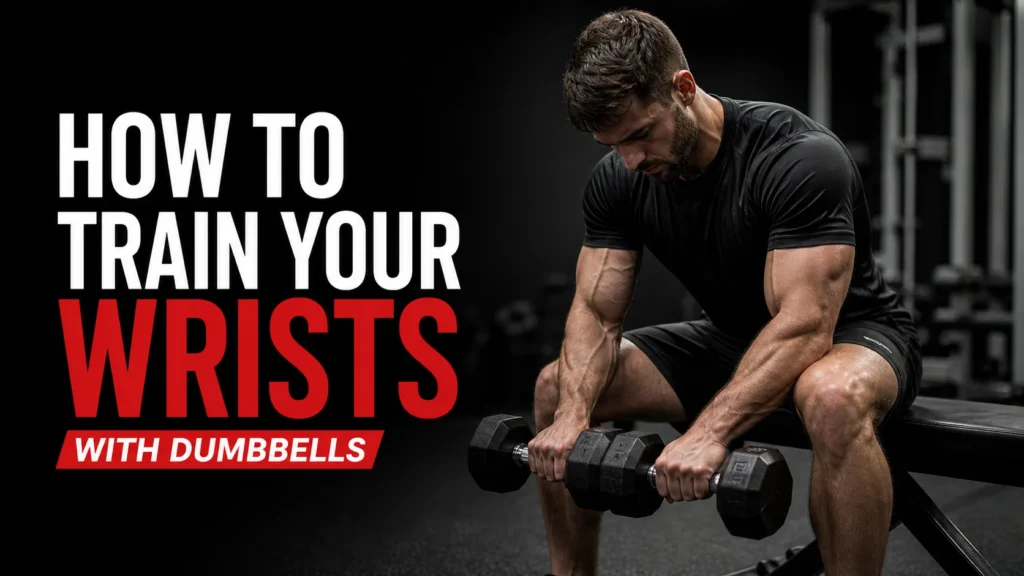
Sit on a bench or chair with your forearm resting along your thigh, palm up, wrist hanging just past the knee. Let the dumbbell pull your wrist into extension, then curl upward by flexing the wrist. Lower with control. The forearm should stay flat on the thigh throughout.
Primary Muscles
Flexor carpi radialis, flexor carpi ulnaris, palmaris longus.
Advanced Variation
At the bottom of each rep, let the dumbbell roll to your fingertips before curling it back. This extends the range of motion and adds a grip-training component that standard wrist curls miss.
Reverse Wrist Curl (Palms Down)
Setup and Execution
Identical position to the wrist curl, but palm faces down. Raise the back of the hand upward by extending the wrist, then lower with control. Use lighter weight here than you would for regular wrist curls, the extensors are weaker than the flexors in almost everyone.
Primary Muscles
Extensor carpi radialis longus and brevis, extensor carpi ulnaris.
Why it can’t be skipped
Flexor-only training creates a muscular imbalance across the wrist that increases susceptibility to lateral epicondylitis. Every set of wrist curls should have a corresponding set of reverse wrist curls.
Pronation and Supination
Dumbbell Forearm Pronation / Supination
Setup and Execution
Kneel and rest your elbows on a bench with roughly a 90-degree bend. Hold a dumbbell in each hand with palms facing each other (neutral position). Slowly rotate your forearms so your palms face up, pause briefly, then rotate so your palms face down. Keep your wrists in a neutral position throughout, don’t let them flex or extend. The rotation comes from the forearm, not the hand.
Primary Muscles
Supinator, pronator teres, pronator quadratus, brachioradialis.
Zottman Curl
Background
Developed by 19th-century strongman George Zottman, this exercise remains one of the most efficient wrist and forearm developers available. The Strength and Conditioning Journal specifically recommends it for sports requiring lower-arm stability, including baseball, volleyball, powerlifting, and combat sports, and notes it may be preferable to traditional wrist curls for younger lifters and those with prior wrist injuries.
Setup and Execution
Stand with a dumbbell in each hand, palms up. Curl the weights upward with your elbows pinned to your sides. At the top, rotate your wrists so your palms now face down. Lower slowly for 2 to 4 seconds in this pronated position. At the bottom, rotate back to palms up and repeat.
What makes it effective
The concentric phase recruits the biceps strongly. The eccentric phase, performed with the forearm pronated, shifts the load onto the brachioradialis and the extensor musculature. You train multiple elbow flexors and forearm positions in a single set. The wrist and finger muscles also work isometrically during the pronated lowering to keep the dumbbell stable, which is why grip and forearms fatigue faster than biceps during this exercise.
Critical technique note
Do not flip the dumbbell quickly at the top. The rotation is part of the stimulus. A ballistic wrist rotation under load is how people strain the TFCC. Use less weight than your standard curl and earn the reps with control.
Radial and Ulnar Deviation
Radial Deviation (Neutral Dumbbell Wrist Raise)
Setup and Execution
Sit with your forearm resting along your thigh, wrist at the knee edge. Hold a dumbbell loaded on one end only, gripping the unloaded end. Let the weighted end hang in front of your hand. Raise it upward by cocking your wrist toward the thumb side, then lower with control. Keep the elbow and shoulder still; all movement comes from the wrist.
Primary Muscles
Extensor carpi radialis longus, abductor pollicis longus, flexor carpi radialis.
Ulnar Deviation
Setup and Execution
Same position, but the loaded end of the dumbbell points behind your hand instead of in front. Raise the loaded end upward toward the pinky side of the wrist. These two deviation exercises are typically performed back to back.
Primary Muscles
Flexor carpi ulnaris and extensor carpi ulnaris, working together to produce pure lateral movement without flexion or extension.
Who particularly benefits
Climbers, racket sport athletes, baseball players, and anyone who experiences asymmetrical wrist discomfort during pressing or overhead work.
Compound Dumbbell Movements That Build Wrist Strength Indirectly
Hammer Curl
Setup and Execution
Hold dumbbells with a neutral grip (thumbs pointing up, palms facing each other). Curl the weights with your elbows pinned to your sides. The wrist stays perfectly straight throughout, no tilting inward or outward. This neutral positioning is the entire point of the exercise.
Why the neutral wrist matters
The neutral grip strongly recruits the brachioradialis, the largest and most visible muscle on the forearm. Allowing the wrist to tilt into ulnar deviation under load, which happens when people use too much weight and let form slip, puts direct stress on the TFCC ligament complex at the ulnar side of the wrist. That’s a slow-healing structure you don’t want to strain.
An underappreciated benefit
The hammer curl is the right curl variation for anyone dealing with existing wrist discomfort. The neutral position takes stress off the wrist joint itself while still building brachioradialis and forearm thickness.
Farmer’s Carry
Setup and Execution
Pick up a heavy dumbbell in each hand, stand upright, and walk. Chest open, shoulders back, grip tight. The goal is distance or time, not a fixed rep count.
What it trains
The farmer’s carry builds wrist stability under sustained load, which is more specific to real-world demands than isolated curl movements. It also develops grip endurance, builds upper back and trap density, and improves posture. It’s an honest finishing exercise that reveals grip weaknesses that curls don’t.
Injury Prevention: The Mistakes That Derail Wrist Training
Loading Too Heavy Too Fast
The muscles of the wrist are adapted primarily to endurance work. The tendons crossing the wrist have limited blood supply and heal slowly when damaged. Overloading them once can mean months of tendinopathy rather than weeks of productive training. Start lighter than feels necessary. Progress by smaller increments than you’d use for large muscle groups.
Training Only Wrist Curls
Flexor-only training creates a chronic imbalance between the front and back of the forearm. The extensors need equal volume. The pronation/supination plane and the lateral deviation planes are usually ignored entirely. An imbalanced wrist is a vulnerable wrist.
Skipping the Warm-Up
Before any wrist training session, spend two to three minutes rotating your wrists in circles, moving them side to side, and flexing and extending them through their full range with no load. Tendons are less pliable when cold and more susceptible to microtears. The warm-up isn’t optional.
Training Through Pain
Muscular burning during a set is normal. Sharp pain at the wrist joint, pinching sensations, or pain that worsens over the course of a session are not normal. Stop, rest the wrist, and evaluate before continuing. If joint pain persists beyond 48 hours, see an orthopedic specialist before returning to wrist training.
Grip Strength, Wrist Training, and the Long Game
Grip strength shows up consistently in health research as a marker of broader physical resilience. Studies link it to lower mortality risk, improved metabolic health, better blood pressure, and even some protection against cognitive decline. The mechanism isn’t that strong wrists make you live longer in some direct causal sense. It’s that grip strength functions as a proxy for overall musculoskeletal health, and people who maintain that tend to maintain their physical independence as they age.
For athletes in their training prime, the practical payoff is more immediate. Stronger wrists let you hold heavier loads in deadlifts and rows without grip becoming the limiting factor before your target muscles are fatigued. They stabilize the bar during overhead work. They improve the quality of every pulling movement. And when grip is no longer a weak link, training stops feeling like a chain with an obvious weakest link.
Research on eccentric wrist training specifically, controlling the lowering phase slowly, shows it stimulates collagen repair in tendons while maintaining flexibility. Physical therapists include this type of training in rehabilitation protocols precisely because controlled eccentric stress rebuilds tendon tolerance to repetitive loading. The Zottman curl and the slow-eccentric wrist curl are doing the same thing for healthy wrists that rehabilitation exercises do for injured ones: building tendon resilience before it’s needed.
Frequently Asked Questions (FAQs)
How much weight should I start with for dumbbell wrist curls?
Most beginners should start with 2 to 5 lbs for isolated wrist curl movements. The tendons here are sensitive and the range of motion is small. Using 15 lbs because a lighter dumbbell feels embarrassing is a common mistake that leads to tendon strain within a few weeks. Start where technique stays clean, then progress by 1 to 2 lbs at a time.
How often should I train my wrists with dumbbells?
Two to three times per week on non-consecutive days is appropriate for most people. Wrist tendons have less blood supply than muscle tissue and need more recovery time. Daily heavy wrist training is one of the more reliable ways to develop overuse injuries in a joint that heals slowly.
Can dumbbell wrist training help with carpal tunnel syndrome?
Wrist strengthening alone won’t resolve carpal tunnel syndrome, which involves compression of the median nerve in the carpal tunnel, not a muscular problem. Building the surrounding musculature can reduce mechanical stress and improve joint control, but anyone with a diagnosed carpal tunnel condition should work with a physiotherapist to develop a program tailored to their specific situation before adding weighted exercises.
Should I train wrists before or after my main workout?
After. Fatiguing your wrists and forearms before compound pulling movements, like rows, pull-ups, or deadlifts, reduces your grip capacity and limits the quality of those exercises. Wrist isolation work belongs at the end of a session as a finisher, not at the beginning.
What is the difference between wrist strength and grip strength?
Grip strength is specifically the force your hand generates while squeezing. Wrist strength covers all six planes of movement: flexion, extension, radial deviation, ulnar deviation, pronation, and supination. Most grip training tools build grip without addressing the extensors or the rotational planes. Dumbbell wrist training addresses all of them, which is why it’s more comprehensive than grippers or thick-bar training alone.
How long does it take to see results from wrist training?
Most people notice improved grip endurance within three to four weeks. Published research shows measurable strength gains across all planes of wrist motion within four weeks of twice-weekly training. Visible forearm development takes longer, typically two to four months of consistent, progressive work.
Are wrist wraps useful during dumbbell wrist training?
Wrist wraps restrict the range of motion that wrist training is designed to develop. For heavy compound lifts like bench press or overhead press, wraps provide support under high load. For wrist isolation work specifically, they’re counterproductive. Train wrists without wraps unless you’re using them for genuinely heavy lifting where joint support is the priority.
Can I train my wrists at home without a gym?
Yes. A pair of light dumbbells is all the equipment needed for a complete wrist training program. A set ranging from 5 to 20 lbs covers the full loading range for most wrist exercises. This is one area of strength training where home equipment is not a meaningful limitation compared to a gym.
Why are my wrists clicking during exercises?
Occasional clicking without pain is usually benign and often comes from gas bubbles releasing in the joint, similar to cracking knuckles. Clicking accompanied by pain, a sensation of instability, or a catching or locking feeling is a different matter. That combination warrants evaluation by an orthopedic specialist to rule out structural issues like TFCC injury or ligament laxity.
Is wrist training necessary if I already do heavy compound lifts?
Heavy compound lifts build grip endurance and general forearm strength, but they don’t adequately address wrist extensors, radial and ulnar deviators, or the supinator and pronator muscles. Targeted wrist work fills those gaps, reduces injury risk in the smaller structures of the wrist joint, and improves stability in ways that deadlifts and rows alone don’t achieve.
In conclusion
Wrist training gets pushed off indefinitely because it doesn’t feel urgent until something breaks down. A grip that fails mid-set. A nagging ache after heavy pressing. A wrist that finally protests after years of being ignored. At that point, the problem is already established and healing is slower than building would have been.
Two or three 20-minute sessions per week, done with appropriate weight and genuine attention to technique, builds wrist resilience that carries into every upper body exercise you do. Dumbbells make this accessible. They’re inexpensive, easy to store, and uniquely suited to wrist training because they allow the full range of motion in every plane, something no other common piece of equipment matches.
Start lighter than feels necessary. Progress by smaller increments than you’re used to. Train all six planes. Your future self, still training without joint pain at an age when most people have given up on heavy lifting, will find it was worth the investment.
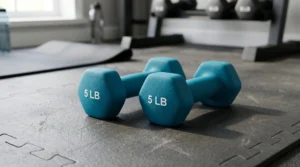
Thinking about buying neoprene weights? Check out What Are The Disadvantages Of Neoprene Dumbbells? to understand their limitations, durability concerns, and whether they’re the right choice for your workouts.